What Is Publicity? PR Strategy and Media Exposure Approaches That Build Trust Beyond Advertising
- カテゴリ:
When you hear the term “publicity,” many people may understand it simply as “a method of getting media coverage without advertising costs.” However, the essence of publicity is not merely free exposure—it is a strategic communication activity that builds trust in a company through the perspective of third-party media.
This article provides comprehensive coverage of practical knowledge, from the differences with advertising and when to leverage publicity, to designing news value that media want to cover and secondary utilization after exposure.
What Is Publicity? PR Activities That Build Trust Through Third-Party Perspective, Not Advertising
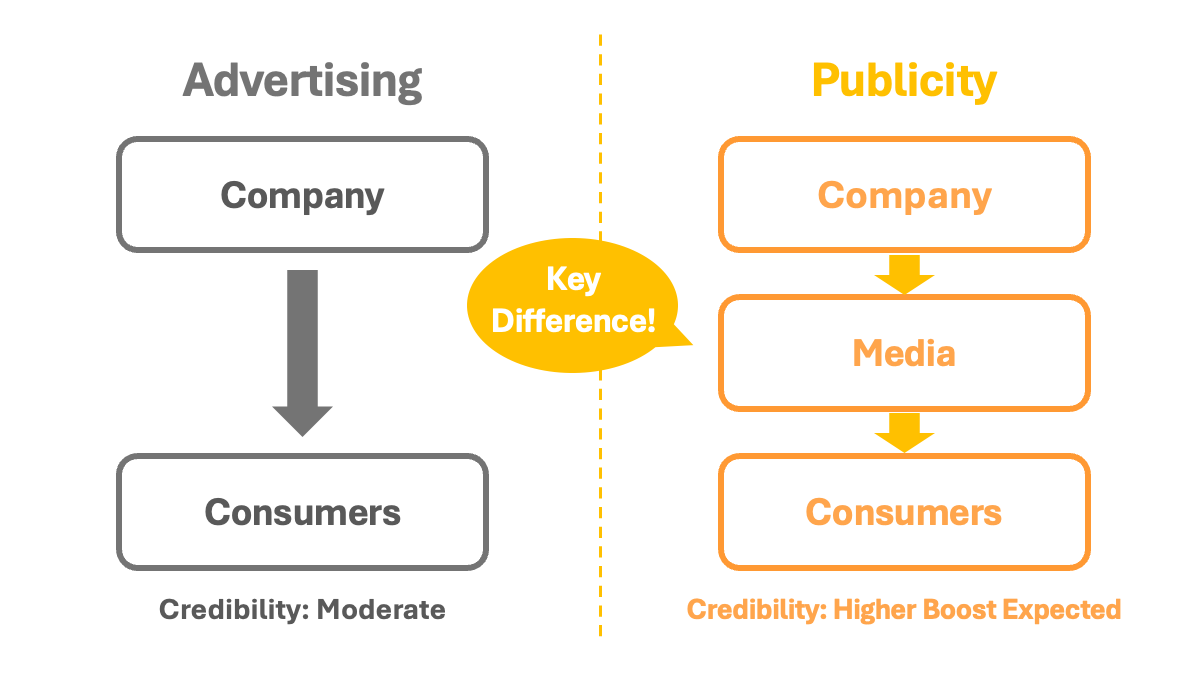
When you hear the term publicity, what kind of activities come to mind? Let’s first clarify the basic meaning of publicity and how it fits within advertising and PR as a whole.
| Comparison Item | Publicity | Advertising |
|---|---|---|
| Source of Information | Media (third party) | Company (direct party) |
| Placement Cost | No purchase cost for placement (however, planning and preparation effort is required) |
Purchase cost for placement is incurred |
| Content Control | Rests with the media | Controllable by the company |
| Social Trust | High due to objectivity | Relatively low as it is perceived as promotion |
Publicity Is an Activity to Get Covered as News by Media
Publicity refers to activities that provide information about your company to media such as television, newspapers, and web outlets, and get it covered as news or articles. It involves distributing press releases, providing information directly to journalists, and building relationships with media. It is important to note that publicity is not necessarily a free exposure method. It should be viewed as strategic communication that creates a reason why your company’s information deserves to be discussed in society and poses questions to the world through media.
The Difference from Advertising: Conveyed Through Third-Party Perspective, Not Corporate Messaging
One difference between advertising and publicity lies in whose perspective the information is told from. Advertising is a method where companies pay for placement and deliver their intended message directly. Publicity, on the other hand, is disseminated to the world after media—as third parties—objectively judge the value of information and edit it. When media report that “this product solves social issues” rather than a company claiming “our product is excellent,” it tends to earn greater trust from consumers.
The Role Publicity Plays Within PR Activities
PR (Public Relations) refers to a broad range of activities for companies to build favorable relationships with society and stakeholders. Within that larger framework, publicity is a method specialized in building relationships with media. In recent years, rather than treating media exposure itself as the goal, there is a growing need for the perspective of using the trust gained as an entry point for brand building, recruitment activities, and B2B business opportunities. Publicity can be said to play a role in creating important touchpoints connecting companies and society.
[Related Article]What is a PR Strategy? Explaining the Planning Process to Create Trust and Value Beyond Advertising « Column
When Companies Should Strengthen Publicity
In the process of company growth, there are several situations where the power of publicity is particularly needed. Let’s look at representative timing for when investment in media exposure should be strengthened.
| Timing to Strengthen | Expected Effects | Appropriate Information to Communicate |
|---|---|---|
| New Product/Service Launch | Rapidly increase market awareness | Development background and industry-first novelty |
| When Advertising Effectiveness Plateaus | Rebuild customer trust | Social issue initiatives and corporate stance |
| When Strengthening Branding | Improve recruitment power and gain fans | Management vision and organizational culture |
When You Want to Build Social Awareness of New Products or Services
The timing of launching new products or services to market is one of the prime opportunities to execute publicity. Information that provides new value to the world can become attractive news that media should deliver to readers. However, simply introducing specifications is unlikely to get coverage. By conveying the background leading to development and the social issues the product solves as a set, greater awareness expansion can be expected.
When Trust Building Through Advertising Alone Becomes Difficult
When continuing digital advertising operations, customer acquisition costs may surge at some point and effectiveness may plateau. This can be considered a sign that approaches to manifest demand have completed a cycle and that the advertising format alone makes it difficult to gain trust from new audiences. When facing such challenges, publicity—which can earn third-party endorsement—becomes one effective option. By fostering a sense of security in the brand through objective reporting, there is potential to improve overall advertising performance as well.
When You Want to Broadly Communicate Corporate Stance and Brand Values
Publicity is also an effective means when you want to convey not just the products themselves but the vision the company aims for and its social stance. For example, initiatives on environmental issues and internal systems that respect diversity are themes that tend to gain consumer empathy. When corporate stance is reported in media, effects can be expected not only in customer support but also in attracting interest from job seekers. In phases aiming for long-term brand value improvement, publicity can become an initiative that drives business growth.
[Related Article] Strategies to Increase Brand Awareness from a PR Perspective! Practical Design Connecting to Inquiries and Direct Searches « Column
How to Create “News Value” Needed to Achieve Results with Publicity
Media personnel receive an enormous volume of press releases and information submissions daily. To have your company’s information selected from among them, it is necessary to strategically design news value that makes media want to report it.
| News Value Elements | Specific Meaning | Design Hints |
|---|---|---|
| Social Relevance | Is it connected to public interests or issues? | Combine with trends or regulatory changes |
| Novelty | Is it a new initiative never done before? | Find facts like first in Japan or first in industry |
| Timeliness | Is there a reason to report it at this time? | Announce in alignment with seasonal events or commemorative days |
| Unexpectedness | Is there surprise or contrast that overturns common sense? | Collaborations between seemingly unrelated industries, etc. |
【Related Article】 What is News Value? Explaining How to Create and Deliver Information That Gets Picked Up by the Media « Column
Design Social Relevance, Novelty, Timeliness, and Unexpectedness
When journalists search for article themes, four representative criteria for measuring information value are social relevance, novelty, timeliness, and unexpectedness. It is advisable to confirm whether it aligns with social trends, is an industry-first new attempt, fits the current season, or has a gap that surprises everyone. Objectively reexamining which of these elements your company’s information corresponds to is the first step toward becoming news. By combining multiple elements, the strength as news will further increase.
Transform What the Company Wants to Say into an Angle Media Want to Convey
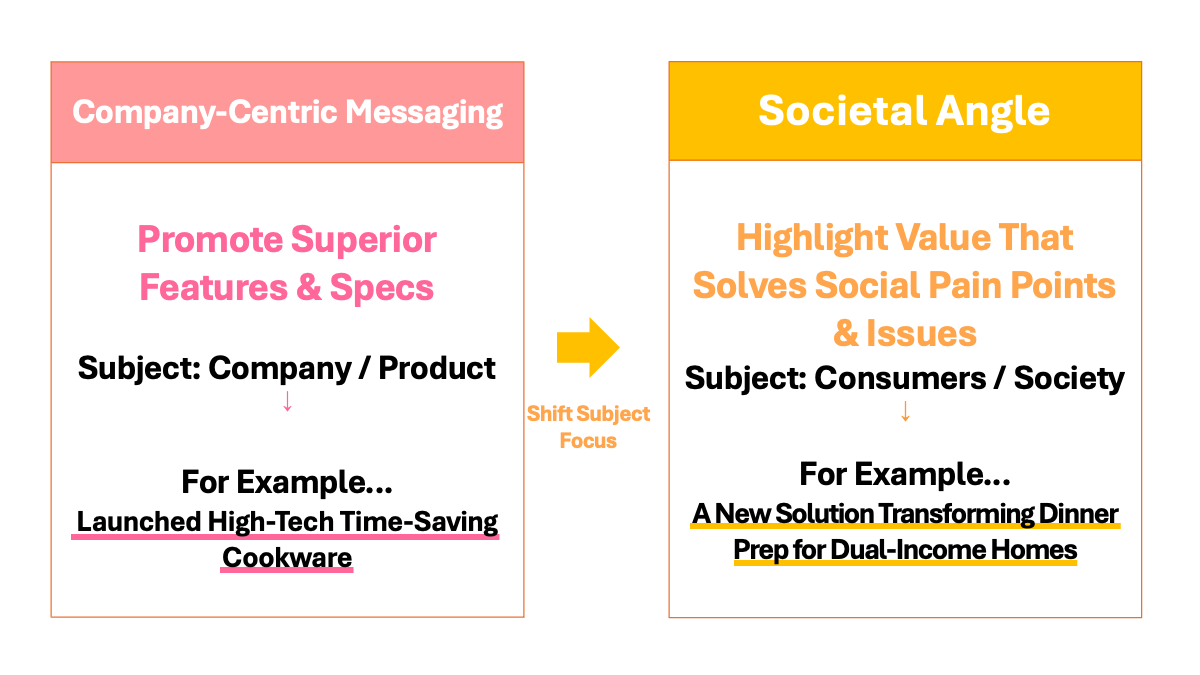
One common failure in publicity is unilaterally communicating only what the company wants to say. Since media are not corporate newsletters, there is no reason to cover information unless it is beneficial to readers or viewers. Rather than appealing functional superiority, it is advisable to convert to the perspective of what social inconvenience that function resolves. Shifting the subject from the company to society can be a shortcut to finding an angle that media will adopt.
Create Touchpoints with Consumers and Society, Not Just Product Information
It is also important to depict not only the appeal of the product itself but how it connects with consumers’ daily lives and societal movements. For example, when launching a new food product, it is advisable to present as a story how it addresses time-saving needs of dual-income households, not just taste quality. By specifically showing touchpoints with society, journalists can more easily create article context. The possibility of information spreading in a form that resonates with more readers will also increase.
Risks to Be Aware of in Publicity Initiatives
While publicity has the potential to bring significant results, mistakes can result in not achieving the expected effects. Let’s confirm representative risks to know before execution and how to avoid them.
| Publicity Risks | Causes | Countermeasures to Avoid |
|---|---|---|
| Weak Reason for Coverage | Limited to mere product introduction | Connect with social issues or trends |
| Mismatch with Media | Not understanding target outlet characteristics | Analyze past articles and make individual proposals |
| Missing Exposure Effects | Being satisfied with just getting coverage | Design secondary utilization in SNS and sales materials |
Becoming Mere Product Introduction with Weak Reason for Coverage
When providing information to media, it is advisable to avoid sending only product descriptions like those in brochures. From a journalist’s perspective, that is promotion, not news, and it may be difficult to find a reason for coverage. It is necessary to carefully construct a story about why this information is being released now and from what social background the service was born. The attitude of constantly standing in a third-party perspective and continuously questioning objective news value is important.
Insufficient Understanding of Each Media’s Interests and Readers
Sending the same press release content to all media simultaneously is unlikely to yield high effectiveness. For example, business newspapers and women’s magazines have completely different reader demographics and the angles of information journalists seek. Research in advance what themes the media you want to approach usually cover and who their readers are. If you cannot provide information aligned with their interests, even valuable news may get buried.
Not Designing Through to SNS, Landing Page, and Sales Utilization After Exposure
Making the moment of television or newspaper coverage the goal of publicity can lead to missed opportunities. Media exposure is merely one entry point for gaining awareness and trust, and it is necessary to prepare pathways connecting it to business results. Creating mechanisms to spread on SNS immediately after articles appear and displaying media coverage achievements on landing pages to increase conversion rates are also effective approaches. It is advisable to design in advance to maximize exposure value by combining with advertising, events, influencer initiatives, and other methods.
Practical Steps to Succeed with Publicity
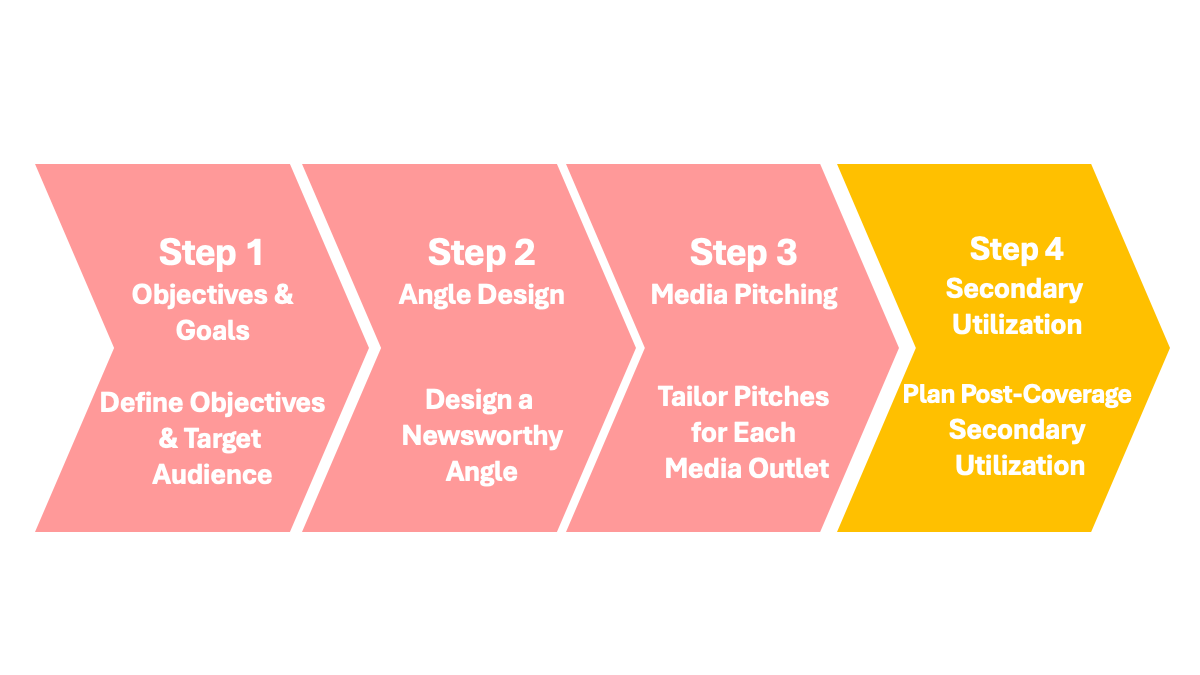
From here, we will explain specific steps for actually advancing publicity activities. Rather than ad hoc approaches, taking strategic steps should improve the probability of media exposure.
| Practical Steps | Specific Tasks to Execute | Success Points |
|---|---|---|
| Set Objectives and Targets | Decide who to reach, what to deliver, and desired actions | Clarify KGI and KPI and share internally |
| Design the Angle | Create story based on four news value elements | Abandon self-interest and align with social context |
| Propose to Media | Provide customized information for each outlet | Read journalists’ bylined articles to explore tendencies |
| Execute Secondary Utilization | Expand exposure achievements across other channels | Collaborate with sales and marketing departments |
Clarify Objectives and Targets
Before starting publicity activities, it is advisable to first clarify the purpose of seeking media exposure. The message to communicate differs depending on whether you want to increase awareness, gain trust to connect to business opportunities, or strengthen recruitment activities. Additionally, it is important to specifically set which media you want to use to deliver information to what targets. If this becomes unclear, subsequent planning and media selection may become ambiguous, so careful organization at the initial stage is required.
Design an Angle That Becomes News
Once objectives are set, find angles from your company’s information that media will be interested in. While being conscious of elements like social relevance and novelty, consider what titles would catch readers’ attention. Attractive stories may be hidden in casual internal data or developers’ failure stories. The process of questioning your own assumptions and refining plans while incorporating external perspectives will be key to publicity success.
Vary Proposal Content for Each Media Outlet
Once the angle is solidified, create a list of media you want to deliver information to and begin outreach. Reading past articles of target media and preparing proposal materials tailored to each outlet’s characteristics is effective. For business-oriented outlets, enrich data on market size and economic impact; for lifestyle magazines, focus on changes in consumers’ lives. It is advisable to be conscious of providing careful information that media personnel can use directly as article structure proposals.
Design Through to Secondary Utilization After Exposure
Once media placement is confirmed, proceed with preparations to maximize utilization of that achievement. It is important to communicate placement information through official company SNS and email newsletters, establishing pathways for more people to read the article. Displaying it as objective evaluation in sales materials and recruitment sites can also be expected to increase long-term trust from stakeholders. The perspective of not ending with publicity alone but rippling it throughout overall marketing activities will be key to success.
Cases When You Should Consult a PR Agency About Publicity
While publicity can be completed in-house, requesting support from PR agencies with specialized expertise is also one effective means. Let’s look at guidelines for when to rely on external partners based on what challenges you face.
| Your Company’s Situation | Solutions PR Agencies Can Provide | Expected Benefits |
|---|---|---|
| Cannot Find News Angle | Planning from objective perspective | Stories that attract media interest are completed |
| No Media Connections | Provision of extensive media relations | Information can be delivered directly to appropriate contacts |
| Don’t Know How to Connect to Results | Overall strategy design including post-exposure secondary utilization | Connects to business contribution such as increased inquiries |
Cannot Turn Your Company’s Products or Activities into News
Objectively reexamining your company’s product appeal and transforming it into news aligned with social context is not an easy task. When thinking only with internal personnel, there tends to be a bias toward appealing functions and specifications. PR agencies often have expertise in discovering attractive stories from third-party perspectives based on experience supporting many companies’ public relations activities. When you feel stuck on information dissemination angles, incorporating external objective perspectives may improve the situation.
Concerns About Media Relations and Proposal Pitching
No matter how excellent a plan you prepare, it is difficult to achieve coverage without routes to deliver it to appropriate media contacts. For companies that have just established PR departments, cases where media relationships are nearly zero are not uncommon. PR agencies often have broad networks with journalists and editors at diverse media outlets. Since they are well-versed in who to propose to and at what timing, they can be expected to efficiently increase the probability of exposure.
Want to Connect Not Just Exposure but Through to SNS Amplification and Inquiry Generation
When you want to draw PR strategies directly connected to business growth, specialist knowledge will also be useful. Excellent PR agencies not only secure media placements but propose integrated communication strategies starting from that point. The scope of activities is diverse, including planning that involves influencers for SNS amplification and creates synergies with advertising operations. An entity that accompanies you from media exposure as an entry point through to achieving final business objectives can become a reliable partner.
Establishing “publicity” that maximizes media exposure requires deep trust relationships with each outlet. At SUNNY SIDE UP, we leverage our powerful media network cultivated over many years to strongly support strategic information dissemination. Our strength lies in proposing unique angles that maximize news value, not just providing information. PR managers aiming for higher results should review SUNNY SIDE UP’s specific media support services.
Summary: Publicity Is a Strategy That Builds Trust Unobtainable Through Advertising
Let’s summarize the key points of this article. Publicity is not merely a free exposure opportunity but an activity that creates reasons for your company to be discussed in society. What differs greatly from advertising is that it is communicated from a third-party perspective, which is why it tends to earn high brand trust from readers and viewers. However, making media coverage itself the goal is putting the cart before the horse. The perspective of positioning publicity exposure as an entry point for recruitment strengthening and business opportunity generation, connecting it to management results, is important. Also, rather than completing it as a standalone initiative, by coordinating with other means such as SNS and advertising, you can draw out greater effects. Hold these perspectives and advance strategic PR activities to connect to your company’s growth.
To effectively secure publicity, advanced expertise and networks that attract media interest are necessary. At SUNNY SIDE UP, based on many years of achievements, we propose optimal methods to transform your company’s products and services into “news.” We also accept consultations such as “want to know specific placement possibilities” and “want to strategically increase exposure.” If you are considering strengthening public relations activities, please feel free to contact us first through this inquiry window.