What Is Sustainability PR? An Information-Dissemination Strategy That Turns Corporate Initiatives into Trust and Empathy
- カテゴリ:
Many PR and communications professionals may want to share their company’s sustainability initiatives but struggle with concerns such as “I do not know how to communicate it” or “I am worried we will be criticized for SDGs washing.”
This article explains “sustainability PR,” which involves accurately delivering initiatives such as environmental protection and efforts to address social issues to stakeholders and connecting them to trust in the company. From common failure patterns and measures to avoid reputational backlash to strategic approaches that extend to recruitment, branding, and IR, it comprehensively covers practical perspectives.
What Is Sustainability PR? PR Activities That Turn Efforts to Address Social Issues into Trust
Sustainability PR refers to strategic communication activities that accurately convey your company’s efforts in environmental protection and solving social issues to stakeholders and build relationships of trust. Let us organize the original role of sustainability PR and the perspectives it requires.
[Related Article] What Are Public Relations and PR? A Thorough Beginner’s Guide, from Job Responsibilities to How to Build a Strategy! « Column
Efforts to Accurately Communicate Sustainability Initiatives Externally
Business partners and job seekers generally assess a company’s stance on social responsibility based on information disclosed externally. No matter how earnestly initiatives are pursued internally, if they are not communicated externally, they tend not to translate into corporate evaluation. For example, even if a company invests heavily in reducing CO2 in its manufacturing processes, if it does not communicate this in an easy-to-understand way, it becomes difficult to see how it differs from companies that are less proactive about environmental considerations. Rather than presenting specialized initiatives as-is, companies are expected to “translate” them to fit the social context and deliver them accurately through appropriate channels.
Not Merely Communicating SDGs, but Communicating Corporate Stance
One common pitfall is assuming that simply displaying the UN-defined SDGs logo means sustainability PR is being done. Showing only the logo makes it difficult to convey how you differ from many other companies, and the message may end up being forgettable. What matters is communicating a clear corporate stance: what awareness your company has regarding social issues and how it intends to solve them through its core business. Moving beyond superficial appeals and clearly communicating why your company engages in sustainability—its very reason for being—is the key to success.
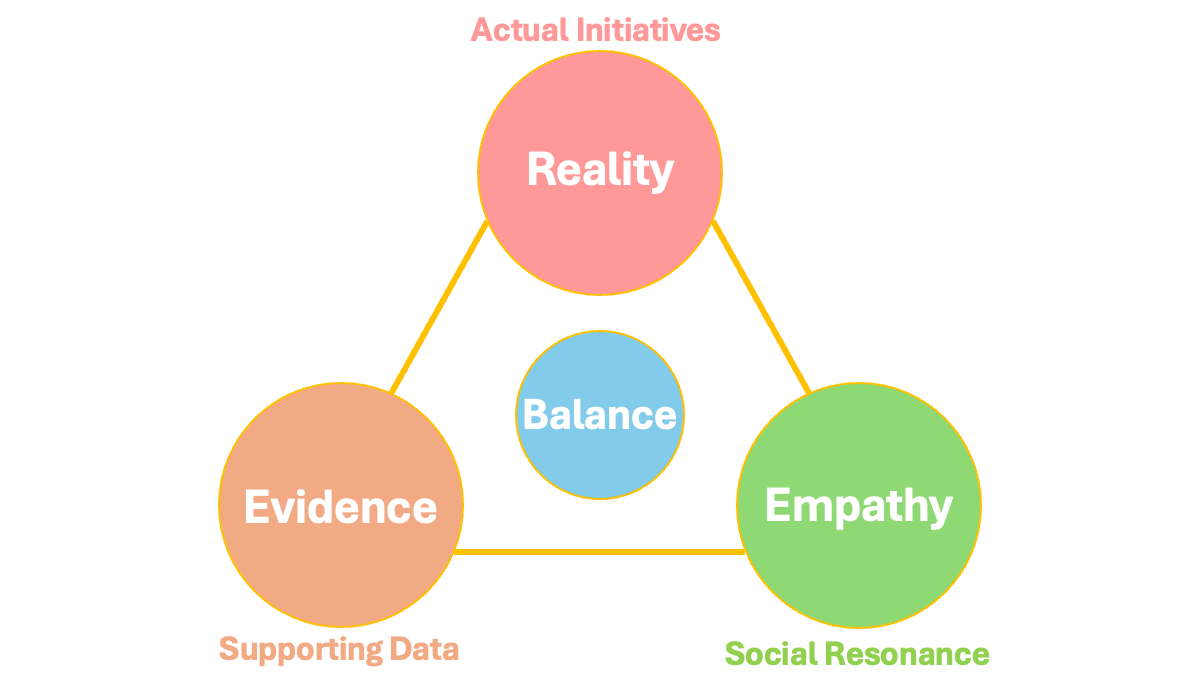
From a PR Perspective, Balancing Reality, Evidence, and Empathy Is Essential
To make sustainability PR work, it is considered important to maintain a high-level balance among three elements: reality, evidence, and empathy. If even one is missing, the message may lose persuasiveness or fail to reach the audience sufficiently. Even if you try to generate empathy with an inspiring vision, without evidence grounded in facts and the underlying reality to support it, you may face criticism as an insincere company. Conversely, simply listing data and facts in a dry manner is unlikely to move people, so it is necessary to build a story that resonates with society based on solid realities.
Why Companies Should Engage in Sustainability PR
One reason companies are making serious investments in sustainability PR is that how they are perceived by society has come to affect business outcomes to a meaningful extent. Here, we explain specific reasons why companies should engage in sustainability PR.
| Stakeholders | Impact of Sustainability PR |
|---|---|
| BtoB business partners | Selection as an ESG-compliant supplier and continued orders |
| Job seekers and employees | Stronger hiring competitiveness and reduced turnover through empathy with the company’s social purpose |
| Investors | Assessment of mid- to long-term risk management capabilities and smoother fundraising |
| Media | Favorable coverage as an advanced company addressing social issues |
Consumers and Business Partners Are Increasingly Evaluating Corporate Stance
In today’s consumer behavior and inter-company transactions, not only product quality and price but also how the provider company engages with society is becoming an important criterion. Moves to avoid doing business with companies that do not consider the environment or human rights are particularly notable in BtoB supply chains. For example, if a major company revises its procurement guidelines and announces a policy of prioritizing suppliers with lower environmental impact, it would not be surprising for companies with insufficient communication to be avoided as business partners. Appropriately communicating your initiatives can be one of the keys to securing trust from partners and capturing new business opportunities.
It Also Affects Recruitment, Branding, and IR
Communications about sustainability initiatives can extend beyond product sales promotion and ripple into a wide range of areas, such as recruitment activities, corporate branding, and investor relations communications. By clarifying a company’s social purpose, it can become an opportunity to gain support from diverse stakeholders. Among students seeking employment and people changing jobs, many hope to work for a company that aligns with their values. A sincere stance toward social issues can be one of the strengths that attracts top talent.
[Related Article] What Is Corporate Branding? A Thorough Explanation from Objectives to How to Proceed and Successful Examples! « Column
Communicating Social Value Helps Build Mid- to Long-Term Trust
Rather than pursuing only short-term sales, continuously communicating a company’s social value can help build a foundation of mid- to long-term trust in today’s highly uncertain environment. As recognition spreads that the company contributes to solving social issues, it may also help soften public backlash if the company faces misconduct or a crisis. By candidly communicating the hardships and philosophy behind initiatives in normal times, it can become a brand asset that protects the company when it matters most.
Common Failures in Sustainability PR
While sustainability PR has significant potential to enhance corporate value, if handled incorrectly it also carries the risk of severely damaging trust. Here, we introduce representative failure patterns that companies commonly fall into.
| Failure pattern | Specific outcome | Key points to avoid it |
|---|---|---|
| Overstated messaging | Overemphasizing environmental consideration beyond reality and being criticized as washing | Share only objective facts and data, regardless of the level of achievement |
| Disconnect from the core business | Focusing only on topics unrelated to the business, such as donations | Clarify the business rationale—why your company must do it |
| Overuse of jargon | Complex environmental terms make it completely incomprehensible to general readers | Translate it into plain language that even middle school students can understand |
| Concealing inconvenient facts | Talking only about achievements and staying silent about challenges | Disclose current challenges and unmet areas sincerely as well |
Making Initiatives Look Bigger Than They Are
In sustainability PR, one point to be careful about is exaggerating your company’s initiatives beyond reality. The anxiety of wanting to look even slightly better can invite harsh criticism such as greenwashing or SDGs washing. For example, if you use recycled materials only in some products but present it as though all products the company produces are fully environmentally friendly, there is a risk of losing trust when the facts come to light. Avoid overstatement and strive for sincere communications based on facts.
Weak Connection Between Social Issues and Your Business
Another common failure is choosing social issues that are unrelated to your company’s business model or strengths. Initiatives that do not appear connected to the core business may be perceived as superficial activities for PR purposes, making it difficult to gain deep empathy from stakeholders. Even if an IT company suddenly promotes agricultural support, without technical synergy or a unique context, readers may question, “Why is this company doing this?” It is necessary to identify social issues that your company can solve precisely because of its technology and business domain, and to focus communications there.
Too Much Jargon Fails to Reach the Public
The sustainability field contains many specialized standards and unique terms, and communicating them as-is may make it difficult for readers to understand. Even terms that are taken for granted within specialized internal departments can sound unfamiliar to the general public or business partners in different industries. Rather than listing jargon such as “reducing Scope 3 greenhouse gas emissions,” re-explain it in plain language in terms of how it relates to people’s lives and the future. Converting corporate initiatives into language that resonates with society is one of the key roles of PR professionals.
Hiding Challenges or Room for Improvement Makes You Look Insincere
If you emphasize only the positive aspects and try to hide challenges or unmet areas, it may instead create an impression of insincerity. Sustainability efforts are a work in progress for any company, and claiming to be perfect from the outset can itself appear unnatural. Companies that candidly disclose, “At present, this area remains a challenge, but we plan to improve it by a few years from now,” tend to earn long-term trust more easily. A willingness to share not only ideal statements but also real difficulties and lessons learned can be one key to generating genuine empathy.
How to Implement Sustainability PR That Leads to Corporate Value
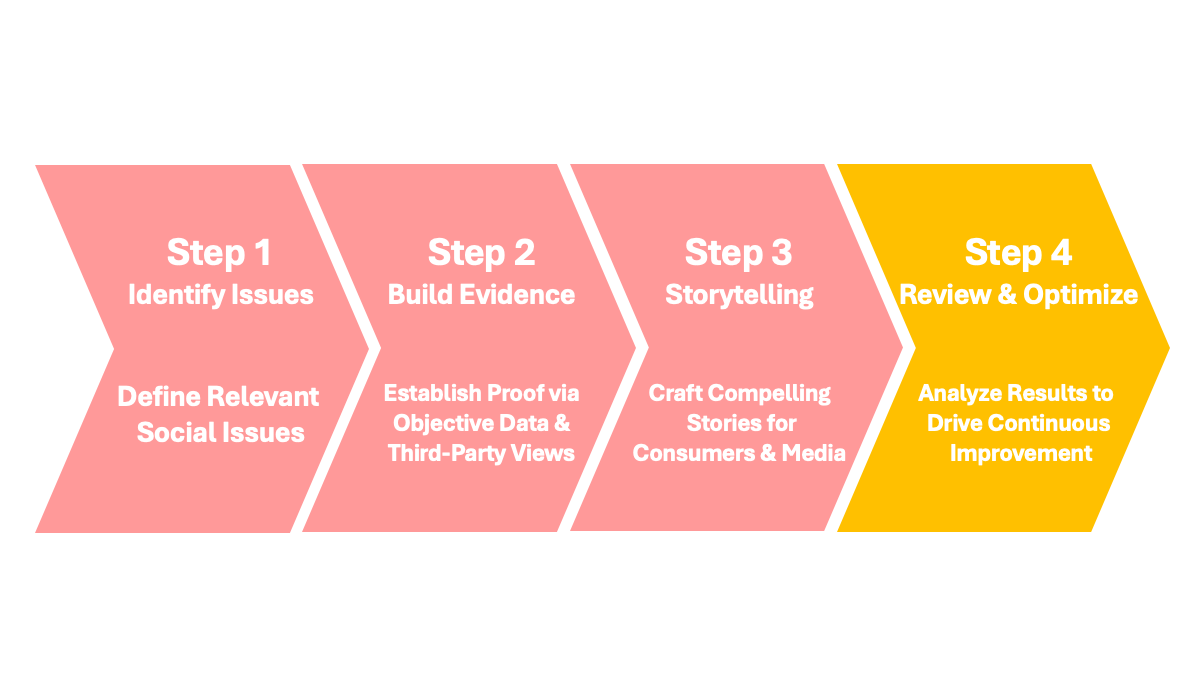
To practice sustainability PR that contributes to management and brand enhancement while avoiding the risk of failure, it is necessary to follow systematic steps. Here, we explain specific ways to proceed to effectively increase corporate value.
| Implementation steps | Specific actions to take | Expected effects |
|---|---|---|
| 1. Organize the issues | Identify social issues with high affinity to your business | Creates uniqueness and persuasiveness in what you communicate |
| 2. Build evidence | Gather quantitative data and third-party evaluations | Prevents washing criticism and ensures credibility |
| 3. Turn it into a story | Translate specialized information to fit the social context | Captures the interest of the media and the public |
| 4. Verify effectiveness and improve | Analyze article response and the quality of inquiries | Improves the accuracy of future communications and leads to business results |
Organize Social Issues Closely Related to Your Business
First, it is recommended to start by extracting and organizing themes that are closely related to your business from among the diverse social issues in the world. If you try to address every issue, your message will become scattered, making it harder to convey your company’s uniqueness and strengths. You will need to redefine the value your products and services provide to society and logically identify which SDGs goals you contribute to achieving. By clarifying why your company must engage in these efforts, you can establish a foundation that keeps your communications consistent.
Build Evidence Based on Numbers, Facts, and Third-Party Perspectives
Next, collect and build objective evidence to demonstrate your company’s initiatives for the selected themes. Talking about social contribution with words alone tends not to be persuasive, and support from numbers and facts plays an important role. For example, in addition to your own data such as the percentage reduction in CO2 emissions year-on-year, incorporating third-party perspectives such as evaluations by external certification bodies and comments from experts can be more effective. Designing communications that present reality and evidence together can be one key to increasing trust in the information while reducing reputational backlash risk.
Convert It into a Story That Resonates with the Public and the Media
Once you have the supporting data, rather than listing it mechanically, you need to convert it into a story that moves people. Objective facts are important, but on their own they tend to be difficult for the media to cover as news, and for the public to relate to personally. By weaving in elements such as trial and error at the development site, the passion of employees who led the initiative, and customer voices that emerged as a result, the information can feel more human. Shift the subject from the company’s perspective to society’s perspective, and place it into a context that anyone can understand.
Analyze Post-Release Reactions and Apply Them to the Next Improvements
After releasing information, it is advisable to establish a mechanism to analyze stakeholder reactions from both quantitative and qualitative perspectives and apply them to the next actions. Sustainability PR is not a one-time effort; it is an ongoing process of refining messages through dialogue. In addition to press release views and the content of mentions on social media, feedback from the sales front lines—such as how your stance was evaluated during BtoB business discussions—can also be useful indicators. By adjusting expressions and channels based on analysis results, the contribution to corporate value is expected to increase gradually.
Communication Methods You Can Use for Sustainability PR
Once your sustainability PR strategy and story are in place, you need to choose the means to deliver it to the appropriate target audience. Here, we explain representative communication methods that are easy to use in practice.
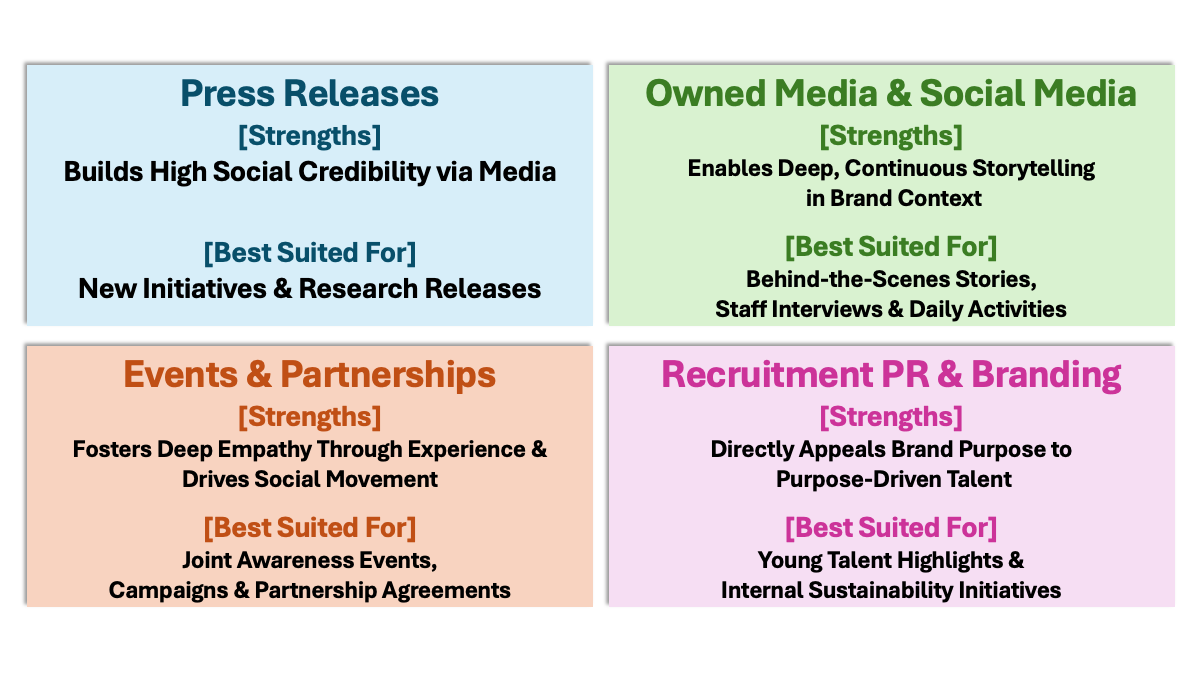
| Communication method | Benefits | Best-suited content |
|---|---|---|
| Press releases | Remains as an official record and is more likely to catch the media’s attention | Launching new initiatives, announcing survey results, etc. |
| Owned media | No constraints on length or expression, allowing in-depth storytelling in your own context | Long-form stories such as behind-the-scenes development stories and interviews with those in charge |
| Hosting events | Enables direct dialogue with stakeholders and sharing enthusiasm | Joint announcements with partner companies and experiential programs |
| Expanding into recruitment communications | Allows you to directly appeal to job seekers about the company’s social purpose | Young employees’ achievements and internal sustainability promotion activities |
Press Releases and Media Pitches
A widely used approach for official corporate announcements is distributing press releases and proposing individual story ideas to the media. Being reported through the filter of a third party—the media—tends to increase social credibility. Newsworthy events such as launching a new environmentally friendly product or signing an agreement with a local community are themes you should proactively communicate via press releases. However, it is important to avoid turning it into mere product promotion by linking it to the underlying social issue and preparing an angle that the media will want to cover.
[Related Article] What Is a Press Release? Strategies and Tips to Increase PR Impact « Column
Ongoing Communications via Owned Media and Social Media
Another recommended method is ongoing communications using your company’s blog or owned media and official social media accounts. Rather than simply waiting to be covered by the media, you can connect directly with stakeholders in your own words and deepen understanding over time—this is a major strength. By carefully writing about small daily improvement activities that may not become major news, or the thoughts of employees working on the ground, you can gradually increase your company’s fans. Ideally, after understanding each platform’s characteristics, you should continue communicating in an approachable tone rather than in a stiff, report-like style.
[Related Article] What Is a Media Strategy in PR Activities? How to Think About “Information Design” That Does Not End with One-Off Exposure « Column
Events, Campaigns, and Partnerships
To make efforts to address social issues visible and involve more people, implementing events and campaigns and building partnerships with other companies can be effective. By going beyond information dissemination and providing stakeholders with concrete experiences, you may generate deeper empathy. For example, co-hosting an awareness event on environmental issues with other companies in the same industry can help you reach audiences you cannot reach alone. Creating a larger movement that involves society can also help establish an impression of leadership within the industry.
[Related Article] Successful PR Promotion Methods Using Events! 15 Approaches and Key Tips for Success « Column
Expanding into Recruitment Communications and Corporate Branding
Content created through sustainability PR can potentially be expanded into recruitment communications and company-wide branding activities. This is because highly capable talent with strong motivation to contribute to society tends to be interested in sustainability information communicated by companies. By creating a dedicated page on your recruitment site for sustainability promotion initiatives or sharing related stories at company information sessions, you can increase candidates’ interest in applying. Ideally, you should establish a system to leverage information company-wide by collaborating not only with the PR department but also with HR and corporate planning.
[Related Article] What Is Rebranding? How to Proceed and When to Implement It for Success « Column
When You Should Consult a Specialist Firm for Sustainability PR
While sustainability PR can be advanced using internal resources alone, it is a field that requires high expertise, and more companies are requesting support from external PR firms. Incorporating a third-party perspective is said to help prevent self-centered communications and make risk management easier. Here, let us look at what kinds of situations indicate a company should consider consulting a specialist firm.
| Company challenge | Value a specialist firm can provide |
|---|---|
| Not sure how to communicate it | Convert your initiatives into a story aligned with the social context |
| Concerned about risk | Prevent washing criticism and reputational backlash in advance through an objective review framework |
| Not seeing results | Develop strategies that resonate with management and business partners and lead to BtoB inquiries |
| Insufficient resources | Leverage media relationships to secure effective exposure |
Not Sure How to Communicate Your Initiatives
If your company is conducting excellent initiatives internally but does not know how to communicate them externally in an appealing way, support from a specialist firm can be a major help. When you are inside a company, many things can become too “normal,” making it difficult to objectively judge what is valuable to society. PR firms often have the know-how to carefully interview companies about their activities and, while comparing them with social trends, translate them into stories that anyone can understand. By having your strengths drawn out from a third-party perspective, you can expect improvements in the quality of your communications.
Want to Avoid SDGs Washing and Reputational Backlash Risk
Because even minor wording mistakes in sustainability communications can damage corporate trust, companies that prioritize safety should consider consulting experts. Ethical and environmental standards change daily, and without understanding the latest trends, communications may inadvertently become inappropriate. A PR firm with a proven track record can be expected to thoroughly implement “no overstatement” design and fact-checking processes, and to eliminate expressions that are likely to invite criticism in advance. Even from a risk management perspective alone, there is ample value in seeking expert advice.
Want to Connect Socially Meaningful Activities to Media Exposure and Brand Value
External expertise can also be helpful if you want to ensure your communications do not end as mere self-satisfaction, but instead lead to concrete business contributions such as favorable media coverage and BtoB inquiries. PR firms tend to be well-versed in what angles the media seek and what information business partners trust. If you can find a partner who can connect management strategy and PR strategy and draw a mid- to long-term roadmap that also extends to recruitment and branding, sustainability initiatives may gain greater momentum.
If you feel there are limits to sustainability PR in-house due to a lack of expertise or concerns about SDGs washing, we recommend consulting a specialist firm. With SUNNY SIDE UP’s PR services, we provide end-to-end support from strategy development through execution. By building stories that capture social trends, you can communicate compelling information that enhances corporate value. If you are considering effective communication design, please review the service details below.
Conclusion: Sustainability PR Is the Key to Building Trust
Here are the key takeaways from this article. Sustainability PR is not limited to superficial appeals; it is an activity that communicates your company’s very reason for being to society. The basis for communications is a story grounded in reality, and sincere information dissemination is expected to help avoid criticism of greenwashing and become the foundation for generating essential trust from stakeholders. Furthermore, to connect it directly to management outcomes such as recruitment and increased BtoB inquiries, strategic communications are essential. Having confidence in your initiatives and steadily continuing to communicate them in language that resonates with society can be a driving force that opens up your company’s future.
If your company would like to communicate sustainability initiatives not as mere activity reports but as PR stories that lead to trust and empathy from society, please consult SUNNY SIDE UP. We support you from organizing points of connection with your business to designing information that reaches the media and the public.
CONTACT « SUNNY SIDE UP GROUP Inc.