What Is IP Marketing? A PR Strategy to Generate Buzz for Your Brand by Leveraging Characters and Content
- カテゴリ:
As it becomes harder for information to reach consumers through traditional advertising alone, “IP marketing,” which leverages intellectual property (IP) such as characters, works, and talent, is attracting attention. IP is not merely a way to “borrow” popular content; it is a strategic approach to designing new touchpoints between a brand and its fans.
This article explains IP marketing from a practical perspective—from the basic concept and why it is gaining attention, to how it can be applied to business challenges and how to proceed to maximize results.
What Is IP Marketing? A Method for Expanding Brand Touchpoints Through the Power of Characters and Content
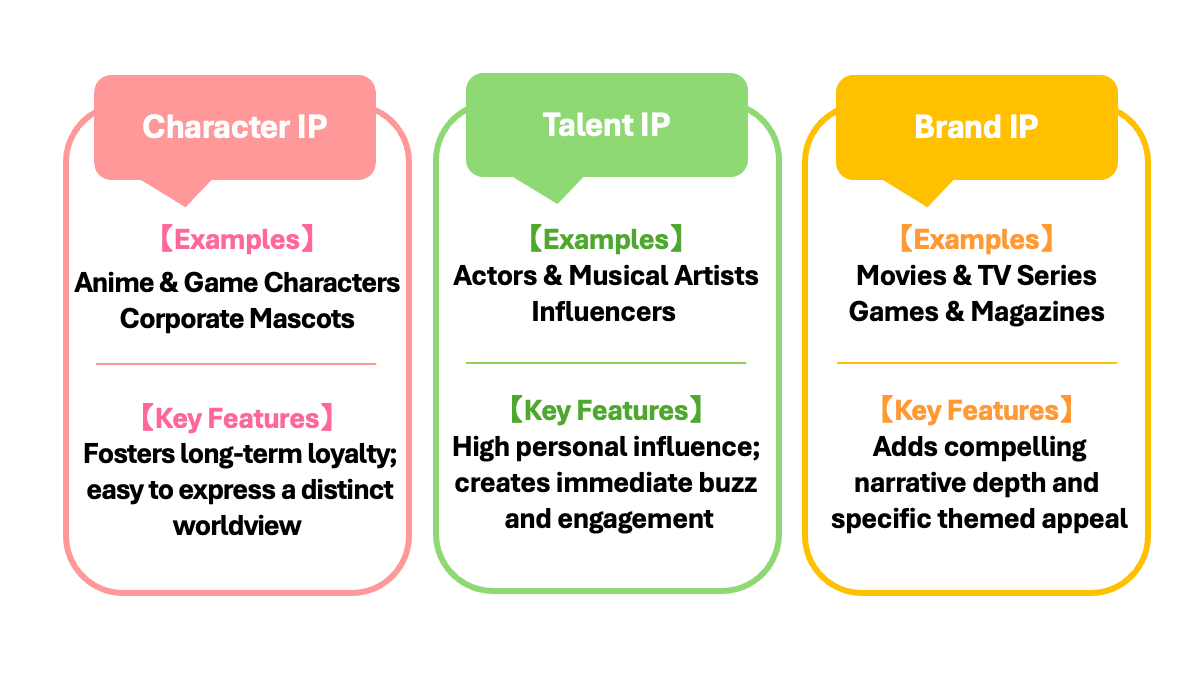
| IP category | Examples | Key characteristics of use |
|---|---|---|
| Character IP | Anime and game characters, corporate mascots | Builds long-term attachment and makes it easy to express a world view |
| Talent IP | Real-life actors, artists, influencers | Strong personal reach and can generate buzz quickly |
| Work/brand IP | Films, dramas, magazines, game titles | Can add a story element or a specific theme from the work |
IP refers to intellectual property such as characters, works, and talent
IP is an abbreviation for “Intellectual Property,” meaning intellectual property in Japanese. In marketing and PR, IP commonly refers to anime and game characters, works themselves such as manga and films, and real-life talent and artists. The approach of leveraging the social recognition and positive feelings that each IP has already earned among fans for your own brand activities is called “IP marketing.” It is important not to treat IP as mere eye-catching decoration, but to deeply understand its appeal and align it with your brand message.
【Related Article】 What are Influencer Measures from a PR Perspective? Explaining Design Without Failure and the Concept of Utilizing PR Agencies « Column
Use IP to create touchpoints with existing fans
When considering IP marketing, viewing it simply as temporarily “borrowing” a popular character may prevent you from achieving sufficient results. The true objective is to identify shared values between the brand and the IP and design new touchpoints that are meaningful for both. The IP in question already has many existing fans who enthusiastically support the work or person. It is essential to build careful communication that naturally connects fans’ attachment and enthusiasm to positive feelings toward your brand—without undermining them.
From a PR perspective, the “context fans will accept” is essential
When executing initiatives, what matters is designing a context that IP fans will be happy to accept. Unnatural collaborations—such as suddenly having a character hold a product or speak lines that ignore the world view—can instead provoke backlash. It is important to consider a plan that satisfies all three parties: the IP holder (rights owner), your brand, and the consumers who receive the content. Finding ways to place the brand message within the IP’s story and deliver it to society without discomfort will lead to success.
[Related article] What Is Fan Marketing? How to Build a Brand Loved for the Long Term from a PR/Publicity Perspective « Column
Why IP Marketing Is Gaining Attention
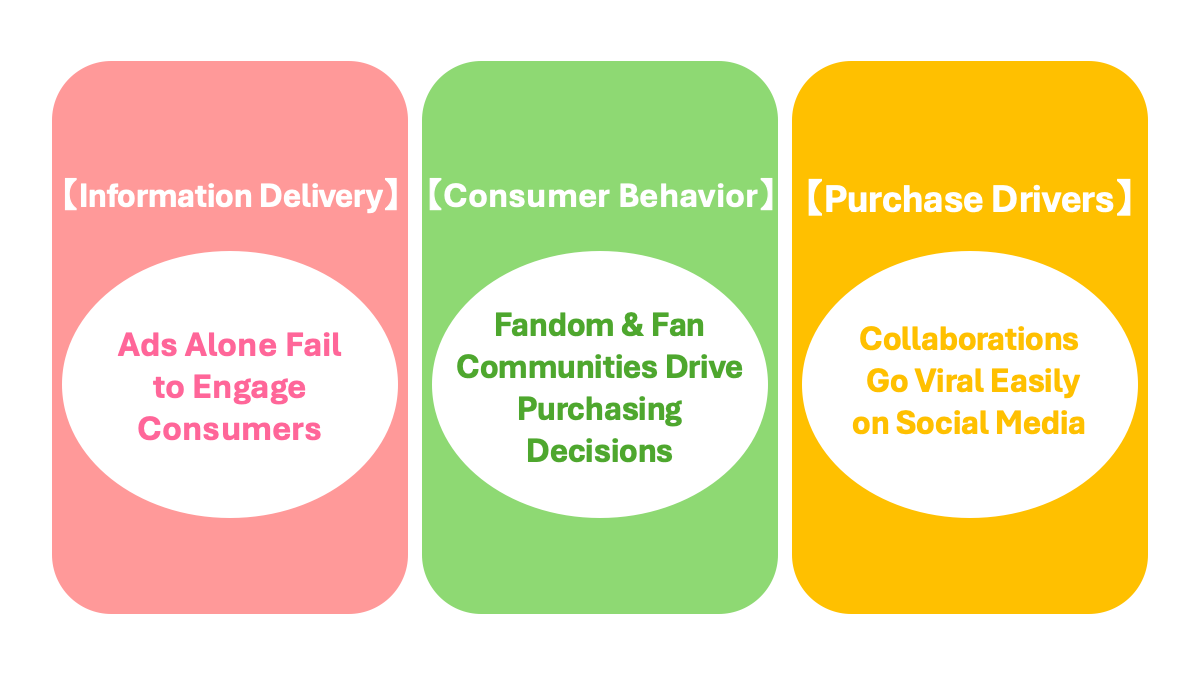
| Perspective | Traditional environment | Today’s environment |
|---|---|---|
| How information reaches people | One-way advertising via mass media | Multi-faceted touchpoints centered on digital and social media |
| Consumer behavior | Passively receive messages sent by companies | Actively search for information of interest and share it within communities |
| Purchase motivation | Functional value and pricing of products | Supporting and empathizing with what one loves (fan support activities) |
It is becoming harder to capture consumer interest through advertising alone
In recent years, the spread of smartphones and digital devices has rapidly increased the amount of information consumers receive each day. Pure advertising messages from companies tend to be processed as noise, making it difficult to gain attention. No matter how strongly you appeal to functional advantages, it will not lead to purchase if people do not look your way. By leveraging the power of IP that already attracts consumers’ interest and goodwill, there is a growing need for approaches that lower the barrier to initial engagement.
Reference: Consumer Affairs Agency, “Recent Trends in the Advertising Market”
Fan support activities and fan communities are influencing purchasing behavior
Another major factor is the widespread establishment of the culture of “fan support activities,” in which people enthusiastically support their favorite characters or individuals. Today’s consumers tend not only to buy what they need, but also to actively spend on products and services related to what they love. Communities of fans who support the same subject have also formed, and information exchange within these communities effectively encourages purchases. Through IP, companies can approach highly engaged fan communities.
Collaboration information is more likely to spread on social media
On social media platforms centered on short posts and real-time information gathering/sharing, as well as visually driven platforms focused on photos and short videos, collaboration information with popular IP tends to spread easily. When fans find new visuals or limited-time projects, they often share them proactively and share the excitement. Even without investing heavily in advertising, companies can expect organic dissemination of information. If a project has strong news value, it is also more likely to be picked up by external media such as web outlets and TV programs, leading to greater brand awareness.
[Related article] How Can You Make an SNS Campaign Successful? A Design Method That Anticipates Buzz, UGC, and Media Exposure « Column
Business Challenges That IP Marketing Can Solve
| Challenge | Approach through IP marketing | Expected outcomes |
|---|---|---|
| New customer acquisition has plateaued | Use IP with strong support among younger or specific segments | Build new touchpoints with segments you could not reach before |
| The product lacks fresh buzz | Plan an unexpected collaboration with a character | Increase media exposure and organic spread on social media |
| The brand image feels outdated and fixed | Blend with the world view of forward-looking or fashionable IP | Refresh the corporate image and redefine brand value |
We want to create touchpoints with new customers and younger audiences
As a business operates over many years, it may face the challenge of an aging existing customer base and difficulty reaching new generations. Using anime works and influencers that have strong support among younger audiences can be an effective option. With IP serving as a bridge, you can provide a trigger for segments that previously had little interest in your products to become interested simply because “an IP I like is involved.”
We want to add buzz to our products and services
In markets where commoditization is advancing, it is becoming difficult to differentiate from competitors based on functionality and price alone. When you want to increase buzz at the launch of a new product or at the time of a renewal, leveraging IP tends to be effective. By developing surprising, unexpected combinations and limited-edition packaging that appeals to fans, you can create news value. As buzz grows, it can also lead to improved shelf placement rates in stores and an increase in name-specified purchases.
We want to expand our brand world view
A company’s guiding principles and brand messages can sometimes be difficult for consumers to grasp when conveyed in words alone. By leveraging the rich world view and storytelling of IP, it becomes easier to communicate the brand’s appeal in a more intuitive way. For example, when a company promoting environmental protection collaborates with a work themed around nature, it can evoke deeper empathy than verbal explanations alone. By overlaying the IP’s image, it becomes easier to effectively highlight new facets of the brand.
[Related article] A PR Perspective on Strategies to Increase Brand Awareness: Practical Design to Drive Name Recognition and Inquiries « Column
Benefits and Considerations of IP Marketing
| Item | Benefits | Considerations |
|---|---|---|
| Awareness and sharing | Rapidly deliver information to an existing, highly engaged fan base | The IP may become the sole focus, creating a risk that the brand is not recognized |
| Scope of planning | Enable innovative creative and plans that differ from the usual | Plans that ignore fan sentiment may invite criticism or backlash |
| Execution and management | Incorporate new world views and expressions not available in-house | Strict review processes by the rights owner require ample schedule buffer |
You can expect greater awareness among existing fans
One major benefit is that you can quickly make your company known to the many fans the IP already has. Building a fan base for your products from scratch requires significant time and cost, but leveraging IP can shorten the nurturing process and create positive initial contact. Because fans often actively seek information related to the IP, brand messages are more likely to be received favorably, and conversion rates to purchases or service use also tend to increase.
It is more likely to lead to buzz, social media sharing, and media exposure
Projects featuring trending IP tend to have high news value. In addition to expected sharing by fans on social media, they are also more likely to gain PR-style exposure in trend-focused web media and information programs. Because publicity effects can generate significant value when converted into advertising spend, this can improve ROI as a marketing investment. Gaining public attention may also bring secondary benefits, such as boosting internal motivation.
Be mindful of world-view mismatches and rights reviews
While there are benefits, there are also important considerations. Plans that impose only the brand’s convenience, or expressions that contradict the IP’s original settings, can invite harsh criticism from fans. In creative production, you are required to undergo strict rights review by the IP holder. Because detailed rules must be followed—such as character proportions, color tones, and logo handling—the review process tends to involve more checks than typical production workflows. It is important to build sufficient schedule buffer.
Risks differ between talent IP and character IP
It is also necessary to note that the nature of the risks varies depending on the type of IP used. With real-life talent IP, there is a risk that private scandals or remarks could suddenly force you to halt a promotion. In contrast, character IP such as anime tends to carry a relatively lower risk of personal scandals. You should compare both characteristics and risks in line with your objectives.
How to Proceed with IP Marketing to Maximize Results
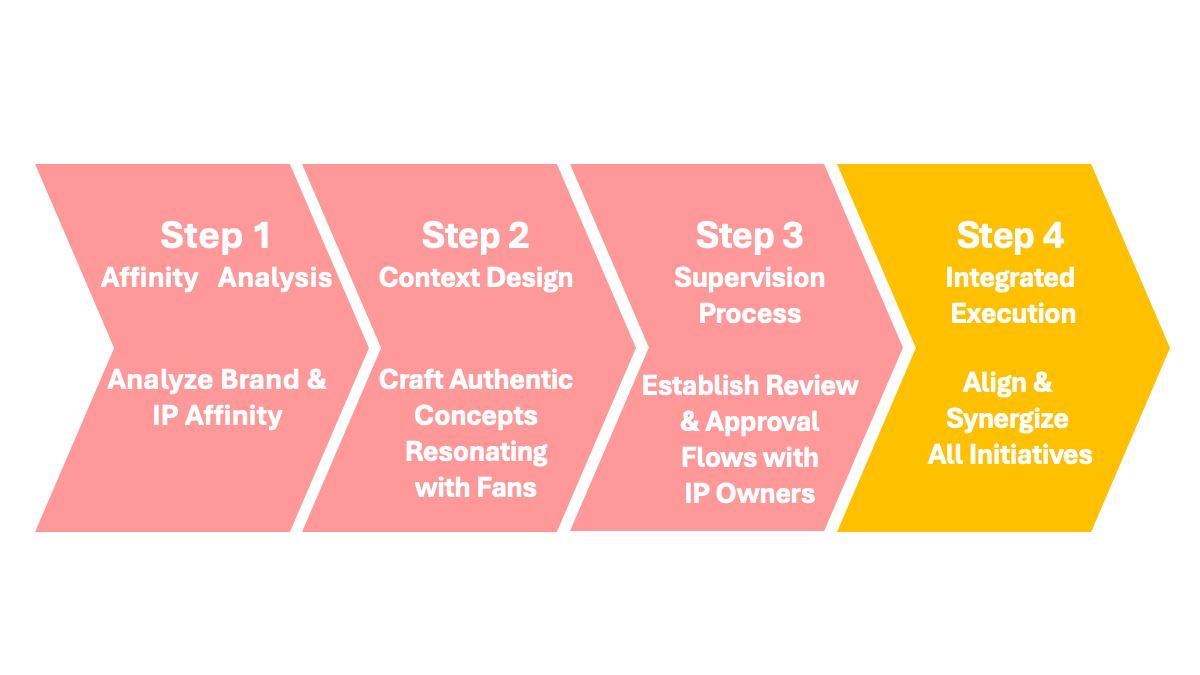
| Step | Action overview | Keys to success |
|---|---|---|
| 1. Analyze affinity | Evaluate the fit between the target audience/brand value and the IP | Assess not only name recognition, but also alignment in values and fan attributes |
| 2. Design the context | Create a story with a compelling rationale for the collaboration | Develop a plan that satisfies the rights owner, the brand, and consumers |
| 3. Build the review workflow | Obtain rights-owner confirmation for designs and plan details | Create a schedule with buffer, assuming multiple rounds of revisions |
| 4. Execute in an integrated manner | Run PR, social media, in-store campaigns, etc., simultaneously | Leverage each channel’s strengths to maximize buzz across a broad surface, not in isolated points |
Analyze the affinity between the brand and the IP
The first step in planning is to calmly analyze the affinity between your brand and the IP candidates. Rather than choosing solely because it is currently in the spotlight, confirm whether the target customer segment’s age and gender align, and whether there are commonalities between the brand’s guiding principles and the IP’s themes. The higher the affinity at this stage, the smoother subsequent communication design will be, and the more likely consumers will perceive it as a natural collaboration they can accept.
Design a collaboration context that fans can accept
After confirming affinity, design a story that makes people feel there is a compelling reason why this brand and IP are partnering. Fans tend to react coolly to plans where only commercial intent shows through. It is important to respect the IP’s world view and prepare a context that makes fans feel, “This brand understands (the IP’s background and positioning).” Finding the point where what the brand wants to convey, what the rights owner wants to protect, and what consumers want to see naturally intersect will be the core of the plan.
Establish a confirmation and review workflow with the rights owner
Once the proposal and actual creative production begin moving forward, build a thorough confirmation structure with the rights owner, who is the IP holder. When leveraging IP, deliverables generally must pass the rights owner’s review. To prevent misalignment, it is important to align direction in detail from the early rough stage. By setting milestones with sufficient buffer in advance—assuming multiple rounds of revisions—you can more easily prevent last-minute execution issues.
Link PR, social media, in-store, and campaigns
In the phase of delivering the completed plan to consumers, you need to ensure the initiative does not end as a standalone effort. Ideally, you should integrate and link efforts such as gaining media exposure through press release distribution, participatory campaigns on social media, in-store POP displays, and distribution of limited-edition goods. By designing a flow that generates social buzz through PR, expands circles of empathy on social media, and ultimately guides consumers smoothly to purchasing behavior in stores or on websites, you can expect improved ROI for IP marketing.
When You Should Consult a PR Agency for IP Marketing
| Common obstacles in-house | Support provided by a PR agency | Expected solutions and benefits |
|---|---|---|
| You cannot think of suitable IP candidates for your company | Multi-angle casting proposals aligned with objectives and budget | Select the optimal IP with strong affinity that directly leads to buzz |
| You do not know how to approach rights owners or proceed with negotiations | Handle negotiations as the point of contact and organize/coordinate complex rights relationships | Use specialized expertise to avoid issues and proceed smoothly |
| You created a plan, but cannot predict how information will spread | Develop an integrated PR strategy that anticipates everything from media exposure to social media rollout | Achieve large-scale buzz across a broad surface, not isolated point initiatives |
You cannot determine which IP to use
Even if your company’s challenges are clear, it is not uncommon to be unsure which specific characters or talent would be most effective. By consulting a specialized PR agency or a company with casting know-how (such as SUNNY SIDE UP), you can receive appropriate IP proposals based on the latest trends and target-audience insights. Rather than simply following name-recognition rankings, we recommend incorporating a professional perspective to identify candidates that match the brand’s direction and are feasible within a realistic budget.
You are concerned about coordination and reviews with rights owners
In IP marketing, one area that is often perceived as particularly challenging is negotiations with rights holders or talent agencies. For first-time initiatives, it can be difficult to judge what process is required to obtain permission and how much creative freedom will be allowed. By bringing in a partner with extensive experience in rights coordination, it becomes easier to have them handle complex confirmation tasks on your behalf. Because they often understand in advance what rights owners prioritize, this can lead to safe and reliable project execution with fewer rework cycles.
You want to generate buzz without ending the collaboration as a one-off initiative
There are also failure cases where initiatives ended as one-off efforts—such as plans that merely printed an IP image on packaging—and did not deliver sufficient results. To achieve strong outcomes, an integrated PR rollout is required, designed end-to-end—from product planning to media-facing launch events, social media amplification, and in-store execution. By involving a PR agency that specializes in generating buzz, you can develop a strategy that circulates information broadly rather than in isolated points, and create a successful case that remains in consumers’ memories for a long time.
If you face challenges such as maximizing exposure through IP or a lack of internal resources, consulting an experienced specialist is effective. At SUNNY SIDE UP, we provide end-to-end support—from selecting the optimal content and handling complex coordination with rights owners, to PR design that engages the media. We have compiled details on our support and approach methods on our service page. Please review the details.
Conclusion: Enhance Brand Value by Leveraging IP
Here is a summary of the key points of IP marketing, which leverages the power of characters and content to solve business challenges. IP is not simply a means of “borrowing” popular characters or content. It is a strategic option for designing new touchpoints between a brand and its fans. To maximize effectiveness, the key to success is how carefully you can create a context that the three parties—rights owner, brand, and consumers—can genuinely accept. In addition, by integrating and linking initiatives across PR, social media, and in-store campaigns, you can amplify the impact of generating buzz. If you feel uncertain about casting, rights coordination, or PR rollout, consulting a specialist company is also a valid option. By appropriately incorporating the enthusiasm and story that IP carries into your brand, aim for long-term value enhancement that goes beyond short-lived buzz.
At SUNNY SIDE UP, we design PR plans that are naturally accepted by consumers and fans while respecting the world views of both the brand and the IP. If your company is considering buzz-generating initiatives that leverage characters, content, or talent, please contact us.