How can you make PR for a pop-up event successful? A guide to the planning and steps that generate buzz.
- カテゴリ:
When hosting a pop-up event, have you ever felt that “if we rent a space, display our products, and announce it somehow, people will come”? In today’s information-saturated world, simply being a limited-time shop is no longer enough to drive sufficient foot traffic. That is why a key factor is a “PR strategy” that gives the event itself news value and captures public interest.
This article explains why a PR perspective is essential for pop-up events, common pitfalls when running everything in-house, four concrete strategies to generate buzz and encourage social media sharing, and six detailed steps to execute them.
Why is a PR perspective essential for pop-up events?
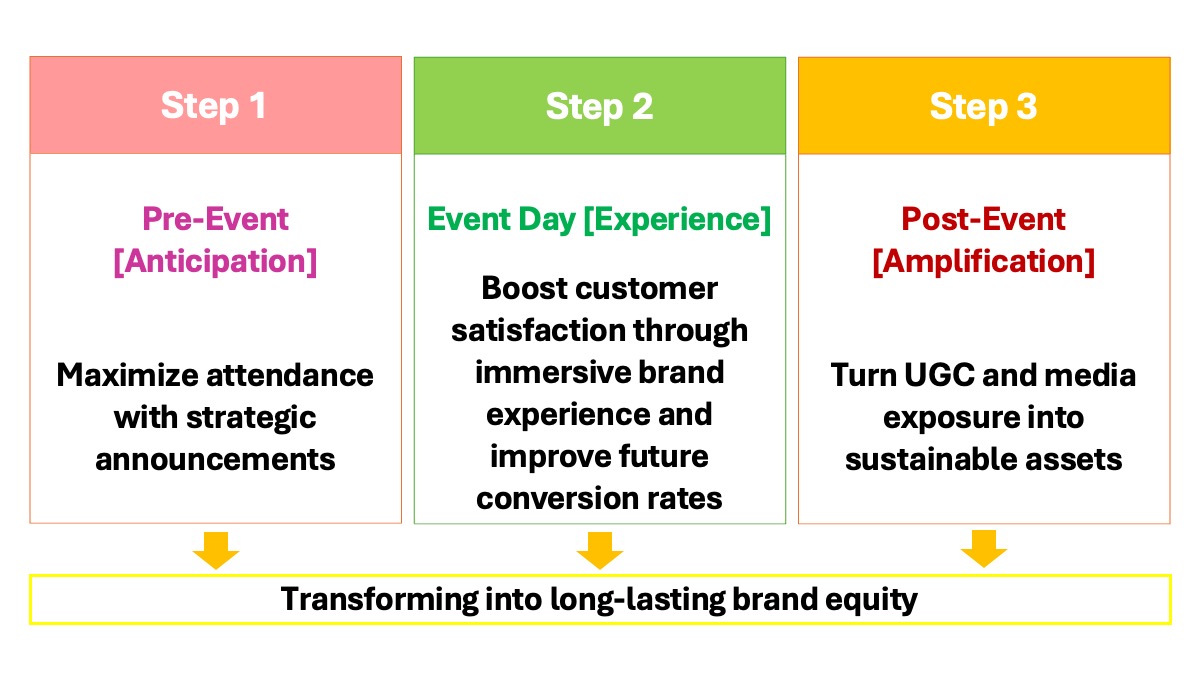
What is needed for a successful event is to incorporate a PR perspective that develops a communications strategy. With a PR perspective, the event itself gains news value and can become a catalyst for attracting broad interest.
[Related article]How can you make event PR successful? From planning process to success stories « Column
To help people deeply experience the brand’s world offline
A pop-up event is not solely intended to sell products as a temporary store. It functions as a valuable opportunity for customers to directly engage with and experience the brand’s world, deepening their connection with the company. Precisely because online shopping has become the norm, the value of a real, offline “brand experience” is increasing. In particular, for D2C brands without physical stores, pop-ups are a major opportunity to interact directly with customers and communicate the brand story through all five senses. For example, when a cosmetics brand launches a new product, it does more than simply hand out samples—it creates a special space aligned with the product concept and branding. By incorporating thoughtful touches that make visitors feel it is enjoyable just to be there, positive feelings toward the brand naturally emerge. Designing the experience with a PR perspective—by planning “how to communicate it in the most compelling way”—and providing an experience that moves visitors is the first step toward gaining long-term fans.
Build anticipation through strategic communications before the event and create early momentum for customer traffic
An event’s success depends not only on how you operate on the day, but also heavily on pre-event communications. By developing a PR strategy that builds anticipation in advance, you can expect to attract many visitors from day one. It is recommended to release information in a planned manner through social media and the media before the event to capture consumer interest. Specific approaches include teasing only the silhouette of limited items in advance or livestreaming videos of venue preparations. Ideally, you will gradually share information to naturally expand buzz among your target audience, creating both the motivation and the hook that makes people think, “I want to go as soon as it opens.”
It is important to design the event so the buzz continues afterward
A pop-up event is a limited-time initiative lasting from a few days to a few weeks, but a PR perspective is useful to ensure the impact is not fleeting. It is important to design the event so that the buzz continues even after it ends—remaining active in digital spaces and the media. For example, high-quality UGC (user-generated content) created at the venue may continue to spread on social media after the event, or media articles resulting from a press preview may be published later. This helps people who could not attend directly feel, “So that’s what it was like,” and “I want to join next time,” allowing the brand’s appeal to reach them. By reframing the pop-up event not as merely “providing a space,” but as an “origin point for information dissemination,” you can turn a limited-time investment into a mid- to long-term brand asset.
Common failure cases in in-house pop-up events
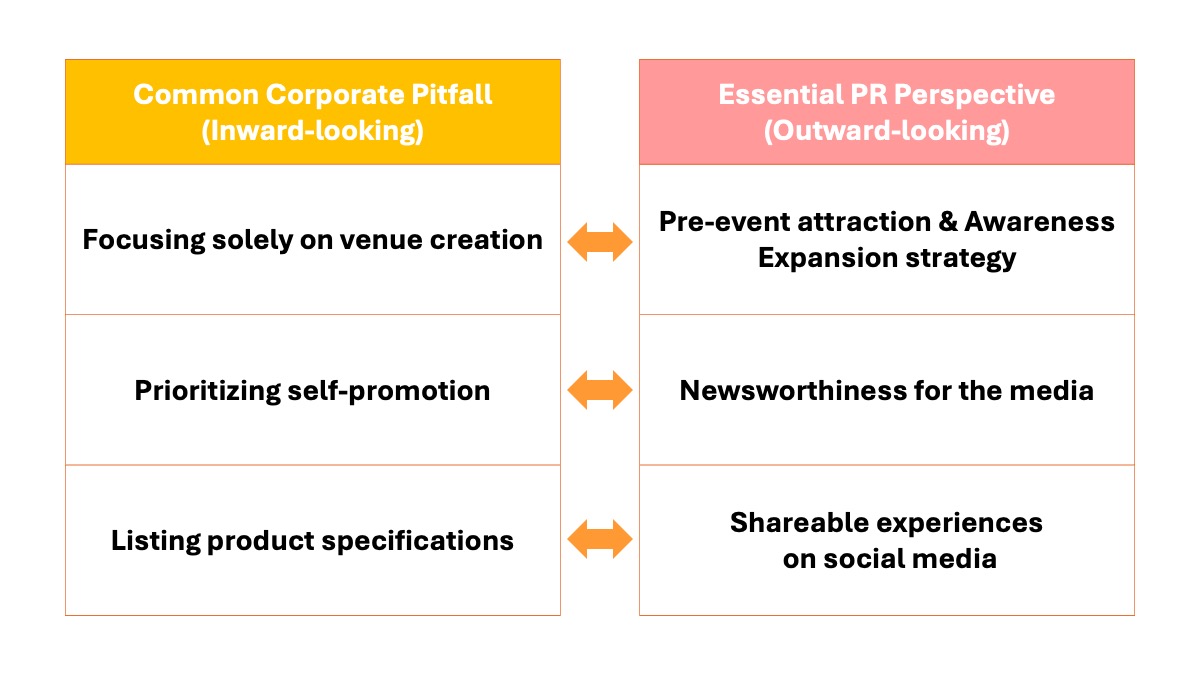
To move forward with planning and operations without specialized know-how, there are several key points to keep in mind. Here, we explain three common failure cases that tend to occur when running a pop-up event entirely in-house.
You built an elaborate venue, but it does not generate buzz
A common pattern is that, despite investing budget to create a beautiful interior and displays, the crucial “visitors” do not show up. This stems from the assumption that “if we create a good space (good content), people will naturally come.” If you lack the context-building needed to generate buzz in advance and a PR strategy to deliver information to your target audience, even the most attractive venue may go unnoticed. Without a perspective on who to reach and how to reach them, you may not achieve results commensurate with the costs invested.
Weak news value for the media
To be covered by major media outlets, you need news value—such as trend relevance, social significance, or novelty—that makes reporters think, “I want to write about this.” However, when planning solely from an internal perspective, you tend to focus on “announcing a new product,” “store opening information,” or “a celebrity we want to invite,” which can weaken the context that attracts media interest. TV program directors and magazine editors receive countless press releases every day. If the news value is insufficient, or if you lack points of contact (relationships) with the media that allow you to pitch directly to the right person, media outreach may not go well, and you may miss opportunities to expand awareness.
Insufficient experience design that makes people want to post on social media
When planning only in-house, the company’s perspective—“we want to sell products” and “we want to communicate the brand’s strengths”—tends to become too strong. Consumers are sensitive to one-sided promotion and information, so it is difficult to aim for social media amplification with displays that are purely company-driven. For example, if you only line up product specs on panels at the venue, visitors are unlikely to feel compelled to take photos and share them. Consumers are motivated to share when there is value they want to tell others about—such as something they experienced and found interesting, or a photogenic space—making them think, “I want to show people who weren’t there,” or “I want to share this with someone.” The key is experience design that enables visitors to be the protagonists and generate UGC (user-generated content).
PR strategies to make a pop-up event successful
When planning a pop-up event, a PR strategy that increases customer traffic and expands awareness is essential. You need a mechanism to intentionally create buzz and spread it. Here, we explain four concrete strategies to lead your event to success.
| PRStrategy name | Specific actions | Expected impact |
|---|---|---|
| Develop a buzz-driving concept | Make meaningful societal trends, social issues/user issues, and product/content design—aligned with the product and brand—the core of the event | Encourages media and consumers to talk about it voluntarily (appetizing appeal, unexpected combinations, an aspirational world view, etc.) |
| Design the announcement narrative | Provide angles and interview opportunities that media and reporters will want to cover | Build objective credibility through media exposure and drive visits (purchases) |
| Create experience and photo-taking flow | Design a space that makes people want to take photos and build a path that leads naturally to sharing | Organic generation of UGC by visitors and a chain reaction of word of mouth |
| Embed social media pathways | Leverage well-known figures/influencers with strong affinity to the company IP/brand, services, and products, and link with digital initiatives | Expand reach to potential audiences and generate buzz digitally |
[Buzz awareness growth] Create a concept that becomes the core of buzz
What matters in the planning stage is to connect what the public cares about with your event and create a strong “concept” that becomes the core of buzz. Simply broadcasting the message your company wants to convey makes it difficult to earn consumer empathy. It is important to firmly shape the event’s overall concept around social trends, seasonal events, or narratives that align with the concerns of your target audience, as well as narratives that feel aspirational and make people want to experience them. In recent years, collaborating with IP (intellectual property) such as anime and characters—combining relevant scenes/settings with products and services—has also been a common way to involve existing passionate fan communities and generate buzz. By creating a clear concept that combines social significance, the fun of the event, and strong pull, you can generate news value beyond mere commercial activity and give many people a reason to take interest.
[Driving visits] Design an announcement narrative that resonates with the media
When an event is introduced through the objective perspective of a third party—the media—it increases the credibility of the information and helps encourage visits. Aim to design a compelling announcement narrative (story and angle) that makes reporters think, “I want to go cover this,” and “I want to write about this.” Even when holding a preview event (press preview) that invites only media stakeholders before the public opening, it is important not to simply invite them, but to present clear news value. Prepare an environment that supports media production needs, such as flashy staging that looks good on camera, information being revealed for the first time, and opportunities for direct interviews. As a result, the likelihood of coverage increases, and you can stimulate more viewers’ and readers’ desire to attend.
[Related article]What is news value? How to create and deliver information that gets picked up by the media « Column
[Experience promotion] Create experience and photo-taking flow that naturally generates UGC
There is growing demand for pop-up events to create “experiences” and “photo-taking flow” that encourage visitors to voluntarily take photos and videos and post them on social media. Prepare immersive experience booths or special offline-only events, and design spaces that make people instinctively want to point their cameras—encouraging the creation of UGC (user-generated content). In addition, it becomes easier to drive action by creating a flow that naturally guides visitors from the entrance to the exit through photo spots, and combining it with initiatives such as a limited novelty giveaway campaign using a designated hashtag. If you can establish a flow that enables visitors to act on the desire to “share a fun experience with someone,” it becomes easier to create a high-quality cycle where word of mouth generates more word of mouth.
[Digital buzz] Incorporate influencers and social media pathways
To deliver information directly to your target audience and energize buzz digitally, it is also recommended to incorporate influencer utilization and social media sharing pathways from the design stage. In addition to direct promotion from the company and media exposure, posts and word of mouth from admired figures or trusted creators, as well as user-generated posts and reviews on social media, are said to more easily evoke consumer empathy and encourage action. For example, for a food-focused pop-up event, invite influencers with influence in the food space in advance and have them post about its appeal. At that time, it is recommended to choose not only someone with many followers, but someone with a high engagement rate and a strong core fan base. By smoothly designing digital pathways—such as guiding users from influencer posts to your official account or to a reservation site—you can deliver event information to the timelines of potential audiences who do not usually know your company, making it easier to connect digital “buzz” to actual visits.
[Related article]What are influencer initiatives from a PR perspective? How to design them without failure and how to work with a PR agency « Column
Common practical challenges with pop-up events
In pop-up events, it is common to face challenges such as the following:
• Unable to forecast visitor numbers
• Unable to invite media or influencers
• The venue was built out, but it does not generate buzz
• No buzz remains after the event
These are points that can be significantly improved through advance PR design.
What you can consult SUNNY SIDE UP about
At SUNNY SIDE UP, we design and support pop-up events end-to-end as an “origin point for buzz,” from concept design to media outreach, social media-linked planning, and UGC acquisition.
• PR strategy design to build anticipation before visits
• Design of media outreach and influencer initiatives
• Experience design premised on social media sharing and UGC creation
• Post-event exposure capture and ongoing buzz design
We support designs that remain as brand assets, not one-off events.
For pop-up events, results vary greatly depending on whether you can map out media outreach before the event and buzz design before, during, and after visits.
• “We prepared, but we are not getting covered by the media as much as expected.”
• “We attracted visitors, but it did not spread on social media.”
• “We want a design that remains memorable as a brand experience.”
If this applies to you, please feel free to contact us first.
How to proceed through to running a pop-up event
From here, we explain the concrete steps to plan a pop-up event and move it into execution. By following strategic steps, you can fully draw out PR impact. Below, we have organized six steps toward launch and the key points for each phase.
| Step | Phase | Key points |
|---|---|---|
| 1 | Clearly define objectives and target audience | Put into concrete words who you will communicate what to, and how, to achieve the objective/goal in the shortest path |
| 2 | Develop the concept and buzz design | Create the event’s core message and content design, and build a narrative that media and users will like |
| 3 | Incorporate venue, flow, and experience design | Select a location that fits the target audience and create spaces/flow that generate UGC |
| 4 | Prepare press planning and pre-announcements | Strategically control information release and additional announcements, such as press release distribution and influencer invitations |
| 5 | Day-of operations and media handling | Hold a press preview for the media and ensure smooth on-site support for visitors (how you handle visitors on-site can improve—or conversely worsen—your corporate brand image) |
| 6 | Post-event exposure capture and reporting | Quantify coverage results and social media response, and apply insights to the next initiative (including conducting a retrospective) |
Step 1: Clearly define objectives and target audience
The first step in creating an event is to carefully define why you are holding it, who you want to attend, and what you want to achieve. If you proceed while this remains unclear, your subsequent planning and PR initiatives may lose focus, potentially resulting in an event with low buzz. Whether you want to increase awareness of a new product or strengthen loyalty among existing customers, the approach differs greatly depending on the objective. When setting your target audience, do not limit yourself to basic demographics such as age and gender—also envision their preferences and purchasing behavior in concrete terms. A high-resolution target profile naturally reveals what media they typically use to get information and what kinds of experiences they find enjoyable and valuable.
Step 2: Develop the concept and buzz design
Once objectives and target audience are set, the next step is to decide the concept that will serve as the event’s theme. What is important at this stage is not only thinking about spatial design, exhibits, and content design, but also advancing in parallel the buzz design of “how to deliver it to the public.” Pause and check whether there is an angle that works as news, not just visual beauty. When creating the proposal, it can also be helpful to come up with several hypothetical web news headlines. If you incorporate elements that make it easy to generate positive articles and UGC, your subsequent communications will be very smooth.
Step 3: Incorporate venue, flow, and experience design
After the concept is solidified, you move into finding a location and designing the venue to bring it to life. Of course, it should match the brand’s world view and product concept, but rather than simply choosing a busy terminal station, select an area your target audience visits regularly. Also consider whether access is convenient and whether equipment can be brought in easily, assuming you will invite media stakeholders. Once the location is decided, design the visitor flow. Carefully calculate the order in which visitors will experience content from entrance to exit, and when you will encourage photo-taking. At this stage, incorporate experience design that naturally encourages visitors to generate UGC (user-generated content), such as photo spot placement and campaigns using a designated hashtag.
Step 4: Prepare press planning and pre-announcements
From one to two months before the event, you enter the concrete communications phase. First, create a press release summarizing the event overview and distribute it to each media outlet. It is also essential to reach out individually to media outlets with high affinity. At this time, strategically control the timing of information release—by sharing information in multiple rounds (initial announcement, additional details, and a last-minute reminder), you can gradually build anticipation (and excitement for users). At the same time, contact major influential media outlets individually to propose coverage and invite them to the preview event. It is also a good idea to list influencers with strong affinity to your target audience and coordinate advance invitations during this period.
[Related article]What is a press release? Strategies and tips to maximize PR impact « Column
Step 5: Day-of operations and media handling
On the day before the event or the morning of the first day, you will hold a press preview inviting media and influencers. Here, it is necessary to prepare an environment where the media can take their time filming and conducting interviews. PR staff should strive for careful communication aligned with media needs, such as escorting interviews and proposing camera-friendly shots. After the event opens to the public, maintain an operational structure that allows visitors to enjoy the event safely and smoothly. Prepare and thoroughly implement manuals for unexpected congestion and trouble, and also be ready to respond flexibly by checking real-time reactions posted on social media and fine-tuning on-site flow and staff placement as needed. If something can be adjusted from the next day onward, improve it promptly.
Step 6: Post-event exposure capture and reporting
After the event ends, be sure to conduct a retrospective and measure results. Rather than being satisfied with simply having completed it, it is important to identify what worked and what should be improved based on objective data. Using a retrospective format such as KPT helps organize information effectively without relying on individuals. To make the next plan even better, create a process to accumulate know-how internally. From a PR perspective, it is common to comprehensively collect coverage results (clipping) across TV, web media, magazines, etc., and calculate advertising value equivalency. You also need to measure the number of social media posts (UGC volume) and engagement that include the designated hashtag. By combining these quantitative data with qualitative feedback—such as total visitor numbers during the period, product sales, and visitor survey responses—you can create a comprehensive report, review how well the PR strategy functioned against your objectives, and apply the learnings to the next initiative.
Benefits of hiring a specialist company for pop-up event PR
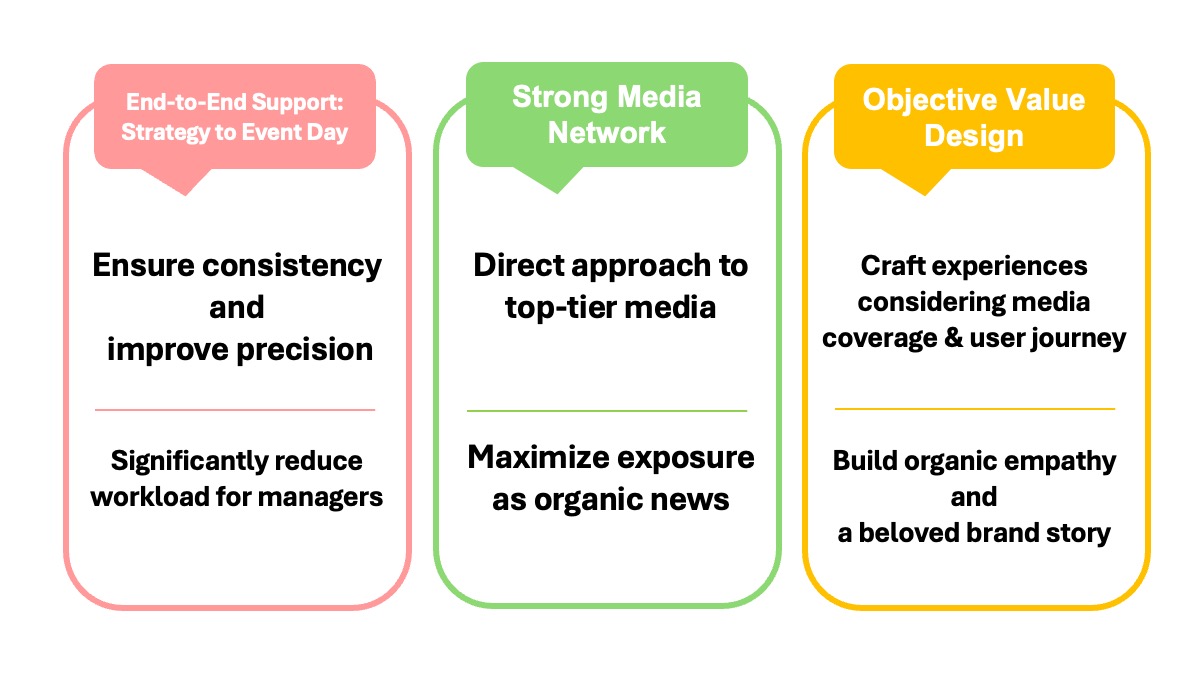
To resolve the challenges of in-house operations, requesting support from a PR specialist company is also a practical option. PR agencies are professionals in building relationships with the media and creating narratives that capture societal trends. Here, we have organized the benefits you can gain by engaging a PR agency.
Benefit 1: You can proceed consistently from buzz creation to media outreach
A major advantage of using a PR agency is that it can consistently handle everything from “concept design for generating buzz” to press release creation and day-of “media outreach and handling” to make the pop-up event successful. You form a project team with the PR agency several months before the event and proceed with strategic preparation according to the schedule. Because the story-building that serves as the starting point for buzz and the outbound strategy for delivering it to the media are linked, initiatives are less likely to lose focus. With professionals who have specialized knowledge managing progress, you can prevent issues such as rework and insufficient preparation, allowing your in-house PR staff to concentrate resources on their core responsibilities.
Benefit 2: You can gain access to exposure channels you cannot reach on your own
PR agencies have extensive media networks (relationships), including TV producers, editors-in-chief of major magazines, and reporters at influential web media outlets. They continuously gather information on what each media outlet is currently seeking and propose information with appropriate angles for each channel. With only in-house communications, you tend to be limited to general press release distribution, but PR agency staff also conduct “promotion activities” by visiting media outlets directly to pitch ideas. Through unique relationships and direct approaches, they prevent your information from being buried and increase opportunities to be featured in major media special articles and news program segments that are difficult to approach on your own.
Benefit 3: You can design not only customer traffic, but also brand experience value
Another strength of PR agencies is that they can draw out strengths and appeal that are easy to overlook from inside the company, from an objective perspective. They constantly observe societal trends and topics gaining traction on social media, and develop plans that naturally connect those narratives with your event. By creating a brand story that people want to participate in voluntarily while reducing overt promotional tone, they generate deep empathy such as “this brand’s initiative is interesting.” As a result, you can shape the event into an experience that enhances the “brand experience value” itself—remaining in visitors’ memories—rather than stopping at temporary customer traffic or social media buzz.
For a limited-time pop-up event, the key to success is how effectively you concentrate attention at the moment it launches. At SUNNY SIDE UP, we can work with you to develop a total PR strategy specialized for pop-ups—from pre-launch announcement strategy to press release distribution, media relations, and social media amplification initiatives. Please share what you know at this stage, such as timing, scale, and approximate budget. Our specialist team will propose the optimal plan to generate buzz.
Summary: Pop-up event results depend on “pre-launch PR design”
To make a pop-up event successful, it is important not only to secure an attractive space, but also to create buzz before launch. Content planning and PR design that expand awareness before visits and increase customers’ motivation to visit (purchase)—by leveraging strategic release control such as staged information releases and additional announcements—will greatly influence overall results. By involving your target audience in advance and building momentum, you can not only expect strong customer traffic from day one, but also increase the chances that information spreads and is picked up by the media. Day-of operations are also important, but the most critical point for achieving business goals and maximizing the value of a pop-up event is careful pre-launch planning for “how to deliver information and motivate people to come.”