What Is Recruitment PR? Strategies to Attract the Right Talent and Key Points for Working with a PR Agency
- カテゴリ:
In recent years, in recruitment activities, it has become increasingly difficult to differentiate from competitors and secure talent through traditional job ads that appeal only to conditions such as salary and benefits. This is why “recruitment PR” is gaining attention. Recruitment PR refers to mid- to long-term communication initiatives that proactively share a company’s vision, culture, and the realities of the working environment to generate empathy among job seekers.
In this article, we explain in detail the background behind the growing need for recruitment PR, common pitfalls, and five concrete steps for moving forward.
What Is Recruitment PR?
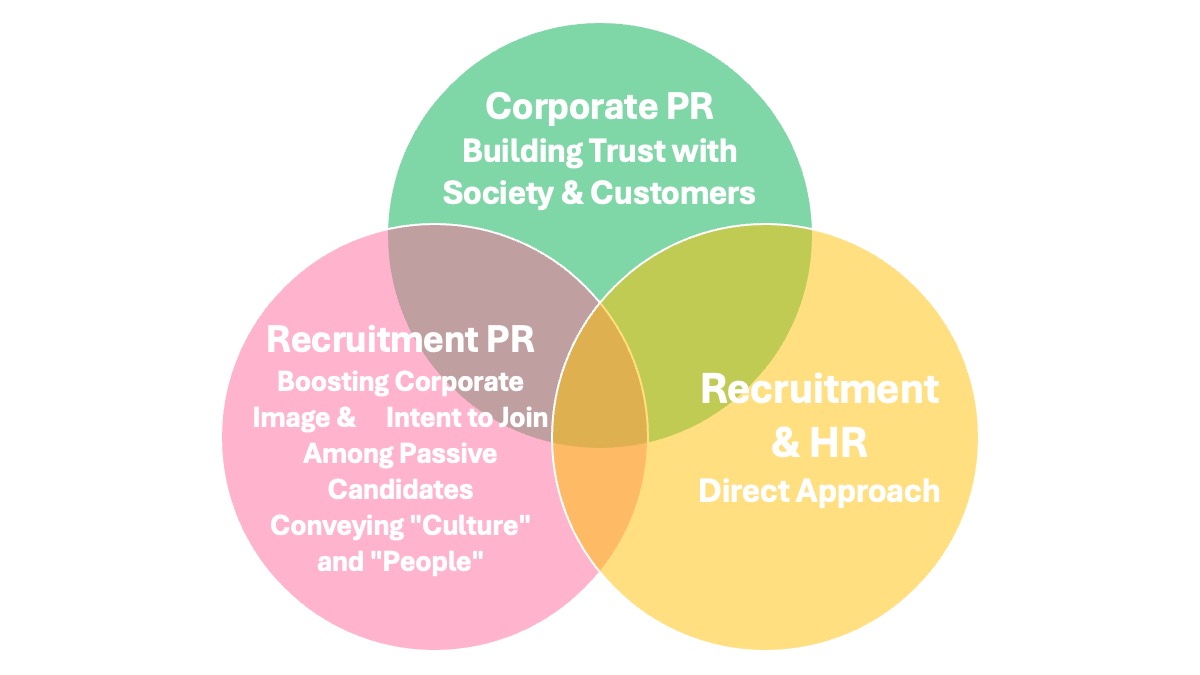
Recruitment PR has a distinct positioning that differs from traditional job advertising and general corporate PR. Here, we will整理 the differences and the unique characteristics of recruitment PR.
[Related Article] What Is Corporate PR? Explaining the “Attitude” and “Stance” Needed to Earn Trust and Support from Society! « Column
Initiatives That Deepen Company Understanding—Unlike Job Ads
The foundation of recruitment PR is communicating the company’s inner qualities—things that cannot be conveyed through job ads that focus only on conditions such as salary and working hours. For the talent you ideally want to attract, proactively share externally what kind of company you are and what kinds of people actually work there, including your culture and employees’ authentic voices. Examples include employee interviews on owned media and content creation and distribution on official social media and note. By continuing these “initiatives that deepen company understanding,” you play an important role in attracting people who resonate deeply not only with conditions but also with your values and culture, and in preventing mismatches after joining.
A Communication Initiative Positioned Between PR and Recruitment
Recruitment PR is a branding/communication initiative positioned between general “corporate PR” and “recruitment (HR) activities.” While corporate PR primarily aims to enhance corporate value (products, performance, business alliances, etc.) for customers and investors, the target of recruitment PR is job seekers. Unlike HR activities that manage the selection process and directly approach applicants, recruitment PR places emphasis on “improving the company image” and “cultivating empathy” through information dissemination. A key feature is aligning PR’s ability to communicate with the hiring side’s desired candidate profile, linking the two to create synergy between “HR” and “PR/communications.”
A Mid- to Long-Term Initiative to Create Touchpoints with the Passive Talent Pool
Another important aspect of recruitment PR is creating touchpoints not only with the “active” segment currently considering a job change, but also with the “passive” segment that could become future candidates. If you only place ads on job boards, your reach will be centered on people currently job hunting. However, if you continue to share your company’s appeal on a daily basis through blogs, social media, and owned media, it can prompt interest from people who think, “I’m not planning to change jobs right now, but this company seems interesting.” It is also a mid- to long-term investment aimed at improving the company image from a long-term perspective, building momentum, and ensuring you are recalled as a “top choice” when the person eventually considers changing jobs.
Why Recruitment PR Is Needed
In recent years, many companies have begun working on recruitment PR. Behind this is a societal shift in which securing talent has become difficult with conventional recruitment methods alone. Here, we整理 three key backgrounds and factors explaining why “recruitment PR” is receiving so much attention today, and provide a detailed explanation.
| Background | Drivers of Change | Impact on Recruitment |
|---|---|---|
| Difficulty Differentiating | Job boards tend to lead to comparisons of salary and conditions | Growing need to communicate unique appeal without falling into a conditions-based competition |
| Diversification of Values | Job seekers increasingly prioritize “job satisfaction” and “culture” | Growing importance of transparently communicating the company’s inner qualities and real 모습 |
| Intensifying Competition for Talent | A persistent seller’s market due to structural labor shortages | Increasing importance of approaching passive candidates and building awareness in the industry through mid- to long-term company image improvement |
It Is Hard to Differentiate Through Job Boards Alone
Until now, the mainstream approach to recruitment has been a “wait-and-see” method: posting job requirements on job boards (navigation sites, etc.) and waiting for applications. However, on these platforms, character counts and formats are limited, and comparisons tend to become uniform based on “working conditions” such as salary, location, and benefits. Startups, SMEs, and BtoB companies that cannot easily rely on financial power may be overlooked before they even catch job seekers’ attention, even if they have unique strengths or attractive business development. The fact that differentiation has become difficult through presenting “conditions” alone is one major reason recruitment PR—where you can freely communicate your story and strengths—is increasingly needed.
Reference: Survey on Recruitment Activities at Companies’ Regional Bases
We Are Now in an Era Where Company Culture and Employees’ Voices Are Visible
Job seekers’ values toward work have diversified, and selection criteria now include not only “high pay” but also elements such as “social significance (purpose),” “flexible ways of working,” and “a culture that suits me.” Before applying, job seekers increasingly check a company’s social media, owned media, review sites, and more in detail, and may verify in advance: “What is the meaning of working at this company?” “Does it match my values?” and “Is there any gap between official information and reality?” Companies are expected to communicate transparently—not only the positive aspects, but also the challenges of the work and the issues that must be overcome—sharing the real 모습 of the culture and the workplace without hiding anything. This not only encourages motivation to join, but also serves as a filter to prevent mismatches (early turnover) caused by “it wasn’t what I imagined” after joining.
Competition for Talent Is Intensifying, Making Awareness Building Essential
Due to structural labor shortages associated with a declining birthrate and aging population, the recruitment market has become a “seller’s market” in recent years, and competition among companies to secure talent is intensifying. Targeting only the “active” segment already job hunting is not enough to build a sufficient candidate pool. To ensure job seekers recall your company—thinking “I’ll try applying to that company”—when they consider changing jobs, it is important to approach passive candidates on a daily basis and build awareness in advance. Mid- to long-term awareness-building efforts—“first, get people to know the company and improve the company image”—through media exposure and communications on social media and note, etc., have become a key differentiator in recruitment.
Common Pitfalls in Recruitment PR
While recruitment PR offers many benefits, starting without specialized know-how can often lead to limited results. Here, we整理 the challenges companies tend to overlook when working on recruitment PR, and three common pitfalls.
| Pitfall | Common Situation | Negative Impact on Recruitment |
|---|---|---|
| Focusing Only on Explaining Systems | It becomes a list of job requirements and benefits | You cannot differentiate from other companies, and empathy for the company culture does not emerge |
| Insufficient Articulation of Internal Appeal | The company page is filled with typical employee interviews, but job seekers cannot imagine “what kind of people they would work with” or “what value they could deliver at that company” | The real atmosphere and unique strengths that job seekers want to know do not come across |
| One-Off Communications | Updates happen only when there is news, and continuous operation is not possible (no regular posting / no updates for three months when you check the publish date, etc.) | Awareness in the industry and the company image do not accumulate, and it does not lead to trust-building as recruitment branding |
Explaining Systems Alone Does Not Convey Appeal
Even after starting recruitment PR, some companies end up publishing content that is merely an extension of job boards. Even if you share only explanations and lineups of “conditions” and “systems” such as salary, leave policies, and benefits on blogs or social media, it is difficult to move job seekers. What job seekers want from recruitment PR content is not whether systems exist, but the real picture: “How employees actually use them and what kind of work style they have,” and “What value I could deliver in that environment.” If you stop at explaining conditions, your unique culture will not come across, making it difficult to differentiate from other companies.
Your Internal “Normal” Has Not Been Put into Words
Even if you want to communicate your company’s appeal, some companies may think, “We don’t have any special strengths we can highlight.” However, it may not be that you have no strengths—rather, unexpected appeal may be hidden within the “normal” things you do not notice from the inside. For example, a culture such as “no barriers between departments and an atmosphere where it is easy to ask anyone questions,” or “a management philosophy that encourages challenges without fear of failure,” may feel normal to insiders, but can appear highly attractive to external job seekers who feel similar bottlenecks in their current jobs. Try to maintain an objective perspective and be mindful of the process of carefully putting into words the real voices from the workplace and the everyday moments within the company.
[Related Article] What Is Internal Branding? Explaining Objectives, Benefits, and How to Proceed with Success Stories « Column
One-Off Communications Do Not Improve the Company Image
Results from recruitment PR do not appear immediately; efforts from a mid- to long-term perspective are required. However, if you start without securing operational resources, you may fall into one-off communications such as “publishing only the first few articles and then stopping updates” or “only running social media during periods when recruitment becomes active.” If communications end as one-offs, they will not stick in job seekers’ memories, and awareness and trust in the company will not build. Social media accounts and blogs left unattended with sporadic operation can instead give job seekers negative impressions such as “their management system is weak,” “they are not serious about hiring,” or “there may be other issues.” View recruitment PR as an investment to build a future “recruitment asset (brand),” and aim to create a structure that enables continuous communications.
Characteristics of Companies That Should Strengthen Recruitment PR
If you face challenges such as the following, strengthening recruitment PR is effective.
• You receive applications, but the right-fit talent does not gather
• Your company’s appeal and culture are not being communicated effectively
• You cannot differentiate through job boards alone
• Recruitment communications end as one-offs
Recruitment PR is an initiative that creates a state where you are chosen not for “conditions,” but for “empathy.”
What You Can Consult SUNNY SIDE UP About
At SUNNY SIDE UP, we support recruitment PR not as “information dissemination,” but as “empathy design.”
• Concept design and articulation aligned with your recruitment persona
• Communication design for employee stories and company brand culture
• Integrated design across owned media, social media, and media exposure
• Content planning that deepens job seekers’ understanding and improves application quality
We support “PR design that leads to hiring results,” not mere exposure.
Recruitment PR is not only about posting on job boards; the key differentiator in securing talent that fits your company is whether you can deliver your values and the real stories of the people who work there within a context that fosters empathy.
• “We get applications, but few candidates fit our culture”
• “We cannot create reach with only one-off employee interviews”
• “We want to deliver our appeal to passive candidates as well”
If this resonates with you, please feel free to contact us.
How to Proceed with Recruitment PR
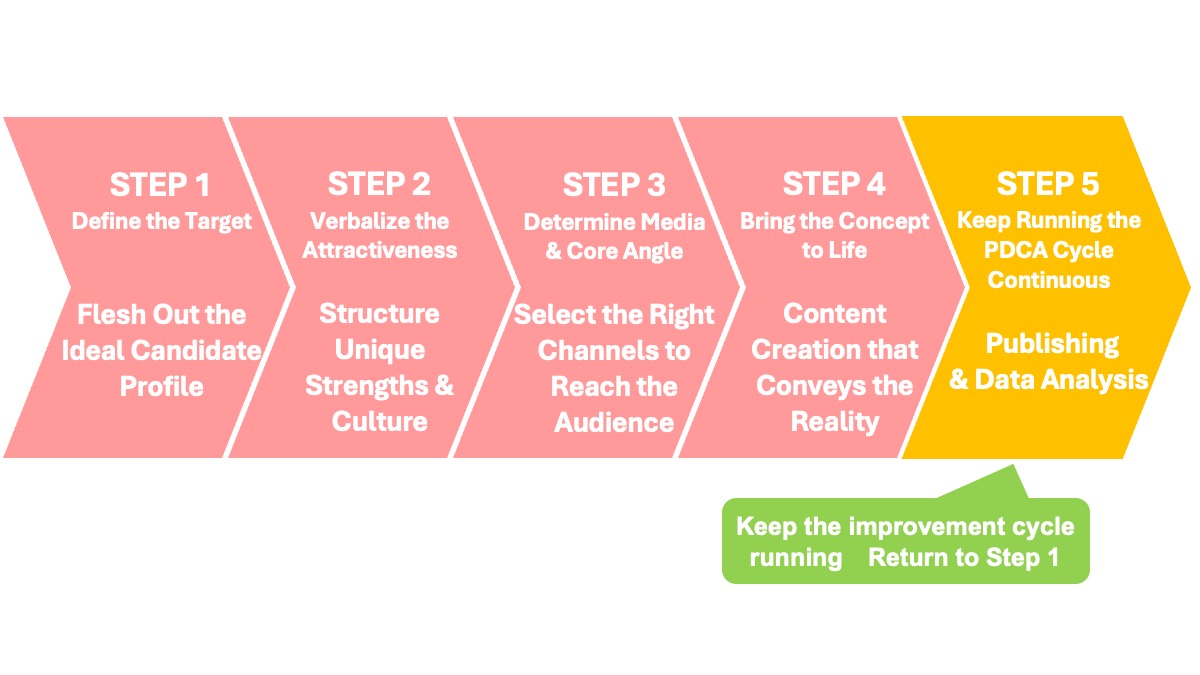
If you are starting recruitment PR, following strategic steps is the shortest path to success. Starting with clarifying the desired candidate profile, then organizing your company’s appeal, choosing the right channels, and continuing communications and improvements—we explain how to effectively advance recruitment PR through five concrete steps.
Define Your Recruitment Persona and Communities to Solidify the Candidate Profile
The first step is to set your target profile in detail by defining your “recruitment persona and communities.” In addition to basic information such as age and work history, articulate specifics such as values toward work, future goals, and even the “communities they typically belong to” (technical communities, specific industry networks, etc.). By increasing the resolution of your target, you can improve the precision of content creation and the resulting KPI metrics by clarifying who you should communicate to and what information you should share.
Organize Your Company’s Appeal and Culture
Next, identify your unique strengths that competitors do not have and organize the culture that forms the foundation of your company. It is important to create a “core message” that becomes the reason job seekers choose your company among many. In addition to your management philosophy, it is also recommended to survey employees working on the front lines and ask: “Why do you work at this company?” “What skills can you develop here?” and “Where are we lacking?” Appeal may be hidden in what has become “normal” for insiders. Gather unembellished, real voices and put into words a culture that is true to your company and can attract highly motivated job seekers.
Decide Your Communication Themes and Channels
Once your message axis is set, decide “what themes” you will communicate and “which channels” you will use to deliver them. Based on hypotheses about which social media and media platforms job seekers in your industry use for daily information gathering, communicate and run the PDCA cycle. User demographics differ by platform—for example, business audiences at BtoB companies may use platforms specialized in career development and building business connections. Rather than opening every account comprehensively, it is recommended to choose channels aligned with the behavioral characteristics of the personas and communities you defined at the outset. If resources are limited, first narrow down to the single channel that best fits your culture, decide the themes to communicate (ways of working, technical capabilities, social contribution, etc.), and begin operations.
Translate Employees, Systems, and Business into Job-Seeker-Friendly Content
After deciding channels and themes, you will finally move into content creation. Use hooks that job seekers will want to read (or watch) to translate your organized appeal into concrete forms. Rather than simply extending job requirements, communicate through diverse angles such as “interviews with high-performing employees” and “behind-the-scenes of the project team driving a new business.” By also turning real struggles—such as the obstacles you face and how you overcome them—into content, job seekers can consider “what value I could deliver if I joined that environment,” which helps increase their understanding of the company.
Operate Continuously and Improve
In recruitment PR, one of the most important—and difficult—elements is “continuity.” Set a posting frequency that your company can sustain without strain (e.g., several times a month), and establish an operating structure with continuity as the primary goal. In addition to simply continuing to publish, regularly analyze responses to your content (sessions, user engagement on social media [likes and shares], contribution to actual applications, etc.). Use data to understand “which themes resonated with the target” and “which content tends to lead to drop-offs,” and refine your content and communication methods little by little while running the PDCA cycle. These accumulated efforts gradually shape your recruitment brand and increase the number of people who want to work at your company.
How Recruitment PR Changes When You Add a PR Perspective
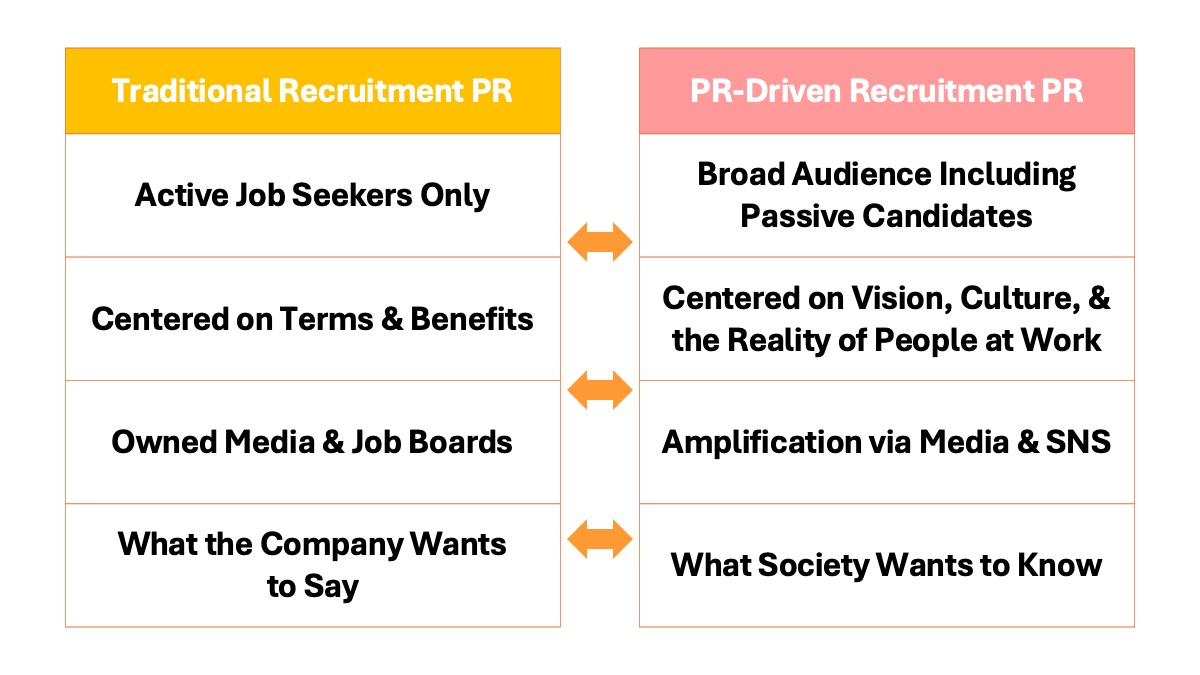
By incorporating a PR perspective into recruitment PR, you can deliver your company’s appeal to job seekers more three-dimensionally and effectively. Here, we summarize the differences between conventional recruitment PR and recruitment PR that incorporates a PR perspective.
| Comparison Item | Conventional Recruitment PR | Recruitment PR Incorporating a PRPerspective |
|---|---|---|
| Primary Target Segment | Active job changers (people looking for a new job immediately) | A broad segment including passive job changers (can expand the business pie) |
| Main Information Communicated | Conditions such as job requirements, salary, and benefits | The company’s mission, unique culture, people who work there, and social significance |
| Communication Channels | Your recruitment site and paid job boards | Third-party communications via media platforms and social media |
| Perspective of Communications | Company perspective (communicate what the company wants to say) | Societal perspective (provide information society is seeking now) |
You Can Put Your Company’s Appeal into Words from a Third-Party Perspective
With a PR perspective, you can reframe systems and culture that feel “normal” within your company as appealing strengths from the outside. Strengths that are hard to notice from within an organization become easier to express in words when aligned with societal interests and job seekers’ perspectives. As a result, you can naturally deliver messages that feel convincing.
You Can Expand Awareness Through Media Platforms (e.g., note) and Social Media Amplification
By sharing your recruitment information on media platforms such as note, you can reach audiences you previously had no touchpoints with through search and recommendations. Articles that resonate with readers are also more likely to spread on social media, and your recruitment brand will begin to be discussed in third-party contexts. This is a key strength of PR-perspective communications: you can naturally expand company awareness to a broad range of candidates, including passive job changers, without relying on advertising spend.
[Related Article] What Is a Media Strategy in PR Activities? How to Think About “Information Design” That Does Not End with One-Off Exposure « Column
You Can Design Stories That Also Reach Passive Job Changers
By communicating as a brand story, you can also reach passive job changers who think, “I’m not considering changing jobs now, but I would like to know about good companies.” Sharing day-to-day ways of working and the background behind challenges gradually builds interest and curiosity. These accumulated efforts become the foundation that, in the future, leads to applications from job seekers with strong motivation to join.
Benefits of Outsourcing Recruitment PR to a PR Agency
Many companies choose not to complete recruitment PR solely in-house, but to outsource it to an external specialist—a PR agency. With PR and communications professionals involved, you can expect improvements in the quality of initiatives, from strategy development to execution. Here, we explain the benefits of incorporating the perspectives of specialist firms.
| Operating Structure | Advantages | Disadvantages |
|---|---|---|
| In-House Operation | • Smooth internal information gathering, reducing outsourcing costs • Easier to create synergy between HR and PR/communications |
• Objective perspective can be lacking, and planning can become repetitive • Time and human resources for operations tend to be insufficient |
| Outsourcing to a PR Agency | • You can leverage professional PR and communications know-how and expect high-quality, effective communications • For companies with limited coordination between HR and PR/communications, having a third-party specialist in between makes it easier to organize information |
• Ongoing costs will be incurred to outsource to external specialists |
You Can Organize Recruitment Branding from an External Perspective
Based on experience supporting communications across various industries, PR agencies can calmly analyze your company’s current situation from an external perspective. They can also uncover strengths that are easy to overlook internally and refine them into messages that clearly differentiate you from competitors.
You Can Design Communication Plans That Are Hard to Create In-House
When conducting recruitment PR in-house, planning often skews toward certain patterns such as employee interviews. PR agencies are well-versed in the latest trends and angles that media journalists prefer, enabling them to design communication plans from fresh perspectives. This also makes it easier to create opportunities to attract interest from audiences you previously could not reach.
Do Not Let Recruitment PR End as “Just Content Production”
A common trap many companies fall into is feeling satisfied simply by publishing content on their owned media. PR agencies carefully calculate the pathways for information amplification—how to deliver the created content to as many people as possible. Rather than treating content production as the goal, they play a role in connecting it to hiring outcomes by linking information provision to media and social media strategies.Another major advantage that you cannot achieve in-house is having strong relationships with multiple specialist publications.
Recruitment PR is not merely information dissemination; it is “a design to create empathy and meet talent that fits your company.”At SUNNY SIDE UP, we support articulating your company’s appeal and communicating it in a way that reaches job seekers.
“We want to meet talent that fits our company”
“We want to strategically strengthen our recruitment PR”
If this resonates with you, please contact us. Our staff will respond carefully to inquiries at any stage.
Conclusion: The Key to Recruitment PR Is “Translating What Makes You You.” Secure High-Intent Talent That Fits Your Company
The key to successful recruitment PR lies in “translating what makes your company you”—re-examining the “everyday appeal” within your organization from an objective perspective and converting it into a context that resonates with society and job seekers. By moving beyond comparisons based solely on conditions and communicating your vision and the real culture on the ground candidly, you can attract talent aligned with your values. In addition, it is essential not to end with one-off efforts, but to continue communicating over the mid to long term as a story that incorporates a PR perspective. If you find articulation challenging, leverage the perspective of external specialists as well, and aim for recruitment that connects through empathy.