How to Maximize Results with Owned Media: Balancing Traffic Growth and Lead Generation from a PR Perspective
- カテゴリ:
Many companies want to establish their own customer acquisition mechanisms without relying too heavily on advertising. In recent years, customer interests have become increasingly segmented, and information-gathering methods have expanded significantly, making it harder to reach audiences through traditional mass marketing alone. Owned media is increasingly being utilized to achieve continuous growth with customers.
This article provides detailed explanations of the steps for launching owned media and key design points, along with unique distribution strategies incorporating a PR perspective. It covers specific design points for achieving end-to-end results—from building trust with customers to generating inquiries (or purchases)—not just increasing access.
Why Owned Media Has Become a Critical Corporate Initiative
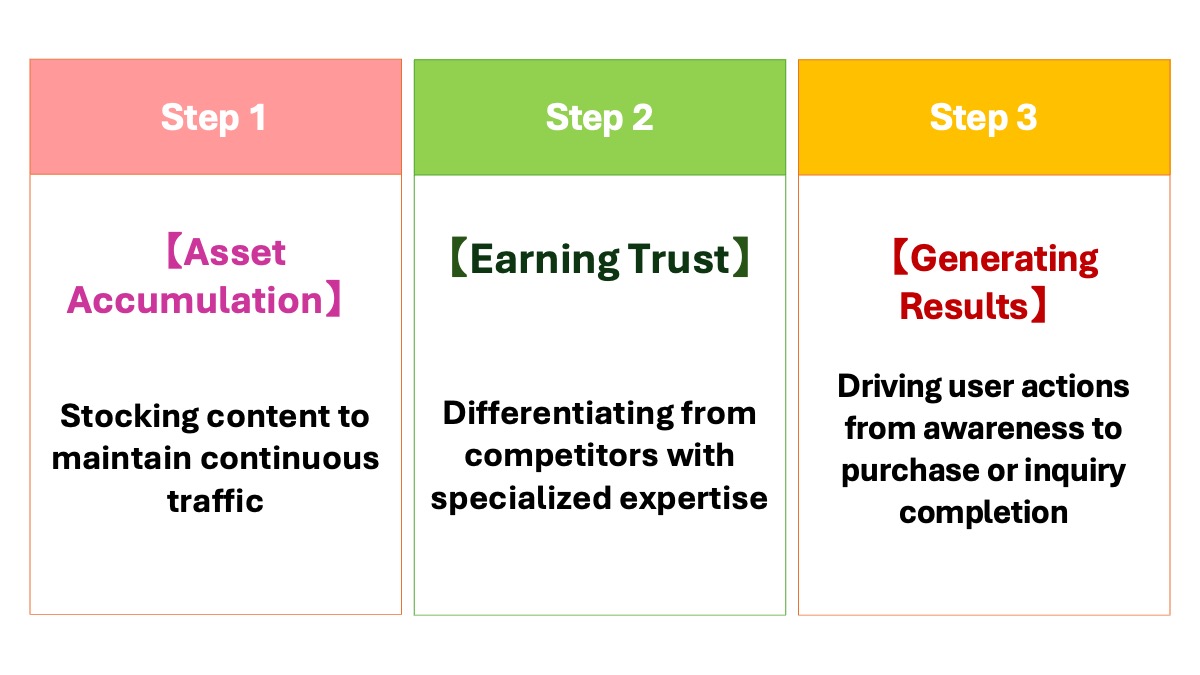
The reason companies position owned media as a critical initiative lies in the advantage of building a sustainable customer acquisition foundation through flexible communication of what they want to convey via SNS and physical stores. Here, we organize the main purposes and expected effects of operating owned media.
Reference: Ministry of Internal Affairs and Communications | 2023 White Paper on Information and Communications | Internet
Related Article: What is Corporate PR? Explaining the “Attitude” and “Stance” for Being Trusted and Supported by Society! « Column
Because It’s an “Asset-Based Initiative” That Accumulates Search Traffic and Leads to Prospect Acquisition
One major characteristic of owned media is that published articles accumulate as “assets.” Unlike short-term advertising (flow-based initiatives), as a stock-based initiative, accumulating high-quality content can lead to sustained and increased traffic from search engines over the medium to long term if managed well. Once created, articles do not incur costs each time a campaign is run, as with advertising, and continue to contribute to customer acquisition after publication. By continuously providing solutions to readers’ concerns and questions, stable prospect acquisition (lead generation) can be expected at low cost.
Because You Can Convey Your Company’s Expertise to the Comparison and Consideration Audience
Users tend to conduct their own comparisons and considerations before purchasing products or adopting services. In such cases, having owned media that shares the latest industry trends, trending products and services, advanced technical explanations, and specialized know-how becomes a significant advantage. By providing in-depth information from a professional perspective beyond just feature introductions, you can help readers recognize that “this company is knowledgeable,” “there are trustworthy points,” “I can gain new insights,” and “the product is customer-focused.”
Because It Connects End-to-End from Awareness, Trust Building, to Inquiry Generation
Owned media is one of the most cost-effective initiatives that can aim for everything from “awareness” among those who don’t yet know your company, to “trust building” through articles, and finally to “inquiries (CV).” You can design a customer journey that provides valuable information to users who arrive via search, builds trust, and then guides them to actions such as downloading whitepapers or making inquiries. Because you can provide appropriate information tailored to the user’s state at the right timing for your company, it leads to results while preventing churn.
Benefits Gained from Owned Media
The benefits of operating owned media extend beyond temporary customer acquisition to broad business contributions. Here, we explain the strengths of owned media compared to web advertising.
| Comparison Item | Owned Media | WebAdvertising |
|---|---|---|
| Cost Nature | Stock-based, centered on production and operation costs | Flow-based, according to placement media and advertising distribution volume |
| Effect Sustainability | Effective for medium- to long-term accumulation | Effective for increasing short-term volume |
| Information Depth | Can convey desired content in detail without certain restrictions | Limited to each format’s tone and manner within set frames, such as image size, video length, and character count |
Benefit 1: Build a Continuous B2B or B2C Approach Foundation Without Dependence on Advertising Costs
By increasing organic traffic from search engines, you can potentially reduce dependence on web advertising step by step. If you continue to publish high-quality article content on the internet at a consistent frequency, it becomes your company’s “asset” that continues to create touchpoints with users over the medium to long term. Whether it’s lead generation in B2B (business-to-business transactions), new customer development in B2C (general consumers), or elevating them to loyal customers, it leads to building a customer acquisition foundation that can continuously approach target audiences regardless of their attributes.
Related Article:What is Media Strategy in PR Activities? The Concept of “Information Design” That Doesn’t End with One-Time Exposure « Column
Benefit 2: Deeply Convey Your Company’s Strengths and Philosophy
Because owned media has no detailed restrictions on character count or expression, you can more flexibly convey your company’s specialized know-how, unique strengths, and business philosophy to users. By publishing specialized knowledge and the latest industry information, you can expect improved social trust in your company. For example, if a tax accounting firm publishes articles that explain complex tax procedures in an easy-to-understand manner, it creates an opportunity for readers to feel “I should consult this company about this field.” As a result, the barriers to inquiries and purchases may naturally lower. By utilizing it as a place to prove expertise while carefully explaining the background of development and how it will change the lives of customers beyond the company, understanding of your company’s essential value deepens, and you can expect the effect of becoming less likely to be caught up in mere price competition.
Benefit 3: Create Touchpoints with Latent Audiences That Sales Materials Can’t Reach
Direct sales activities and service introduction materials alone tend to focus on approaching the “manifest audience” who are already considering adoption. However, with owned media, you can also create touchpoints with the “latent audience” who haven’t yet clearly recognized their own issues or have just begun searching for solutions. Through helpful articles and know-how explanations that solve users’ everyday questions and concerns, you can naturally create touchpoints from the initial stage. If you can build relationships by providing useful information tailored to each customer stage, it will become an opportunity to nurture them into future high-value customers (lead nurturing).
Common Failures in Owned Media
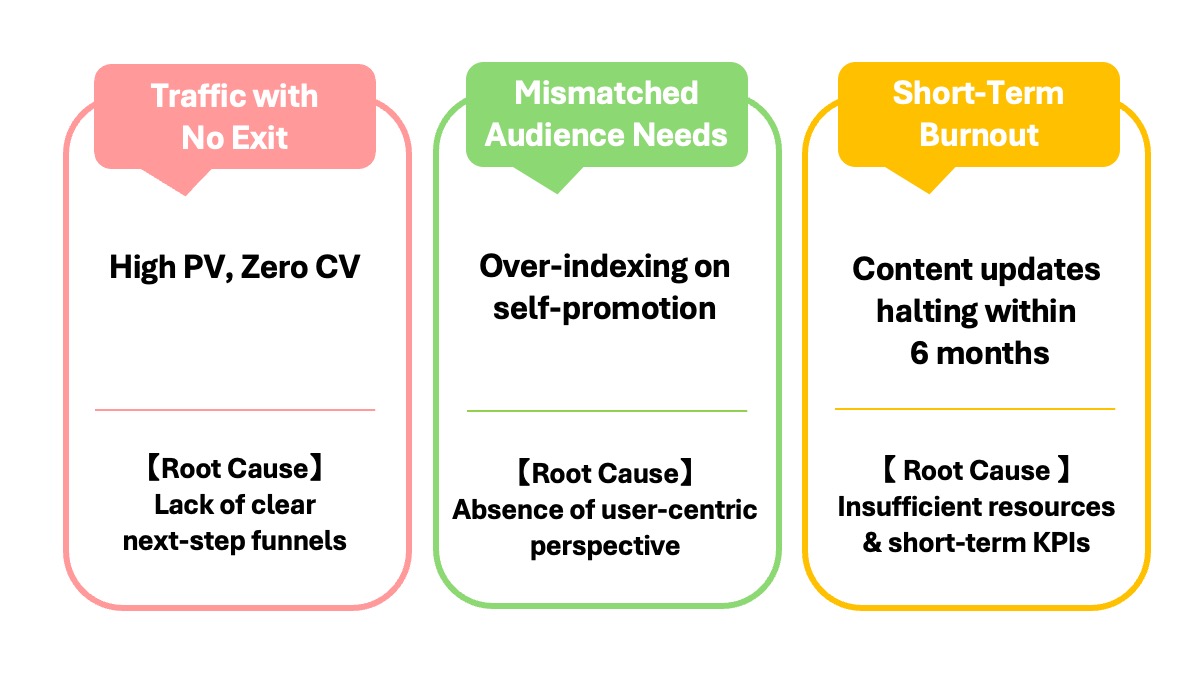
While owned media has many benefits, there are also cases where companies fail to achieve expected results by starting with insufficient strategy or structure. Here, we explain typical failure patterns that are easy to fall into when operating owned media.
Traffic Increases but Doesn’t Lead to Inquiries
This is a failure case where companies focus only on increasing access numbers (PV) and fail to connect to the original purpose of prospect acquisition (lead generation) or inquiries. Even if you attract many people from search, if the funnel design for “next actions (such as requesting materials, newsletter registration, inquiries)” after reading articles is not done well, users are likely to leave immediately after reading. Also, if you’re acquiring customers with trend keywords completely unrelated to your company’s services, misalignment with the target audience occurs, making it difficult to lead to conversions.
Themes Become Company-Centric and Misalign with Search Needs
This is a case where companies prioritize only “what the company wants to convey” or “product information they want to promote,” deviating from the concerns and questions users are actually searching for (search needs). The protagonist of owned media is always the reader (user). If you create only self-centered articles with strong sales pitches or excessive use of technical terms because you want to appeal your company’s strengths, reader bounce rates will increase. Because it also becomes difficult to be evaluated by search engines, it’s necessary to design content prioritizing “information readers are seeking” based on sufficient keyword research.
Post-Publication Improvement Operations Don’t Continue and Results Plateau
This is a case where the means of creating content becomes the end itself, and subsequent effectiveness verification, rewriting (improvement), and continuous article production cease. “Lack of prior awareness regarding time and resources” is also greatly involved in the background. Owned media generally requires about six months from launch until it’s properly evaluated by search engines. Because there tends to be a period initially when it’s difficult to directly connect to sales, there’s a risk of the effectiveness being questioned at that point. Additionally, continuing to write high-quality articles requires time and effort. Considering these circumstances, it’s important to share in advance with internal stakeholders that “this is a medium- to long-term initiative.” Additionally, it’s important to build a sustainable operation and improvement structure, such as incorporating media management into the business objectives of on-site employees.
Thinking to Enhance Owned Media Results from a PR Perspective
To further enhance owned media results, we recommend a strategy that incorporates not only SEO (search engine optimization) but also a PR (public relations) perspective. Rather than just creating articles and waiting for search traffic, it’s more effective to proactively generate buzz and implement leveraged initiatives aimed at information dissemination. Here, we organize the thinking and specific initiatives to maximize media value from a PR perspective.
| PR × Owned Media Strategy Direction | Specific Initiative Examples | Expected Ripple Effects |
|---|---|---|
| Utilizing Public Interest | Publishing original research tied to trends and social issues | Initial awareness acquisition through various media coverage |
| Design Premised on Dissemination | Creating easy-to-understand catchphrases and shareable infographics | SNS dissemination beyond own platform |
| Connection to Branded Search | Implementing campaigns that encourage UGC (user reviews) | Trust acquisition through third-party recommendations and increased branded searches (user words spread digitally, replacing advertising) |
[Related Article]What is a PR Strategy? Explaining the Planning Process to Create Trust and Value Beyond Advertising « Column
Plan Based Not Only on Search Intent but Also “Public Interest”
What’s important when operating owned media from a PR perspective is starting with the element of “capturing public interest and turning it into a plan.” While the SEO perspective of responding to users’ current concerns (search intent) is also important, that alone may cause you to be buried among competitors’ content. Therefore, combine “themes the world is currently paying attention to,” such as social trends and current issues, with “your company’s expertise.” For example, we recommend the method of turning original research reports related to social concerns into articles and distributing them as press releases. By being picked up by news media and industry publications, even during the early launch period when search traffic is low, you can attract public interest and easily generate significant access and awareness in a short period.
Related Article:What is a Press Release? Explaining Strategies and Utilization Tips to Enhance PR Effectiveness! « Column
Design Themes Premised on Media and SNS Dissemination
Owned media content should be designed from the start with the premise that it will be “disseminated (shared) on external media and SNS,” not just “viewed and finished on your own site / read and finished.” To approach latent audiences who don’t have search intent, dissemination of information through SNS is considered effective. We recommend incorporating devices in advance that encourage readers’ “voluntary sharing,” “empathy / saving,” and “following,” such as including elements in articles that seem likely to solve issues readers are likely to feel, or creating infographics that explain difficult text in an easy-to-understand manner. Content that incorporates unique perspectives tends to spread easily on SNS, creating new touchpoints that aren’t affected by changes in search algorithms.
Design Funnels That Increase Branded Searches and Comparisons
After information is disseminated, to ultimately connect to your company’s business results, you need to properly design funnels that guide users who read articles to “branded searches (searches by company or service name)” or “comparison and consideration.” The key point here is creating UGC (reviews and generated content by general users). By setting up experiential content for readers on the web, preparing questions for readers at the end of articles, or providing easy-to-implement know-how to encourage “I actually tried it” reports / emotional sharing on SNS, you create opportunities to generate quality UGC. The final goal of owned media with a PR perspective is to create a virtuous cycle where other users who see it become interested in your company, conduct branded searches, and begin deeply comparing and considering services.
Owned media has changed to an era where it spreads not just by gathering search traffic but through “buzz creation” and “empathy.”
At SUNNY SIDE UP, we support “PR-perspective owned media utilization” from proposal planning to operation, including content design that makes people want to share, starting from SNS and video platforms, and design that looks ahead to UGC and media exposure.
- “We’re creating articles, but they’re not being disseminated (remaining as single article initiatives)”
- “We can’t design communication linked with SNS and video”
- “We want to connect buzz creation to inquiries”
If you’re thinking this way, please consult with us.
Design Points for Connecting Owned Media to Inquiry Generation
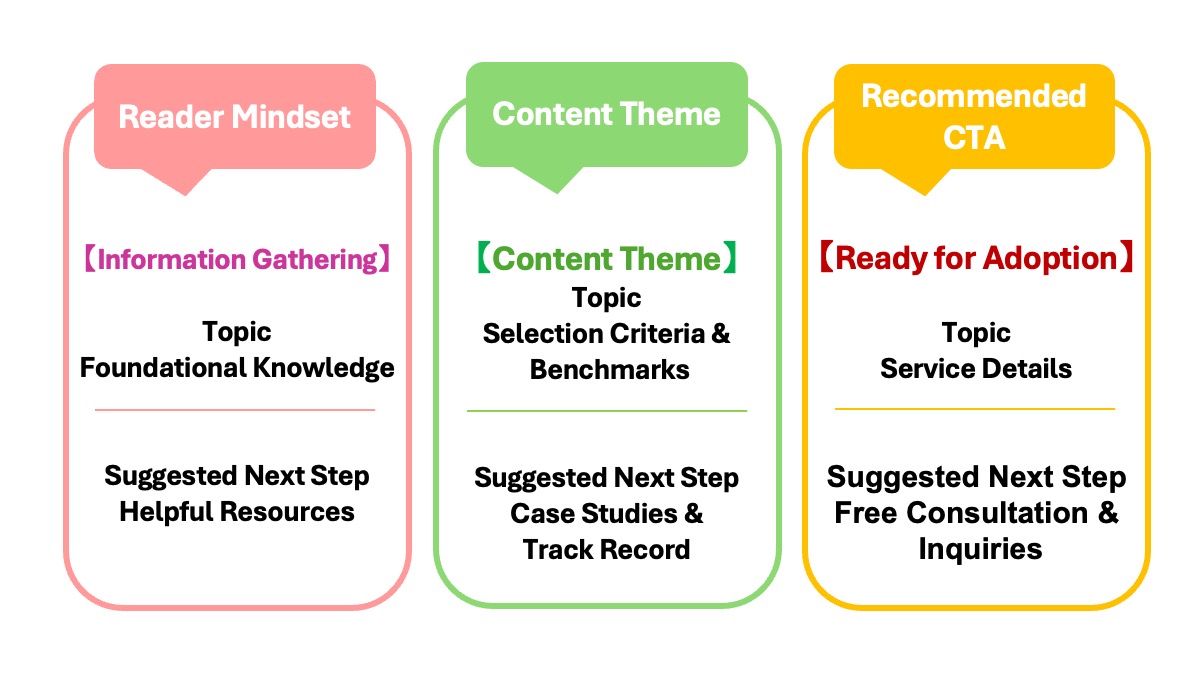
To succeed with owned media, simply gathering access numbers is insufficient. Strategic funnel design is required to reliably guide gathered readers to inquiries. Here, we explain three specific design points for maximizing inquiry generation.
Separate CTAs into “Material Requests, Consultations, and Case Studies”
The funnel that prompts users to take the next action after viewing owned media content is the CTA (Call To Action). Not all readers are immediately seeking direct consultation, so avoid uniform guidance. Prepare multiple options tailored to readers’ levels of interest. For readers still in the information-gathering stage, encourage easy-to-download helpful material requests; for readers whose consideration has progressed a bit further, encourage viewing of specific implementation case studies. For readers whose concerns are already clear, we also recommend placing funnels to free consultations or inquiries.
Separate Themes That Convert Easily from Those That Don’t
Depending on content themes, ease of connection to CV (conversion: final results such as inquiries) varies. In owned media utilization, aiming for direct inquiries with all content is not very efficient. It’s important to understand the nature of searched keywords and design with clearly separated roles. Specific service names and keywords like “comparison” and “how to choose” tend to convert relatively easily. On the other hand, themes seeking basic knowledge like “what is~” tend not to lead immediately to inquiries. From articles with themes that don’t convert easily, first aim to build relationships with users by guiding them to related material downloads.
Place Implementation Cases, Track Records, and Support Scope in Close Proximity
After readers gain valuable information from owned media articles, what they’re likely to consider next is “whether to request from this company.” Therefore, we recommend placing information that increases trust in locations easily visible to readers, such as at the end of content or in sidebars. Specifically, these three: “past implementation cases,” “track record to date,” and “support scope.” Ideally, at the timing when interest is heightened after experiencing content, track records and coverage scope are presented nearby. Providing a sense of security that “they seem likely to solve our company’s issues too” will be the final push toward inquiries. To smoothly advance readers’ consideration, placing related information nearby makes it easier to proceed to the next consideration.
Five Steps to Succeed with Owned Media
To launch owned media and get it on track to produce results, we recommend following the correct steps to solidify the strategic foundation. Haphazard management may lead to losing sight of objectives midway and failing. First, understanding the following flow makes it easier to proceed.
| Steps to Execute | Overview of Activities | State to Achieve |
|---|---|---|
| 1. Purpose and KPI Definition | Clarification of media’s final goal and intermediate indicators | Management axis is established and decision criteria don’t waver |
| 2. Target and Needs Organization | Improving resolution of target audience and understanding search intent | “To whom” and “what” should be delivered becomes clear |
| 3. User Journey Design | Visualization of user psychology from awareness to CV (results) | Content needed at each phase is comprehensively covered |
| 4. Operation Structure Construction | Role allocation and rule formulation to cycle from production to improvement | By verbalizing tone and manner and keeping it as internal data, continuous media operation becomes possible |
| 5. Analysis and Funnel Improvement | Data-based optimization of site structure and internal funnels | Not just access, but actual results (CV) improve |
Step 1: Define Purpose and KPIs
The first step in media management is to clearly define “why we’re doing owned media (purpose)” and “how to measure it (KPI).” Depending on the purpose—”lead (prospect) acquisition,” “recruitment strengthening,” “branding,” etc.—the numbers to track differ. Rather than just pursuing PV (page view) numbers, set specific KPIs directly connected to business results, such as whitepaper download numbers, newsletter registration numbers, and inquiry numbers. The clearer the goal setting, the less likely subsequent content planning and management policies will waver.
Step 2: Organize Target Communities and Search Intent
Once the purpose is decided, organize the recipients of information (communities) and the concerns they have (search intent). If the target is just vague attributes like “20s sales professionals,” reach to the target audience will also weaken. Verbalize with as high resolution as possible what walls they hit in daily work and what solutions they seek when typing words into the search box. If you can identify search intent that fits a specific person or specific community, it becomes easier to plan highly specialized content that differentiates from competitors.
Step 3: Design User Journey
Once targets and search intent are visible, predict the psychology (insights) and behavioral changes of users until they use your company’s services, and structurally visualize them as a “user journey.” Place keywords users are likely to search for each process, from the “awareness / latent audience” stage of recognizing issues to reaching the “comparison and consideration audience” through information gathering. Having this blueprint reduces information gaps across the entire media, thus increasing comprehensiveness. Also, because you can present appropriate content according to users’ behavioral changes, it becomes easier to smoothly connect to the next action.
Step 4: Decide Production, Publication, and Improvement Structure
To give form to strategy, building a working team that regularly posts content to owned media is necessary. Centered on a person in charge who manages overall quality, clearly allocate roles such as planning, production, publication work, and effectiveness measurement. If resources are insufficient internally alone, we recommend actively considering utilizing external partners such as specialized writers, SEO consultants, and PR firms for buzz creation. Determining workflows in advance, such as how many articles to produce monthly and who conducts final checks, prevents work from becoming dependent on specific individuals and is the turning point for creating a structure that can continue improvement cycles without strain.
Step 5: Conduct Structure and Funnel Improvements While Monitoring Numbers
Content doesn’t end with “publication.” To achieve objectives (KPIs), repeatedly improving site structure and funnels while observing actual reader reactions is required. Utilize analysis tools like Google Analytics to analyze with objective data “which content is being read well” and “where users are leaving.” If there’s access but it’s not connecting to inquiries, review CTA (call to action) text positions and button placements within articles, or organize internal link structures that circulate to highly related content groups—conduct site-wide funnel improvements. Regular tuning is important for achieving KPIs.
Benefits of Requesting Owned Media from a PR Firm
When seriously advancing owned media utilization, what many companies easily face is lack of specialized know-how and personnel. As a solution, operation outsourcing or consulting requests to PR firms can be mentioned. PR firms are professionals in media relationship building and information dissemination, possessing unique strengths not found in in-house operations. Here, we clearly summarize typical differences between operating in-house and requesting from PR firms.
| Comparison Item | In-HouseOwned MediaOperation | PRFirm Request |
|---|---|---|
| Perspective Objectivity | Tends to be biased toward internal perspectives and industry common sense | Can plan, design, and operate content with objective third-party perspectives close to readers |
| Planning Breadth | Tends to be biased toward only specific areas like SEO measures | Can integrate and execute buzz creation for society and owned media communication |
| Operation Resources | Work burden on assigned employees increases significantly | Can reduce in-house burden by entrusting content planning through production / execution / reporting to PR firm |
Can Verbalize Your Company’s Appeal from a Third-Party Perspective
By requesting owned media utilization from a PR firm, you can incorporate objective, calm third-party perspectives on your company’s product and service appeal. You can gain “new insights” such as points you couldn’t notice or overlooked in internal discussions. Also, PR firms are skilled at connecting consumer interests and the latest social trends with corporate strengths. As a result, they will help your company continuously produce high-quality content that deeply resonates with target audiences.
Can Design End-to-End from Buzz Creation to Media Exposure and SNS Dissemination
Owned media has changed to an era where it spreads not just by gathering search traffic but through “buzz creation” and “empathy.” With articles focused only on search rankings, creating major buzz that spreads widely on SNS is difficult. PR firms possess the knowledge of “buzz creation” that gathers public interest and the planning and execution capabilities to expand the search volume itself (demand pie). They don’t separate owned media initiatives into search traffic and other dissemination from the start, but conduct integrated design where readers who arrive via search naturally want to talk to someone / want to communicate in corporate account posts. You can simultaneously aim for both long-term search traffic acquisition and short-term awareness expansion on social media.
Can Continue Operations While Supplementing Internal Resource Shortages
Many owned media operation failures involve article updates stalling and abandoning the medium. This is because creating high-quality content regularly requires considerable time and internal resources from planning through design to execution. By requesting from a PR firm, you can receive support for knowledge to create buzz from owned media communication, posts linked with PR and public relations, video production, etc., so you can resolve internal resource shortages at once. Assigned employees can concentrate on their original core work while continuing stable information dissemination without lowering media quality. As a result, you can gain solid trust from readers and nurture owned media as a valuable corporate asset.
What SUNNY SIDE UP Can Do for Owned Media Support
To succeed with corporate owned media utilization, choosing partners skilled in buzz creation through media and SNS and possessing knowledge for creating UGC becomes important. SUNNY SIDE UP’s characteristic is an accompanying support structure close to clients while maximizing abundant PR know-how cultivated to date. We provide comprehensive support to enhance brand value, not limited to content production. Below, we briefly explain specific support content.
Theme Development Conveying Corporate Value and Brand Story
Media’s role is not just providing useful information to users, but correctly conveying your company’s reason for existence. For this, unique theme development that only that company can communicate, not imitation of others, becomes necessary. SUNNY SIDE UP deeply explores the core of customers’ corporate value and brand story through careful hearings, based on PR perspective buzz creation knowledge, planning capability, and execution capability. Then, we propose content plans where that value shines brightest and directly connects to solving target user issues. By verbalizing / creating buzz around corporate uniqueness, you can achieve clear differentiation from competitors and elevate to a brand preferred / loved by customers.
Inquiry Funnel Design That Doesn’t End with Just Traffic Increase
Even if you spend much time and budget increasing site access numbers, it’s meaningless if it doesn’t ultimately connect to results. To directly connect owned media utilization to business growth, meticulous design is required to guide readers to the next action. SUNNY SIDE UP supports enabling users who view content to naturally make inquiries or request materials in a natural flow. We construct funnels that provide optimal information at the right timing while analyzing reader search intent and insights and adding PR perspectives for buzz creation. The goal is not to be satisfied with just increasing “quantity” of access, but to firmly produce “quality” results that contribute to business.
Owned media has changed to an era where it spreads not just by gathering search traffic but through “buzz creation” and “empathy.”
At SUNNY SIDE UP, starting from SNS and video platforms,we support content design that makes people want to talk with someone / want to share,and “PR-perspective owned media utilization” that looks ahead to UGC and media exposure, from proposal planning through operation accompaniment.
- “We’re creating content, but it’s not being disseminated”
- “We can’t design communication linked with SNS and video”
- “We want to connect buzz creation to inquiries”
If you’re thinking this way, please consult with us.
Summary: In Owned Media Utilization, “Results Design” Is More Important Than “Creating”
Owned media becomes a powerful asset for realizing sustainable customer acquisition. To firmly connect to results, “results design” that considers everything from awareness to inquiry generation in a connected form from start to finish is necessary, not just remaining at article production. Strategically conduct search intent understanding, buzz creation from a PR perspective, and CTA placement according to user enthusiasm. Building an operation structure with a medium- to long-term perspective and repeating data-based improvements is the key to producing stable results.