How to Create a Media List: Designing Effective Media Relations from a PR Perspective
- カテゴリ:
Treating a media list as a mere distribution list for press releases is a missed opportunity. In PR and communications, the true role of a media list is not to unilaterally broadcast information, but to serve as a “blueprint for relationship building” to establish trust with individual journalists. By slightly changing how you perceive and manage your list, the quality of your daily PR activities will improve dramatically, leading to high-quality coverage based on a deep understanding of your company’s stance.
In this article, we will explain the importance of a strategic media list, common pitfalls to avoid, and specific operational steps to deepen ties with journalists. Let’s explore how to maximize the use of your media list as an asset for enhancing long-term brand value.
What is the Role of a Media List in Public Relations?
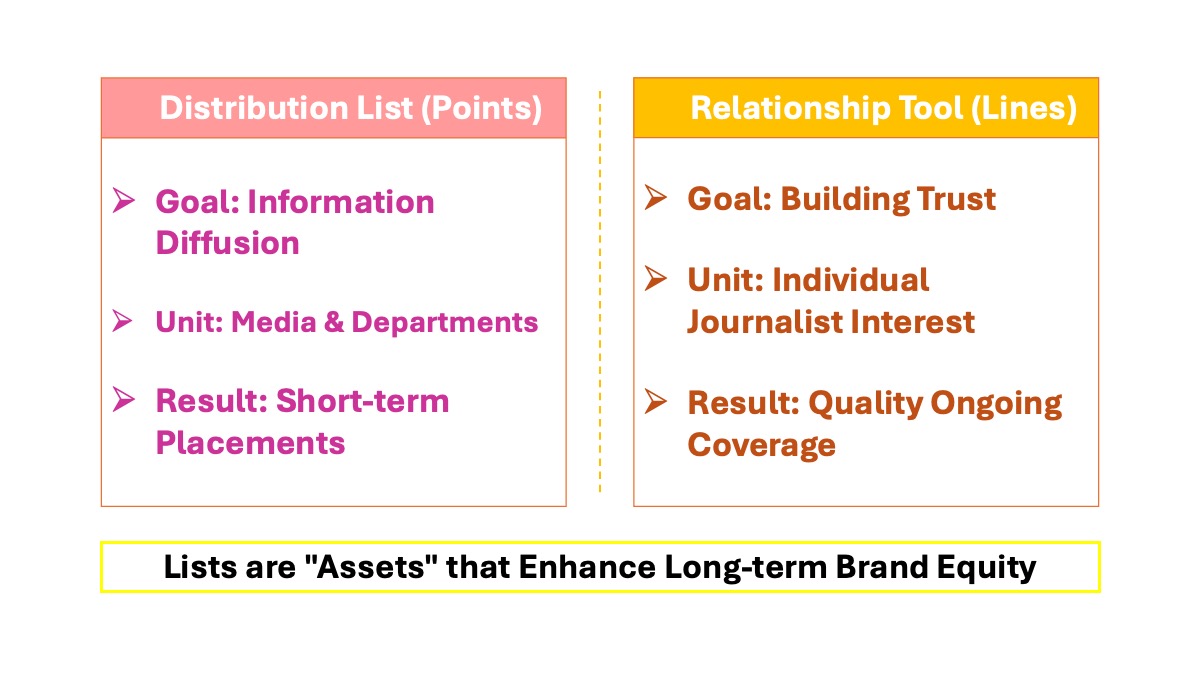
When people hear the term “media list,” many might think of it as a database of recipients for press releases. However, in PR and communications, a media list plays a vital role as the “keystone” for building positive relationships between a company and the media. Here, we explain the true role of a media list from a PR perspective.
[Related Article]What is Public Relations (PR)? A thorough explanation for beginners, from job descriptions to strategy formulation « Column
Why It Is More Than Just a Distribution List
A media list is not just a list for mass-sending press releases. Journalists receive a massive amount of news and information every day, so it is physically impossible for them to read every generic email sent by every company. If you manage your list solely for the purpose of broad dissemination, the probability of catching a journalist’s eye remains low. Reframe your understanding of a media list: it is not a simple list of contacts, but a tool to determine “why this media outlet,” “to whom and what information should be delivered,” and “the characteristics of each outlet.”
Its Role as a Relationship-Building Tool
The true role of a media list is to serve as a tool for designing and managing ongoing relationships with journalists. By accumulating data on past articles and a journalist’s areas of focus, you can provide information and proposals with individual angles tailored to the interests of each media professional. Journalists are human beings; they will only engage in a two-way dialogue once they feel you understand the information they are looking for. By using your list to facilitate efficient dialogue, update information, and build trust, you can expect to consistently generate high-quality articles that reflect your company’s philosophy and intended content. A media list functions as a valuable asset for increasing long-term brand value.
Common Failures in Media List Management
When creating a media list, it is not uncommon for management to drift away from the original purpose of PR. Actions taken with good intentions can sometimes cause a loss of trust from the media. Here, we explain typical failure examples to avoid when managing a media list.
Focusing on “Quantity” in Distribution
When managing a media list, avoid the goal of simply increasing the number of contacts and the “quantity” of distributions. The idea that more recipients lead to a higher probability of coverage ignores the convenience of the journalists on the receiving end. Sending a new food product release to an IT trade publication will likely be ignored because it falls outside the journalist’s interests; in the worst case, your emails may be marked as spam. Distribution focused on “quantity” that indiscriminately adds unrelated contacts will result in a loss of trust, marking you as a “company that doesn’t understand our media.”
The Risk of Information Getting Buried via Mass Distribution
Repeatedly sending mass distributions with template text to general media addresses often leads to failure. Information sent via mass distribution is easily perceived as “low-value information sent to everyone,” carrying a high risk of getting buried in the inbox of a journalist who receives vast amounts of data daily. An individual email addressed to a specific person, such as “Dear Mr./Ms. [Name],” that includes feedback on their previous article is far more likely to catch their attention than a mass email addressed to “To whom it may concern.” Because these interactions often lack a face-to-face element, communication that addresses each journalist individually is essential.
Using Outdated, Unupdated Lists
Continuing to use a media list once it has been created without updating it is another factor for failure. The media industry frequently updates its information policies, content selection, and personnel assignments. If you rely on old information, there is a high possibility that your message will not reach the intended recipient. For example, if you continue to send releases to a journalist you exchanged cards with months ago who has already moved to a different department, it may give a negative impression that your company’s PR management is lax. A media list must be kept up to date, or it will cease to function as a relationship-building tool.
Characteristics of an Effective Media List
In PR and communications, a media list serves as the essential foundation for effectively delivering your company’s information to the media. Media lists of companies that achieve results share several common characteristics. Below, we explain the specific features that maximize the results of PR activities.
| Item | Standard Media List | Effective Media List |
|---|---|---|
| Management Unit | By Outlet (Company or Department) | By Journalist/Director Interests |
| Information Content | General Phone/Email Contacts Only | Includes Past Interests and Writing Trends |
| Update Frequency | A Few Times a Year or Irregularly | Updated with Every Personnel Change or Coverage |
Management at the Journalist Level
Many people manage their media lists only by outlet name or general contact points. To achieve results, it is crucial to manage them at the “individual” level, such as specific journalists or program directors. Even within the same outlet, interests vary greatly depending on the person in charge. For example, in the same business magazine, a journalist strong in the latest IT technology and one strong in corporate organizational development will seek completely different information. If you can increase the resolution of your list to the point where you can visualize the face of the person you want to approach, you will be able to provide the optimal information tailored to each media professional.
Understanding Areas of Interest
Once you can manage at the journalist level, the next step is to accurately grasp their respective areas of interest. Check what kind of articles they have written in the past and what themes they post about on social media to analyze which social issues or trends they are currently interested in. The contexts or elements that the media prefers to cover are called “media hooks,” and this process can be described as deciphering those hooks. By successfully combining your company’s information with their areas of interest, the probability of being featured will increase dramatically. Make it a habit to check the content shared by those in charge and record it in detail in your media list.
Continuous Updates
A media list is not something you create once and finish. It requires continuous updates to keep it in its latest state. The media industry sees frequent personnel turnover and departmental transfers, so with outdated information, important press releases may not reach the intended recipient. Update your information immediately after exchanging business cards, as well as during the regular personnel reshuffle periods in spring and autumn. In addition to new contact information, noting their reactions when approached or details of minor conversations will be useful later. It is steady work, but these daily efforts create a significant difference in media relations when it matters most.
[Related Article]What is Media Relations? Explaining the Basics You Should Know and 5 Points for Success « Column
How to Create and Manage a Media List
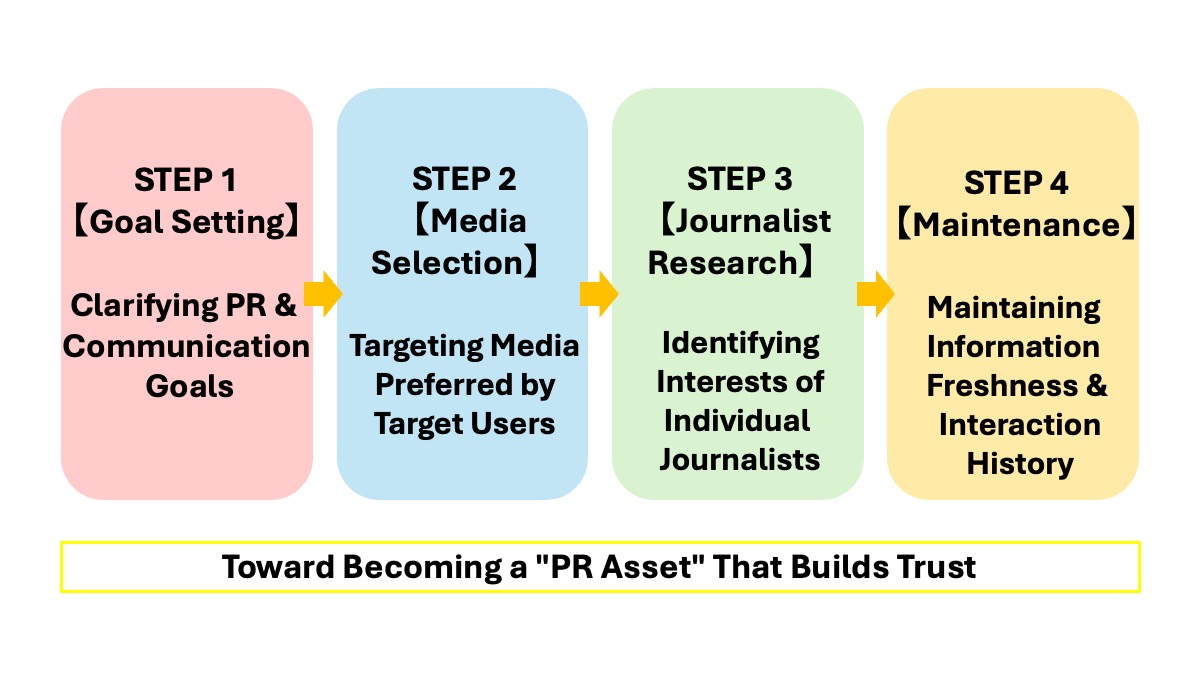
Now that you understand the importance of a media list and the concepts behind its design, it is time to move on to the specific steps for creation and operation. Here, we explain the practical steps from creation to management that demonstrate effectiveness from a PR perspective. This should become a practical tool for building strong relationships with journalists.
[Related Article]What is News Value? Explaining How to Create and Deliver Information that Gets Media Coverage « Column
STEP 1: [Goal Setting] Define PR Objectives and Establish a Distribution Axis
The first thing to do when creating a media list is to clearly define the purpose of your PR activities. If you start creating a list with vague objectives, you won’t have a standard for selecting media, which may lead to an increase in irrelevant recipients. For example, the genre of media you should approach will change significantly depending on whether you want to quickly generate buzz for a new service or deeply penetrate the industry with your company’s technical prowess through high-influence trade media. Verbalizing who you want to reach and what change you want to create is the starting point for all work.
STEP 2: [Media Selection] Carefully Select Media Outlets According to Strategy
Once your objectives are set, move to the step of selecting the appropriate media outlets to achieve them. Imagine what kind of media your target audience usually looks at and what information they obtain, then narrow down the media that serve as touchpoints for information gathering. If you want to promote a trend product for a younger demographic, you would prioritize web media and lifestyle magazines with high social media affinity over newspapers or business magazines. You need to identify where your target customers’ needs overlap with the media’s readership.
STEP 3: [Journalist Research] Research and List Journalists’ Areas of Responsibility
After selecting the media outlets, work on organizing the list by individual journalists rather than just the outlet. It is necessary to focus on the program staff, journalists, or editors responsible for specific pages or segments, rather than the media organization as a whole. For example, search past articles to identify authors, or use PR databases to add the names, contact information, and recent writing trends of journalists strong in that field to your list. This detailed information gathering for relationship building determines the value of your list.
STEP 4: [Listing] Regularly Update Information to Maintain Freshness
After the list is complete and operation has begun, incorporate regular updates into your workflow. As mentioned earlier, the media industry is highly mobile, so the value of the list’s information will drop quickly if left alone. Regularly review the entire list, confirm transfer information, and add new journalists, while also keeping detailed records of meeting histories and reactions to proposals. By accumulating a history of dialogue while maintaining the freshness of the media list, the list will grow into a more powerful PR asset.
Distribution Methods to Increase Coverage Rates Using Media Lists
After creating a high-precision media list, the question is how to use it. Put into practice distribution methods that move the hearts of journalists by leveraging the information in your media list.
Individualized Approaches and Tone Optimization Based on the List
Based on the journalists’ areas of interest recorded in the media list, make proposals tailored to each individual. Even for the same new product announcement, change the email subject line and the angle of the body text to match the concept of the program they handle, the target audience, and the information they are seeking. At this time, you must also consider the “tone and manner” (the atmosphere and worldview of the writing) of the media outlet. A journalist for a serious business newspaper will likely prefer a logical, data-based proposal. On the other hand, for someone at a softer lifestyle magazine, it is recommended to use expressions that appeal to the readers’ emotions and align with the media’s worldview. By communicating in a way that fits the media, the possibility of coverage will increase significantly.
Context Design Tailored to Media and the Difference Between B2B and B2C
Imagine who the readers beyond the media are and design the context in which you provide information. The context that resonates is completely different between consumer media (B2C) and business media (B2B). When approaching B2C media, a perspective on how the product enriches the consumer’s daily life is required. In contrast, for B2B media, the focus is on how it solves corporate challenges, such as improving operational efficiency or reducing costs. Check the characteristics of the outlet in your media list and translate the information into the context that the readers of that media want to know most. Finding the intersection between what your company wants to convey and what the media seeks is the key to context design.
Optimal Timing Strategy Considering the Journalist’s Situation
No matter how wonderful a proposal is, the probability of it being read is low if it is sent when the recipient is busy. Use your media list to predict the recipient’s deadlines and editorial meeting schedules when approaching them. Generally, many journalists are busy with meetings or weekend preparations at the beginning of the week or on Friday afternoons. It is recommended to contact them during relatively relaxed times, such as Tuesday to Thursday mornings. Providing information slightly before seasonal events or social trends peak is also effective. By aiming for the perfect timing when the recipient is looking for exactly that information, your story is more likely to be adopted.
[Related Article]What is Media Strategy in PR Activities? The Concept of “Information Design” to Go Beyond One-Off Exposure « Column
How to Use Media Lists to Build Corporate Assets
The true value of a media list is only realized through communication tailored to each journalist. Here, we explain specific approach methods for effectively deepening relationships with journalists using the media list you have created.
| Approach Method | Specific Actions to Take | Positive Impression on Journalists |
|---|---|---|
| Sending Individual Messages | Add a sentence at the beginning of the email tailored to the journalist’s interests | Trust that information is selected with an understanding of the media’s circumstances |
| Communication such as Impressions and Feedback on Past Articles | Ask for feedback on written articles or past coverage, regardless of sales pitches | Understanding and affinity that you are closely following the media’s work |
| Providing Information Other Than Releases | Share information useful for the journalist’s planning, such as industry trend data | Evaluation as a reliable information source rather than just a promoter |
Building Relationships Carefully with Individual Messages
When delivering information to a journalist, avoid boilerplate text and include an individual message tailored to the recipient. By receiving a message customized for them, the journalist will feel that “this company understands my areas of interest.” We recommend adding a sentence at the beginning of the email, such as “I saw the article on measures against the declining birthrate that you wrote the other day, and I would like to inform you about our related new initiatives.” Moving away from template-based mass distribution and presenting an individual context based on list information is the first step to getting your email opened.
Showing Sincerity by Sharing Impressions of a Journalist’s Past Articles
In addition to providing new information, sharing your impressions of articles a journalist has written in the past can be a very effective means of relationship building. Journalists are always concerned about what kind of changes their articles have brought to society or companies. Sincere feedback will surely make them happy. Even at a time completely unrelated to your company’s information dissemination, simply sending an email saying, “Yesterday’s special feature on [Topic] was very informative, reflecting the real voices from the field,” will help you stay in their memory. Showing respect for their work is the foundation of a long-term relationship of trust.
Gaining Trust by Sending Useful Information Other Than Releases
By regularly providing useful information that aligns with a journalist’s interests, even outside of press release distributions, your relationship will deepen further. Journalists are always looking for seeds for new projects or the next trends in the industry, and they tend to value corporate representatives who serve as high-quality information sources. Even if it is unrelated to your company’s new product announcement, an approach such as sharing industry-wide trend data or latest overseas cases related to a theme the journalist is following “for your reference” is also good. By using your media list to understand a journalist’s needs and establishing a position as a reliable information provider, it will ultimately lead to coverage for your company.
Benefits of Partnering with a PR Agency
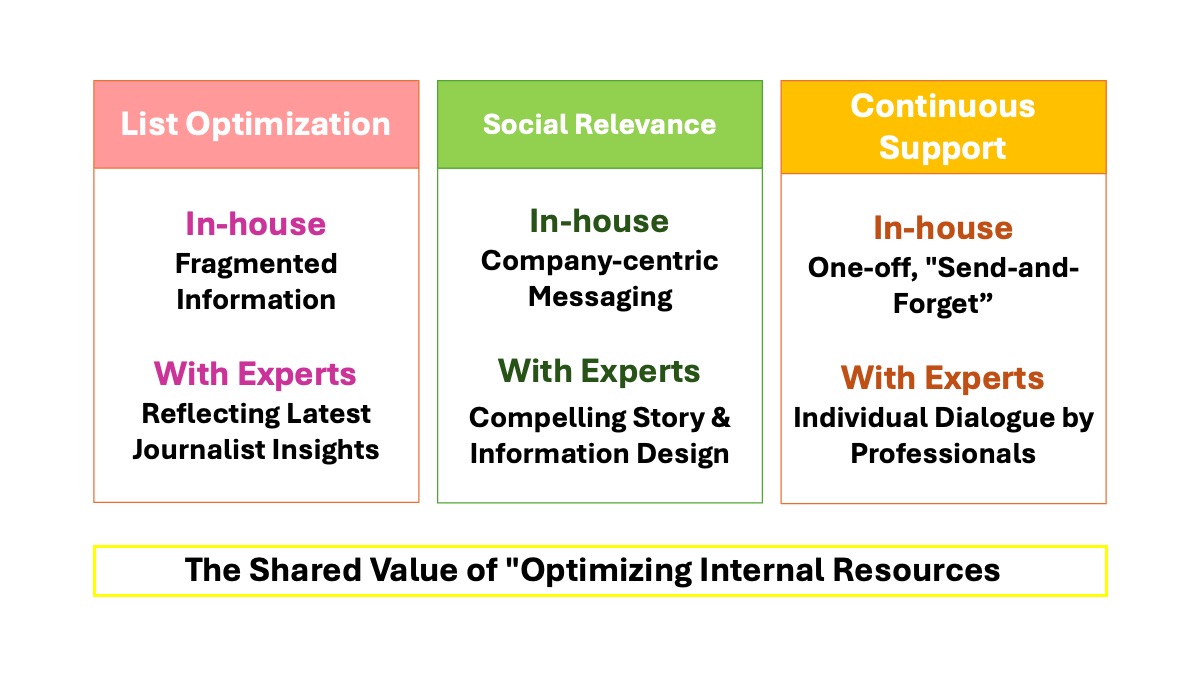
Even if you create a list following the steps explained so far, many PR and communications professionals may find themselves unable to keep up with relationship building due to their daily workload. Furthermore, there may be many instances where it is difficult to judge what can be achieved through PR or what criteria should be used to select journalists based only on internal knowledge. If you feel stuck in the strategic design or operation of your media list, requesting support from a professional PR agency is an effective option. Here, we explain the specific benefits of partnering with a PR agency. By incorporating appropriate support, you should be able to find a way to break through current challenges.
Improved List Accuracy
PR agencies have their own powerful media networks and are well-versed in journalists’ current interests and media industry trends. Based on information that cannot be fully collected by your company alone, they can optimize your list objectively and accurately. They can verify if your current list is in an appropriate state and narrow down the recipients you should truly reach, thereby reducing wasteful distribution and improving the accuracy of the list.
Increased Coverage Rate
If your company’s information lacks the social significance or unique story that makes the media want to cover it, you may not be able to move a journalist’s heart no matter how precise a list you create. A PR agency will return to the starting point of how your business contributes to solving social issues and will work with you to redesign your overall PR strategy and redefine your message. Because they can plan angles and projects that resonate with target journalists from a professional perspective, the quality of distribution increases, and as a result, an improvement in the coverage rate can be expected.
Relationship Building Support
A media list is not finished once it is created; it requires repeated dialogue with journalists, but internal resources often cannot keep up with individual responses. A PR agency comprehensively supports and assists in ongoing relationship building with the media, which can often feel like a trial-and-error process, including individual approaches to appropriate journalists and regular information provision. By utilizing external professional knowledge and execution power, you can move away from one-way information dissemination and take a step toward building a strong relationship of trust with the media.
Are you struggling to gain media exposure despite working daily on creating and managing media lists? SUNNY SIDE UP is a PR agency with a strength in powerful media relations backed by years of PR achievements. We provide a consistent range of PR services, from creating and distributing press releases to producing press conferences and planning and managing PR events. Leveraging our unique planning capabilities and extensive media network, we can propose the optimal timing and angles for information dissemination. If you are looking to strengthen your PR activities and be featured in more media outlets, please feel free to contact us.
Summary
A media list is not something you create once and finish; it is a valuable asset that should be refined through dialogue with journalists. Mass distribution that only pursues numbers or neglecting information can instead cause a loss of trust from the media. What is important is to build sincere communication with each individual based on your company’s PR and communications strategy, after deeply understanding the journalist’s interests and expertise. By continuing to provide useful information while maintaining the latest status, a media list becomes a powerful weapon that goes beyond a mere directory. By keeping strategic list design and careful operation in mind, let’s build positive relationships where media and companies can walk together and realize sustainable brand communication.