What Is Sponsorship? How to Use It as a PR Strategy and How It Differs from Advertising
- カテゴリ:
When people hear “sponsorship,” they often think of corporate logos seen at sports venues, but its essence goes beyond simply spreading a name. Its true role is to communicate your company’s beliefs to society, earn deep empathy and trust from those involved, and improve brand preference. Unlike advertising that buys media space, or CSR aimed at social contribution, sponsorship is a PR/public relations approach that enhances brand value by creating experiences and stories together with stakeholders at the supported organization and integrating them naturally into the customer experience.
This article provides a detailed explanation of the benefits and challenges of sponsorship, as well as specific steps to achieve success. Let us shift the perspective from simply displaying a logo and explore tips for building a brand that customers, users, and stakeholders will love and feel close to.
What Is Sponsorship? What Is Its Purpose?
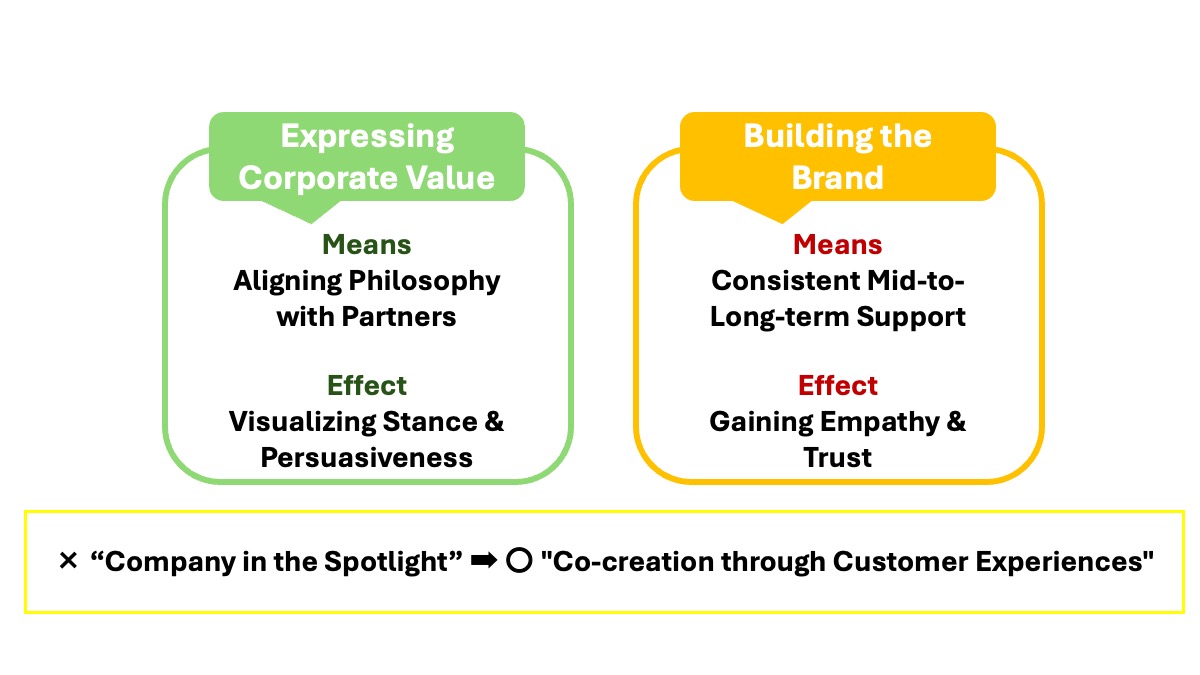
Sponsorship is not ultimately about making a logo stand out. Its true purpose is to clearly communicate how your company should be to society and to build strong relationships with stakeholders. Here, we explain two essential objectives.
A Means of Communicating Corporate Value to Society
Sponsorship can be a powerful way for a company to show what it values and what kind of future it aims to create. Supporting sports teams or cultural and artistic activities is not merely financial backing. By aligning the philosophy and story of the supported party with your own corporate principles, you can communicate a message to customers and society that is more persuasive than words alone. It can also be seen as a process of making visible which social issues your company is addressing.
A Means of Building a Brand Loved for the Long Term Through Empathy
Another important objective is to foster long-term attachment to the brand from a mid- to long-term perspective, rather than creating temporary buzz. When customers feel that a company is cheering for and supporting what they love, they are often moved by that mindset and attitude and become more inclined to support the brand. By continuing consistent support activities, your desire to make society better is conveyed, and trust gradually accumulates. The relationships with customers and stakeholders nurtured in this way will guide you toward a brand with unique value—one chosen for more than price competition alone.
[Related Article]What Is Corporate PR? Explaining the “Attitude” and “Stance” Needed to Earn Trust and Support from Society! « Column
How Does Sponsorship Differ from Advertising and CSR?
When discussing budgets internally, you may find it difficult to clearly explain how sponsorship differs from advertising/promotion or social contribution activities, and feel uncertain. While they may appear similar at first glance, their goals and approaches differ significantly. Properly organizing each role is the first step toward leading an initiative to success.
| Approach | Primary purpose | Who communicates | Expected outcomes |
|---|---|---|---|
| Advertising | Increase awareness and drive short-term purchases | Company (your organization) | Higher sales and greater awareness |
| CSR activities (environmental protection, social contribution, improving working conditions, etc.) | Fulfill corporate social responsibility | Company and society | Ensure sustainability and reduce risk |
| Sponsorship | Communicate your stance and gain deep empathy | Company, supported party, and society | Mid- to long-term trust and increased brand value |
Advertising Aims to Increase Awareness of Products and Services
Advertising is an effective means of purchasing media space and using various creative approaches to make more people aware of your products and services and directly drive purchasing behavior. The subject is the “company,” and it specializes in controlling the message you want to communicate and delivering it broadly. It is highly effective when aiming for short-term sales growth or increased awareness. However, because it primarily focuses on promoting the merits of the product itself, it tends to be less effective at conveying the deeper philosophy behind the company.
[Related Article]Strategies to Increase Brand Awareness from a PR Perspective! Practical Design Connecting to Inquiries and Referrals « Column
CSR Aims to Fulfill Corporate Responsibility Through Social Contribution
CSR activities refer to initiatives undertaken to fully meet the responsibilities a company should fulfill toward society. This area has a strong defensive character, encompassing efforts that companies should naturally carry out, such as environmental protection activities and thorough compliance. The primary purpose is to reduce negative impacts arising from business activities and contribute to the sustainability of society. It differs from initiatives that prioritize direct business returns, such as pursuing profits or significantly increasing brand value.
Sponsorship Aims to Build Empathy and Trust in the Activities
Sponsorship sits between the “offense” of advertising and the “defense” of CSR, functioning as a PR strategy that expands circles of empathy. It is a method of communicating the values your company cherishes by naturally integrating them into experiences through the supported party. The subject is not only the company; messages are formed within a context where three parties intersect: the company, the supported party, and society as a whole. Sharing that context is the greatest factor in creating deep ties with stakeholders.
Benefits of Using Sponsorship for Companies
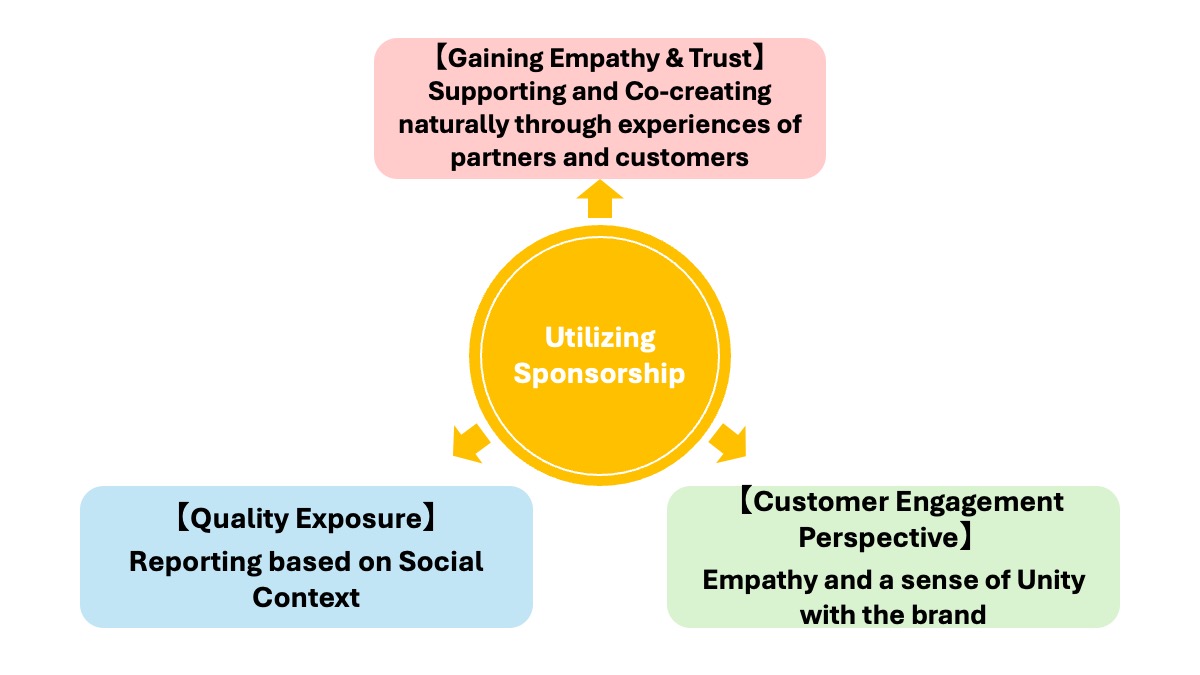
What positive aspects can companies gain from investing budget in support activities? When proposing internally as a PR/public relations professional, viewing it not as something that ends as social contribution but as an important strategy for growing the business enables you to expect results in various forms.
Benefit 1: A High Potential to Earn Trust from the Target Customer Segment
A major advantage is the ability to approach passionate fans and communities of the supported party in a natural way. For example, by continuing to support a specific sports team, you may be received favorably by the team’s fans as “a company that supports what we love.” Because it reduces any sense of being forced, it is considered easier to build trust in the brand without triggering strong wariness.
Benefit 2: Increase Employees’ Attachment to and Pride in the Company (Improved Engagement)
It affects not only external appeal but also the motivation of employees working within the company (employee engagement). The fact that your company supports activities that contribute to society can greatly help employees take pride in their work. Sharing the supported party’s achievements in internal newsletters or participating in events as volunteers can foster a stronger sense of unity within the organization. In recruitment branding as well, it can be expected to make it easier to attract talent who empathize with the company’s stance.
Benefit 3: Expand Awareness Through High-Quality Media Exposure
Story-driven activities through support are more likely to attract media interest and can become an opportunity to gain high-quality publicity. Compared with news that simply announces a new product launch, stories that include social significance in the background—such as “why the company supports this activity”—are more likely to be covered as articles. When communicated through third-party media, it can be expected to increase the objectivity and credibility of the information.
[Related Article]What is Media Relations? Explaining the Basics You Should Know and 5 Points for Success « Column
Potential Drawbacks to Consider When Implementing Sponsorship
While sponsorship offers many benefits, there are also points that should be considered carefully when implementing it. It is important to understand in advance not only the advantages but also the aspects that require caution.
Drawback 1: Difficult to Visualize Results Numerically
One challenge is that it is difficult to measure, in short-term numbers, how much impact was achieved relative to the cost invested. Unlike advertising, you cannot directly track clicks or purchase counts, so there are many cases where explaining ROI is difficult. For measurement, you need to devise your own evaluation metrics, such as pre-campaign brand awareness surveys and qualitative analysis of reactions on social media.
Drawback 2: Potential to Damage Your Brand Due to Issues or Trouble
If a problem occurs with the supported party or performance declines, it may also affect your brand image. The deeper the connection with the supported party becomes, the more likely it is that others will view both parties as one. In case of trouble, it is necessary to organize in advance the criteria for whether to continue support or review it.
Drawback 3: Securing Budget Is Necessary for Ongoing Support
If you end support in the short term, it may create a negative impression such as “they stopped supporting due to poor performance.” To enhance brand value, continuity over a certain period is often assumed, making a stable budget essential. While gaining understanding from management that this is a long-term investment, you are required to design a budget that is less susceptible to short-term business performance.
Sponsorship Design Steps to Lead to Success
To steadily enhance corporate value while avoiding unexpected failures, it is necessary to plan step by step. Here, we explain specific build-out steps that incorporate a PR perspective.
| Design steps | Specific actions to take | State achieved |
|---|---|---|
| 1. Define current business issues and objectives | Analyze the current state of your brand and articulate goal setting | The initiative’s direction and evaluation criteria become clear |
| 2. Confirm alignment with the brand | Select partners whose ideals and values resonate with what you aim for | A strong, consistent collaboration framework can be built from the customer’s perspective as well |
| 3. Build the communication context | Design the story and brand message where the three parties intersect | A compelling rationale that resonates with media, society, and customers is created |
| 4. Ongoing communication | Execute diverse touchpoints internally and externally | Attachment and trust take root as mid- to long-term assets |
STEP 1: [Set objectives] Organize your company’s issues and define the objectives
Successful companies ensure that their own issues and goals align with the purpose of sponsorship. The foundation of an initiative is this “alignment with the company’s direction.” First, look inward and organize the issues your current brand faces. Is awareness among younger audiences insufficient, or is an innovative image lacking? Analyzing the current situation is the starting point. What state do you aim to achieve through this initiative? It is important to clearly articulate the goal you should pursue. If this remains vague, subsequent decisions will become inconsistent.
STEP 2: [Select the supported party] Confirm shared values and alignment with the supported party
Successful companies align their values and future vision with those of their partners. In addition to whether it matches the objective, a key point is whether the philosophies and ways of thinking naturally overlap. For candidate organizations or individuals, carefully interview them not only about past achievements but also about the values they cherish and their future vision. Are they a partner you can move forward with in the same direction? It is essential to assess this from multiple perspectives.
STEP 3: [Communication design] Build a communication context that resonates with society
Successful companies craft stories that are meaningful for each party: the company, the supported party, and society. The core of communication is the point where these three overlap. Once a partner is decided, design what message you will communicate. It is important to shape it so that it conveys what positive change you want to create for society, rather than being one-sided. With a consistent context, it will be communicated as a coherent story in press releases and media coverage as well.
STEP 4: [Ongoing operation] Continue communicating the significance of the activities internally and externally
Successful companies ensure that the ideals and context they set forth always align with their actual activities, and they build in “continuity” so it does not end as a one-off. Based on the context you have built, continue to share information consistently through both internal communications and external PR. Design diverse touchpoints, such as fan-participation events and joint projects with the supported party to solve social issues. By not ending with a single communication and instead regularly sharing progress and outcomes, you can improve long-term engagement and establish attachment and trust as mid- to long-term assets.
Key Characteristics of Successful Sponsorship Case Studies
Companies that do not stop at simply purchasing sponsorship inventory and instead achieve significant results share common traits. Funding alone cannot move consumers’ hearts. Successful companies have strategies that combine solving their own issues with the growth of the sponsored party. Here, we explain three important elements seen in successful cases.
| Key elements | Examples of specific initiatives | Main expected effects |
|---|---|---|
| Alignment with the brand | Supporting targets whose philosophy and target customer segment align | Greater persuasiveness Lead acquisition |
| Storytelling | Articulating the background and intent behind the support | Building deep empathy and attachment to the brand |
| Media ripple effect | Creating buzz aimed at social sharing and PR linkage | Information dissemination Maximizing media exposure |
[Related Article]What Is Fan Marketing? Explaining How to Build a Brand Loved for the Long Term from a PR/Public Relations Perspective! « Column
Alignment with the Brand
The first step to making sponsorship successful is to increase alignment with your brand. The company’s philosophy and target segment must be deeply connected to the characteristics of what you support. For example, a company that advocates environmental protection may support a sports event that is mindful of sustainability. If the values of both parties align, consumers will feel strong persuasiveness in the company’s message. If the target segments overlap, it can also be expected to more effectively draw out interest in the brand.
Storytelling
Next, it is important to incorporate storytelling that evokes empathy. Clearly communicate why your company supports that team or event, and the intent behind it. Simply exposing a logo is unlikely to remain in people’s memory. It requires ingenuity, such as aligning the image of athletes facing challenges with the company’s own challenging spirit. With a unique context, consumers will develop deep empathy and attachment to the brand.
Media Ripple Effect
Finally, mechanisms that consider ripple effects to the media are also essential. Create a state in which sponsorship activities naturally spread through media such as social media and television. To do so, you need newsworthiness that the media will want to cover. Planning experiential events that fans will instinctively want to photograph and post on social media is also recommended. By firmly linking it with PR activities, you can enhance the value of sponsorship.
How to Think About ROI
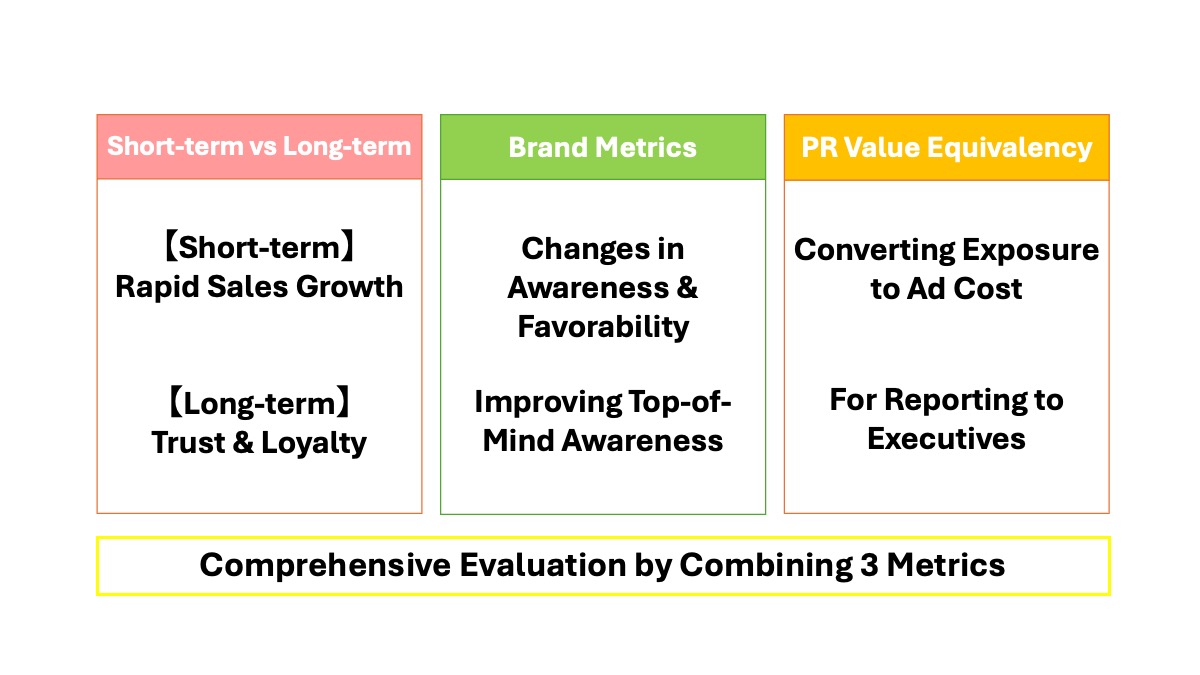
When implementing sponsorship, many people struggle with measuring ROI. It is necessary to appropriately assess what results were achieved relative to the budget invested. Here, we explain three perspectives for properly evaluating effectiveness.
[Related Article]How Should You Set Goals at the Start of a PR Term? KPI Metrics and Planning to Visualize PR Results « Column
Short-Term Impact vs. Long-Term Value
It is important to view sponsorship effectiveness along two axes: short-term impact and long-term value. Short-term impact refers to items such as increased sales during the event period and increased website traffic. Long-term value, on the other hand, refers to brand trust cultivated over multiple years and improved customer loyalty. If you pursue only short-term sales, you may misjudge the true value. Consider the balance between the two and set an evaluation period appropriate to your objectives.
Brand Metrics
To measure improvements in brand value, effectiveness measurement using brand metrics is useful. Quantify changes in awareness, favorability, purchase intent, and more through surveys and similar methods. By comparing before and after the sponsorship, you can visualize how consumer perceptions changed. In particular, “top-of-mind awareness,” which measures the first brand recalled in a specific category, is an important metric. Tracking it continuously makes it easier to judge brand growth.
PR Value Equivalency
PR value equivalency is a method of expressing the impact of media exposure in monetary terms. It is a calculation method that converts the amount of coverage on TV, newspapers, and web media into advertising costs. It is useful when explaining the economic value of sponsorship to management in an easy-to-understand way. However, because it does not reflect the quality of exposure, negative coverage is also calculated as a positive amount, so caution is required. Use PR value equivalency as one guideline only, and evaluate comprehensively in combination with other metrics.
Benefits of Consulting with / Hiring a PR Agency
Sponsorship activities are an effective way to deliver a company’s intent to society and build trust with stakeholders. However, it may be difficult to create a context that earns empathy from your company’s perspective alone. Here, we explain in detail the importance of a PR perspective and key points for maximizing effectiveness through collaboration with experts.
[Context Design] Build a Story That Creates Empathy Beyond Advertising Inventory
If you proceed on your own, your attention may tend to focus on advertising-like metrics such as logo exposure and frequency. By incorporating the objective perspective of a PR agency, you can create a socially grounded story (context design) around “what kind of relationship to build with society through this support.” Rather than one-sided, company-led communication, you can create a context that generates public empathy while staying close to the supported party and its community.
[Risk Management] Prevent Backlash and Brand Damage in Advance with an Objective Perspective
Communications in sponsorship activities carry the risk that misreading the public mood or insufficient consideration for the community may invite unexpected criticism or backlash. Because PR agencies are well-versed in media perspectives and public trends, they can calmly identify risks from a third-party viewpoint that are likely to become blind spots internally. By thoroughly managing risk—from tone and manner to consideration for diverse stakeholders—you can prevent brand damage in advance and achieve safe communication.
[Maximizing Value] Realize “Win-Win-Win” for Society, the Supported Party, and the Company
Sponsorship activities are not limited to financial support. By appropriately amplifying the significance of the activities to the public through suitable methods, their value increases dramatically. With a partner that provides end-to-end support from PR strategy design through execution, you can generate long-term effects such as enhancing corporate value and advancing the supported party, in addition to effective information dissemination. “Maximizing value” that benefits society, the supported party, and the company alike is the greatest significance of engaging a specialist firm that is a communication professional.
Are you concerned that even after concluding a sponsorship agreement, you are not sufficiently communicating the value of the activities to society? SUNNY SIDE UP is a PR professional that “moves people’s hearts and moves the world.” We provide a wide range of PR services end-to-end, including press release creation and distribution, press conference production, PR event planning, media relations, and reputation management. We strategically support expanding awareness and enhancing value for your corporate brand through sponsorship activities, leveraging our unique planning capabilities and strong media network. If you are looking to maximize the effectiveness of your sponsorship, please feel free to contact us.
Common Traits of Companies Whose Sponsorship Ends at Logo Placement
There are several common traits in cases where, despite paying substantial sponsorship fees, the expected improvement in brand value is not seen.
The Context Between Your Company and the Supported Party Does Not Align
If there is no apparent connection between your business content or corporate philosophy and the supported party’s activity domain, empathy is unlikely to arise. If people cannot understand “why this company supports this team,” it may be perceived as mere exposure. It is important to carefully assess not only surface-level name recognition but also the connection in the story.
Being Satisfied with Only Temporary Buzz
There are many cases where activities end after the initial excitement of a press conference right after announcing the contract or a one-off event. Even if you gain temporary awareness, it is unlikely to remain in memory without ongoing touchpoints. You need to continue everyday communications and build relationships with fans to accumulate the investment as a brand asset.
Insufficient Intent to Deliver to Society
If you lack the perspective of what kind of society you want to realize through the support activities, the message will lack depth. With only an abstract slogan such as “We support people who are doing their best,” it is difficult to differentiate from competitors, and initiatives that leverage your strengths are required. It is important to articulate specifically what you want to achieve together with the supported party.
Summary
The key to successful sponsorship lies in not selecting a supported party based solely on name recognition, but in carefully digging into alignment with your company and connections to society. By not ending with temporary buzz and continuing activities from a mid- to long-term perspective, assets such as employee pride and trust from society will accumulate for the first time. It is important to design messages that are meaningful for all three parties—your company, the supported party, and society—and to continue communicating them consistently. If you are unsure about strategy design or effectiveness measurement, it is also effective to incorporate the insights of PR professionals. Rather than making logo placement the goal, use sponsorship to the fullest as a starting point for dialogue that expands circles of empathy and drives your company’s growth.
For those considering effective marketing through sponsorship, SUNNY SIDE UP’s services are recommended. As a PR agency founded in 1985, we will support your company with extensive experience leading sports marketing. We handle a wide range of areas, from sponsored solutions that connect companies and sports events to athlete management and casting, as well as sports promotions. By maximizing the power of sports, we propose the optimal sponsorship strategy that leads to enhanced brand value and expanded awareness. If you would like to strengthen brand communication through sports, please feel free to contact us.