
What are the key points for managing corporate accounts? Explaining design methods to be loved by fans from a PR perspective
- カテゴリ:
When managing a corporate social media account, is it easy to find yourself chasing only “numbers” such as follower counts and engagement metrics (user reactions)? However, from a PR and public relations perspective, the essential role of a corporate account is not merely the dissemination of information. A corporate account becomes the “face” of the company and serves as an important window for brand communication with users.
In this article, we will explain the ideal state of an account from a PR and public relations standpoint, which differs from a marketing perspective. We have summarized management methods that enhance brand value, ranging from typical failure examples to strategic design steps for being loved in the long run. This article is recommended for those in charge who feel that “the numbers are there, but there is no real sense that the fan base is growing.”
The Importance and Role of Corporate Accounts in PR and Public Relations
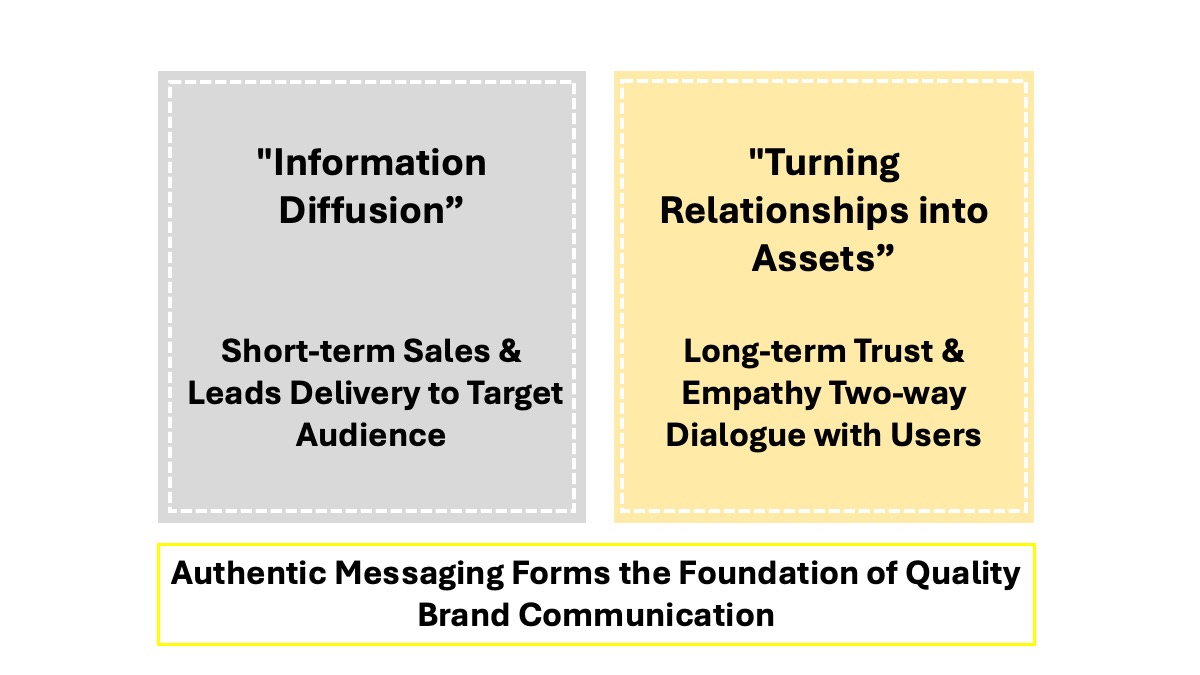
When managing corporate accounts, many professionals tend to emphasize marketing-oriented figures focused solely on reach, such as “how many people were reached.” However, from a PR and public relations perspective, the role of an account goes beyond simple information dissemination. Here, we explain the essential role corporate accounts play in PR and public relations.
[Related Article]What is Public Relations (PR)? A thorough explanation for beginners, from job descriptions to strategy formulation « Column
The Role of Building Trust as the “Face” of the Company
A corporate account is not just a tool for sending out information; it plays the role of the company’s “face” to the public. Since social media is predicated on being a service that promotes communication and interaction between people, it is difficult to gain empathy through inorganic information like press releases alone. For example, rather than just mechanically listing the specifications of a new product, by speaking in your own words about the background of development or the passion of the person in charge, users will feel a sense of affinity with the company. Striving to communicate in a sincere and approachable manner as the “face” of the company shortens the distance with users and forms the foundation for building a strong relationship of trust.
Why It Functions as a “Relationship Asset” Rather Than Just an Announcement
In public relations activities, a corporate account functions not as a one-way “announcement,” but as a “relationship asset” accumulated through dialogue with users. While traditional advertising was the transmission of information from a company, social media is a place where you can directly receive reactions from users and interact with them. For example, if a corporate account carefully thanks a user for their impressions of a product or answers their questions, the user will develop a favorable impression of the company. The accumulation of daily, diligent two-way dialogue turns into “assets” and “preference” in the form of fans who will support the company in times of need.
What Are the Responsibilities of Corporate Accounts in the Social Media Era?
In the social media era, where information spreads over a wide area in a short time, corporate accounts carry the significant responsibility of “maintaining good relations with society.” Thoughtless posts aimed only at temporary “buzz” or creating a stir can sometimes lead to backlash and risk damaging the brand’s credibility. Rather than being active only during campaigns, an attitude of continuously sending out information that is useful to users on a daily basis and sincere messages based on corporate philosophy is required. The responsibility of a corporate account can be described as protecting and nurturing the foundation for the brand to be loved for a long time, while reading the social atmosphere without being swayed by immediate numbers.
Common Examples of Failure in Corporate Account Management
In social media management, measures taken with good intentions can sometimes lead to results that damage brand value. In particular, cases where there is an obsession with achieving visible numbers from campaigns and measures, or starting without a proper internal structure, are not uncommon. Here, we explain typical examples of failures that people tend to fall into when managing corporate accounts.
| Failure Trend | Main Causes | Negative Impacts |
|---|---|---|
| Emphasis on Follower Count | Because the evaluation criteria are based only on appearance and easy-to-understand numbers | Decrease in engagement and increase in users indifferent to the brand |
| Emphasis on Posting Volume | Because the management system prioritizes meeting quotas over quality | Cluttering users’ timelines and leading to unfollows |
| Occurrence of Backlash | Because clear communication guidelines and persona settings as a company do not exist | Loss of trust in the entire company and a significant decline in brand image Risk of “digital tattoos,” where information is spread across social media and the web, leaving a permanent record of the posts |
| Ambiguous KPIs | Because objectives and indicators are not linked, and there is no standard to correctly measure results | Management becomes a mere formality and motivation of the person in charge decreases |
Chasing Only Follower Counts and Damaging Value
In managing a corporate account, avoid making the follower count your only goal. Having a large number of followers does not necessarily equate to a high level of favorability or trust in the company. For example, a case in point is when followers are rapidly increased through frequent incentive-heavy giveaway campaigns, but after the campaign ends, there is no reaction to posts at all, resulting in a connection based only on numbers. This does not contribute to the original goal of forming a fan community and instead leads to the erosion of brand value.
Prioritizing Posting Frequency and Lowering Content Quality
Management goals that emphasize only volume and frequency without accompanying quality in posts are also factors that easily lead to failure. If low-quality posts appear continuously on a timeline, they may actually cause discomfort. Accounts that only post daily greetings tend to be judged as having no useful information, leading users to unfollow. Think carefully about “where the benefit for the user lies,” and rather than just fulfilling a quota for the number of posts, consider how to ensure value and quality unique to your company in each individual post.
Lack of Management Policy Increases the Risk of Backlash
Most instances of social media backlash for corporate accounts are thought to stem from the fundamental management policy of the organization rather than individual mistakes by the person in charge. Without clear guidelines or tone and manner, decisions are left to the personal judgment of the person in charge at the time. As a result, from the user’s perspective, the corporate account may appear to have multiple personalities, or the risk of making posts that lack social consideration increases. For example, a case where a flippant post is made about a socially sensitive topic without an official view, leading to criticism of the entire company’s stance, would fall into this category. To prevent backlash, it is necessary for the entire organization to share rules regarding themes that should not be touched upon and the appropriate distance to maintain with users.
Ambiguous KPI Design Makes It Impossible to Evaluate Results
Starting management with ambiguous objectives for “why we are using social media” and the KPIs (Key Performance Indicators) to measure them is another common cause of failure. If objectives are not set, it is unclear which figures to evaluate—such as the number of “likes,” impressions, or link clicks—making it impossible to review the success or failure of measures. As a result, there is a possibility that management becomes a mere formality of just continuing to post. Correctly set indicators that directly link to your objectives, such as engagement rates and the number of positive mentions, to visualize results.
[Related Article]What is Corporate PR? Explaining the “Attitude” and “Stance” to be Trusted and Supported by Society! « Column
KPI Design for Corporate Accounts That Deliver Results
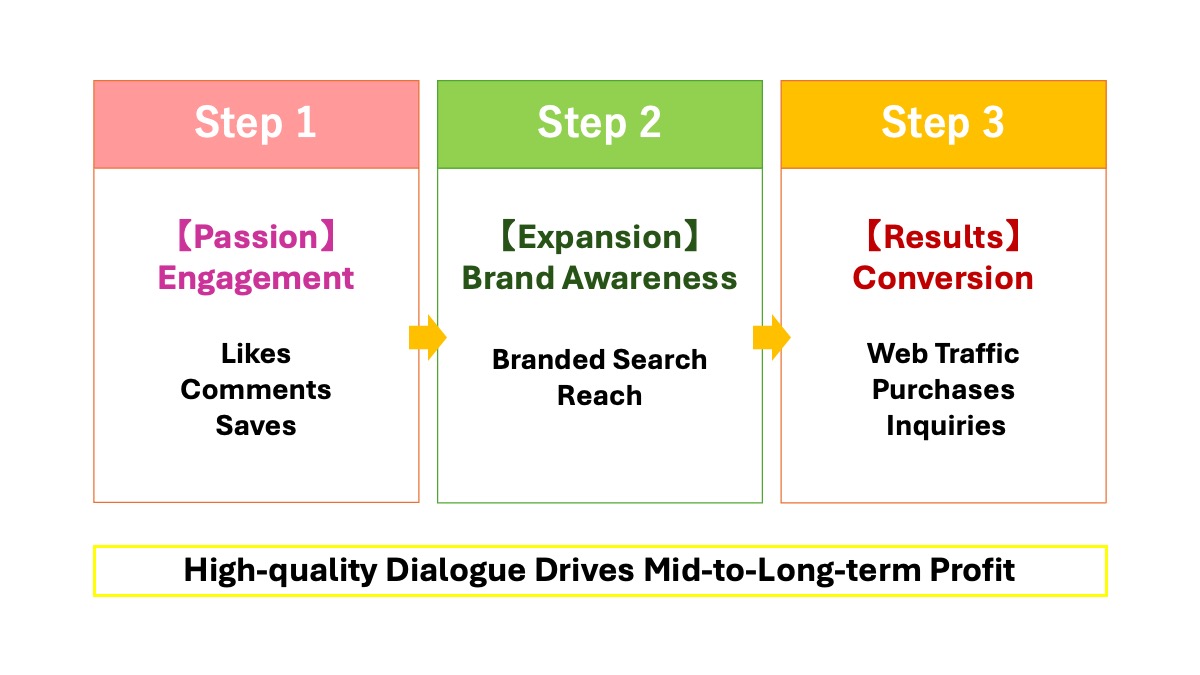
To manage a corporate account and reliably achieve results, appropriate KPI design is necessary. KPIs refer to intermediate indicators for achieving final goals and serve as a guide for management. Even if you continue to post with ambiguous objectives, you cannot accurately measure the contribution to your business. Here, we explain specific ways to set indicators to lead a corporate account to success.
Emphasize Engagement Rather Than Follower Count
In managing a corporate account, we do not highly recommend making the follower count your only goal. No matter how many followers you have, if there is no reaction to your posts, they cannot be counted as fans of your company. Therefore, we recommend emphasizing “engagement” such as likes, comments, and saves. By drawing out active reactions from users, it also works advantageously within the algorithms of various social media platforms and search engines. If you continue high-quality communication, you will eventually be able to deliver information to more potential customers.
The Importance of Branded Search Volume and Brand Recall
The “branded search volume,” which indicates how often your company name is searched for through social media posts, is also important. Users who encounter useful information will use search engines to find more detailed information. Additionally, “brand recall”—being remembered as “that company when it comes to a specific field”—is a point that should not be forgotten. Aim to be the first choice when a need arises in a customer’s life. Increasing brand recall contributes significantly to medium- to long-term corporate profits and stable customer mobilization.
Designing Indicators to Link Social Media to Sales and Inquiries
The final goal of a corporate account is to contribute to actual business, such as sales and inquiries. To visualize the effect, it is necessary to measure the number of visitors to your site from social media and the number of purchases made. Rather than just posting and finishing there, analyze what kind of posts prompted action. We recommend using access analysis tools and adding parameters to the URLs of each post to visualize the effects. If you can accurately understand which path the results originated from, it should lead to continuous improvement of measures.
Designing Corporate Accounts in Alignment with PR Strategy
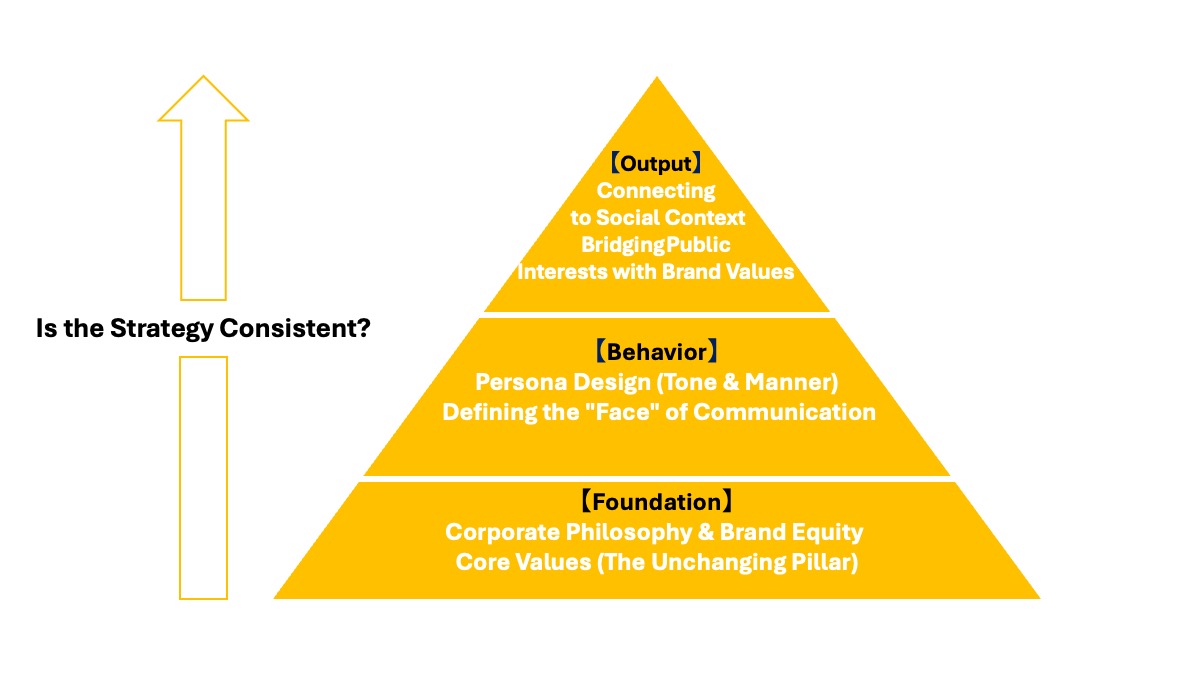
When considering the launch of a social media account, a common stumbling point is starting management as a “standalone social media project.” A corporate account is part of the company’s overall communication activities and must be strongly linked to the core PR strategy. Here, we explain the importance of account design linked to PR strategy and specific design approaches.
[Related Article]What is Fan Marketing? Explaining How to Build a Brand Loved for a Long Time from a PR Perspective! « Column
Connection with Corporate Philosophy and Brand Value
Managing a corporate account does not function well if it is considered in isolation as a standalone social media measure. It is required to reflect the vision, corporate attitude, and brand values that the company cherishes at the very foundation of the account. For example, if a company lists environmental protection in its corporate philosophy, showing the behind-the-scenes of how it considers the environment in its daily operations through social media posts will give the philosophy credibility. Designing to sincerely deliver the values at the core of the company, rather than relying on superficial techniques, is the first step in generating empathy from users.
How to Design Persona (Tone Manner)
Once the brand’s values are established, design the account’s persona (tone and manner)—the “wording” and “behavior” used to convey them to users. If the official website promotes a solid and serious corporate culture, but the social media account uses extremely casual youth slang, it will cause confusion among users. Define an appropriate sense of distance and word choice that fits your brand character, and design it to be the “face of the company” that remains consistent even if the person in charge changes.
Communication Design That Connects with Social Context
In account design from a PR and public relations perspective, it is always necessary to consider how your company’s communications connect with “current social interests and trends (social context).” Statements from a company are sometimes taken more seriously than those from individuals and have the power to influence social values. While it goes without saying that expressions reinforcing specific stereotypes should be avoided, there is a demand for sending positive messages that respect diversity and information that leads to the resolution of social issues. Furthermore, message design that empathizes with and considers existing user communities is very important. A perspective that harmonizes with each existing community as well as society as a whole, connecting the world’s context with your company’s communications, will enhance the account’s raison d’être and credibility.
Steps to Design a Loved Corporate Account
To prevent haphazard management and suppress the risk of backlash, meticulous prior account design is necessary. Here, we explain the specific flow for launching a corporate account from a PR and public relations perspective and getting management on track in four steps.
| Step | Specific Content to Implement | Important Points to Consider |
|---|---|---|
| Define the PR/Public Relations Objectives | Determine the account’s raison d’être, such as strengthening recruitment or customer support | • Align understanding with management and other departments to eliminate contradictions • Share the benefits to the company gained by implementation |
| Define the PR/Public Relations Persona | Document the tone and manner, such as character settings and wording | • Ensure it is approachable for the target audience and aligns with the corporate culture / has affinity |
| Formulate Management Policies | Create a common understanding for posting themes / reply standards / escalation flows for backlash, etc. | • Eliminate personal judgment and create rules that allow anyone to manage safely • Conduct regular knowledge sharing to deepen understanding |
| Perform Appropriate Effectiveness Measurement | Analyze both “quantitative” indicators such as engagement and positive mentions, as well as “qualitative” indicators | • Measure the degree of long-term relationship building without being swayed by immediate numbers • Visualize how the corporate account is linked to business growth. |
STEP 1: Define PR/Public Relations Objectives and Solidify the Management Axis
When launching a corporate account, first clearly define the objectives for public relations. If management starts with ambiguous objectives, inconsistencies will arise in the content, and it will become unclear what you want to deliver to which audience. Whether the objective is to strengthen recruitment activities or to support existing customers, the messages to be sent and the functions to be used will change significantly. The starting point is for all stakeholders to share the answer to the question, “Why are we managing this account?” which serves as the foundation for all measures.
STEP 2: Define the Account Persona and Create a Sense of Affinity
Once the objectives are set, move on to the task of defining the account’s “face of public relations.” By giving the account a consistent character, users can more easily imagine the person on the other side of the screen, making it easier for them to feel a sense of affinity. Set details such as age group, gender, personality, hobbies, and topics of expertise, and document the tone and manner of how to interact with users in terms of wording within the company. The goal is to unify the tone of communication even when managed internally by multiple people, achieving seamless communication.
STEP 3: Formulate Management Guidelines and Prevent Inconsistencies
After the persona is clear, enter the stage of formulating specific daily management policies. Management policies are comprehensive rules that include everything from selecting themes for content to standards for replying to user comments and even response flows for when trouble occurs. For example, establish rules such as not touching on sensitive topics like politics or religion at all, or standards for escalating to a manager rather than replying based on a single person’s judgment when negative opinions are received. Establish a system that allows for the continuation of safe management without hesitation. This will also enable calm internal responses when highly urgent events occur.
STEP 4: Measure Effects Appropriately and Build an Improvement Cycle
After starting management, regularly perform appropriate effectiveness measurements in line with the defined objectives. Since the objective is long-term relationship building, it is necessary to identify qualitative changes rather than judging the success or failure of measures based solely on short-term increases or decreases in followers. Analyze how user sentiment is changing by measuring the number of spontaneous mentions of your brand through UGC, such as the ratio of favorable comments to posts and content that is mentioned particularly often. Effectiveness measurement that deciphers the user psychology (insights) behind the numbers is crucial for improving the corporate account in line with changes in the environment.
How to Turn a Corporate Account into an Asset
If you feel at a standstill with strategic corporate account management, a perspective is needed to move beyond simple information dissemination and elevate the account itself into a corporate “asset.” Here, we explain specific steps for assetization to link social media management to long-term results, and approaches for utilizing the expertise of specialized companies when it is difficult to solve issues with internal resources alone.
Designing the Path from Social Media to Branded Search
The first step in turning an account into an asset is designing a path that reliably connects users who gained awareness on social media to your business. If you feel at a standstill, it is necessary to fundamentally review your overall PR strategy. Return to the starting point of how you want your brand to be seen by society, and plan by working backward to see how social media posts link to users’ “branded searches (searches by company or brand name).” By integrating the presentation with owned media such as your website and press releases, each measure should work together to create a synergistic effect.
Linking with Media Exposure
Rather than completing everything within social media alone, the value of the account will increase further by linking it with exposure in mass media and web media (publicity). If it is difficult to design a PR strategy involving the media using only internal resources and know-how, consulting a specialized PR company is a recommended option. Specialized companies are well-versed in success stories across various industries and media interests, and can propose optimal strategies to spread social media communications as news from an objective perspective.
[Related Article]What is Media Relations? Explaining the Basics You Should Know and 5 Points for Success « Column
Accumulation of Long-Term Brand Value
The ultimate goal is the accumulation of long-term brand value through daily high-quality communication and dialogue. By starting with an understanding of the current state of the account and performing tasks such as appropriate persona setting and the creation of management manuals, brand building with suppressed backlash risk becomes possible. If it is difficult to improve the quality of management on your own, move away from trial-and-error management with the support of professional guidance and grow your corporate account into a strong “relationship asset” that supports your company over the long term.
Corporate social media accounts play an important role not only in information dissemination but also in brand building and strengthening engagement with customers. SUNNY SIDE UP’s digital and social media services provide wide-ranging support for measures related to corporate accounts, from promotion planning utilizing social media to the construction and management of owned media and data analysis through social listening. With the philosophy of “digital communication with human warmth,” we can design strategies that fuse technology with a human perspective. Please feel free to consult our expert team, which has a wealth of experience, for everything from the launch of corporate accounts to continuous management improvement.
When to Outsource Corporate Account Management
Although many companies have opened corporate accounts, not a few face human resource challenges for continuous management. To continue producing expected results stably, it is recommended to have the option of enlisting professional help at the appropriate time. Here, we explain in detail the timing for outsourcing management and how to choose an outsourcing partner.
Points to Identify the Limits of Internal Management
While managing a corporate account in-house, there may come a time when results gradually stagnate. At that point, first objectively check whether the workload of the person in charge is being overwhelmed. Caution is needed if time for regular posting and data analysis cannot be secured due to concurrent duties with other tasks. It can also be a sign of reaching a limit when the planning of post content becomes repetitive and new ideas stop emerging. When you feel a chronic shortage of internal resources or the limits of knowledge and skills, it is the appropriate time to start considering outsourcing.
Effects Gained by Outsourcing
By requesting a specialized external company to handle management, companies can enjoy many benefits. The greatest effect is that while concentrating internal human resources on core business that should be the focus, it becomes possible to send out high-quality communications on social media and video platforms that leverage the latest trends and the mechanisms of each platform. Since professionals with specialized knowledge perform data analysis from an objective perspective, more accurate improvement measures can be executed continuously and quickly. The inclusion of an objective external perspective leads to the discovery of new charms and strengths that could not be noticed from within the company.
Differences Between PR Companies and Social Media Management Companies
In choosing an outsourcing partner, correctly understand the differences between PR companies and social media management companies. PR companies excel at expanding awareness across society as a whole, including television and web media, and comprehensive brand building across mass media, social media, and the web. On the other hand, social media management companies specialize in the practical operations of the field, such as daily post creation, comment response, and algorithm analysis. If you want to create synergy all at once, such as through large-scale events or media exposure, requesting a PR company is recommended. If you want to grow your account steadily and deepen intimate communication with users daily, a social media management company is recommended. Identify the most suitable partner according to your company’s objectives and current challenges.
[Related Article]Strategies to Increase Brand Awareness from a PR Perspective! Practical Design Connecting to Inquiries and Referrals « Column
Summary
In managing a corporate account, it is important not to just chase the numbers in front of you, but to continue dialogue in line with PR and public relations thinking. If you define a character that is true to yourselves and continue to sincerely communicate the company’s thoughts, trust that is not swayed by trends will be born. We recommend setting management rules and having multiple people check content to prevent trouble, and establishing a system to collect valuable information that benefits users in cooperation with other departments. Think of a corporate account not as a tool for promotion but as a platform for forming a user community, and carefully nurture fans with unique benefits. An attitude of facing this as an entire organization will become the power that enhances brand value.
Many people may have concerns regarding corporate social media account management, such as “I don’t know where to start” or “I want a proposal for measures that fit my company.” SUNNY SIDE UP handles a wide range of services from strategic planning for corporate accounts to daily management support, and you can easily request or consult with us through our inquiry form. The form is designed for you to fill in an overview of your request, the period of activity, the image you want to achieve, and your budget. Our dedicated staff with a wealth of experience will provide careful proposals while empathizing with your company’s challenges, so please feel free to contact us first.