What is Lifestyle Marketing? A PR Strategy to Make Brands the Choice Within the Consumer Context
- カテゴリ:
It is said that target settings based solely on attributes, such as “women in their 30s” or “men in their 50s,” no longer easily reach the hearts of consumers. In today’s world, where lifestyles and values have diversified, the starting point for marketing may have shifted from age and gender to the perspective of “what kind of life do they value?”
This article explains the concept and practical steps of “lifestyle marketing,” which involves deciphering insights from consumers’ daily lives, hobbies, values, and communities to design touchpoints with a brand.
What is Lifestyle Marketing? A Concept for Designing Brand Touchpoints Based on Consumer Values
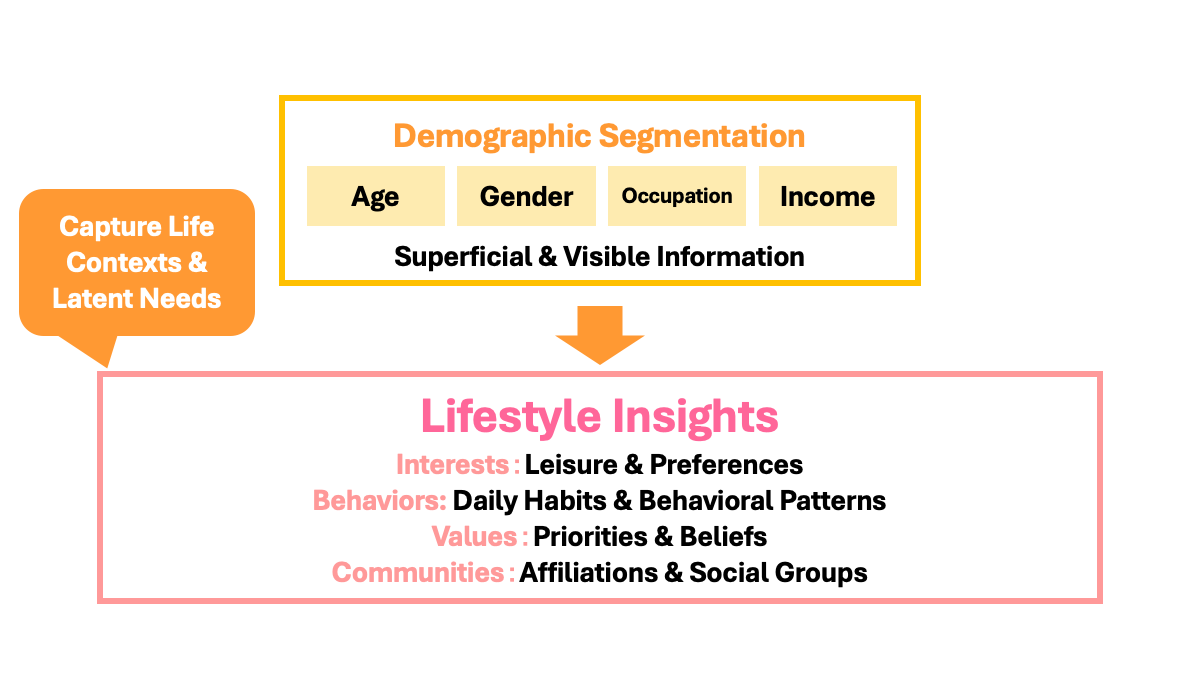
Lifestyle marketing is an approach that categorizes consumers not just by demographic attributes like age and gender, but by criteria such as how they spend their days, their values, and their hobbies and preferences.
| Classification Criteria | Specific Indicators | Marketing Focus |
|---|---|---|
| Attribute-based (Traditional) | Age, gender, place of residence, occupation, income, etc. | Superiority of product functions and price |
| Lifestyle-based | Hobbies, values, how weekends are spent, affiliated communities | Experiences showing how the product is useful in specific life scenes |
Consumer Insights That Cannot Be Captured by Age and Gender Alone
In the past, it was not uncommon to see somewhat consistent purchasing behavior within attributes such as “working women in their 20s” or “men in management in their 50s.” Today, however, people’s ways of working and living have diversified, and it is common for individuals of the same age and gender to have different spending habits and interests. For example, among women in their 30s, some may enjoy watching movies at home on weekends, while others may spend their time actively outdoors. It is now necessary to delve deep into the target’s true feelings and desires—their insights. Understanding in what situations they feel joy and what they feel dissatisfied with is the first step toward effective communication.
Capturing Needs Through Hobbies, Actions, Values, and Communities
To understand consumer insights, it is important to observe their usual hobbies and actions. Furthermore, by knowing the values they hold dear and the characteristics of the communities they belong to, latent needs that are difficult to see from superficial data may emerge. Even for something as simple as how a weekend is spent, the products and services sought will change significantly depending on whether they prioritize time with family or dedicate it to personal skill development. Analyzing what information is exchanged and what they empathize with in online communities is also an effective method. By capturing this information comprehensively, you can see what role your company’s products should play in the target’s life.
In PR, Creating a “Context That Consumers Want to Talk About” is Crucial
When applying lifestyle marketing to the field of PR, it is important to create stories and contexts that consumers themselves will want to share with others. If a company only sends out information unilaterally, it risks being quickly buried in today’s information-overloaded world. When people who have purchased a product feel that it “perfectly matches my values” or “I empathize with this brand’s way of thinking,” they tend to naturally want to share that experience on social media. To elicit this spontaneous sharing, the brand’s message must be naturally linked to the consumer’s daily life and interests. Rather than simply conveying the merits of a product, it is effective to show the new lifestyle gained by using the product or the brand’s stance toward social issues.
Why Lifestyle-Oriented Marketing is Important Now
There are several reasons why lifestyle-oriented marketing has become necessary in today’s market environment.
| Factors of Change | Traditional Characteristics | Currently Required Response |
|---|---|---|
| Commoditization of Products | Differentiation through function and price was possible | Presentation of the brand’s unique values and worldview |
| Main Actors in Information Transmission | Unilateral mass advertising from companies | Sharing of experiences between consumers via social media |
| Criteria for Purchase Decisions | High specs and cost performance | Whether it fits one’s lifestyle or mood |
It is Becoming Difficult to Differentiate Based on Product Specs Alone
With technological progress, many high-quality products have appeared on the market. Since it is easy to obtain a certain level of satisfaction regardless of which company’s product is chosen, consumers are less likely to choose based solely on functional superiority or high specs. If another company announces a new function, it is often quickly followed, frequently resulting in price competition. To differentiate in such a situation, it is necessary to provide consumers with a motivation other than “buying because the function is good.” Emotional values, such as the development story behind the product or the ideal life realized by owning it, will become important.
Consumer Values and Experiences are Visualized on Social Media
With the spread of smartphones and social media, anyone can easily share their personal experiences and values. What consumers are interested in and what they are moved by is now visualized in real time. For companies, this is a valuable source of information for understanding the real-life situations of their targets. By observing posts on social media, it is possible to directly understand in what context your company’s products are being used or what dissatisfactions are being voiced. How to design experiences that are naturally talked about on social media will be a key factor in the success or failure of PR.
Brands are Required to Have a “Reason to Fit into Daily Life”
Even a brand with a wonderful philosophy will not be chosen on a daily basis if it does not fit into the consumer’s actual life. Consumers tend to choose products based on personal and practical criteria, such as whether they match the interior of their room or can be seamlessly integrated into their daily routine. Brands are required to propose specific usage scenes, such as “this product stays close to this mood of yours” or “using this service makes a tedious habit more enjoyable.” To get consumers to see the brand as relevant to them, an attitude that respects their daily activities is more important than company-centric messaging.
Corporate Challenges That Can Be Solved with Lifestyle Marketing
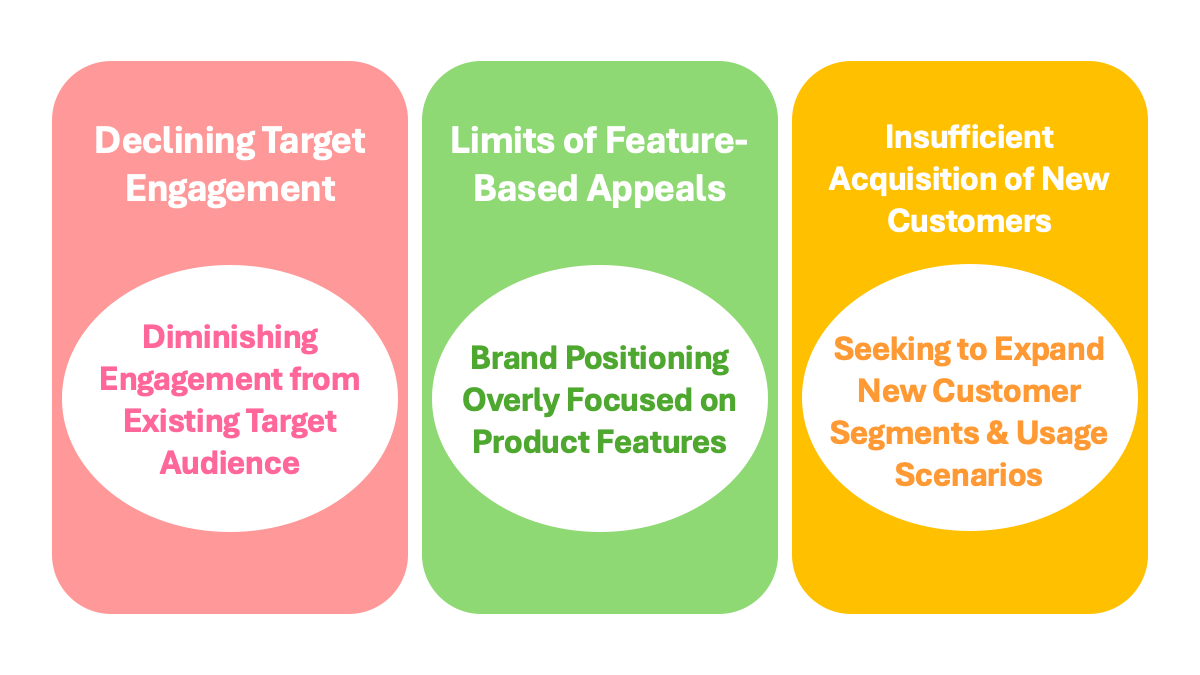
Lifestyle marketing is said to have the power to solve various communication challenges faced by companies. If you feel that your current measures have reached their limit, you may find a new way forward by changing your perspective.
| Challenges Faced by Companies | Solution Approach from a Lifestyle Perspective |
|---|---|
| Declining Target Response | Re-segmentation based on values rather than attributes |
| Limits of Functional Appeal | Presentation of emotional benefits in daily life |
| Insufficient Development of New Customers | Creation of brand touchpoints in different life scenes and communities |
Response from Existing Targets is Becoming Dull
When marketing to the same target for many years, ad click-through rates may drop or participation in campaigns may decrease. This is thought to be because not only has the age of the target group increased, but the lifestyle itself has changed with the times. If you are bound by past data and assume that “this message should resonate with this attribute,” there is a risk of a gap between your message and the current real-life feelings of consumers. When you feel that the response has become dull, it is a good idea to remove the framework of attributes and re-observe with a flat perspective what they are currently interested in and what kind of life they are leading. By updating the brand’s proposals in line with changes in values and lifestyle habits, you may be able to reconnect with communication that moves the target’s heart.
Brand Presentation is Biased Toward Functional Appeal
Companies that focus on product development tend to lean toward functional appeals, such as “formulated with new ingredients” or “lighter than previous models.” However, even when presented with technical terms and detailed figures, general consumers often find it difficult to intuitively understand how it relates to them. When functional appeal is central, a “translation” process is required to show how that function solves the consumer’s problems and what joy it brings. For example, for a lightweight laptop, rather than simply stating the weight in grams, it should be conveyed as “the lightness to work freely in any location, such as a cafe or a travel destination.” By shifting the brand’s presentation from function to experience, consumers will find it easier to feel that they want to incorporate the product into their lives.
Wanting to Develop New Customer Segments or Usage Scenes
To grow a business, it is necessary to reach out to new customer segments beyond existing frameworks and develop usage scenes that were not previously envisioned. A cross-sectional approach like lifestyle can be useful. For example, by proposing outdoor goods not only to serious climbers but also to “people who want to relax on their balcony on weekends” or “families with high disaster prevention awareness,” new markets may be born. It is important to imagine how a product fits into the lives of people with different values, without being bound by its original purpose. By discovering unexpected usage contexts and developing appropriate PR measures for them, the possibilities for the brand will expand significantly.
Analysis and Planning Steps to Find Consumer Context
From here, we will explain the specific steps to actually find the consumer context and incorporate it into PR planning. The key to success is not to end with mere data analysis but to link it to executable measures.
| Step | Specific Actions to Execute |
|---|---|
| 1. Understanding Life Scenes | Investigate not only purchase history but also preceding and succeeding actions and social media posts |
| 2. Designing Usage Context | Describe in what mood or situation the brand is needed |
| 3. Integration of Touchpoints | Connect measures such as media exposure, social media, and events in a consistent context |
Understanding Life Scenes Beyond Purchase Data
The first step of analysis is to understand the entire life scene behind the purchase, not just the purchase data at hand. Looking only at the resulting numbers of who bought what and when often makes it difficult to see the reason why they chose it. It is important to imagine the series of processes from when the consumer becomes aware of the product to the purchase, including what places they visited, what media they were exposed to, and who they talked to. It is also important to capture the overall picture of their life, such as how they use and store the product after purchase and how they eventually dispose of it. Through this process, you may discover small dissatisfactions the target has or habits they perform unconsciously.
Designing “Usage Context” Rather Than Personas
Many companies create detailed personas or communities to increase the resolution of their targets, but there are cases where they are satisfied with creating a fictional character and fail to fully utilize it in actual measures. What is important is to design the usage context: “in what situation and in what mood” the person picks up the product. For example, you should describe specific scenes such as “the moment on a Friday night when you want to treat yourself a little to heal the fatigue of the week” or “the moment during a busy morning when you flip a switch to change your mood.” Once the context is clear, it should naturally become apparent what message should be delivered and at what timing.
Incorporating into Media, Social Media, and Event Touchpoints
Once the usage context is designed, it is incorporated into specific customer touchpoints. In modern PR, it is necessary to organically link multiple channels rather than completing everything in a single medium. You should deeply convey the brand’s worldview in a special feature article in a web medium and prepare hashtags that make it easy for people who read the article to share their thoughts on social media. Furthermore, it is important to place brand experiences along the consumer’s path, such as holding pop-up events at stores or commercial facilities where they can experience that worldview in real life. By connecting a series of experiences in a single context, consumers will have a consistent impression of the brand and find it easier to see it as relevant to them. A design that overlooks the whole is required so that each measure does not end as a one-off.
Key Points for Successful Lifestyle Marketing from a PR Perspective
To link lifestyle marketing to PR results, there are several points to keep in mind. We will explain the techniques for spreading information to the world and creating social movements.
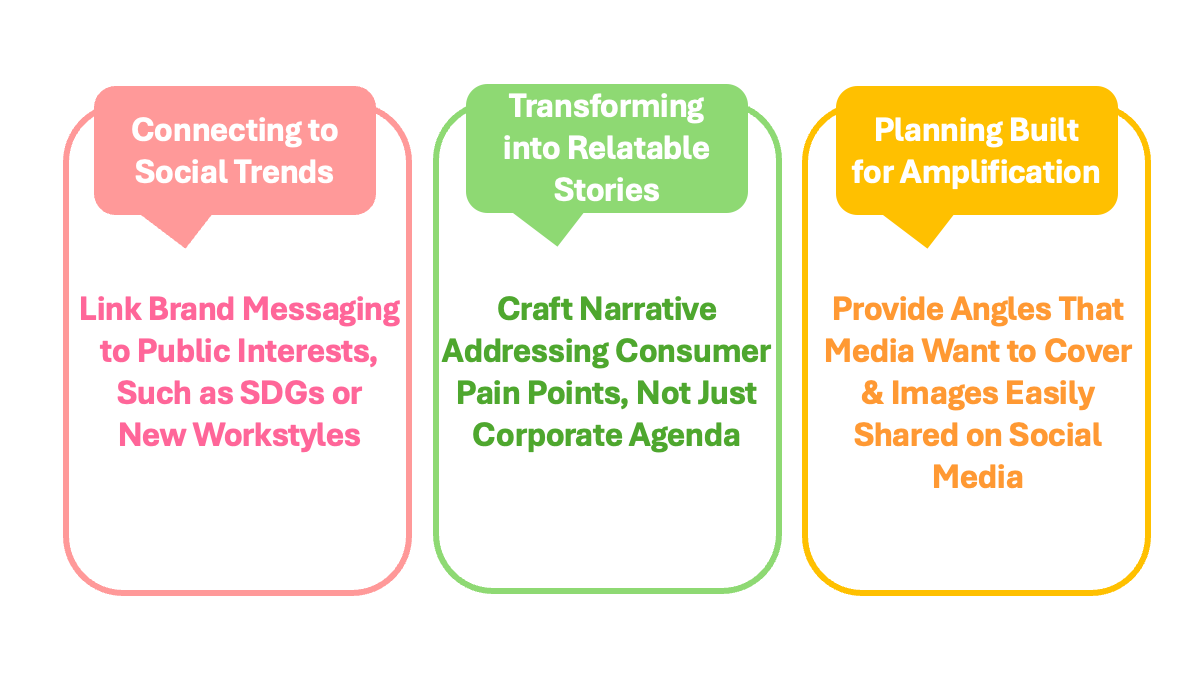
Connecting Social Trends and Brand Value
Media outlets want to cover something as news because they feel it is meaningful information for today’s society. When conducting PR for your company’s products, it is effective to connect the brand’s value not only to the appeal of the product itself but also to current social trends and public interests. For example, if interest in environmental issues is high, angles such as the background of using sustainable materials or proposals for a lifestyle that can be continued for a long time tend to attract media attention more easily. By positioning your brand within the larger context of the world, you may be able to give it social significance. Rather than simply jumping on a trend, sincerely talking in your own words about how the brand’s underlying philosophy connects with the trend will lead to trust.
Converting into Stories That Consumers Can Easily Empathize With
It is not uncommon for there to be a gap between the information the company wants to convey and the information the consumer wants to know. The role of PR is to bridge this gap by converting the message from the company into a story that consumers can easily empathize with. Rather than simply conveying the developer’s secret production stories or unique technical capabilities, it is better to refashion them into a consumer-oriented story: “Because of this technology, this daily stress of yours will be resolved.” By including familiar episodes that anyone experiences daily, it will be easier to gain a sense of closeness. Honestly sharing a few failure stories or hesitations during the development process can sometimes be more human and evoke empathy.
Planning Based on the Premise of Media Exposure and Social Media Diffusion
It is important to assume how the media will report it and how it will be spread on social media from the planning stage of PR measures. Even if you try to force a topic later, there are many cases where you cannot obtain the desired effect. For the media, it is good to provide catchy keywords that could become article titles as they are, or visually impactful survey data. For social media users, it is effective to prepare experiential content that they will want to take photos of and share, or questions that make them want to participate in a discussion.
Cases Where You Should Consult on Lifestyle-Oriented PR Design
While we have conveyed the importance and practical methods of lifestyle marketing, there are many cases where it is difficult to fully execute these within the company alone. Since objective perspectives are often helpful, we will introduce cases where consulting a specialized PR company can be a shortcut to a solution.
| Challenges Easily Faced Internally | Solutions Obtained by Consulting a PR Company |
|---|---|
| Target Image is One-Dimensional | Can extract three-dimensional consumer insights based on unique research and knowledge |
| Cannot Escape Company-Centric Messages | Can translate into words that resonate with consumers from an objective third-party perspective |
| Measures End as One-Offs | Enables integrated strategic design across media, social media, and real events |
Target Setting Stops at Attribute Information Alone
When setting marketing strategies internally, there is a tendency to rely on existing customer data and easily obtainable attribute information. Many companies may struggle with being unable to escape rough target settings such as “for women in their 30s” and being unable to imagine specific life scenes. PR companies handle projects in various industries daily and are exposed to the latest consumer trends. They can analyze targets from a unique perspective not found within the company and propose new communities and value angles. By redefining the target from an objective standpoint, you may find ways to approach potential customer segments that you had not noticed before.
Product Value is Not Verbalized from a Consumer Perspective
Because of the affection and pride you have for your own products, you tend to talk about their appeal from a provider’s specialized perspective. Even if you understand the excellent points of a function, the task of putting it into simple words like “how it is good for life” is difficult for those inside. PR professionals often have the skills to organize complex information and translate it into stories that consumers can intuitively understand. Without losing sight of the core value the company truly wants to convey, they will reconstruct it into a context that moves the hearts of readers and consumers. If attractive verbalization is achieved, the media will also find it easier to cover, and as a result, the brand’s message will reach more consumers more easily.
Wanting to Create a Brand Context That is Chosen by Consumers
If each department is conducting measures separately, such as social media posts, in-store experiences, and article exposure through media, there is a risk that the message as a whole brand will become blurred. To deeply penetrate the consumer’s mind, high planning ability is required to connect each touchpoint with a single “brand context.” This integrated strategic design is considered an area where PR companies excel. While taking social trends into account, they should be able to comprehensively produce when to use which media and what kind of experience to provide at events to naturally blend into the consumer’s daily life. If you want to build a three-dimensional lifestyle marketing system that is difficult to achieve on your own, it is a good idea to consult with PR experts from an early stage.
To succeed in lifestyle marketing, a perspective that elevates the value of products and services into matters of public interest is important. In SUNNY SIDE UP’s “Strategic Planning,” we utilize PR knowledge to design contexts that resonate with the target’s daily life. Through an integrated approach that combines advertising and sales promotion, we can help spread the brand’s appeal to the entire market. If you are looking for specific measures to move consumers’ hearts, please visit our service details page.
Summary: Capture Values and Move Customers’ Hearts with Lifestyle Marketing
Here is a summary of the key points of this article. What is first important in practicing lifestyle marketing is not to rely solely on attribute data, but to delve deep into insights from consumer values and daily habits. In doing so, it is necessary to move away from product functional appeals and carefully design a usage context showing how it fits into life scenes. Furthermore, by linking social trends and the brand, it is important to create empathetic stories that consumers will want to tell someone about. And being conscious of integrated PR that connects diverse touchpoints such as media exposure, social media, and real experiences in one context is thought to increase the effectiveness of the overall measures. If it is difficult to escape a company-centric perspective, consulting a PR company with an objective eye is also an effective means. Let’s stay close to the real emotions of consumers and grow the brand into an indispensable presence in their daily lives.
At SUNNY SIDE UP, we accurately capture the latest trends and consumer insights to comprehensively support marketing measures that generate empathy. Even if you “don’t know what kind of development is suitable for your company,” please feel free to consult us. We will propose the most suitable plan, so we look forward to hearing from you through our inquiry desk.
CONTACT « SUNNY SIDE UP GROUP Inc.