How to Plan a Press Conference: How to Create an Announcement Event That Reaches the Media
- カテゴリ:
Many of you may have been tasked by your supervisor with holding a product or service launch event, yet are unsure where to begin. In this article, we explain in detail how to plan a press conference that attracts media interest, as well as the preparation process to ensure smooth operations on the day. By the time you finish reading, even if it is your first time planning such an event, you should have a clear set of concrete steps to facilitate internal coordination and successfully drive media attendance.
What Is a Press Conference? When You Should Hold One
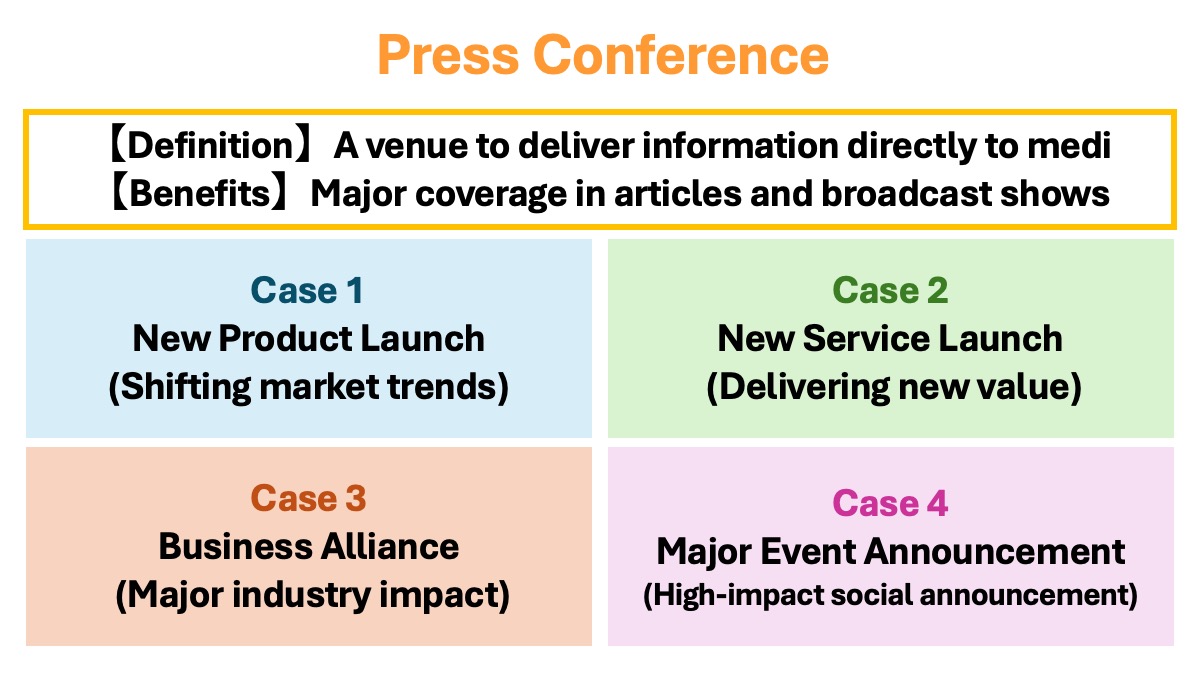
A press conference is an approach companies use to communicate important information to society. Its defining feature is that, rather than simply releasing information, the company invites reporters and editors to a venue and provides a direct, thorough explanation. Let us unpack the fundamental thinking behind when this method should be chosen.
| Item | Overview / Details |
|---|---|
| Definition of a press conference | A forum where media representatives are gathered to announce a company’s latest information directly and take questions |
| Typical use cases | New product launches, new service rollouts, business partnerships with other companies, announcements of mid- to long-term management strategies, etc. |
| Greatest benefit | Increases the likelihood of being featured prominently in articles or programs, leading to greater awareness |
A press conference is a venue for directly communicating a company’s important announcements to the media.
A press conference is an event held when a company discloses news that can have a major impact on society. When executives or development leaders convey the passion and background in their own words, it can enhance the credibility and depth of coverage. For the media as well, it is a valuable reporting opportunity because they can ask questions on the spot and dig deeper. For this reason, it is generally held at key milestones that go beyond a simple factual announcement—moments that can influence the company’s future.
Well-suited to new products, new services, business partnerships, and major event announcements
Not every piece of news is suited to a press conference; there are themes that are appropriate for holding one. Specifically, examples include new products that could change market trends and business partnerships that may affect the industry landscape. Announcements of major events with significant social value can also serve as a compelling rationale for holding a press conference. Because the media can more readily judge that readers and viewers will be interested, the likelihood of journalists attending increases.
Effective for content that is difficult to convey through a press release alone
Press releases made up only of text and images are convenient, but there are limits to conveying nuance and passion 100%. For example, the feel of operating a product that uses proprietary technology, or the sincere intentions executives have behind a partnership, are best communicated face-to-face. In addition, allowing journalists to experience something with their own senses helps foster a realistic impression that supports stronger writing. In this way, when you want to communicate appeal in a more three-dimensional way beyond the confines of text, planning a press conference truly demonstrates its value.
[Related article] What Is a Press Release? Strategies and Tips to Increase PR Impact! « Column
What to Clarify Before Planning a Press Conference
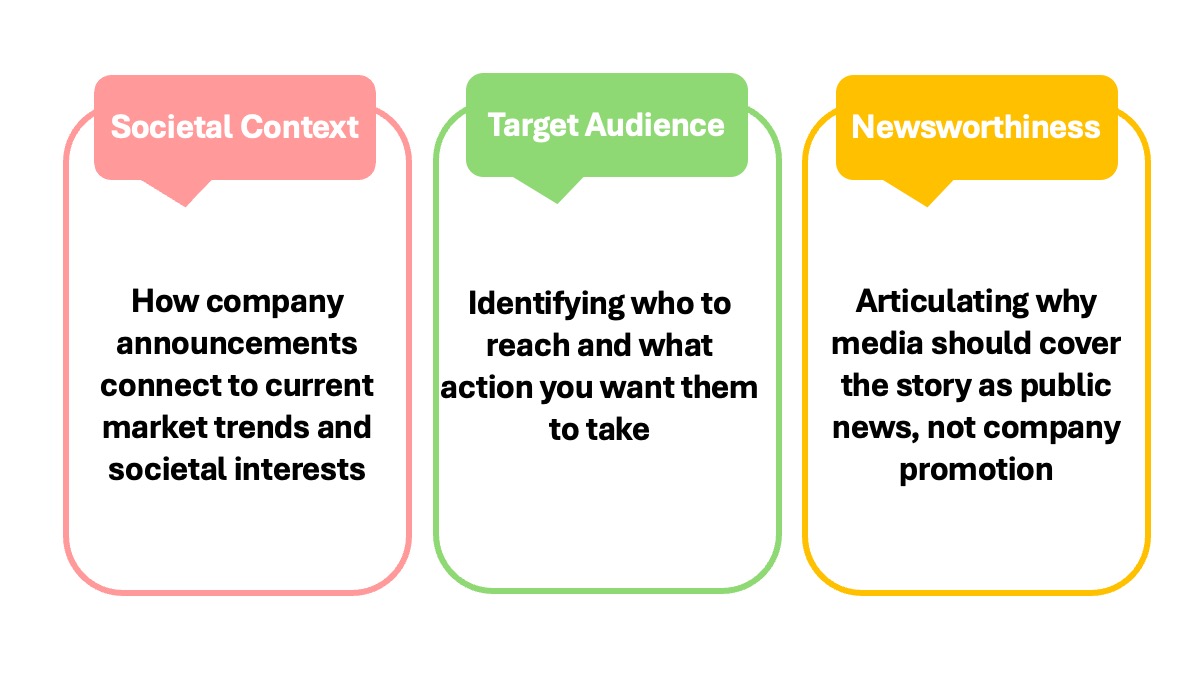
If you start drafting a proposal right away, it can easily become content driven by the company’s self-satisfaction. First, you must organize the objective factors that form the essential prerequisites for the media to come and cover the event.
【Related Article】 What is News Value? Explaining How to Create and Deliver Information That Gets Picked Up by the Media « Column
The social context of why you are announcing it now
What the media values is what the information means “right now, for society.” No matter how excellent a product may be, if it is out of step with the times or public interests, it will not be treated as news. You are expected to link your initiatives to currently highlighted social issues and changes occurring within the industry. A clear answer to the question “Why now?” will determine how persuasive your plan is.
The message of what you want to communicate, and to whom
Clarify the readers or viewers you are addressing, and narrow the core message you should deliver to a single point. If you try to cram in too much information, it becomes unclear what you are trying to say, and the media will find it difficult to turn into an article. By sharpening the central message, the axis of speakers’ remarks and distributed materials will remain consistent. It is important to imagine your audience specifically and select the words and angle that will resonate most.
Newsworthiness that gives the media a reason to cover it
The media is not an organization that helps companies advertise; it is an institution that delivers useful news to the general public. Therefore, you must explain what kind of surprise or benefit your novelty and uniqueness will bring to society. Look for elements that make reporters feel, “This must be covered,” such as being the first initiative in the industry or dramatically changing conventional methods. Unearthing this newsworthiness is precisely the critical area where PR professionals should devote significant time during the planning stage.
Elements to Include in a Press Conference Plan That Resonates with the Media
Once the preliminary preparation is complete, you will move into the stage of building the concrete content of the plan. Let us incorporate compelling content that makes the media want to add it to their reporting schedule.
| Media type | What they look for and how to incorporate it into the plan |
|---|---|
| Television (video media) | Dynamic staging, high-profile speakers, facial expressions during hands-on experiences—“scenes that look good on camera” |
| Newspapers / business magazines | Detailed market data, the story behind development, and evidence of social impact |
| Web / social media | Catchy phrases readers will want to share, and images that look good on smartphones |
Reframe the announcement into an “angle that becomes news”
Even if you write the functions and features your company wants to promote as-is in the proposal, it will not resonate with the media. You need to combine those features with consumers’ concerns and social trends and present them as a “snapshot of society.” For example, rather than simply a time-saving cooking device, rephrase it as “a proposal for new eating habits for time-efficiency-minded businesspeople.” With just a slight change in angle, a typical corporate product announcement can be elevated into social news.
Design the “visuals” through speakers, staging, and hands-on elements
Especially if you want to attract television or web media, designing the visual elements—visual planning—is extremely important. Footage of a president simply speaking seriously can look dull, so incorporate product demonstrations and unique staging. It is also effective to set aside time after the announcement for journalists to actually touch the product or sample it. Please intentionally build symbolic moments into the schedule—moments that make photographers want to press the shutter.
Consider how it will “look” across TV, web, newspapers, and social media
Because journalists from various outlets attend press conferences, you must prepare materials in a well-balanced way that meets each outlet’s needs. In addition to flashy staging favored by television, it is essential to provide detailed data materials and graphs that satisfy newspaper reporters. For web media, set up a system to share high-resolution product images online so they can be easily reused in articles. The key to success is ensuring that every representative can return to their desk and write smoothly.
[Related article] What are the key points for operating a corporate account? Explaining design methods to be loved by fans from a PR perspective « Column
Preparation Steps for a Press Conference Plan
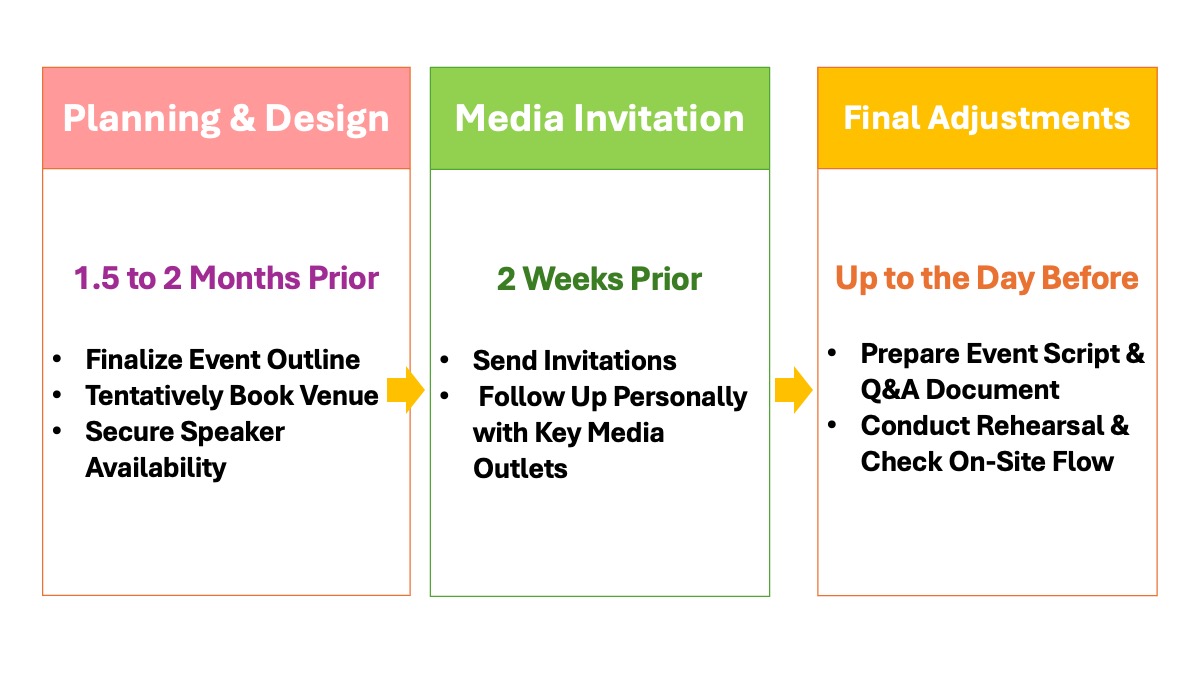
To ensure a press conference succeeds without issues, you need back-planned schedule management and careful execution of each step. To avoid scrambling on the day, make sure you fully understand the tasks required at each stage. Below, we explain the main steps needed up to the day of the press conference and the tasks for each period.
1.5 to 2 months before: Plan design, venue selection, and speaker coordination
This period is the most important phase for building the foundation of the press conference, during which you finalize the planning concept internally. At the same time, proceed with booking an event venue or hotel in the city center that is easy to access and convenient for the media to attend. Secure schedules for the executives who will speak, and, as needed, begin negotiations with external speakers such as guest talent or experts. Careful consensus-building at this early stage will determine the pace of all subsequent work.
2 weeks before: Send invitations and conduct media outreach
About two weeks before the event, send invitations to media representatives in a single distribution. The invitation should clearly state not only the date, time, and venue, but also what news will be announced and what kinds of visuals can be captured. Do not stop at sending it—approach key outlets you especially want to build relationships with individually by phone or email. Because reporters’ schedules fill quickly, proactive outreach during this period greatly affects attendance.
Up to the day before: Script, Q prep, reception, and flow-line checks
In the period immediately before the event, focus on fine-tuning to perfect day-of operations. Create a minute-by-minute run-of-show script, and verify teleprompter use and slide-switching timing so speakers can present smoothly. In addition, to avoid being caught off guard by sharp questions, review an anticipated Q document with the executive team and practice responses repeatedly. Conduct on-site rehearsals down to details such as the business card exchange flow at reception and photographers’ shooting positions.
Common Pitfalls in Press Conferences
If you are overseeing a press conference for the first time, there are several traps where well-intentioned actions can backfire. It is important to learn from many past failure cases and adopt a perspective that helps you avoid risks in advance.
| Failure pattern | Cause and resulting risk | Approach for improvement |
|---|---|---|
| Company-centric PR | Lacks objective newsworthiness and focuses only on what the company wants to say, causing reporters to lose interest | Tie it—even if forcefully—to social issues or trends, and add a perspective that serves the public interest |
| Inadequate filming environment | Insufficient camera seating or lighting adjustments prevent capturing clean video or photos | Rehearse in advance from the photographer’s perspective and finalize equipment placement |
| Insufficient post-briefing coordination | Ends as a one-day event and does not lead to subsequent coverage or sales activities | Create a plan in advance for secondary use of materials and share it with relevant internal departments |
【Related Article】 What is Media Relations? Explaining the Basics You Should Know and 5 Points for Success « Column
It focuses only on what the company wants to say, with a weak media perspective
A common failure is a case where the company unilaterally delivers an impassioned pitch about product specs and its own commitments. Even if it is big news for the company, if there is no perceived social significance, reporters may leave midway through. Always remember the hard-nosed perspective of “Is this something ordinary readers would pay money to read?” Rather than pushing corporate promotion, it is important to foreground the stance of providing new value to the market.
The day-of visuals and filming flow lines are not designed
Issues also frequently occur, such as lighting being too dark to capture speakers’ faces clearly, or obstacles in front of camera seating preventing filming. In particular, TV cameras are fixed on tripods, making it difficult to move them once positions are set. Clearly separate areas for still cameras and video cameras, and secure space that allows shooting from any position without obstructions. If such detailed consideration is lacking, media satisfaction will decline and may lead to refusal to cover future events.
There is no plan through post-briefing coverage, social sharing, and sales use
There are many cases where teams feel satisfied simply because the press conference day ends without incident, and neglect follow-up afterward. You are expected to move quickly, such as sending breaking materials and on-site photos to media outlets that could not attend immediately after the briefing ends. It is also important to consider how to introduce the resulting coverage on your website and social media, and how to use it as a sales tool. Rather than viewing the event as a single point, design it as a starting point connected to mid- to long-term promotion.
Benefits of Hiring a PR Agency to Plan a Press Conference
As explained so far, executing a press conference perfectly with only in-house resources requires enormous effort and specialized know-how. If you feel you lack resources or experience, seeking support from a professional PR agency is also a wise option.
| Support area | Specific value a PR agency provides |
|---|---|
| Refining the plan | Proposes powerful angles and staging that attract media interest from an objective perspective |
| Media network | Leverages proprietary connections to attract reporters from influential outlets you cannot reach on your own |
| Day-of operations and crisis management | End-to-end support for running the briefing, including schedule control, reception, and rapid response to issues |
You can refine it into a plan the media will want to cover
Because PR agencies interact daily with many media professionals, they have a deep understanding of what kinds of story ideas those professionals are currently seeking. They can draw out hidden appeal in your product that you may not have noticed and elevate it into a highly newsworthy plan. Bringing in an objective third-party perspective is expected to significantly reduce the risk of the content becoming self-serving. There is also a secondary benefit: when passing internal review, professional backing increases persuasiveness.
They can support everything from media outreach to day-of operations and crisis management
Because they maintain proprietary lists covering contact information for influential media outlets, they can conduct effective media outreach. They can also handle complex reception operations, guide reporters, and respond to sudden equipment issues with experienced staff. In the unlikely event that unfavorable questions arise during Q, you can also receive comprehensive advice on appropriate ways to respond. This enables PR staff to focus on core tasks such as supporting executives and greeting key reporters.
They can design an end-to-end approach to maximize exposure after the announcement
Even after the press conference ends, PR agencies can individually follow up with each outlet to encourage coverage. They can re-approach TV program producers and newspaper editors using footage and materials from the briefing, expanding the potential for exposure. You can also receive consistent advice on measuring the impact of coverage and linking it to the next PR initiatives. When you want to achieve maximum results with limited budget and staffing, a PR agency can be a reliable partner.
As introduced above, the know-how of a specialized PR agency is a major force in leading a press conference to success. At SUNNY SIDE UP, we leverage a strong media network and an objective perspective to provide total production of press conferences that capture public interest. Because you can entrust us with complex arrangements and day-of operations, your team should be able to focus on core responsibilities. If you are considering how to plan a press conference, please review the details of our services.
Conclusion: Deliver a Press Conference That Reaches the Media Through Thorough Planning and Preparation
To summarize the key points of this article: The key to a successful press conference is to thoroughly organize the social context and newsworthiness in advance, and plan with angles grounded in a media perspective. To do so, you should proceed with preparation in a structured manner starting two months before the event, and build operations that consider visual planning on the day and how it will appear across different media types. If you lack in-house experience or resources, relying on a PR agency’s specialized know-how and network can also help maximize media exposure. Using the steps outlined here as a reference, why not begin by identifying the “social context” that makes your announcement timely and relevant?
If you feel uncertain about planning an in-house press conference or lack sufficient resources, consulting a specialist firm is the quickest path to success. At SUNNY SIDE UP, we leverage strong media relationships and objective planning capabilities to produce press briefings that capture public interest. If you have an important announcement coming up that you absolutely cannot afford to fail, please feel free to contact us using the form below. We will propose the optimal support plan to maximize your company’s appeal.