What is Fan Marketing? Explaining How to Build a Long-Loved Brand from a PR Perspective!
- カテゴリ:
The era of “if you make something good, it will sell” has passed, and many people no longer choose products based solely on functionality or price. Whether they can empathize with the creator’s passion behind the scenes or the company’s stance has become an important criterion for selection. If the role of public relations and PR is not just to be featured in the media, but to build good relationships with society and the people around them, then fan marketing can be said to play the most important role. How can we ensure that a brand continues to be loved forever, rather than ending as a temporary boom?
In this article, we will re-examine the true meaning of fan marketing from a PR perspective and unravel the hints on how to actually proceed, one by one.
What is the Essential Definition of Fan Marketing?
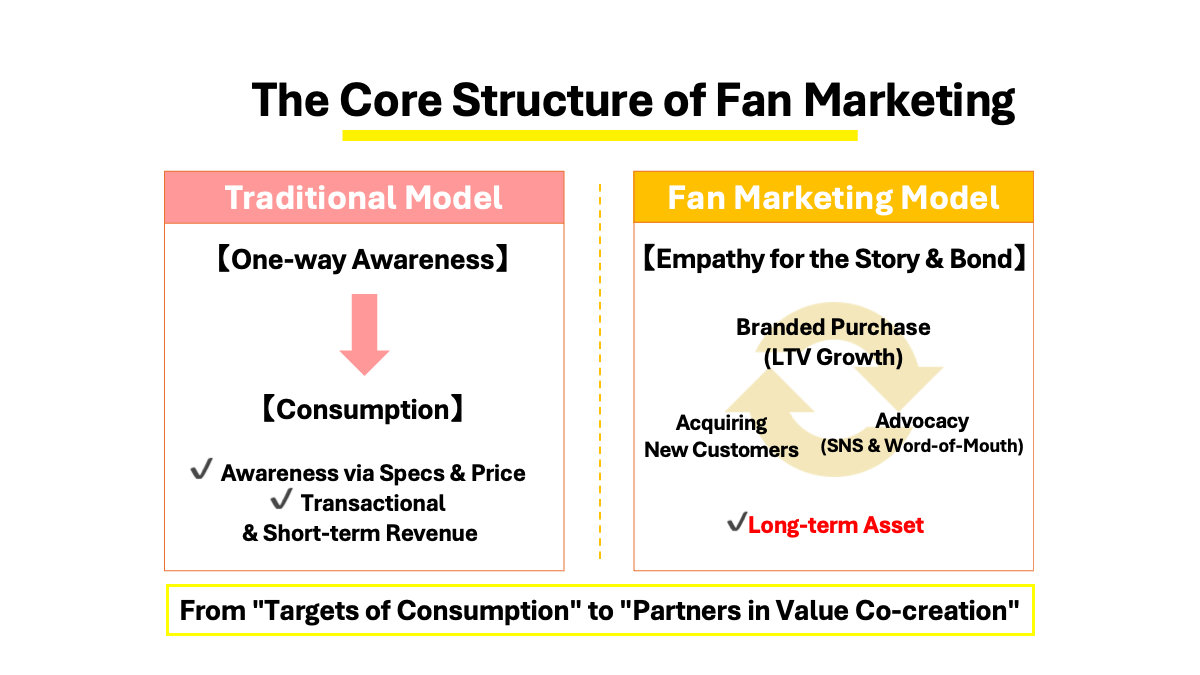
Fan marketing is a method that aims to improve medium- to long-term sales and strengthen brand value by valuing “fans” who enthusiastically support a specific company or brand and deepening the emotional connection with them. The original role of public relations and PR is to build healthy relationships with stakeholders. It begins by viewing customers not just as “consumers,” but as “partners” who enhance the value of the brand together.
[Related article]What is Public Relations? A thorough explanation for beginners, from job description to how to develop a strategy! « Column
Designing “Relationships” Rather Than “Awareness”
Traditional marketing has prioritized “awareness”—getting the name known—above all else. On the other hand, fan marketing aims to go beyond being known and foster a strong “bond” between the brand and its customers. Instead of appealing only through product functionality or price, we build a deep relationship of trust where customers say, “I like it precisely because it’s this brand,” by having them empathize with the company’s vision and story. A major characteristic of fan marketing is the emphasis on creating a deep and long-lasting bond with each individual.
LTV, Designated Purchases, andMechanisms that Generate Recommendations Mechanism for generating
As the bond with fans deepens, they will choose your brand by name, saying “because it’s a product from this brand,” rather than comparing it with other companies’ products. Not only will there be no need to compete on low prices, but customers will also use a single product for a long time, and the relationship with them will become deeper. An even greater power is the recommendation by the fans themselves. Fans who enthusiastically support a brand will naturally spread its merits to family and friends or share positive voices on social media. Fan marketing is the very mechanism that creates a “virtuous cycle” where current customers bring in new ones, and positive connections spread one after another.
The Difference Between Short-Term Measures and Long-Term Assets
Fan marketing differs significantly in nature from measures such as campaigns and advertisements that aim for temporary sales growth. The process of listening carefully to customers’ voices and accumulating sincere interactions certainly takes time. However, the relationship of trust built there becomes a valuable asset for the company. Rather than ending as a mere temporary fad / customer acquisition, the true goal is to foster an “emotional connection” that continues to support the brand even in times of social instability or difficult situations.
Why Companies Need a Fan Strategy Now
In the current situation where there is hesitation toward advertising and information is overflowing, it is difficult for a company’s message of “this is a good product” to reach customers’ hearts. What is important in this day and age is to create a situation where trustworthy people around them naturally talk about the good points of the brand. Fan marketing that incorporates the concepts of public relations and PR becomes a force that naturally creates this “flow of trust being transmitted one after another.”
| PR Perspective Elements | Specific Effects | Expected Results |
|---|---|---|
| Sincere Information Disclosure | Eliminate customer anxiety and build trust | Reduction in churn rate |
| Context Design | Generate empathy for the brand story | Cultivation of attachment |
| Dialogue with Stakeholders | Turn customers into allies | Improvement of brand defense |
| Connection with Society | Recognized as a socially significant entity | Strengthening of recruitment power |
The Advertising-Dependent Model Has Its Limits
In the current environment surrounding digital advertising, while the burden of advertising costs continues to increase, it is becoming difficult to deliver information to customers as intended due to the impact of regulations. The current reality is that the customer mobilization model, which simply spends money to get the name known for reach purposes, is gradually reaching its limits. Because people are exposed to so much information every day, they have become sensitive to advertisements that they feel are being “forced” on them, and it is becoming harder for their hearts to be moved by mere advertising slogans. Instead of methods that buy temporary attention, there is a need for a shift toward a mechanism where customers naturally want to hear more while valuing trust and empathy.
The Fact That Social Media Followers Do Not Necessarily Lead to Sales
It is often thought that “if followers increase, sales will also grow,” but in reality, this is not necessarily the case. This is because people who gather only to obtain benefits such as campaigns, or those who are just looking at posts, do not necessarily actually purchase products or recommend them to someone. What we want to look at here is not the superficial “large numbers,” but the “high level of passion”—how close they feel to the brand and how much they value it. Rather than hundreds of thousands of people who know the brand broadly and shallowly, the existence of tens of thousands or thousands of “fans” who truly love the product and enthusiastically recommend it to those around them will be a great force supporting the steady growth of the brand.
Sustainable Brand Growth Requires “Relationship Assets” with Customers
In this day and age where the population is decreasing and goods are overflowing, there is a risk that the method of constantly chasing only new customers will become unsustainable. What is required now is to carefully accumulate the trust built with customers you have already met as an “irreplaceable asset” of the brand. The bond built by growing the brand value together with fans as important partners should become a reliable foundation.
Does Your Company’s PR Have These Challenges?
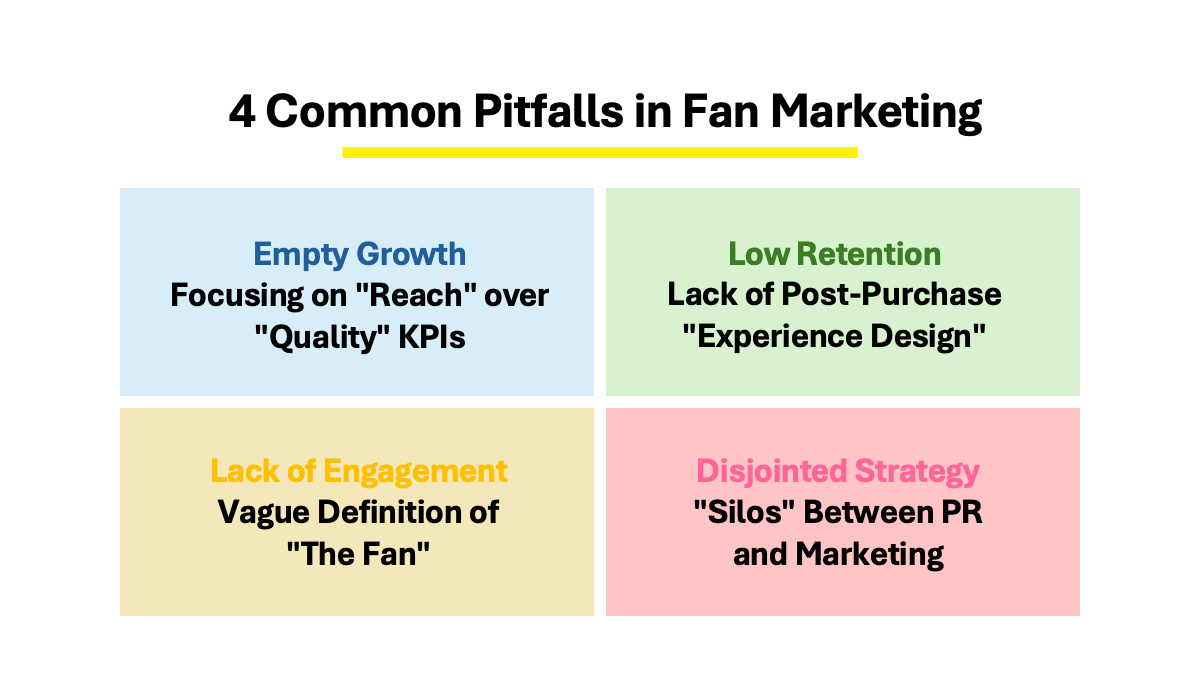
In recent years, many companies have realized the importance of fan marketing and have begun to work on initiatives. However, when it comes to actual practice, it is not uncommon to hit walls such as “not getting the expected results” or “not knowing what the right answer is.” First, let’s check if your company has fallen into the following patterns.
| Signs of Challenges | Assumed Factors |
|---|---|
| Only Social Media Metrics Grow | The goal has become short-term “numbers,” and high-quality relationship building is not being achieved. |
| Low Repeat Rate | Resources are biased toward new acquisition, and follow-up for existing customers is insufficient. Or the churn rate of existing customers is high. |
| Community Depopulation | It is unclear “who the place is for,” and the benefits of participating are not being communicated. Or the community space is not well-maintained. |
| Inconsistency in Initiatives | There is no coordination between the PR department and the marketing department. Initiatives remain as isolated “points” rather than a continuous “line.” |
Social Media Reactions are Increasing, but They Don’t Lead to Purchases or Inquiries
It is very common to worry that despite the steady increase in the number of followers and “likes” on official social media, it does not lead to results such as actual sales or inquiries. The main cause is thought to be that the key performance indicators (KPIs) for fan marketing are placed simply on the “number of contacts.” Even if temporary attention is gathered through gift campaigns, if the group does not empathize with the product’s value or the brand’s philosophy, it is difficult to lead to purchasing behavior. What is important is not the superficial quantity of numerical values, but the “quality.” It is necessary to review whether the posted content solves the target’s problems, whether it provides benefits to the target, or whether it correctly conveys the brand’s worldview.
New Customers are Being Acquired, but Repeaters are Not Increasing
Even if new customers can be acquired, a state where they do not lead to a second or subsequent purchase and you are constantly chasing new ones is also a cause for concern. Are you in a state like constantly drawing water with a leaky bucket? The essence of fan marketing lies in deepening the relationship with customers once a point of contact has been established and increasing LTV (Customer Lifetime Value). However, not a few companies neglect the design of the post-purchase experience and communication for existing customers. It is required to focus on measures to prevent the departure of existing customers as much as, or even more than, new acquisition, and on measures to convey gratitude and a sense of specialness to loyal customers.
The Definition of Fans is Vague, and the Community is Not Functioning
There are also cases where a community for fans has been created, but the conversation does not liven up and it consists only of announcements from the management side. Many of the causes lie in the fact that operation has begun while the definition of “who is a fan” remains vague. If the definition is not fixed, such as whether it is “a person who purchases the company’s products more than X times a year” or “a person who empathizes with the brand’s values and recommends it,” the purpose of the community will become blurred. To create a high-passion community, first clarify the image of the core fans. Then, it is necessary to provide topics and activities that will please the fans.
PR/Public Relations and Marketing Activities are Fragmented
As a structural problem of the organization, there is also the challenge that the PR/Public Relations team and the marketing team are moving separately, and their initiatives are not coordinated. For example, while PR is trying to achieve media exposure as an “environmentally friendly sustainable brand,” the marketing site is repeatedly holding “bargain sales.” This creates a contradiction in the message, and customers may end up feeling distrust toward the brand. In fan marketing, consistency (integrity) is an important element of trust building. The key to success lies in sharing information across departmental boundaries and establishing a system to deliver a unified story as a brand.
If you want to make fan marketing a success, leave it to SUNNY SIDE UP. Utilizing our media relations and planning capabilities, we will realize information dissemination that deepens the emotional bond with fans. We can provide consistent support from press releases and PR events to media training. Professionals with extensive experience support the long-term relationship building between brands and customers. Please feel free to contact us first.
Factors Why Fan Marketing Initiatives Do Not Go Well
While many companies challenge fan marketing, they fail to achieve the desired results and give up. A major reason for this is that they view fan marketing only as a “convenient tool for increasing sales.” If you chase only the numbers in front of you while forgetting the perspective of public relations, it could lead to the unfortunate result of customers’ hearts moving away instead.
| Failure Factors | Common Mistakes | Hints for Improvement |
|---|---|---|
| Numerical Supremacy | Chasing only reach and clicks | Use the quality of conversation with customers as a metric |
| Solicitation by Benefits | Trying to increase fans with simple incentives |
Be conscious of connecting through shared values |
| One-Way Communication | Continuing only announcements from the company | Create space for customers to participate (interactive design) |
| Organizational Sectionalism | What PR and sales are saying is different | Share the brand’s ideal and desired state across the entire company |
[Related Articles]Explaining Strategies to Increase Brand Awareness from a PR Perspective! Practical Design Leading to Nominations and Inquiries « Column
Chasing Short-Term Sales and Losing Long-Term Perspective
A typical example of fan marketing not going well is seeking sales results too quickly. Since it takes time to build a relationship of trust, if you try to judge the success or failure of an initiative based only on a few months of sales data, you will inevitably tend to rely on short-term coupon distribution and sales promotion measures. This will attract people who “buy because it’s a good deal,” but “fans” who like the brand itself will not easily grow.
Shallow Customer Understanding and Inability to Grasp Needs
Defining “what kind of person is a fan” based only on superficial data is also a factor in failure. Customers who buy a lot do not necessarily like the brand from the bottom of their hearts. In some cases, they may be choosing it by process of elimination because “there is nothing else good.” It is required to deeply understand the emotional background of why customers chose you and at what moment their hearts were moved.
Lack of experience design + insufficient internal buy-in
What matters in fan marketing is not repeating campaigns, but carefully mapping out the journey until customers develop an attachment to the brand (customer experience design, or CXD [Customer Experience Design]). A common cause of failure is continuing to roll out stopgap measures. Let us consider, as a coherent flow, what kind of experiences at which moments will make customers like the brand even more. In addition, to create an ideal experience, it is necessary for all departments—not only the marketing department, but also customer-facing staff, customer support, product development, and others—to work together. If coordination is insufficient, it may result in mismatched impressions, such as “SNS feels friendly, yet replies to inquiries are bureaucratic and cold.” Inconsistent responses can make customers feel uneasy and become an obstacle to increasing the number of fans.
Commonalities of Successful Companies
Companies that are producing results with fan-based efforts have common points. Instead of just introducing tools or repeating campaigns, they place importance on the following four elements as the foundation of their activities.
The Definition of Fans is Verbalized
In companies that are proceeding well, “who is a fan for us” is verbalized. They do not just capture it within the framework of “people who bought the product” or “social media followers.” They set their own criteria, such as “people who recommended it to someone” or “people whose behavior changed because they empathized with the brand’s vision.” If this criterion is not clear, who to target and what to do will become blurred, and effect verification will also be difficult. The fact that all employees can specifically imagine the “fan image to be valued” is the first step to success.
There is Contact Point Design
A major characteristic when building relationships with fans is not leaving it to chance encounters, but carefully identifying “when, where, and how to interact.” In the path from knowing the brand to picking up the product and feeling even more attachment, they depict in detail what kind of experience at what timing would make them like it more. By not fragmenting online (social media, email newsletters, apps) and offline (stores, events, inclusions) and delivering a consistent brand experience, customers can smoothly approach becoming fans one step at a time.
There is Community Design
Another important point is that the “community design” for fans to interact with each other or for fans and companies to interact is functioning. This does not mean simply creating a bulletin board or a social media group.
・For what purpose do they gather?
・What roles are there?
・What good things are there by participating?
These points are well-designed in advance. Successful companies view the community not as a “place for one-way announcements from the company,” but as a “place where fans take the lead and passion for the brand spreads.” And they focus on maintaining the comfort of that place and livening it up.
PR and Messages are Integrated
It is also important that consistency is maintained between advertisements aimed at the general public and the language used for fans. For example, if there is a contradiction such as emphasizing only “low price” in advertisements while talking importantly about “brand value” in places where fans gather, fans may feel a sense of discomfort and their hearts may move away. Successful companies align the tone and manner of messages and the core story into one, regardless of where they are disseminated. When everything is connected by a single core of “brand identity,” fans can further deepen their trust no matter what situation they encounter the brand in.
Why is a PR Company Necessary to Lead Fan Marketing to Success?
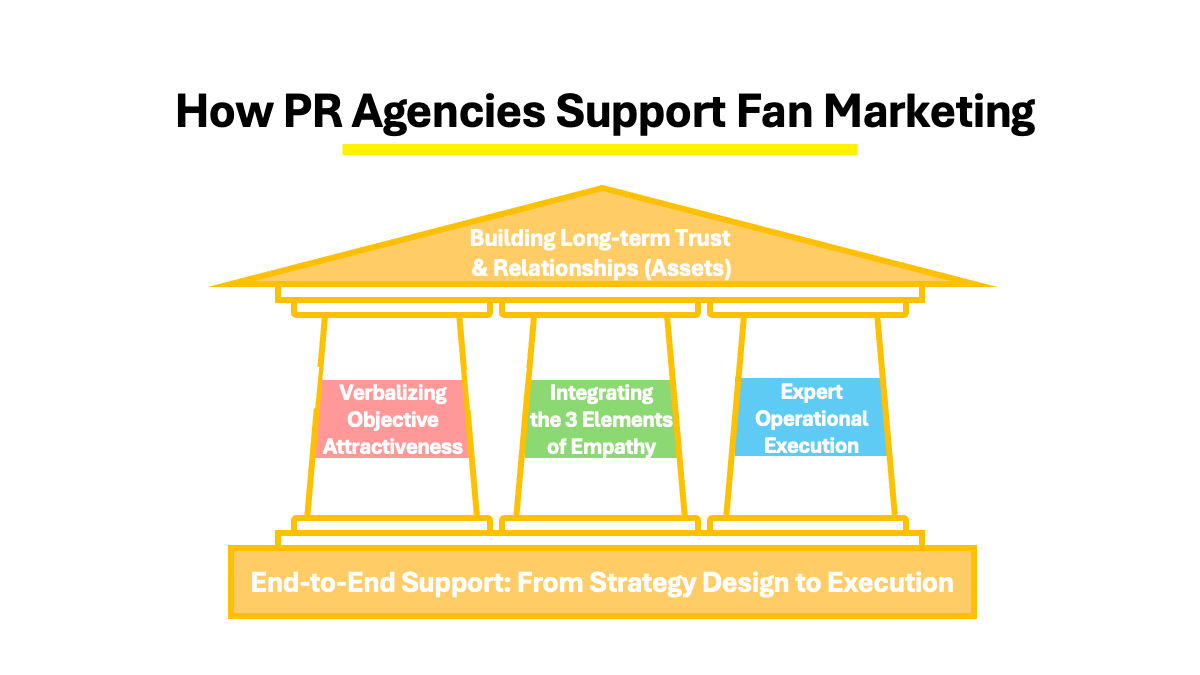
While the number of companies working on fan marketing is increasing, it is not uncommon to face challenges such as “initiatives ending as one-offs” or “fan passion not rising as expected.” Fan marketing requires not just operating social media or holding events, but sophisticated design to build long-term relationships of trust with customers. A “PR company,” which is a professional in relationship building, plays an important role here. PR companies specialize in creating “good relationships with society and customers.” The essence of fan marketing lies exactly in this “relationship building.”
| Benefits of Utilization | Specific Effects |
|---|---|
| Optimization of Overall Strategy | Rather than partial measures, a consistent plan based on the goals of the entire brand can be designed. |
| Objective Perspective | The “true appeal of the brand” that is often overlooked because it is too obvious internally can be discovered and verbalized. |
| Acquisition of Social Trust | By disseminating information through third parties (media), highly reliable awareness different from advertising can be acquired. |
| Securing Resources | Time-consuming practical tasks such as community management and owned media content production can be executed with professional quality. |
Support from Strategic Design to Execution Can Be Provided Seamlessly
To make fan marketing a success, a long-term roadmap is necessary. However, if you try to proceed with the project only internally, you tend to be overwhelmed by “tasks” such as daily social media posts and event preparation, and the original purpose of “improving engagement with fans” tends to be neglected. The biggest advantage of requesting a PR company is that they can support you seamlessly from situation analysis to strategy formulation and execution of specific measures. For example, you can leave everything to them, starting from target setting such as “who to define as a fan,” to scenario design of how to proceed with fan conversion, and the content production and operation work necessary for that. Since strategy and execution are not fragmented and can be promoted with a consistent system, inconsistencies between measures are eliminated, and results can be achieved efficiently.
Brand Appeal and Challenges Can Be Verbalized from a Third-Party Perspective
Because of loving your own products or services too much, it can happen that people inside the company can no longer see the “value that customers truly seek” or the “appeal to the world.” Conversely, there is also a non-zero possibility that internal logic takes precedence and information that is not attractive to fans is disseminated one-sidedly. A PR company has an external third-party perspective. They can objectively analyze and verbalize the potential appeal of the brand and the challenges to be solved. Calm feedback such as “For this product, the development story might resonate more with fans than the functionality” or “The current content is difficult to understand because there are many technical terms” is very useful in correcting the direction of fan marketing. Being able to redefine the “core value of the brand” that resonates with fans, while also taking into account market trends and competitor movements, is a strength unique to an external partner.
A “Mechanism for Spreading Empathy” Can Be Built Utilizing Knowledge of Public Relations and PR
The reason PR companies can demonstrate their strength in fan marketing is that they can build a “mechanism where the circle of empathy naturally spreads” together, rather than just disseminating information. The core of this consists of the three elements of “story design,” “media diffusion,” and “community design.” First, we unearth the story behind the brand and perform “story design” that makes people want to support it. The founder’s vision and development secrets are important elements for building emotional connections that cannot be created by functionality or price.
Next is “media diffusion” utilizing relations with the media. When the media, as a third party, disseminates information as an article, the reliability of the information increases, and it can reach the potential layer while providing a sense of security. Finally, there is “community design” to retain fans. We support the creation of a place where fans spontaneously want to talk about the brand, and the community itself functions as a medium that attracts new fans. Creating empathy with stories, spreading trust with media, and maintaining passion with communities—the strength of a PR company is being able to link these organically.
Success Stories of Fan Marketing Created with a PR Company
SUNNY SIDE UP has achieved numerous successes with initiatives that create interaction between fans.Click here for details.
[Case Study Article]Advocating New Values with the Power of PR! Realizing a World Where Humans and Robots Coexist with “PARK+”! « Achievements
[Case Study Article]Visualizing the USP of Intangible Goods at Events! Experience-Based Entertainment “Values Parlor with” « Achievements
If you are worried about the strategic design of fan marketing, please feel free to contact SUNNY SIDE UP. We will propose the optimal measures to deepen the relationship with fans according to the activity period, budget, and goals you want to achieve. Professionals with extensive experience in PR and public relations will fully support the creation of enthusiastic fans for your brand. First, please let us hear about your company’s challenges and expected effects. We accept consultations through the inquiry form.
Execution Steps for Promoting Fan Marketing
Once the foundation for fan marketing is in place, it is finally time to proceed with initiatives according to specific steps. Instead of trying to create a large-scale community all of a sudden, let’s correctly grasp the current situation and strategically deepen the bond with fans. Here, we introduce six steps to achieve results.
STEP 1: Situation Analysis
The first thing to work on is to objectively re-examine your company’s current situation. Using existing customer data and social media tools, let’s check in detail “how many enthusiastic fans there are” and “where interaction is taking place.” At this time, we value not only “numbers” such as sales, but also the “raw voices” of customers, such as survey responses, social media posts, and inquiry content. Let’s organize one by one what parts of the brand they are attracted to and, conversely, what parts they feel are lacking.
STEP 2: Fan Definition
Based on the customer image seen in the situation analysis, clearly define “who is a fan for your company.” Set requirements not only from the behavioral aspect such as “people with high purchase frequency,” but also from the aspect of psychological and behavioral change such as “people who empathize with the brand’s vision” and “people who recommend it to those around them.” If this definition is vague, the target will be blurred in later measures, so let’s break it down to the level of a specific persona and ensure a common understanding within the company.
STEP 3: Contact Point Design
Design the contact points (touchpoints) for when and where to approach the defined fans. Depict the story from awareness to purchase and then to fan conversion, and select methods to face customers from both online (social media, email newsletters, apps, etc.) and offline (stores, events, inclusions, etc.) aspects. Instead of relying on accidental contact, let’s intentionally create a flow so that fans can naturally continue to encounter the brand.
STEP 4: Experience Design
Once the contact points are decided, let’s specify what kind of “experience” to provide there. Prepare special experiences that move the fans’ emotions (experience design), rather than just selling products. For example, devise ways such as inviting them to special events where they can hear the backstories of how products were born, providing a platform where fans can enjoy interacting with each other, or having them participate in new product creation from the planning stage.
STEP 5: PR Integration
Let’s align the efforts aimed at fans with the public relations activities for the world. Disseminate the passionate thoughts and wonderful episodes born within the community to the outside world as a trigger for public relations, and align advertisements for the general public and messages to fans so they are not inconsistent. By passing a single core through the internal excitement and external dissemination, the brand will come to be more deeply trusted.
STEP 6: KPI Design
Finally, set indicators (KPIs) to measure the results of the activities. Since there are many parts of fan marketing that cannot be fully evaluated by short-term sales alone, a multifaceted perspective is necessary. For example, it is recommended to use the number of UGC (User Generated Content) posts, NPS (Net Promoter Score), community participation rate, and final LTV (Customer Lifetime Value) as indicators. By measuring regularly and continuing to run the PDCA cycle, we will improve the accuracy of the measures.
Summary
In this article, we explained the essence and points for success of fan marketing. Fan marketing is an effort to value customers not as mere “buyers” but as “partners” walking together, and to foster an emotional connection. First, let’s start by clarifying the starting point of “what the brand exists for” and unifying the thoughts of all staff.
SUNNY SIDE UP provides a wide range of solutions to solve all challenges in the marketing and communication field, from strategic planning to PR, media response, digital/social media, and creative. By preparing a place for interaction where fans can take the lead and enjoy themselves, the brand should be loved for a long time and be able to grow healthily together.