What is a Press Release? Explaining Strategies and Tips to Enhance PR Effectiveness
- カテゴリ:
Many PR professionals struggle with the fact that even after working hard to write a press release, it is rarely picked up by the media. Simply sending it out via a distribution service makes it extremely difficult to catch the eye of media representatives who receive a massive amount of information every day.
In this article, we will carefully explain the original role of press releases in PR activities, the mindset required to see tangible results, and the strategy of “how to utilize” them, which is even more important than “how to write” them.
What is a Press Release? Its Role in PR
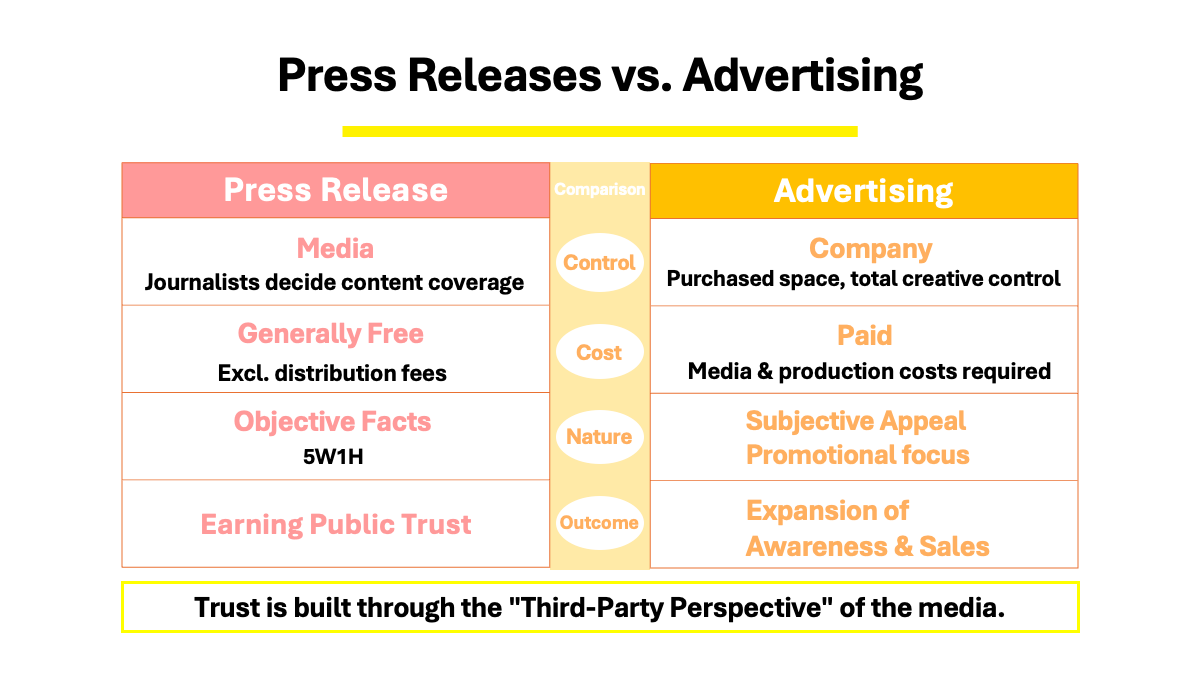
A press release is an official document issued by a company or organization to the media (news outlets) to announce new information or activities related to its management. The purpose is to deliver news material—such as the launch of new products or services, the holding of events, business alliances, or personnel changes—to media representatives at TV stations, newspapers, magazines, and web news sites, so that they may be featured as articles or program segments. In corporate PR activities, it is positioned as the most fundamental and important tool for building a relationship of trust with society.
| Item | Press Release | Advertising |
|---|---|---|
| Initiative in Communication | • Media side (The media decides whether to publish and what the content will be) |
• Company side (The company purchases ad space and freely decides the content) |
| Costs Incurred | • Generally free (Excluding distribution service fees, etc.) |
• Costs such as media fees and production fees are incurred |
| Information Credibility | • High (Objective as it is reported from a third-party perspective) |
• Relatively low (Easily perceived as a sales pitch) |
| Main Roles | • Gaining social credibility • Expanding awareness • Building relationships with stakeholders |
• Sales promotion • Direct customer mobilization • Appealing to specific targets |
| Nature of Information | • “Newsworthiness,” “Social relevance,” and “Facts” are required | • “Appeal,” “Impact,” and “Emotion” are emphasized |
[Related Article]What is Media Strategy in PR Activities? The Concept of “Information Design” to Go Beyond One-Off Exposure « Column
Fact-Based Official Press Materials Trusted by the Media
A press release is an official announcement from a company or organization intended to deliver new information to representatives of newspapers, television, and web news. Media outlets use this material to judge whether the content is worth conveying to the world as news. It plays the vital role of providing the information that reporters and editors need when writing articles. The difference from advertising is that it does not unilaterally promote one’s own merits, but is based on “objective facts” that anyone can verify. By clarifying the elements of “who, what, when, where, why, and how (5W1H)” and carefully providing supporting data and background, it creates a sense of reliability that allows media professionals to introduce the information with confidence.
An Official Means of Communication to Build Trust with Society
The primary role of a press release is for a company to accurately convey formal facts to the world as they are. While advertising is a means of spreading “what we believe is good,” a press release delivers “facts that anyone can verify” to media outlets that handle information impartially. When the media judges that information to be valuable and turns it into an article, it adds credibility as an evaluation through the eyes of a third party, increasing the weight of the information. A major characteristic is the ability to gain trust from society in a way that is different from self-promotion. Such communication also functions as a tool for engaging with all stakeholders, including investors, customers, partners, and employees. By consistently issuing official information, a company demonstrates transparency, contributing to the long-term improvement of brand value.
Impact on Corporate Brand and Sales
When a press release leads to media coverage, it brings new benefits to corporate branding and sales. Information disseminated from the perspective of the media as a third party allows a company to gain “social credibility.” This creates a powerful branding effect, establishing the company and its products as “trustworthy” and leading to differentiation from competitors. Furthermore, since articles published in web media and information on press release distribution services accumulate online, it is also recommended from the perspective of Search Engine Optimization (SEO). When customers search for product or company names and see many positive news articles, it may provide the necessary push for those hesitant to make a purchase. This accumulation of trust serves as an appeal not only to consumers but also to business partners, financial institutions, and job seekers. It becomes the foundation for supporting medium- to long-term corporate growth, such as increasing offers for business alliances and attracting talented human resources.
What Do Successful Press Releases Have in Common?
Press releases that get picked up by the media and generate a significant response consistently have a clearly designed news value: “Why does this need to be reported now?” To achieve results, companies must shift from unilaterally communicating what they want to say to a perspective that converts information into what the media and the readers beyond them are looking for. We have organized the “Five News Values” that media professionals particularly emphasize when judging the value of information in the table below. Check if your company’s releases include these elements before sending them out.
| Element | Content |
|---|---|
| Timeliness | Is there a reason to report this at this very moment? |
| Social Relevance | Does it connect to social problem-solving or public interests? |
| Uniqueness | Are there elements not found in other companies, such as “world’s first” or “Japan’s first”? |
| Human Interest | Is there an emotionally resonant story, such as development secrets or struggles? |
| Proximity | Is it closely related to the readers’ lives or a specific region? |
Clearly Defining Who Should Feel What
Before creating a press release, it is necessary to clarify “whose emotions or actions you want to move” through that information. Whether the target is the general consumer or specific industry professionals, the points to emphasize and the choice of words will change significantly. By designing the post-reading experience, the information is more likely to stay in the reader’s memory rather than just passing through.
Incorporating Social Significance and Designing from a Media Perspective
The criteria media use to decide whether to turn information into an article is whether it has “news value (social relevance, timeliness, uniqueness).” Always include a perspective on how the activity solves social issues or how it relates to current social trends, rather than just focusing on the company’s own profit. Reporters are always thinking about “what benefit there is for the reader in writing this article,” so a structure that anticipates and answers those needs is required.
Planning from News Value and Context Design to Post-Exposure Utilization
Successful companies do not stop at a single communication but design their PR activities with a bird’s-eye view of the whole process. First, they establish news value by addressing “why now” and design the social relevance and context to match social trends, creating a tone that is easy for the media to pick up. They also consider whether the manuscript itself is structured from a media perspective (title, lead, image selection, etc.) so that reporters can easily quote it. It is necessary to think in advance about how to incorporate the track record of media coverage into sales materials and recruitment activities. Whether you can envision an exit strategy is the dividing line between ending with mere awareness or leading to business results.
Common Challenges for Companies That Do Not Achieve Results with Press Releases
While many companies engage in press release distribution as part of their PR activities, the majority do not see results in terms of coverage or sales. When companies struggle with releases not becoming articles or receiving no response, there are often common reasons in their strategy or structure. The reasons that hinder results can be summarized into three main areas: “content of information,” “flow of delivery,” and “manpower and time.” First, let’s look at your company’s current situation and identify which part is becoming a hurdle.
| Signs of Challenges | Main Causes | Current State |
|---|---|---|
| Media coverage count is not increasing | Perspective has become “company-centric” | Reporters judge it as “advertising with no significance to convey to readers.” |
| No sales or inquiries | Lack of a “receptacle” after publication | The path for readers interested in the article to take the next action is broken. |
| Distribution work is a burden or has become a formality | Lack of specialized expertise and time | Unable to create high-quality projects or media lists, resulting in purely mechanical work. |
Company-Centric Communication Prevents Media Coverage
One challenge is that the content of the press release becomes a unilateral “advertisement” from the company side. While a company may want to “sell a new product” or “convey the excellence of a service,” what the media is looking for is “whether it is news of value to society” “and whether it fits the media’s coverage style or project structure.” Content that simply lists features and prices is unlikely to catch a reporter’s eye. This is caused by a lack of social context, such as “why this product is needed now” or “what social issues it solves.” A shift in perspective is required to prioritize what the world wants to know (Object) over what you want to say (Subject).
Lack of Post-Publication Path Design Prevents Business Results
There are also cases where media coverage does not lead to actual business results. This is likely because the distribution of the press release itself becomes the goal, and the actions of the readers after reading the article have not been designed. For example, even if a reader interested in a news article searches for and visits the official site, if the information for the product is hard to find or the inquiry form is complicated, their enthusiasm is likely to cool down. A press release is merely the entrance to awareness. If you do not envision an exit strategy, such as directing them to a landing page, utilizing the coverage in sales materials, or spreading it on social media, it will end as a one-off topic.
Reaching the Limits of In-House Production Due to Lack of Expertise and Resources
A major barrier to achieving continuous results is the lack of internal expertise and the exhaustion of resources. Creating an effective press release requires high-level specialized skills and working time, such as planning projects that read the trends of the times, creating attractive titles, and selecting appropriate media lists. However, in many small and medium-sized enterprises and startups, PR personnel often handle other duties simultaneously, and the current situation is that they cannot devote sufficient time. As a result, they may end up reusing past templates or performing mechanical work just to register with distribution services, leading to a decline in quality. Continuing in-house production under conditions of “not knowing what to write” or “having no contact with the media” makes it difficult to achieve results and can lead to a vicious cycle where only the exhaustion of the person in charge accumulates.
If you want to maximize the effectiveness of your press releases, leave it to SUNNY SIDE UP. We convert the information your company wants to communicate into content that the media will want to report on, and distribute it at the optimal timing. With our unique media relations and planning capabilities, we achieve higher coverage rates. We provide consistent support from creation and distribution to producing press conferences and planning PR events. Our professionals with extensive experience will lead your information dissemination to success.
[Check out our extensive support cases!]Case Studies
[Supporting your company with “Press Releases”]For details, please contact us below!
CONTACT « SUNNY SIDE UP Inc.
How to Design Press Releases That Are Selected by the Media
Many PR professionals tend to focus on “writing good prose,” but what is actually more important is the strategy of “how to deliver it.” Since a massive amount of releases reach reporters every day, simply listing information will cause it to get buried. Here, we introduce three design points that incorporate the media’s perspective.
Point 1: Design “Topics” and “Angles” That Capture Reporter Insights
The key is to understand the insights (psychology and behavioral principles) of why a reporter thinks “this should be an article.” Reporters are not company spokespeople; they are professionals who deliver beneficial information to readers. Instead of putting out the information your company wants to convey as is, you need to convert it into an “angle” that is easy for the media to report on, such as a “solution to a social issue” or a “new industry trend.” Above all, it is important to determine if the information you are trying to send out has strength as a news “topic.” Re-evaluating “who is this news for?” and “is there an element of surprise?” to design a story that attracts the reporter’s interest is the first step to being selected.
Point 2: Design the “Context” of What and How to Communicate
It is important to have “context design” that positions the press release not as an isolated point, but as part of a line in medium- to long-term PR activities. Do not end with a single distribution; increase effectiveness by linking multiple channels, such as social media sharing, secondary use on your own site, and in-depth articles on owned media. A perspective is required to connect the dots and create a larger story, being conscious of “which part of the brand story this release complements.”
Point 3: Optimize “Distribution Timing” and “Delivery Method” from a Media Perspective
No matter how excellent the topic, if the timing or the recipient is wrong, the effect may be diminished. Instead of deciding the distribution date based on your company’s convenience, align the “distribution timing” with the media’s schedule. For example, for TV programs, consider the day of the week when planning meetings are held; for newspapers, the deadline of the reporter in charge; and for seasonal topics, 1 to 2 months before publication, calculating backward based on media circumstances. In addition to relying on mass distribution services, we also recommend a “media individual approach,” where you list reporters who need the topic most and send them polite, individual guidance. The special feeling of “I want you to write this” can move a reporter’s heart and significantly influence the final coverage rate.
How to Realize Press Release Operations That Don’t End with Distribution
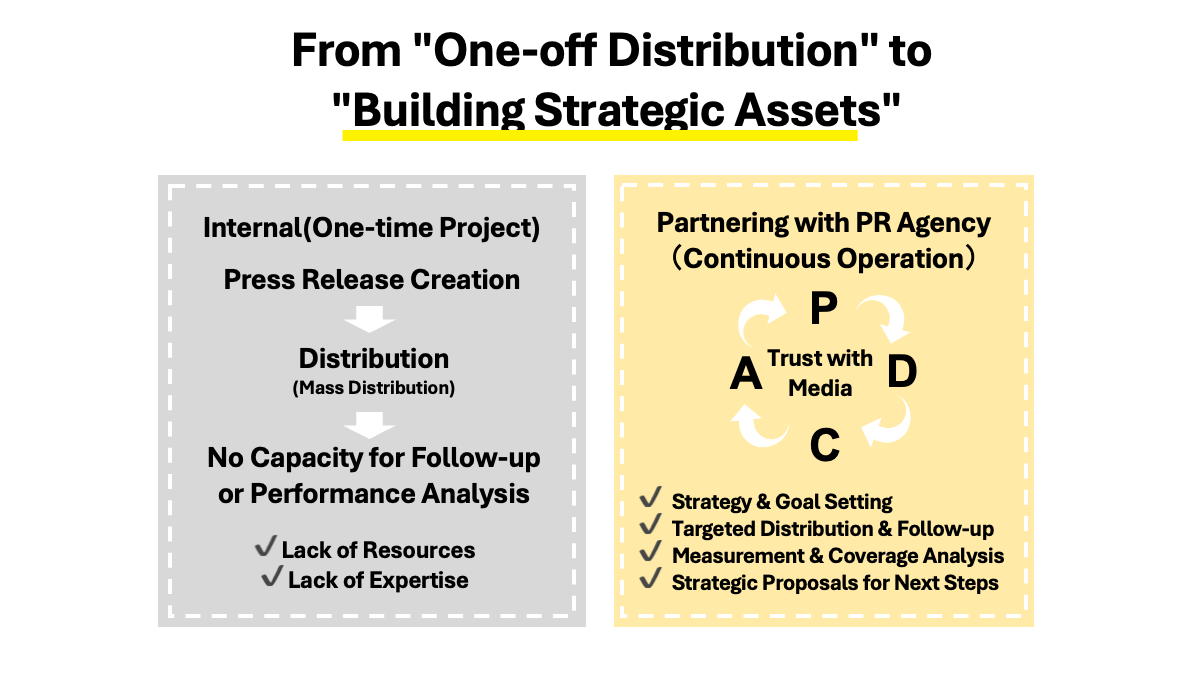
To maximize the effectiveness of a press release, continuous measures after distribution are required. Specifically, a series of operational processes are necessary, such as follow-up with the media after distribution, analysis of publication results, and the construction of an improvement cycle for the next distribution. By designing the entire PR activity from a medium- to long-term perspective rather than a one-off distribution and continuing to run the PDCA cycle, you can gradually build relationships with the media and increase the coverage rate.
Why In-House Operations Often Reach Their Limits
| Challenges of In-House Operations | Specific Issues |
|---|---|
| Lack of Resources | Difficult for personnel with dual roles to handle post-distribution follow-up / review |
| Media Network | Limited relationships with reporters and editors / Tends to rely on individual connections |
| Effectiveness Measurement | Lack of measurement tools and analysis expertise |
| Specialized Knowledge | Lack of experience in distribution timing and strategy formulation |
When conducting press release operations solely in-house, the lack of specialized knowledge and media networks becomes a major barrier. In cases where PR personnel handle other duties, they may be able to devote time to creating press releases, but they often cannot manage follow-up or effectiveness measurement after distribution. In situations requiring high-level judgment, such as daily communication with media representatives or determining distribution timing based on industry trends, the impact of lack of experience can be significant. Limited contact with the media is also a concern. Without personal relationships with reporters and editors, even if a press release is distributed, it is highly likely to be buried among a vast amount of other information. Furthermore, without a system for measuring effectiveness, it is difficult to collect and analyze data such as published media, reach, and response, making it hard to apply to future improvements. Additionally, continuous operation requires appropriate human resources. Companies that can assign a dedicated person to handle a series of tasks—regular press release creation, building relationships with the media, and measuring effectiveness—are limited, and as a result, problems tend to arise where it does not function as a strategic PR activity.
Points That Change When a PR Company Intervenes
When a PR company joins PR activities, the quality and results of press release operations almost always change for the better. The most significant change is the ability to utilize an extensive media network. PR companies communicate with many media representatives daily and are well-versed in the editorial policies of each medium and the trends of topics likely to be published. They can accurately judge which media to approach and how to deliver your company’s press release, and can also appropriately conduct post-distribution follow-up, which will improve the coverage rate. PR design from a strategic perspective is also a vital value. Instead of one-off distributions, they can formulate medium- to long-term PR plans linked to corporate branding goals and marketing strategies, designing PR activities throughout the year. The establishment of a system for measuring effectiveness is also an element that cannot be overlooked. PR companies use specialized tools to calculate quantitative indicators such as the number of media mentions, reach, and advertising equivalent value, and also conduct qualitative analysis of the published content and comparative analysis with competitors. Since they possess expertise in how to write and structure press releases that are easily picked up by the media, the appeal of the information distributed will increase.
[Related article]What is a PR strategy? Explaining the planning process for creating trust and value that cannot be obtained through advertising alone « Column
Support Content for Achieving Medium- to Long-Term Results
Medium- to long-term support by a PR company is not just a press release distribution service, but a comprehensive program that strengthens a company’s overall PR function. The core of the support is the formulation of a PR strategy. We analyze the company’s business goals and market environment to build the optimal media mix and messaging strategy according to objectives such as increasing awareness and establishing a brand image. Continuous media relations building is also an important support item (such as retainer contracts). PR companies regularly contact media representatives to provide information about the company’s business and strengths. Through steady relationship building, the response rate at the time of press release distribution increases, and opportunities for interview requests and article publication grow. Continuous support for content production is also essential. In addition to practical support such as regular press release creation, preparation of materials for press conferences, and creation of FAQ lists, we also develop projects and topics that are easily picked up by the media, such as planning in-house surveys and creating stories using data. Running a cycle of effectiveness measurement and improvement proposals is also important. In monthly activity reports, in addition to quantitative data such as publication records and reach, we provide qualitative evaluations such as tone analysis of published articles and competitor comparisons, proposing strategy revisions and new measures for the following month and beyond. Through such comprehensive support, a company’s PR capabilities will continuously improve, realizing press release operations in the true sense that do not end with distribution.
[Related Article]What is Media Relations? Explaining the Basics You Should Know and 5 Points for Success « Column
If you have concerns about creating or distributing press releases, please feel free to consult SUNNY SIDE UP. We will propose the optimal PR strategy based on your activity period, budget, and the goals you want to achieve. Our professionals with a wealth of media coverage experience will provide full support for your information dissemination. First, please let us know your request and the expected effects. We accept specific consultations through our inquiry form.
When to Request a PR Company
The decision of whether to proceed with PR activities in-house or to request a PR company depends on the company’s growth stage and the challenges it faces. If situations continue where distributed press releases are not picked up by the media, methods for measuring effectiveness are unknown, or PR personnel are overwhelmed with other duties and cannot devote sufficient time, it may be time to seek the help of external experts. Companies facing challenges such as low coverage rates, no reporter contacts, struggling with topic design, not leading to business results, low internal evaluation, or no dedicated PR staff should consider utilizing an external partner. In particular, if “coverage is being achieved but not leading to sales,” it is a stage that requires serious consideration.
Failure Patterns
A failure pattern that many companies easily fall into while continuing press release operations solely in-house is the lack of news value. There are many cases where press releases are created only from the company’s perspective, distributing information that has no value for the media or readers. With just the fact that “we launched a new product,” the social meaning is not conveyed, and the media will not pick it up much. Determining the distribution timing is also a difficult challenge. If it overlaps with news from competitors or if the media’s editorial schedule is not understood, the press release will get buried. Lack of follow-up after distribution also cannot be overlooked. Neglecting to provide additional information to media representatives or respond to inquiries will result in losing contact with reporters who showed interest. Mis-selection of target media also frequently occurs, creating situations where information does not reach the intended audience.
Limits of In-House Production
While in-house PR operations have advantages such as cost and speed of decision-making, there are also limits. The biggest concern is the lack of specialized expertise. Practical skills such as how to write a press release, how to approach the media, and how to determine distribution timing are not acquired overnight. It takes too much time for PR personnel to practice while learning on their own, and in the meantime, there is a possibility of being left behind by competitors. There will also be limits to building a media network. Relationships of trust with reporters and editors are built over many years and are difficult to construct in a short period. Additionally, since PR personnel in many companies handle other duties, they cannot manage continuous media communication or strategy review based on effectiveness measurement. Building a system for measuring effectiveness is also a major barrier to in-house production, and companies may continue measures by trial and error without being able to quantitatively grasp the results of PR activities.
Effects of External Utilization
The effects gained from utilizing a PR company should be worth more than just outsourcing tasks. The greatest benefit is the ability to strengthen overall PR activities from a strategic perspective. PR companies have a wealth of experience and expertise, allowing them to deploy high-quality PR activities from the moment they are requested. Since they can execute a series of tasks from planning and creating press releases to approaching the media at a high level, the time for trial and error in-house can be significantly shortened. An increase in media exposure opportunities can also be expected. By utilizing the wide media network and trust relationships held by a PR company, it may become possible to approach media that could not be reached in-house. Strategy formulation from an objective perspective is also an important effect. With the addition of external PR experts, a company’s strengths can be organized from a third-party perspective, finding points of contact with the information that the media and society are looking for. By running a cycle of effectiveness measurement and improvement, the quality of PR activities will continuously improve.
Success Stories of Press Releases Using a PR Company
Let’s look at the effects of a strategic approach through actual success stories to see how press release operations change with the support of a PR company. here, we introduce specific measures and results through PR cases handled by SUNNY SIDE UP.
Azabudai Hills Christmas Market
Click here for the reference article:Azabudai Hills Christmas Market: Continuing to Enhance News Value in Its Third Year of Opening « Case Studies
Tokyu Plaza Harajuku “HARAKADO” Opening PR
Click here for the reference article:Opening PR for Tokyu Plaza Harajuku “Harakado” « Case Studies
GINZA SIX Opening PR
Click here for the reference article:GINZA SIX: One of the Largest Mixed-Use Commercial Facilities in the Ginza Area « Case Studies
How to Measure the PR Effectiveness of Press Releases
After distributing a press release, it is necessary to objectively evaluate what results the activity brought. By correctly measuring effectiveness, the accuracy of the next measure can be improved.
Visualizing Effectiveness with Publication Count and Advertising Equivalent Value
The most common and easy-to-understand indicators are the number of times it was published in the media and the “advertising equivalent value,” which converts exposure into advertising costs. Publication records are counted for each medium, such as newspapers, television, and web news, and the number of people who may have been reached is estimated. This allows PR activity volume to be reported internally in numerical terms and can be used as a basis for justifying the budget.
Grasping Qualitative Effects from Changes in Awareness and Response
Although difficult to quantify, qualitative evaluations such as the content of published articles and reader response are extremely important. We analyze whether the message the company wanted to convey was correctly expressed in the article and what kind of positive mentions there were on social media. Furthermore, by confirming specific business changes such as an increase in inquiries triggered by the press release or offers for alliances, the contribution of PR activities to brand building can be judged from multiple angles.
Summary
A press release is an official document for a company to deliver objective facts to the media and is a necessary tool for building social trust through a third-party perspective. The key to achieving results is to design “news value” such as social relevance and timeliness, rather than just focusing on promotion, and to present an angle that attracts the reporter’s interest. If distribution has become a formality due to company-centric communication or a lack of resources, strategic perspectives such as post-publication path design and medium- to long-term context creation are essential. By utilizing a PR company with specialized knowledge, information dissemination can be linked to brand value improvement and specific business results through unique media relations and multi-faceted effectiveness measurement. If you aim for steady results by maximizing media exposure, considering support from external professionals will be a shortcut to success.