
What are the benefits of corporate collaboration? Explaining how to promote strategies that generate buzz
- カテゴリ:
In today’s market, it is becoming increasingly difficult to differentiate oneself and continuously attract media attention using only one’s own resources. With consumer preferences diversifying and information overflowing, companies are focusing on “corporate collaboration” as a new breakthrough. However, simply joining forces with another company does not guarantee success. Strategically designed collaborations enhance brand value and generate social buzz.
This article systematically explains the basic knowledge of corporate collaboration that public relations professionals should know, from specific steps to successful case studies.
What is Corporate Collaboration? Differences from Marketing
Corporate collaboration refers to activities in which different companies bring together their respective assets and resources, such as technology, know-how, brand power, and customer base, to create new products, services, events, and more. In the business context, it is sometimes referred to as “alliance” or “tie-up,” but in the context of public relations, corporate collaboration emphasizes “newsworthiness” and “storytelling” more than mere cooperation.
[Related Article] What is Public Relations (PR)? A Thorough Explanation for Beginners, from Job Content to Strategy Development! | Column | SUNNY SIDE UP Inc.
Co-creation Activities that Create New Value by Leveraging Each Other’s Strengths
The essence of corporate collaboration lies in “co-creation.” The goal is to create a chemical reaction where “1 + 1” becomes “3” or even “10” by combining Company A and Company B, rather than simply displaying their logos side by side. For example, combining the tradition of a long-established company with the latest technology of a venture company, or having different industries find unexpected connections to develop new products, provides consumers with surprise and discovery, making them think, “That’s a great idea.”
The table below summarizes the differences between corporate collaboration and general business alliances.
| Item | Corporate Collaboration | General Business Alliance |
|---|---|---|
| Main Purpose | Generating Buzz/Expanding Awareness Brand Improvement Planning/Developing Limited Edition Products |
Mutual Complement Streamlining Routine Operations Expanding Sales Channels (Including Strengthening Technology/Services) |
| Target | General Consumers Media |
Business Partners Shareholders |
| Emphasis | Unexpectedness Story Social Significance |
Practical Benefit Functional Complement Stability |
| Success Metrics | Number of Media Exposures Number of SNS Shares Product Sales/Awareness Expansion |
Sales Profit Margin |
| Duration | Limited (Campaign Period, etc.) | Medium to Long Term Continuous |
Public relations professionals must always have the perspective of how this activity can become “buzzworthy news” for the media and the world.
A Method for Creating Buzz and Social Significance, Not Just Sales Promotion
Corporate collaboration emphasizes “building relationships with society” in addition to increasing sales in the short term. It is important to consider the background and context of “why these two companies are working together now,” rather than simply listing both company names. For example, if companies working on environmental issues collaborate to develop sustainable products, it becomes a social news story told in the context of SDGs, rather than just new product information. The ability to communicate the values and messages that companies cherish to society through collaboration is a major feature of this method.
Four Major Benefits of Implementing Corporate Collaboration in PR Activities
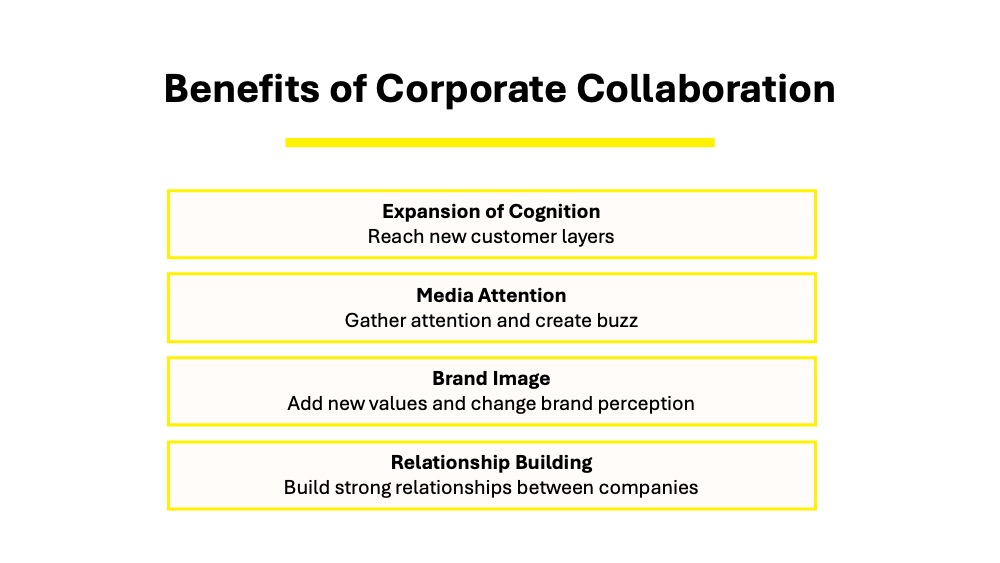
Many companies are proactive in collaboration because there are significant benefits that cannot be obtained independently. Especially in public relations activities, the following four effects can be expected.
Benefit 1: Expanding Awareness to New Customer Segments
The biggest advantage of corporate collaboration is the ability to access the customer base of partner companies. You can approach segments who were unaware of your products and services, or who were not interested in them, through a trusted brand.
The table below shows an image of expanding the target audience.
| Pattern | Effect | Example |
|---|---|---|
| Same Industry Collaboration | Activating Existing Fan Base | Limited Menu Showdown Between Ramen Restaurants |
| Cross-Industry Collaboration | Reaching Completely New Segments | Apparel x Food Manufacturer Toys x Fast Food, Sushi (Eating Together) IP x Food Manufacturer |
| Different Targets | Awareness Beyond Generations and Attributes | Brand for Young People x Long-Established Department Store |
The hurdle to acquiring new customers is significantly lowered because the partner company’s fans feel, “If that brand chose them, I can trust them” or “That looks interesting.”
Benefit 2: Attracting Media Attention and Buzz
The media is always looking for “new information” and “unexpected news.” Even if you distribute a press release for your new product, it is difficult to get it published unless it is truly innovative. However, with corporate collaboration, the “unexpected combination” itself becomes a news hook. The surprise of “I can’t believe this company is teaming up with that company!” is likely to become a Web media article title and induce sharing on SNS. As a marketing strategy, the higher the degree of unexpectedness of the combination, the higher the news value and the easier it is to attract social attention, so it is effective to strategically consider “how much surprise can be created” from the initial stage of partner selection. As a public relations professional, there is the advantage of being able to easily create “visuals” and “angles” that reporters and editors want to cover.
Benefit 3: Changing Brand Image and Adding New Values
Corporate collaboration is also effective for brand repositioning (reconstructing the image). For example, a company with a “serious and rigid” image can collaborate with a pop and youthful brand to appeal to “friendliness,” “flexible adaptation to the times,” and “innovative challenging attitude.” Conversely, emerging brands can gain “trust,” “security,” and “a sense of being major” by partnering with established companies. By partnering with companies that have elements that your company lacks, you can add new values to your brand and change how consumers view it. It can be said that this is a much more persuasive branding method than spending money on image strategies.
Benefit 4: Building Relationships Between Companies
What cannot be overlooked when implementing corporate collaboration is the ability to build strong relationships with other companies. In addition to external results such as temporary sales and increased awareness through promotions, acquiring “invisible assets” such as pipelines between companies has a very significant meaning in management strategy. In the process of jointly carrying out a project, the people in charge of each other will communicate closely, and opportunities to touch on the other company’s decision-making speed, organizational culture, or unique know-how will naturally arise. It also functions as a trigger for organizational revitalization and “open innovation.” In addition, if companies have shared a successful experience once, they can smoothly establish a cooperative system when launching new businesses in the future or when tackling issues across the industry. Building a relationship of trust as a long-term business partner can be said to be the essential benefit of corporate collaboration.
Main Types and Methods of Corporate Collaboration to Use Depending on the Purpose
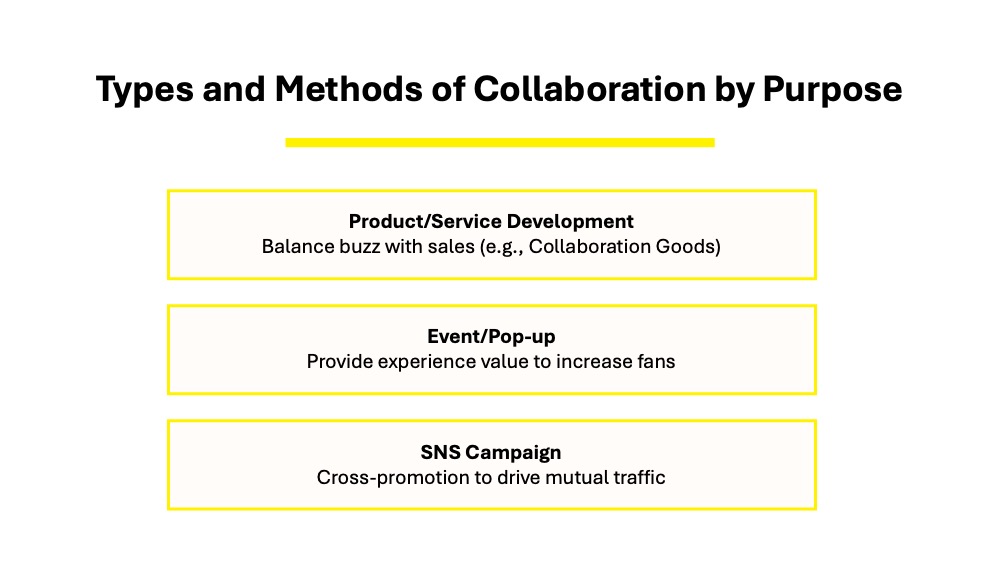
There are many different methods of corporate collaboration. Selecting the optimal method according to your company’s issues and objectives is a shortcut to success. Here, we will introduce three representative methods.
Developing Collaborative Products and Services that Achieve Both Buzz and Sales
The most common and impactful is the development of collaborative products. Specifically, this includes the creation of new products that combine the unique technologies, materials, and know-how of both companies, limited-edition packaged products that incorporate the characters and logos of partner companies into the design, and special-edition products that fuse the brand values of both companies. For example, limited flavors through collaboration between food manufacturers and popular characters, functional fashion by apparel brands and technology companies, and special design packages by cosmetics brands and artists are possible combinations that transcend industries. Tangible products are easy for the media to cover and have high visual appeal, making it easier to gain exposure in magazines and Web media. In addition, on SNS, product photos and unboxing videos are easily spread as “Instagrammable” content, and natural information dissemination through user-generated content (UGC) can be expected. Furthermore, by creating a sense of exclusivity and rarity, it is possible to stimulate purchasing motivation and lead to immediate sales. However, product development requires initial investments such as manufacturing costs, package design costs, and quality control costs. In addition, if sales forecasts are incorrect, there is a risk of losses due to excess inventory (royalty costs depending on the business structure) or, conversely, a decrease in customer satisfaction due to lost opportunities. Thorough preparation and risk management, such as prior market research, refinement of demand forecasts, optimization of sales channels, and establishment of an inventory management system, are key to success.
Events and Pop-Ups that Provide Experiential Value and Increase Fans
Collaboration at events and pop-up stores is effective when you cannot go as far as product development or when you want to encourage experiential consumption. For example, a bookstore and a cafe collaborate to create “a space where you can enjoy coffee while reading a book,” or a limited-time collaboration shop is opened in a commercial facility. By providing customers with a real experience, you can build new touchpoints with the brand (expanding reach) and deepen their attachment to the brand (engagement). It is also a method that makes it easy to gain exposure in television broadcasts and Web media experience reports because it can provide the media with “a place to cover.”
[Related Article] Successful PR Promotion Methods Using Events! Explanation of 15 Methods and Secrets to Success | Column | SUNNY SIDE UP Inc.
Gift Campaigns Using SNS to Aim for Mutual Customer Referral
The easiest and most immediate way to start is to use SNS for campaigns. It is recommended to plan to have users follow the company account and repost the post, and then give away both products by lottery.
The table below summarizes the benefits of SNS campaigns.
| Benefit | Details |
|---|---|
| Increase Followers | Both followers flow to each other (Increase the number of users who can receive information on SNS in the future) |
| Data Collection | Easy to numerically measure users’ direct reactions to corporate collaboration projects (user engagement) Quantitative analysis is possible based on how much it was shared (how much it was talked about) and the amount of UGC spread. |
| Speed | Short lead time from planning to implementation |
| Relatively Low Cost | Can be implemented with just the product price and shipping costs |
SNS campaigns do not require a development period, so their strength is that they can be implemented without missing the timing of the topic. In the initial stage, it is effective to test how much response can be obtained on social media, and then take an approach of finding the optimal method while repeating improvements based on user reaction data. There are many confirmed cases where projects that attract attention on SNS directly lead to increased purchases at brick-and-mortar stores and EC sites. The flow of online excitement promoting real-world consumer behavior has become a standard in modern marketing. Many companies take the step of developing this into large-scale collaborations such as product development.
To make corporate collaboration a success, meticulous strategic design is important. SUNNY SIDE UP’s strategic planning provides consistent support for collaboration planning, from optimal matching with partner companies to building integrated marketing communications (IMC). Maximize synergy with a strategic approach based on market research. See below for details on strategic planning.
Strategic Planning | Service | PR Company | SUNNY SIDE UP Inc.
5 Steps to Lead Corporate Collaboration to Success
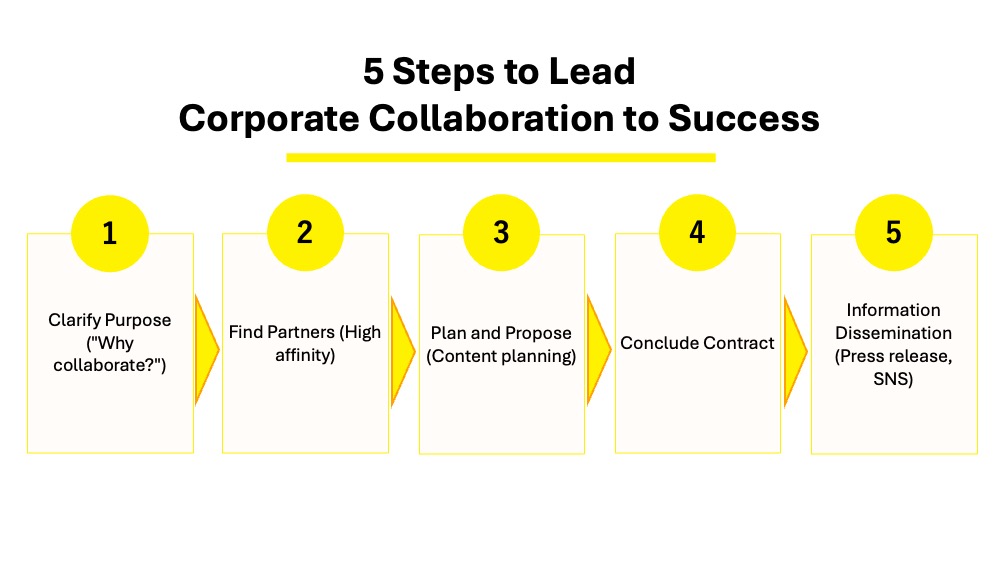
Corporate collaboration is a project that involves not only your own company but also the other company, so careful process management is required. Instead of proceeding on a whim, let’s steadily execute the plan according to the following five steps.
Step 1: Verbalize the Issues You Want to Solve and Clarify the Purpose and Target of “Why Collaborate?”
The first thing to do is to clarify the purpose of “Why collaborate?” Specifically verbalize the issues you want to solve, such as “expanding awareness,” “revamping the brand image,” or “capturing the younger generation.” Once the purpose is determined, the target audience to aim for will naturally be determined. If this is not clear, the criteria for selecting a partner will become ambiguous, and the content of the proposal to the other company will lack persuasiveness. Be sure to build consensus within the company.
Step 2: Find a Partner with High Affinity and Synergy
Based on the purpose and target, list the optimal partner candidates. Rather than simply choosing a company with high name recognition, consider from the perspective of “Does it have high affinity with your company’s target audience?” “Does it have strengths that your company does not have?” “Do the corporate culture and values match?”
The table below is an example of a checklist when selecting a partner.
| Check Item | Confirmation Details |
|---|---|
| Target Expandability | Does the other party’s customer base match the segment that your company wants to target? |
| Brand Image Affinity | Does the other party’s brand image contradict your company’s? |
| Resource Complementarity | Is it a relationship where you can complement each other’s shortcomings and extend your strengths? |
| Buzzworthiness | Is there unexpectedness or newsworthiness in the combination? Is there a story that doesn’t just look like a campaign? |
| Feasibility | Does the other company have a track record or system for collaboration? Can you present the other party with the benefits of partnering with your company? |
It would be self-defeating to confuse consumers by partnering with a company that has no relevance in the pursuit of unexpectedness. Forced connections that are seen through by users will also affect the impact of corporate collaboration. Choose a partner that can draw a convincing story.
Step 3: Plan and Propose Planning Content that Benefits Both Parties
Once candidate companies have been decided, approach them. The important thing is to make a “proposal” rather than a “request.” Instead of asking, “Please collaborate with us,” present a win-win scenario that says, “Your company has these benefits” and “Our customer base is a segment with these characteristics, and these synergistic effects can be expected.” Prepare a proposal that summarizes specific project plans, expected schedules, and expected effects, and provide materials that make it easy for the other party’s person in charge to pass internal approval. This is the key to increasing the contract rate.
Step 4: Conclude a Contract Including Role Sharing and Rights Relationships
Once an agreement has been reached, fill in the detailed conditions and exchange contracts. Clarify areas that are likely to cause problems later, such as the ratio of financial burden, division of duties, supervision flow, handling of intellectual property rights (usage rights for logos and characters), and non-disclosure agreements (NDAs). Agreements at the project progress management level, such as “Which party will be the subject of the press release?” “What is the contact point for inquiries from the media?” and “When is the deadline for creative confirmation?” are also important. If these details are not clarified in advance, communication gaps and delays in decision-making may occur during the project, which may lead to risks such as schedule delays and deterioration of relationships. Requesting a specialized agency or consultant with extensive experience in corporate collaboration and an understanding of the importance of detailed agreements is an effective option to increase the probability of project success.
Step 5: Disseminate Information in Both Directions via Press Releases and SNS
Once preparations are complete, it’s time to disseminate information. The press release should not only introduce the product, but also clearly convey how the product’s unique technology and functions, and its unique features, are superior, and what specific value and experience users can gain (improved convenience, new ways to enjoy, problem solving, etc.). In addition, include a detailed story about the background to the collaboration, the thoughts of both companies, and the development secrets. In addition, maximize the topic by matching the timing of the announcement and simultaneously announcing it on both SNS accounts and owned media. It is also effective to provide the media with opportunities to experience the product and to conduct interviews with representatives from both companies.
Points to Note When Planning Corporate Collaboration
Corporate collaboration has great benefits, but it also has risks. If it fails, it will not only waste costs, but also damage the brand’s credibility. It is important to understand the risks in advance and take measures to counter them.
Point 1: Check that There is No Mismatch or Damage to the Brand Image
The most important thing to be aware of is the risk of scandals or scandals involving partner companies. If the other company causes a problem during the collaboration period, your company may also be targeted for criticism, saying, “Are you teaming up with such a company?” It is essential to conduct thorough due diligence (credit investigation) before entering into an agreement and to check the other company’s management situation and compliance system.
There is also a risk that the tone and manner of the creative will not match, which will betray the expectations of existing fans. It is necessary to make the supervision process strict and to decide on rules to protect each other’s brand world view.
Point 2: Consider the Difficulty of Partner Selection and Adjustment Costs/Schedule Management
Projects with outside companies require far more adjustment costs and time than projects that are carried out by your own company alone. Because companies with different decision-making flows and speeds are working together, it takes time even for one confirmation task, and the schedule tends to be delayed. Therefore, at the stage of selecting a partner company, it is important to determine whether the organization has an organizational structure that can move quickly with the same sense of speed as your company, and whether it has the ability to execute reliably according to the agreed schedule. In addition, collaboration projects require adjustments, confirmations, negotiations, and other tasks in addition to normal operations, so it is necessary to appropriately assign dedicated or concurrent personnel and secure sufficient human resources. A lack of resources will be a direct cause of project delays and quality degradation.
The table below shows measures to address the expected adjustment risks.
| Risk Factor | Countermeasures |
|---|---|
| Clarification of Roles | Clarify the roles of both companies in corporate collaboration, such as which company will do what, when, and how. |
| Delay in Confirmation | Create a schedule with plenty of time and agree on a confirmation deadline in advance. |
| Inconsistency in Policy/Recognition | Set up regular meetings and make detailed adjustments to recognition. |
| Increased Burden on Person in Charge | Secure business resources by assigning a person in charge exclusively for collaboration Thoroughly confirm important matters in writing Areas where discrepancies in recognition are likely to occur should be noted in advance and explicitly confirmed with each other. |
Proceeding with an optimistic outlook that “it will work out somehow” will cause problems to occur just before the release date. A well-planned plan, close communication, and appropriate staffing are key to project success.
Summary
Corporate collaboration is a powerful method that not only promotes sales and services, but also combines each other’s strengths to deliver “new value” and “topics” to society. Its effects are immeasurable in terms of expanding awareness to segments that cannot be reached independently and revamping the brand image.
The shortcut to success is to clarify the purpose and “co-create” with a partner that has high affinity with your company, following the steps introduced in the article. There are hurdles such as adjustments, but the collaboration that is achieved by overcoming them will bring great changes to the company. Please disseminate new news that excites the world through strategic partnerships.
To make corporate collaboration a success, a strategic approach is essential, from selecting a partner company to planning and PR development. SUNNY SIDE UP has a proven track record of handling numerous corporate collaboration projects. If you are considering planning the optimal collaboration project for your company, please contact us using the inquiry form. Our experienced staff will provide you with thorough support.