
How to Develop a Public Relations Strategy: A Detailed Explanation of Organizational Design and Operational Steps that Contribute to Management
- カテゴリ:
In many companies, public relations activities tend to focus on the “quantity” of information disseminated, such as the number of press releases distributed and the number of media mentions. However, public relations originally plays an important role in communicating a company’s philosophy and policies to society and building relationships of trust. If the direction that management is aiming for and the public relations measures being implemented on the ground are not aligned, public relations will remain a “communication task” and will not be able to fully demonstrate its inherent value. This article will explain in detail, with specific steps and approaches, how to transform management messages such as sales targets and business policies set by the management team into stories that society can empathize with, and how to build trust by ensuring that the entire organization, from the management team to employees on the ground, sends out consistent messages.
What is a Public Relations Strategy? The Role of Delivering Management Messages to Society
The essence of a public relations strategy is to refine the vision and philosophy of the management team into a form that can be communicated to society. The words of managers tend to be spoken from the company’s perspective, such as sales and business matters. A public relations strategy connects these to the concerns of consumers and social issues, and plays the role of reconstructing them into stories with social context. Through this process, the company’s communications take on social significance and begin to move people’s hearts. The differences from advertising and specific media classifications are explained in detail in another article, “What is a PR Strategy? Explaining the Planning Process for Creating Trust and Value that Cannot be Obtained Through Advertising Alone,” but this article focuses on public relations from a perspective closer to management.
Public Relations is the Foundation of a Reliable Management Strategy
The premise of strategy formulation is to position public relations not merely as an activity of the public relations department, but as an integral part of management strategy. If management strategy defines “which market to fight in and how to win,” then public relations strategy defines “how to be recognized and trusted by society.” By having both of these wheels in place, business growth and brand accumulation can be achieved simultaneously.
| Perspective | Management Strategy | Public Relations Strategy |
|---|---|---|
| Purpose | Probability of Competitive Advantage and Maximization of Profits | Acquisition of Social Trust and Relationship Building |
| Subject | Company/Business | Society/Stakeholders |
| Time Axis | Short- to Medium-Term Business Results | Medium- to Long-Term Brand/Reputation |
| Performance Indicators | Sales/Profits/Share | Empathy/Trust/Positioning/Exposure |
There is a Risk of Formalism in Public Relations Activities Left to the Field
If information is repeatedly disseminated based solely on the judgment of a few individuals without a public relations strategy, the activities will gradually become a mere formality. Fragmented communication that responds on a case-by-case basis without a long-term perspective or overall strategy lacks consistency in the message as an organization. As a result, it can lead to confusion from society, such as “I don’t know what kind of company they are aiming for” or “Their statements are contradictory,” which can damage brand value. Public relations activities with weak ties to management carry significant risks, such as delays in responding to crises and communications that contradict management policies. That is why public relations needs to be positioned not merely as information dissemination, but as a role that conveys management’s intentions and policies to society.
Benefits of a Public Relations Strategy
Without a public relations strategy, it becomes difficult for information to reach its intended audience, and unexpected problems are more likely to arise for the company. In today’s world, where information flows abundantly and there is a great deal of interest in how companies operate, careful communication from a strategic perspective helps to nurture the brand carefully.
[Related Article]What is Media Relations? Explaining the Basics and 5 Points to Lead to Success | Column | Column | SUNNY SIDE UP Inc.
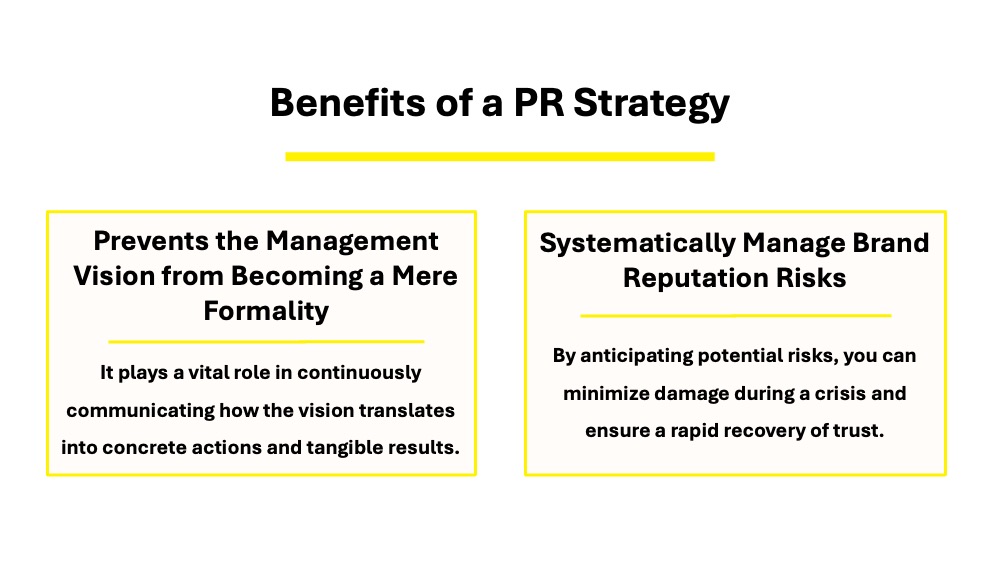
Benefit 1: Prevents Management Vision from Becoming a Mere Formality
Even an excellent management vision will not be fully utilized if it is not carefully communicated to the outside and inside the company. A public relations strategy plays the role of continuously communicating how the management vision is actually manifested in concrete actions and results. By accumulating strategic communications, the vision becomes a word accompanied by a sense of reality.
Benefit 2: Brand Damage Risks Can Be Managed Systematically
Modern companies are constantly exposed to reputational risks. In the process of formulating a public relations strategy, the entire organization, from management to the field, should share and clearly define “What values are non-negotiable for the company (e.g., quality, transparency, social contribution)” and “What risks are anticipated (e.g., product defects, information leaks, SNS flame wars).” By building good relationships with society on a regular basis and clarifying the decision-making process in the event of a crisis, damage can be minimized and rapid recovery of trust can be achieved.
SUNNY SIDE UP’s “Strategic Planning” provides end-to-end support, from planning to execution of public relations strategies. We maximize results through multifaceted approaches such as IMC design integrating marketing and PR, strategic PR design, and branding. Based on meticulous analysis based on market research and knowledge gained from extensive experience, we provide the optimal communication plan to achieve your company’s goals.
Strategic Planning | Service | PR Company | SUNNY SIDE UP Inc.
Steps to Build a Public Relations Strategy
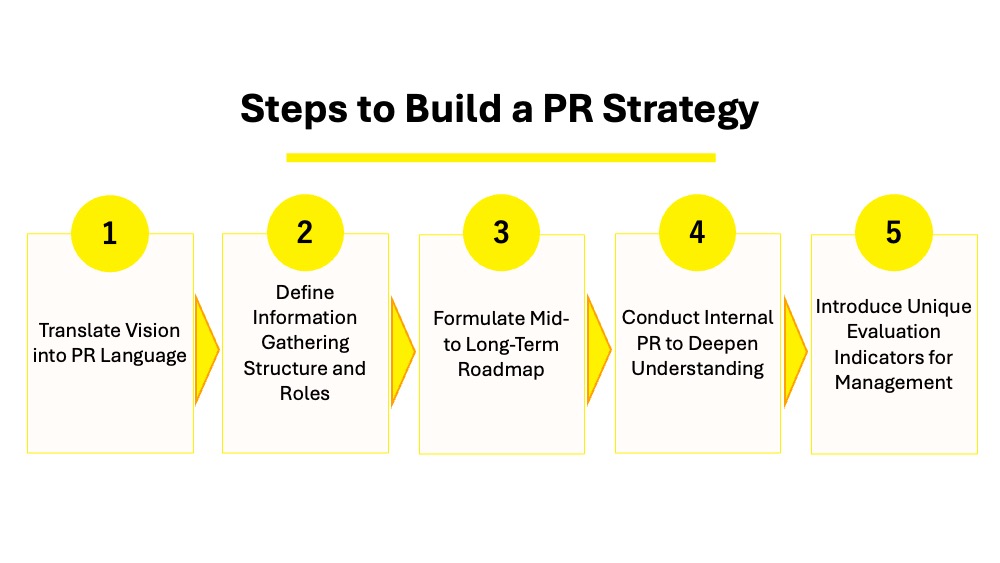
An effective public relations strategy is born from a fusion of top-down approaches from management goals such as sales targets and business policies set by the management team, and bottom-up approaches that capture real insights from society, such as customer voices, media trends, and SNS reputations. By taking the following five steps, you can build a strong strategy that harmonizes management’s intentions with society’s expectations and can be implemented throughout the organization.
Step 1: Translate Management Vision into Public Relations Language
The starting point of a public relations strategy is to deeply understand what the management team wants to achieve. Then, instead of simply communicating that as is, it is expressed in words that have been carefully combined with social needs and trends, and re-examined from the perspective of society, “Why does society need this company or business now?” In this process, it is important to replace the company’s purpose (reason for existence) with a social common language that more people can empathize with.
| Translation Process | Content to Consider |
|---|---|
| Management’s Intent | What is the message that management wants to convey with the highest priority? |
| Society’s Expectations | What role does the target audience or society expect the company to play? |
| Comprehensive Message | Express in a single phrase how the company’s strengths solve social issues |
Step 2: Define the Internal Information Gathering System and Roles
There is a lot of valuable information that should be communicated through public relations, not only within the public relations department but also in the field of business. We will establish a system to continuously share information such as measures to be launched in the future, roadmaps, and up-to-date information from each department such as development / engineering, sales, marketing, and human resources. By assigning public relations representatives to each department or category, or by establishing regular information sharing sessions, the entire organization can share the “value gained by cooperating with public relations” and clarify their respective roles.
Step 3: Develop a Medium- to Long-Term Roadmap
Instead of distributing single releases, we will draw a roadmap from a medium- to long-term perspective of one to three years, showing what kind of impression we want to deliver to society. We will strategically divide the phases, considering seasonality and business milestones, such as which stakeholders to deepen relationships with and when. We will focus on designing the goal of “when and what state we want to be in.”
Step 4: Conduct Internal Public Relations to Deepen Internal Understanding
In order to effectively promote external communication, it is important that each and every employee fully understands and empathizes with the company’s strategies and messages. We aim to create a state in which each employee becomes a good advocate for the company and can naturally convey consistent messages in their daily interactions. If internal communication (internal public relations) is not carried out sufficiently, a gap may arise between external communication and the internal situation, which may affect relationships of trust.
Step 5: Introduce Public Relations Evaluation Indicators that Contribute to Management
The value of public relations cannot be fully expressed by the number of articles published. In order to make the contribution to management goals visible, we will set up KPIs unique to our company. We will consider indicators that show how public relations is contributing to the business, such as changes in the numbers in awareness surveys, the impact on the reasons for applying for jobs, and the increased presence of management in the media. By clarifying the evaluation criteria, public relations activities will be recognized as an important role in management.
Main Roles to Keep in Mind When Considering a Public Relations Strategy
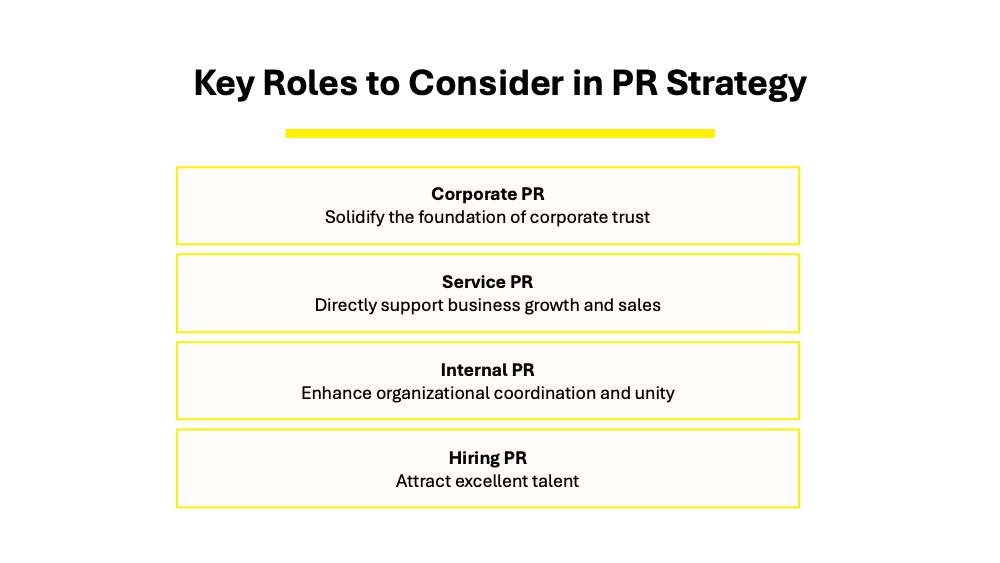
In order to make a public relations strategy meaningful, it is necessary to fully understand the breadth of the areas in which public relations is involved and to carefully use approaches that are appropriate for each. The purpose of public relations activities is not only to gain exposure in one medium, but also to cultivate corporate trust, support business growth, and bring vitality to the organization. These areas are tied together by a single axis of management goals, and only then does it exert its power as a “strategy.”
“Corporate Public Relations” to Solidify the Foundation of Corporate Trust
Corporate public relations is the most fundamental activity for communicating the company’s stance and philosophy to society and building long-term relationships of trust. It plays the role of translating the purpose and vision advocated by the management team into words with social significance and delivering them to stakeholders. It emphasizes an objective perspective of “how the company is viewed by society” rather than short-term profits, and disseminates information with high transparency. Even in the event of a scandal or other emergency, the trust built up on a regular basis will function as a strong foundation to support the company’s recovery.
“Service Public Relations” to Directly Support Business Growth
In the area of service public relations, also known as product public relations, it is important to re-examine the social value of how the company’s products and services solve social issues. By communicating not only the functions but also the stories and thoughts behind them, it is possible to create empathy that resonates with users. The great appeal of service public relations is that it can build trust through evaluations from third parties such as the media and experts, while cooperating with advertising activities. It can build a unique position for the company in the market and more effectively support sales and marketing activities.
“Internal Public Relations” to Enhance Organizational Coordination
In order to effectively deliver messages to the outside world, it is essential that what management wants to convey is properly understood and disseminated within the organization. Internal public relations is an activity that carefully cultivates a state in which each employee can proudly talk about the company in their own words, while sharing the company’s strategies and wonderful success stories with employees. When employees working in the field can feel that the public relations strategy is “about them,” consistent messages will naturally be conveyed in all daily situations, such as to customers and local communities. Furthermore, the spread to the outside world will also grow significantly. If you communicate externally without sufficient internal understanding or empathy, there will be a tendency for discrepancies to arise between what you are saying and what you actually are, so this is a perspective that you want to value when considering a strategy.
“Recruitment Public Relations” to Attract Excellent Human Resources
Recruitment public relations is an activity that fosters encounters with human resources that are a good fit for the company by expressing the company’s culture and working environment in an easy-to-understand manner. By carefully communicating not only conditions such as salaries and benefits, but also the vision that the organization is aiming for and the thoughts of the people who are actually working there, it is possible to meet applicants who are connected by deep empathy. This is an important initiative that not only reduces mismatches after joining the company, but also increases the job satisfaction of current employees. By drawing and showing the future organizational structure in line with the management strategy, it is possible to develop a human resource base that supports the company’s sustainable growth.
“Crisis Management Public Relations” to Protect the Company’s Existence
The role of crisis management public relations is to minimize the impact of problems such as scandals and accidents, and to carefully restore trust. It is management’s responsibility to prepare in advance the flow of who will make decisions and how to explain them when a problem occurs. An attitude of communicating the facts as they are, sincerely and quickly, is the most important factor in regaining the company’s reputation.
Points for a Successful Public Relations Strategy Implementation System
A strategy will only demonstrate its true value when an “operational mechanism” is in place that allows it to be naturally utilized in daily operations, not just created. Carefully incorporating the perspective of public relations into the organization and creating a system that allows it to be reflected in management decisions is an important point for success.
Point 1: Develop an Environment Where You Can Communicate Directly with Management
It is important to create an environment where the public relations manager can participate in management meetings or have the opportunity to talk with the top management once a week. This is to directly receive the “thoughts” behind management’s decision-making and, at the same time, to fulfill the role of “management’s ear” by delivering voices and concerns from society to management. Without such a direct connection, the strategy will become unsubstantiated and may end up being limited to on-site work.
Point 2: Remove Barriers Between Departments and Create a Company-Wide Information Flow
We will create an “information flow” in which the entire company cooperates, rather than limiting public relations to the activities of a single department.
For example, information such as customers’ frank opinions and frequently asked questions obtained by sales staff at business negotiations and exhibitions, and information such as the background of product improvements and non-negotiable quality standards that technical development staff are working on every day, are naturally gathered by the public relations department through internal information sharing sessions and company-wide shared sheets.
Based on this primary information, public relations can translate and communicate to society the context of “what is happening in the field” and “why we value this initiative.” Eliminating the barriers between departments and fostering an atmosphere in which each and every employee feels that “public relations is a partner that properly communicates our initiatives to society” will lead to the power to execute the strategy.
The Relationship Between Public Relations Strategy, Risk Management, and Reputation Management
A public relations strategy requires not only proactive information dissemination, but also a reputation management perspective that appropriately protects and maintains the company’s reputation. Once a company’s reputation is damaged, it takes a lot of cost and time to recover. Therefore, public relations is required to carefully understand social trends and stakeholder perceptions on a regular basis, and to detect the seeds of risk at an early stage, rather than responding after a problem has become apparent.
Public relations strategy, risk management, and reputation management are not independent initiatives, but are mutually linked. In order for public relations to function as a compass for management, it is important not only to build trust through information dissemination, but also to maintain a perspective that keeps the organization in a healthy state.
Quickly Detecting Changes in Social Values
One of the important roles of the public relations department is to sensitively perceive changes in social values and ethics and function as an antenna to convey them to management. Expressions that were not a problem in the past may now be considered inappropriate. If you carefully look at SNS reactions and other companies’ examples on a regular basis in accordance with the public relations strategy, you can check whether your company’s communications and judgments are out of sync with the current social sense.
| Target | Action |
|---|---|
| Changes in Social Ethics | Latest Trends in Gender, Environment, and Compliance |
| Industry Reputation | Trends in Distrust and Expectations for the Industry as a Whole |
| Internal Compliance | Do Inappropriate Practices in the Field Contradict the Content of Communications? |
Designing a Decision-Making Process and System in the Event of a Crisis
Responding to risks in an emergency is an important situation in which the true strength of the public relations strategy is tested. Rather than panicking and thinking about it after a crisis has occurred, we will identify potential risk patterns and prepare a crisis management communication system in advance, including who, when, where, what to judge, and what to communicate. This rapid decision-making mechanism will be a great force in protecting the brand from serious crises.
Summary
A public relations strategy is not merely a plan to aim for media exposure, but an organizational decision-making process to connect management goals to social empathy. By delivering the management vision to society through careful translation, streamlining the flow of information within the company, and building an operational system directly linked to management, public relations becomes the strongest weapon to support the company’s growth. Without being distracted by short-term numbers, the only way to build unwavering trust is to build a strategy from the essential question of what kind of happiness the company’s existence brings to society. Let’s work on building a public relations strategy that contributes to management with a sense of commitment as an organization.
Professional knowledge and experience are essential to realize an effective public relations strategy. At SUNNY SIDE UP, PR professionals offer the optimal public relations strategy tailored to your company’s challenges. Why not feel free to contact us using the inquiry form below? We will listen to your specific measures and cost concerns in detail and provide guidance.