What is Inner Branding? Explaining the Process with Objectives, Effects, and Success Stories
- カテゴリ:
For sustainable growth, a company needs not only excellent products and services, but also the power of the “people” and “organization” that support them. An organization in which each employee takes pride in the company and works toward the same goals has a very strong competitive edge. The key to this is “inner branding.” This article explains everything from the basics of inner branding to specific steps and success stories in an easy-to-understand manner.
What is Inner Branding?
Inner branding refers to the activity of communicating a company’s philosophy, vision, and values to its “employees,” and having them deeply understand and empathize with them, thereby enhancing brand value from within the organization. The main purpose is to increase employee engagement (affection for and willingness to contribute to the company) and foster a sense of unity throughout the organization. This enables each employee to embody the brand and strongly supports the company’s growth.
Understanding the Difference from Outer Branding
In branding, there is “outer branding” as an antonym to inner branding. While outer branding targets “external” stakeholders such as customers, shareholders, and society, inner branding targets “internal” employees. These two are like the wheels of a car, and the brand value of a company cannot be maximized with only one of them.
| Items | Inner Branding | Outer Branding |
|---|---|---|
| Objectives | Thorough Dissemination of Philosophy Improvement of Engagement |
Increased Awareness Increased Sales Acquisition of Fans |
| Main Methods | In-house In-house Events Evaluation System |
PR Activities Website SNS |
| Goals | Employees Embody the Brand | Customers Become Fans of the Brand |
By deepening employees’ understanding of the brand through inner branding, their actions in daily operations and responses to customers change, which in turn enhances the effects of outer branding.
Why is Inner Branding Attracting Attention Now?
In recent years, the importance of inner branding has been increasing due to significant changes in society and work styles. In an era where the lifetime employment system is a thing of the past and the mobility of human resources is increasing, attracting and retaining talented personnel has become a major challenge for companies. In addition, with the diversification of work styles and the spread of remote work, the question is how to foster employees’ sense of belonging and unity. Inner branding, which builds an attractive corporate culture that makes employees want to “continue working at this company” and enhances the organization’s centripetal force, is attracting attention as an indispensable strategy for sustainable corporate growth.
Objectives and Effects of Inner Branding
Inner branding is not just an activity to improve the atmosphere within the company. It has important objectives related to the core of the company, and various effects directly linked to management can be expected.
Improvement of Employee Engagement
The greatest objective of inner branding is to improve employee engagement. Highly engaged employees strongly empathize with their company’s philosophy and vision, and have high motivation and passion for their work. Because they understand how their work contributes to the company’s growth, they act autonomously and strive to produce even greater results. As a result, they also greatly contribute to improving the productivity of the entire organization.
Instilling Corporate Philosophy and Vision
A company’s philosophy and vision are the compass that shows the direction in which the organization should proceed. It is meaningless if it is merely “pie in the sky.” By carefully communicating the thoughts and stories behind the philosophy and vision to employees through inner branding, it can be deeply instilled in the hearts of each individual. When all employees share common values and act toward the same goals, consistency as an organization is born, and rapid and accurate decision-making becomes possible.
Retention of Human Resources and Reduction of Turnover Rate
If employees empathize with their company’s philosophy and can work in a rewarding environment, their affection for the company will naturally deepen. By feeling that their own growth is linked to the company’s growth, they will want to build a long-term career at that company. This is very effective in preventing the outflow of talented personnel and reducing the turnover rate. In addition to reducing the costs of hiring and retraining, knowledge and know-how are accumulated within the organization, leading to the strengthening of the company’s competitiveness.
Benefits of Working on Inner Branding
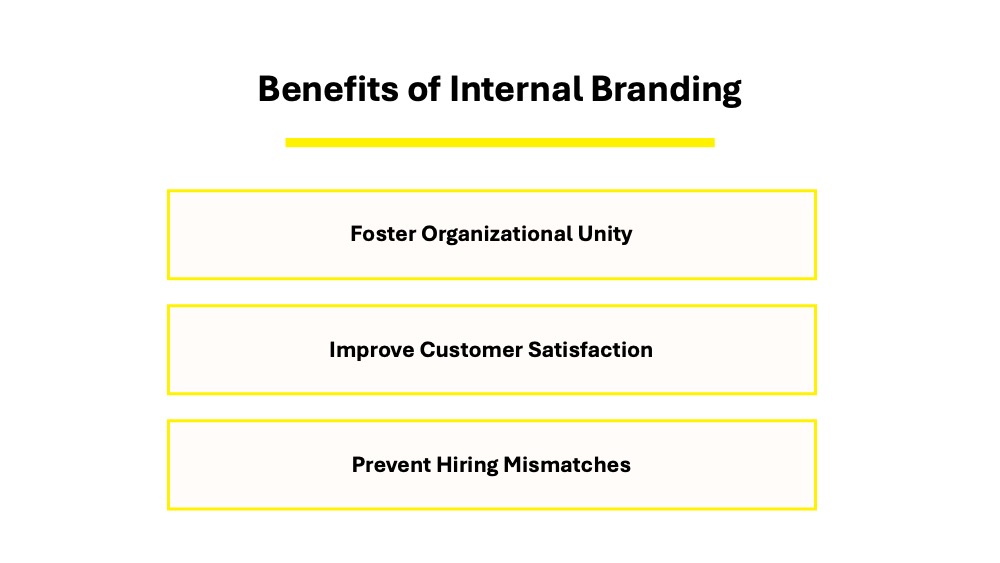
By promoting inner branding, companies can transform from within the organization and gain many concrete benefits.
Benefit 1: A Sense of Unity as an Organization is Fostered
By sharing common values and goals among all employees, beyond the walls of departments and positions, a sense of unity as an organization is born. This fosters a workplace environment with good communication and promotes smooth communication. By fostering a culture in which employees cooperate and support each other, teamwork is improved and the performance of the entire organization is maximized.
| Types of Benefits | Specific Details |
|---|---|
| Communication Activation | Smooth collaboration between departments, improving information sharing and decision-making speed. |
| Improved Teamwork | Deepened trust among employees, strengthening the cooperative system. |
Benefit 2: Leads to Improved Customer Satisfaction
Employees who deeply understand their company’s brand value through inner branding can convey it to customers through their words and actions. By providing heartfelt service based on the company’s philosophy, rather than responding according to a manual, customers are impressed and high satisfaction is achieved. Each employee becomes a “walking billboard,” enhancing the company’s reputation and ultimately contributing to increased sales.
Benefit 3: Prevents Mismatches in Recruitment Activities
By clearly verbalizing the corporate philosophy and culture and communicating it to the outside world through employees, it becomes easier to attract human resources who empathize with the company’s values. Even in recruitment interviews, the company’s appeal can be conveyed concretely, so candidates can clearly imagine how they will work after joining the company. This reduces mismatches such as “it was different from what I expected” after joining the company, and enables the effective recruitment of human resources who fit the corporate culture.
Disadvantages and Points to Note for Inner Branding
While there are many benefits, there are also points to note when promoting inner branding. Understanding these points in the planning stage is the key to success.
Disadvantage 1: It Takes Time to Realize the Effects
Inner branding is an activity that transforms employees’ awareness and behavior, and the organizational culture itself. You must be prepared for it to take several months to several years for visible effects to appear after starting the measures. It is important to avoid seeking short-term results too much and to take a company-wide approach with a long-term perspective, including management. By persevering and continuing, the organization will steadily change in a positive direction.
| Points to Note | Countermeasures |
|---|---|
| Difficulty in Continuing | Secure commitment from management and allocate sufficient resources to the department in charge. |
| Difficulty in Seeing Effects | Visualize progress through regular surveys and share it within the company. |
Disadvantage 2: Consideration Must Be Given to Avoid Imposing Values
While it is important to instill the company’s philosophy and values, it must not be done in a way that unilaterally imposes them on employees. It is essential to respect each employee with diverse values and foster empathy through dialogue. By providing opportunities for employees to think proactively through workshops, etc., in addition to top-down communication, it becomes easier to accept the philosophy as their “own thing.” Ingenuity is required to create voluntary empathy, not coercion.
To ensure the success of inner branding, a strategic plan to enhance employee engagement is essential. At SUNNY SIDE UP, we design comprehensive strategies that create a sense of organizational unity, from instilling corporate philosophy to revitalizing internal communication. We support the creation of an environment where employees understand and empathize with the value of their company’s brand. For more information, please see the details.
Strategic Planning | Service | PR Company | SUNNY SIDE UP Inc.
5 Steps to Take for Concrete Inner Branding
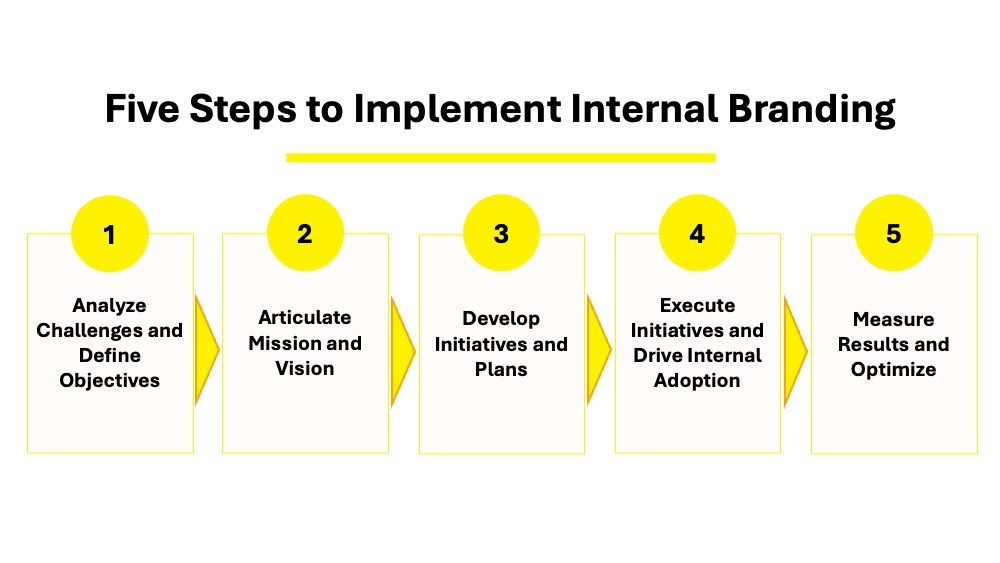
In order to make inner branding successful, it is important to proceed strategically and systematically. Here are five basic steps.
Step 1: Analyze the Current Issues and Clarify the Objectives
First, start by accurately understanding the issues that your company faces. Conduct employee surveys and interviews to visualize the current state of engagement, the degree of philosophy penetration, and communication problems. Identify specific issues such as “high turnover rate” and “poor inter-departmental cooperation,” and clearly set the objective of “what kind of state do you want to achieve” through inner branding.
Step 2: Verbalize the Philosophy and Vision to Be Communicated
Next, clearly verbalize the core values of the company that should be communicated to employees, namely the mission, vision, and values (MVV). If they already exist, review whether they are up-to-date and redefine them if necessary. Express them in concrete and empathetic words that employees can be aware of in their daily work and use as a guideline for their actions.
Step 3: Formulate Concrete Measures and Plans
Plan concrete measures according to the set objectives. Design in detail who (target person), what (message), how (method), and when (schedule) to communicate.
Combine methods that suit your company’s culture and issues from a variety of methods, such as issuing company newsletters, creating credo cards, holding company events, and introducing commendation systems, and create an annual implementation plan.
Step 4: Implement Measures and Promote Penetration to Employees
Based on the formulated plan, steadily implement the measures. It is effective to involve various levels and take a multifaceted approach, such as having management speak about the philosophy in their own words and having managers promote penetration in 1-on-1 meetings with their subordinates. By continuously sending out messages without ending with a one-time event, you will gradually work on employees’ awareness.
Step 5: Repeat Effect Measurement and Improvement
After implementing the measures, be sure to measure the effects. Conduct the survey conducted in Step 1 again and compare and verify how the engagement score and the degree of understanding of the philosophy have changed. Collect feedback from employees and analyze “what was effective and what were the issues.” Revising the plan based on the results and rotating the PDCA cycle to improve the next action is the key to leading inner branding to success.
| Steps | Main Activities | Output |
|---|---|---|
| Step 1 | Confirmation of Existing Awareness | Conducting a Questionnaire |
| Step 2 | Definition/Review of MVV | MVV Statement Brand Book Outline |
| Step 3 | Planning Measures Formulating a Plan |
List of Measures Annual Roadmap |
| Step 4 | Execution of Measures | Implementation of Each Measure (e.g., Holding Events) |
| Step 5 | Effect Measurement Improvement |
Questionnaire Results Improvement Action Plan |
Introduction of Methods Used in Inner Branding
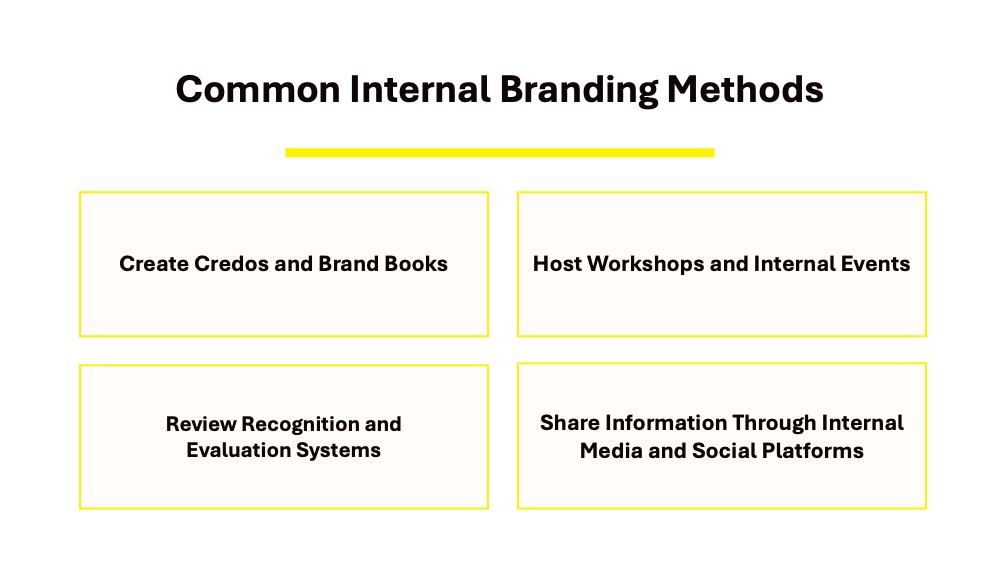
There are various methods to promote inner branding. Here are some typical examples.
Create a Credo or Brand Book
A credo is a concise summary of a company’s beliefs and code of conduct. By making it a card size that can be carried at all times or placed on a desk, you can create an opportunity for employees to return to the philosophy at any time. Creating a brand book that summarizes the company’s history, vision, and values as a story and distributing it to all employees is also very effective in deepening understanding of the brand.
Disseminate Information Through Company Newsletters and SNS
Company newsletters and internal SNS are important tools for continuously disseminating information. By regularly sharing messages from management, introductions of employees who embody the vision, and the latest company trends, employees’ sense of belonging is enhanced and a sense of unity with the company is fostered. It is also important to incorporate video content and other ideas that will interest employees.
Hold Workshops and Company Events
Company events such as company-wide general meetings, award ceremonies, and team-building training are excellent opportunities to revitalize communication between employees and enhance the sense of unity in the organization. By holding workshops where employees discuss the company’s philosophy and values with each other, it becomes an opportunity to proactively grasp the philosophy as their own, rather than passively receiving it.
Review the Commendation System and Evaluation System
Establishing a system to evaluate and commend actions that embody the company’s philosophy and values is a powerful message that clearly shows what kind of actions the company is recommending. In addition, by incorporating the degree of practice of values into the personnel evaluation items, employees will become more aware of the philosophy in their daily work. By linking it to the system, inner branding can be rooted as a culture.
Summary
Inner branding is an important management strategy for sharing a company’s philosophy and vision with employees and strengthening it from within the organization. A company where each employee takes pride in the company and works with enthusiasm has unwavering competitiveness even in a rapidly changing era and can continue to grow sustainably. Please refer to the steps and methods introduced in this article and try to implement inner branding in your company.
We will propose the optimal measures for the implementation of inner branding according to your company’s organizational culture and issues. At SUNNY SIDE UP, we can support the construction of a strong brand from within the organization, from improving employee engagement to instilling the corporate philosophy. If you are interested in revitalizing internal communication or reforming employee awareness, please contact us using the inquiry form.