What Is a Survey Release? Explaining the Strategic Design Steps for PR That Builds Corporate Trust
- カテゴリ:
“We issued a survey release, but it didn’t generate much attention.”
“It ended up being just a list of numbers, and our company’s message didn’t come across.”
Many PR professionals likely share these concerns. In recent years, as the credibility of information is scrutinized more rigorously, survey releases that use objective data to engage with society have become a highly valued PR method. However, many companies fall into the trap of making “presenting numbers” the goal itself, leaving behind the corporate perspective and problem-raising that should underpin the data.
This article provides a detailed explanation of how to use survey releases not as mere “content creation,” but as a strategic communication initiative that builds corporate trust and expertise.
What Role Do Survey Releases Play in Corporate PR?
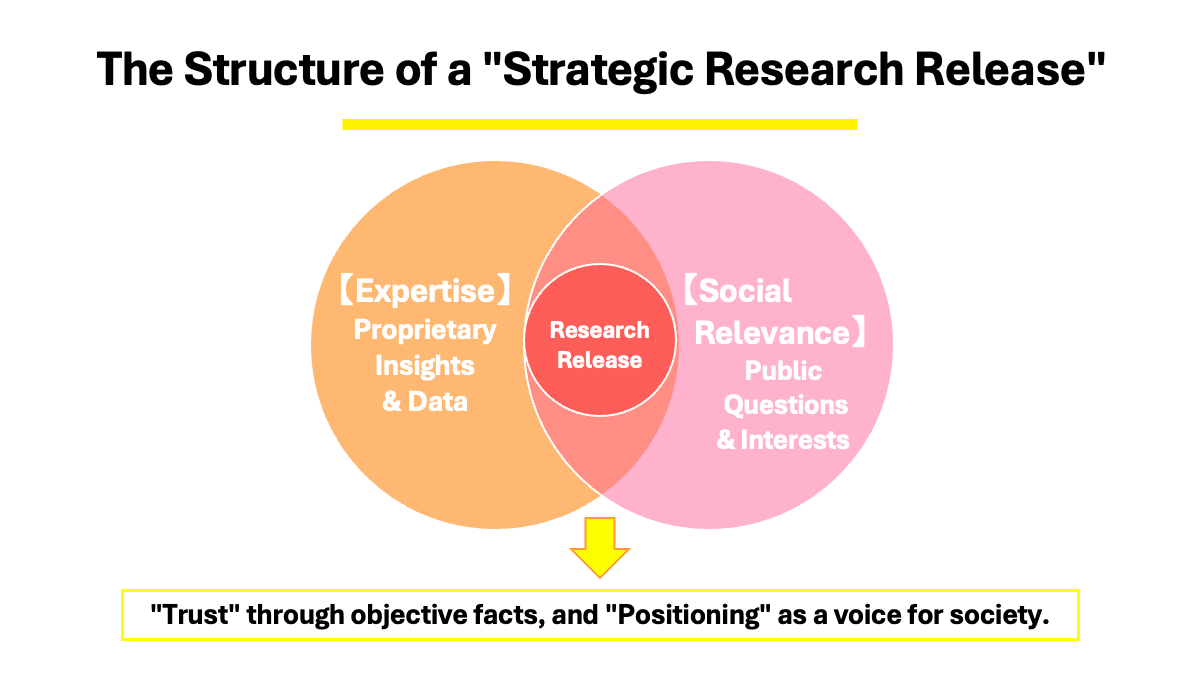
A survey release refers to a PR method in which a company conducts its own survey or data analysis and disseminates the results as news. If the true role of PR is to “build favorable relationships with stakeholders,” then a survey release serves as a “common language” to initiate dialogue. Rather than unilaterally conveying what the company wants to say, it is important to respond to what society is curious about with objective facts in the form of data.
| Item | Traditional Survey Release (Content-Driven) | Strategic Survey Release (Trust-Building) |
|---|---|---|
| Primary Purpose | Media exposure, temporary buzz | Presenting social issues, proving expertise |
| Design Starting Point | Questions likely to yield interesting numbers | Intersection of company stance and social interest |
| Role of Numbers | Main focus (conclusion) | Material to reinforce the message |
| Subsequent Use | Ends after release | Repurposed for company content and sales materials |
[Related article]What is a PR strategy? Explaining the planning process for creating trust and value that cannot be obtained through advertising alone « Column
Why It’s More Than Just a Survey Announcement
A survey release is not simply about announcing compiled survey results. Its greatest value lies in the company’s ability to pose a question to society: “Isn’t this an issue right now?” For example, if a company advocating new work styles releases a survey on “loneliness during remote work,” it becomes more than just data presentation—it becomes an activity that makes social issues visible. By addressing latent social concerns, a company can establish itself as a “voice for society.”
Why It Is Used in Corporate PR
Survey releases are actively used in corporate PR because they allow companies to demonstrate their expertise and enhance credibility through the survey content. For instance, when a financial company surveys “how people save money” or an IT company investigates “the progress of digitalization,” they can communicate to society that they are “entities knowledgeable about the latest trends in that field.” The accumulated data becomes a valuable information source when media outlets plan features on those topics, ultimately leading to new interview requests.
The Strength of “Fact-Based PR” Distinct from Advertising
Unlike one-sided advertising or promotional messages, PR based on clear facts (data) has the strength of being more readily accepted by readers and viewers. Objective data stating “80% of users responded with satisfaction” is far more credible than the subjective claim “Our product is excellent.” Continuously and sincerely disclosing objective facts through survey releases demonstrates corporate transparency and directly contributes to raising social trust in the brand.
Why “Survey Intent” Is Critical in Survey Releases
In PR, the true value lies not in the numbers themselves, but in the “intent”—the perspective the company holds regarding the phenomena the numbers reveal. The background of “why we conducted this survey now” is where the company’s identity and stance toward society reside.
To Design Touchpoints with Society and Gain Empathy
Clarifying the intent of a survey is nothing less than defining where to establish touchpoints with society. By demonstrating the company’s stance toward social changes and consumer insights, media and readers begin to perceive the information not as mere “corporate news,” but as “personally relevant information” connected to their daily lives.
To Express the Company’s Stance and Demonstrate Its Position
Numbers themselves are objective facts, not influenced by corporate ideology. However, how those numbers are interpreted and what message accompanies them—that is where the company’s will and philosophy reside. Continuously demonstrating a consistent stance through survey releases becomes a powerful means of embedding the company’s unique ideology and culture in society.
To Give the Story Persuasiveness and Make It Memorable
The company’s will to “change the world in this way,” combined with objective data showing “this many people are actually facing this challenge”—that is the formula for elevating a claim into solid persuasiveness. What matters here is not making the numbers the protagonist. Numbers are merely evidence supporting the company’s message. Use them strategically as a tool to reinforce the narrative.
The Difference Between Companies Where Survey Releases Work and Those Where They Fail
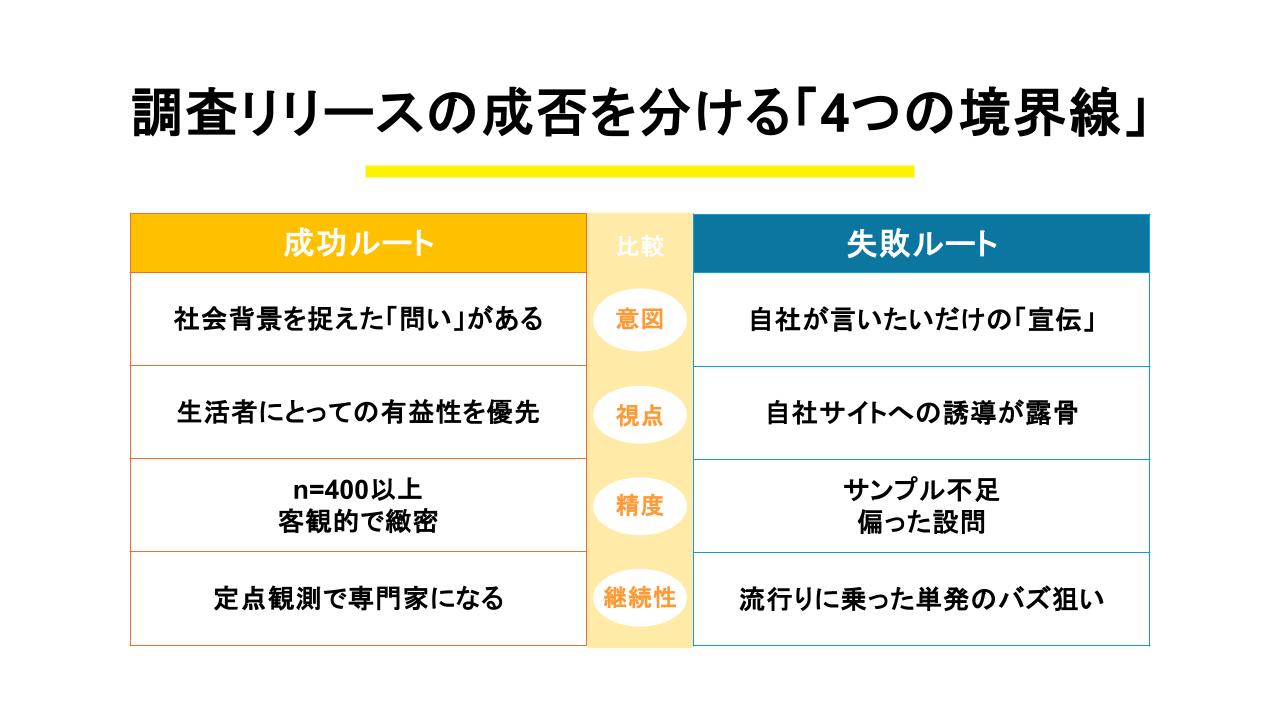
Survey releases produce vastly different results depending on whether a company can leverage them effectively. Even when collecting data and distributing press releases in similar ways, why do some companies continue to be featured in the media while others see disappointing responses? The answer lies not in survey design techniques, but in the “philosophy” behind the dissemination. Below, we outline the differences between companies where survey releases work and those where they fail.
[Related article]How to develop a public relations strategy? Explaining in detail the organizational design and operational steps that contribute to management « Column
Common Traits of Surveys That Only Generate Temporary Buzz
Survey releases that attract temporary attention but fail to lead to sustained media exposure share common characteristics. The background of “why we conducted this survey at this time” is unclear, and the theme becomes too narrow due to prioritizing self-promotion, causing it to fall outside the interests of the general public. Remember that surveys unable to answer “How is this beneficial to the public?” are unlikely to reach the media, no matter how carefully crafted.
Characteristics of Surveys the Media Wants to Cover
Survey releases that journalists want to cover connect social changes with the survey theme, and the context of “there is significance in posing this question now” is designed from the outset. In terms of data reliability, 400 or more valid responses serve as one benchmark. Additionally, whether the “surprise” or “social implications” indicated by the numbers can be articulated from the company’s perspective determines the depth of the information.
Design by Companies That Build Trust Continuously
The true value of survey releases lies in building a position as an expert—”this company for this field”—through continuous dissemination. By conducting longitudinal observations on the same theme or changing angles according to current events, journalists recognize “they’ve provided valuable information again” and continue to cover it. Rather than seeking one-time results, the key is designing long-term trust.
If you are struggling with the strategic design of survey releases, please feel free to contact SUNNY SIDE UP. From identifying social issues to survey design and release distribution, we propose optimal strategies from a PR perspective. Our experienced professionals fully support survey releases that enhance corporate expertise and trust by ensuring data transparency and adding unique insights. First, let us hear about your goals and timeline. We accept specific inquiries through our contact form.
Strategic Survey Release Design Steps to Maximize Results
The success of a survey release is determined at the “design stage” before creating the survey form. Build the strategy in reverse: what story will you use to engage society, and what reputation do you want to achieve as a result? Here, we explain five strategic survey release design steps that incorporate PR intent, not just operational tasks.
| Step | Implementation Details | Design Points |
|---|---|---|
| Step 1 | Identify social issues and define the theme | Legitimacy of “Why now, why us?” |
| Step 2 | How to pose questions that become news | Anticipating angles the media wants to cover |
| Step 3 | How to create survey questions | Balancing data objectivity and persuasiveness |
| Step 4 | Release editing and headline design | Title and story construction that conveys the conclusion at a glance, writing style |
| Step 5 | PR development after release | Secondary use for company content and sales support |
Step 1: Identify Social Issues and Define the Theme
The first step is to identify the “social issue” your company should address. Read the social climate—what is being discussed, what anxieties and expectations people hold. Then, select a theme that has the highest affinity with your company’s business and vision, and one your company is qualified to address. This is the starting point for everything.
Step 2: How to Pose Questions That Become News
Once the theme is decided, consider “news angles the media wants to cover.” Rather than stopping at a simple fact-finding survey, it is important to formulate a hypothesis: “Might there be this kind of issue behind this phenomenon?” Develop a scenario: “Modern people probably feel this way. If that can be backed by numbers, it becomes news.” The sharper the question, the stronger the message of the survey results.
Step 3: How to Create Survey Questions
Next is the specific survey question design to support the questions and hypotheses you have posed. Here, design questions that go beyond simple “yes/no” answers to explore the underlying reasons, emotions, or specific behavioral processes.
What is crucial is to thoroughly avoid questions that lead respondents toward an intended conclusion and to maintain data objectivity. Additionally, a practical point is to design questions that allow for multifaceted perspectives in advance, in case you want to “view the data from this angle” during the analysis stage. While the questions support the hypothesis, they also ensure analytical flexibility. This sense of balance is the key to enhancing survey quality.
Step 4: Release Editing and Headline Design
Once the data is collected, the next step is editing—how to present it as “news.” What is important here is to extract the most impactful number from the vast data as the protagonist, serving as the answer to the “question” posed in Step 2. The title and headline are especially critical, as they are the first information readers encounter. By designing them so that “whose issue, what kind of issue, and its current state” is conveyed at a glance, you can strongly capture the interest of media and readers.
Step 5: PR Development After Release
A survey release does not end with “distribution.” It is after the release that the true value of the data is tested. The data obtained is not just breaking news—it becomes a powerful weapon for secondary PR activities.
For example, publish in-depth articles on your owned media, or use the data as supporting evidence in sales materials—leverage it across all touchpoints. In media outreach as well, individual proposals are important beyond mass distribution. By approaching media with suggestions like “This data aligns well with your upcoming feature theme,” the information is more likely to be accepted as valuable content beyond mere fact-sharing.
How to Use Survey Releases Beyond a One-Time Event
It would be a waste to let a survey release end as a one-time news item distributed to the media. The objective data and social problem-raising you have obtained become valuable corporate assets. Here, we explain specific methods for utilizing and developing survey releases to contribute to long-term corporate value enhancement, rather than ending them as one-off initiatives.
[Related Article]What is News Value? Explaining How to Create and Deliver Information that Gets Media Coverage « Column
Building Expertise Through Longitudinal Surveys
“Longitudinal surveys,” which repeat surveys on the same theme or questions at regular intervals, reveal market changes and trends invisible in one-time surveys. Data on year-over-year changes—”how things have changed compared to last year”—is highly valuable to the media. By continuing to disseminate such data, the company becomes recognized as “the entity most knowledgeable about the latest trends in that field,” leading to the accumulation of expertise and enhanced authority.
Owned Media, Social Media, and Sales Material Deployment
Data obtained from surveys also becomes a powerful weapon for marketing and sales. By developing release content into in-depth columns on owned media or creating easy-to-understand infographics for social media, you can reach a broader audience. Additionally, incorporating the data into sales materials as objective evidence supporting customer challenges and market needs dramatically enhances persuasiveness during negotiations.
Repurposing for Recruitment PR and Brand PR
Survey data can also play a role in recruitment activities and corporate branding. For example, survey results on the work styles and career perspectives of target demographics can be used as persuasive material in recruitment pitch decks and content for job seekers. Furthermore, continuously communicating the company’s stance through surveys on specific social issues generates trust that “this is a company sincerely engaging with society,” functioning as brand PR as well.
When Companies Need Survey Releases
The timing to leverage survey releases varies depending on the company’s situation and objectives. Rather than disseminating data simply because it has been collected, distributing it with strategic intent makes it easier to attract media interest.
| Timing for Use | Primary Purpose | Expected Effects |
|---|---|---|
| New business/service launch | Proving market needs and presenting necessity | Increased acceptance of the service and initial awareness |
| Raising industry issues | Making latent social issues visible | Proving expertise and establishing opinion leadership |
| Awareness expansion phase | Increasing media exposure and building trust | Natural media coverage based on facts and raising awareness |
[Related Article]Strategies to Increase Brand Awareness from a PR Perspective! Practical Design Connecting to Inquiries and Referrals « Column
New Business/Service Launch
When launching a new business or service, it is an ideal time to simultaneously disseminate survey results. This is because objectively supporting with data that the business is “sought after by society” becomes a powerful “news source” for the media. Reinforcing the company’s claim that “this is necessary” with third-party data transforms a mere promotional service introduction into “news” based on social demand.
Raising Industry Issues
When you want to address structural issues facing an entire industry, survey data becomes an excellent trump card. By presenting issues as facts backed by numbers rather than merely “the company’s opinion,” journalists are more likely to perceive them as “issues that should be discussed by society as a whole.” The accumulation of such dissemination leads to being trusted as a leading authority in that field.
Awareness Expansion Phase
Survey releases are also useful when you want more people to know about your company or business. By disseminating data that combines what society is currently interested in with your areas of expertise, you increase the likelihood of being naturally covered as news without advertising costs. Information conveyed through the third-party perspective of the media does not appear as one-sided promotion, allowing readers to remember your name with a sense of security.
To resolve challenges in fully leveraging survey releases, what is required is not merely learning survey methods, but designing sophisticated PR strategies. There is value in investing professional knowledge and time into the strategic aspects—how to interpret social trends and identify angles that align with the company’s purpose (reason for existence).
To maximize results with survey releases, leave it to SUNNY SIDE UP. Through media deployment linked with PR strategy, we enable wide information dissemination while ensuring data credibility. We provide total solutions from press release creation to unique media relations and optimal advertising space design.
Our experienced professionals provide consistent support from survey planning and design to continuous information dissemination. We realize strategic survey releases that enhance corporate expertise and trust.
Design and Expert Support to Achieve Survey Releases Chosen by the Media
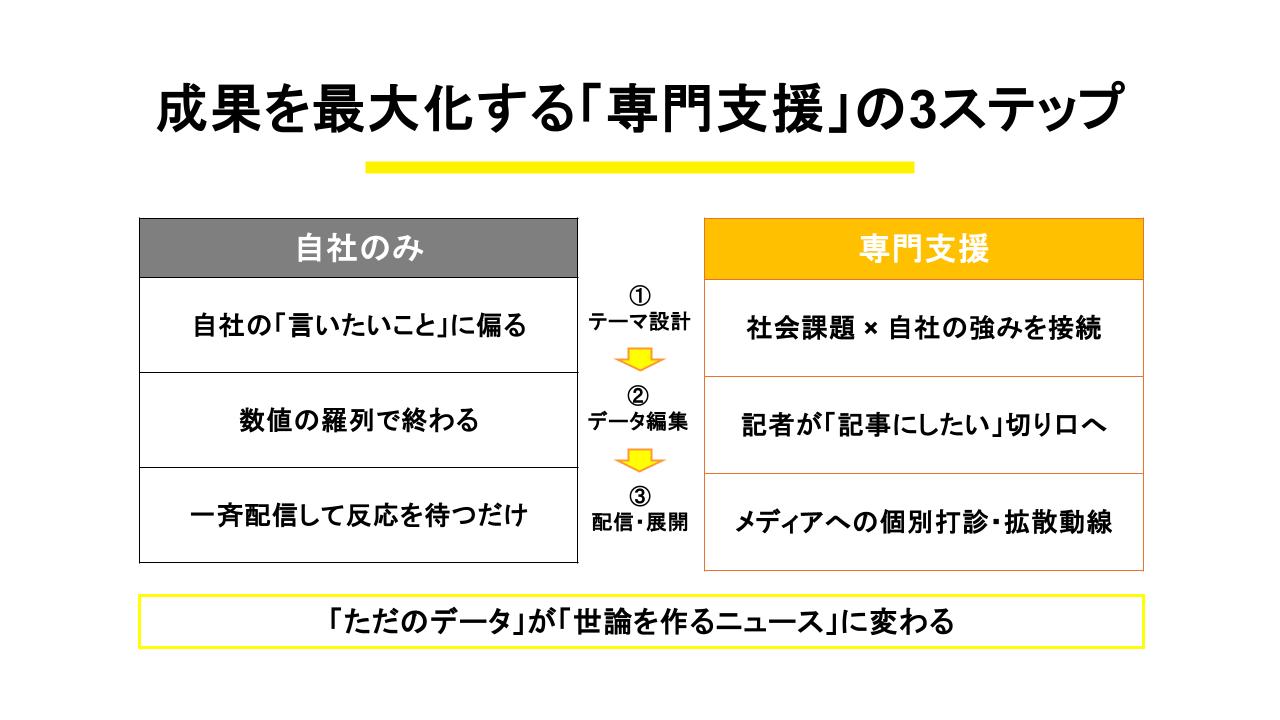
Even if you distribute a survey release, the expected effects cannot be achieved unless the media covers it. Specialized know-how is required, such as setting questions that capture social trends and constructing persuasive stories based on data. If your company lacks the resources or expertise, receiving support from a PR firm is the shortcut to success.
SUNNY SIDE UP’s PR: Accompanying You from Theme Design
Survey releases that attract media interest are largely determined at the initial theme design stage. SUNNY SIDE UP accompanies clients from the planning stage before question creation, reading the social climate and combining it with the client company’s strengths to derive the most effective survey theme.
Editorial Capability Balancing Corporate Message and Media Perspective
After data is collected, the editing process—how to present the results—is crucial. If the corporate message is too prominent, it becomes overly promotional and less likely to be covered by the media. Balancing both perspectives, we extract newsworthy numbers from the data and refine them into compelling titles and structures.
PR Support Anticipating Coverage and Dissemination After the Survey
SUNNY SIDE UP’s support does not stop at release distribution. From individual promotion to media outlets and journalists likely to be interested, to designing social media dissemination pathways after coverage, we strategically support the entire PR activity to maximize the asset value of the survey release.
Design Perspectives Necessary to Turn Survey Releases into Results
The success or failure of a survey release depends more on “design perspective” than on the quality or quantity of data. The entire design—how to plan the survey, how to present it, and to whom to deliver it—greatly influences whether it gets media coverage.
[Related article]What is Public Relations? A thorough explanation for beginners, from job description to how to develop a strategy! « Column
The Difference Between Survey Companies and PR Companies
The role of a survey company is to collect accurate data. On the other hand, the role of a PR company is to craft that data into news and deliver it to the media. Even with the same data, the coverage rate changes significantly depending on the angle and title design.
| Item | Survey Company | PR Company |
|---|---|---|
| Primary Role | Accurately “collect” data | “Transform” data into news |
| Areas of Expertise | Question design, sampling, tabulation and analysis | Theme design, editing, media approach |
| Challenges When Commissioned Alone | Difficult to leverage data for PR | Survey design and implementation require separate arrangements |
To turn survey releases into results, understand the strengths of both and coordinate them appropriately.
Challenges with In-House Production
While half of companies conduct surveys in-house, many担当者 feel challenges such as “it takes time” and “planning and design are difficult.” From planning to information dissemination typically takes about 1–2 months, requiring considerable effort to proceed in parallel with regular duties. What is even more serious is that if the PR perspective is lacking at the question design stage, even when data is compiled, it ultimately does not become news (does not generate buzz). The sense of “which themes will attract journalists’ interest” is difficult to acquire without being a PR professional who regularly interacts with the media.
The Importance of Editorial Design
After data is collected, the editorial ingenuity—which numbers to choose as the protagonist and what story to deliver—becomes the turning point for success. Even with the same survey results, how they are presented completely changes how they are perceived by readers.
What makes journalists think “I definitely want to write an article about this” is numbers that provide society with new “discoveries.” Careful considerations such as word choice in titles, graph design, or adding expert opinions also greatly affect whether journalists find it easy to cover as news. Announcing survey results is never merely a data report. It is an important “narrative” that conveys the company’s perspective to the world. This shift in awareness is the first step toward achieving good results.
Summary
A survey release is not merely a data announcement, but a sophisticated PR method for communicating a company’s perspective and problem-raising to society, and for building expertise and trust. More important than the impact of the numbers is the company’s intent and stance—”why we conducted this survey now”—which creates deep touchpoints with society. To prevent failure and maximize results, strategic story design based on social issues and continuous provision of transparent data are essential.
Position survey releases as powerful material to reinforce your company’s message, and develop PR activities that earn long-term support from society.