
What is Corporate PR? Explaining the “Attitude” and “Stance” Needed to Earn Social Trust and Support!
- カテゴリ:
“We feel like we are working hard on our public relations, but we aren’t managing to build up corporate trust.”
“People say they can’t see the substance of the company because product introductions always take center stage.”
Are you facing these challenges? Many companies tend to view PR (Public Relations) merely as a “method for getting media coverage” or a “means to sell products,” but corporate PR should be at the very core. Corporate PR refers to activities that communicate what kind of value a company provides to society and the stance it takes in its existence, thereby building favorable relationships with all stakeholders.
In this article, we will explain in detail the essence of corporate PR, which serves as the foundation for PR measures, and how to engage with society to become a company that people want to support.
What is Corporate PR? Differences from Product PR
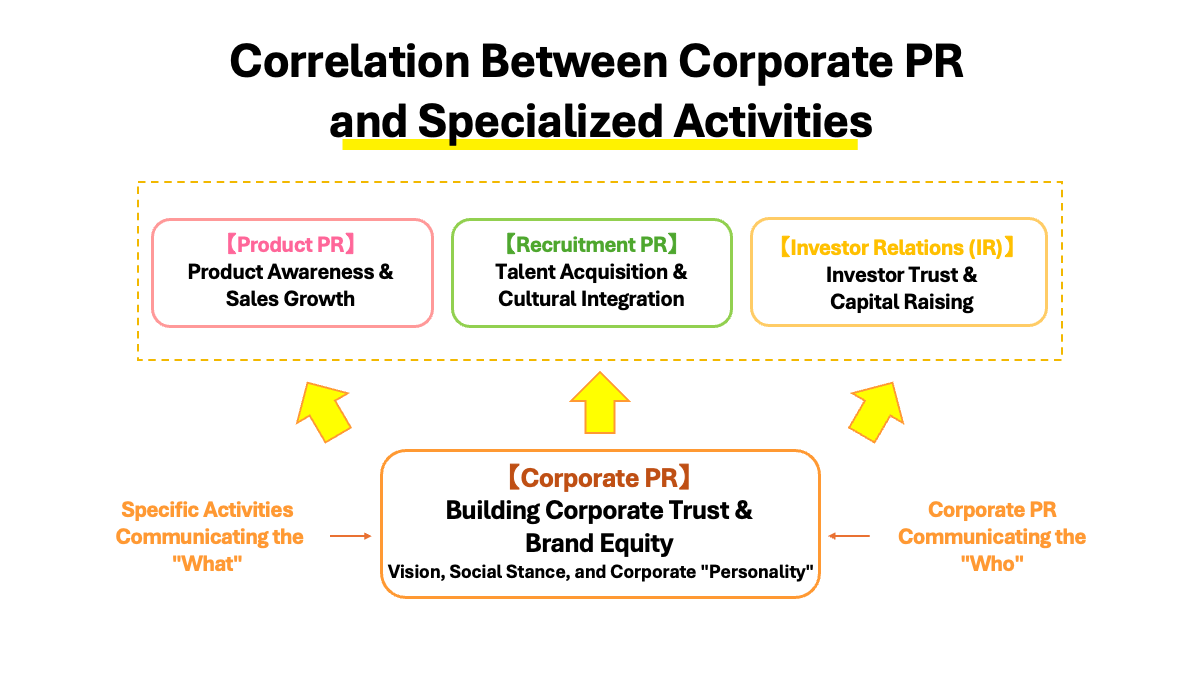
Corporate PR (Corporate Public Relations) refers to PR activities where the subject is the “company itself” rather than specific products or services. While “Product PR (Marketing PR),” as commonly imagined, has the direct goals of expanding product awareness and increasing sales, corporate PR aims to “improve corporate credibility” and “cultivate brand value.” Both are essential for corporate growth, but they differ in their approach, perspective, and timeline.
Activities to Communicate a Company’s “Attitude”
While product PR communicates the “merits of that product,” corporate PR communicates “what role the company plays in society.” What is valued is letting people know the company’s “personality” and “way of thinking” through the founder’s vision, philosophy, and approach to social issues. Rather than simply competing on performance, the goal is to increase the number of fans who feel, “I want to support this company because they are the ones making it.”
Why Corporate PR is Important Now
In today’s world, where goods and services are abundant, it is not easy to differentiate based on performance or price alone. In recent years, the background of “what kind of company is providing this” has become an important criterion for selection. Trust cannot be built overnight. That is why it is important to continue sincere communication on a daily basis and accumulate the intangible asset of “trust” over a long period. Building a positive foundation not only helps convey the appeal of products more deeply but also serves as a strength to protect the company when trouble arises.
Relationship with Product PR, Recruitment PR, and IR
The target of product PR is primarily “consumers,” but corporate PR is an activity that engages with “all stakeholders surrounding the company.” Building trust through corporate PR serves as a powerful foundation for other activities. For example, communicating the company’s appeal and the joy of working there becomes “Recruitment PR” to attract people who want to work with you. Furthermore, demonstrating open management policies and the vision to be achieved leads to “IR” (Investor Relations) that earns the trust of investors. By placing corporate PR at the foundation, activities such as product marketing, recruitment, and investment can positively influence each other, enhancing the overall value of the company from various aspects.
[Related article]What is Public Relations? A thorough explanation for beginners, from job description to how to develop a strategy! « Column
Three Challenges That Arise When Corporate PR is Weak
If corporate PR is not functioning sufficiently, it becomes difficult to achieve desired results even when spending a budget on marketing. Problems such as misunderstandings in the field or a poor impression of the company may become prominent. As a result, staff members end up constantly busy dealing with troubles or following up on parts that were not fully explained. Here, we summarize the difficulties that arise when a company’s stance is not effectively communicated to the world.
[Related article]What is a PR strategy? Explaining the planning process for creating trust and value that cannot be obtained through advertising alone « Column
Media Exposure Ends as a One-Off
Without the long-term perspective of corporate PR, priority is inevitably given to current sales and creating buzz, with attention focused only on things that stand out easily. Because there is no story connecting activities in a “line” of corporate vision and social value, even if the company is featured in the media, it remains a “point” activity, and media exposure ends as a one-off. Consequently, trust—which should be a corporate asset—does not accumulate, leading to exhaustion among staff who must constantly provide new topics and stimulation.
Recruitment, PR, and Brand Become Fragmented
Without a shared “pillar” of corporate PR across the entire company, each department will disseminate information based on its own judgment. For example, a contradiction arises if the PR department touts “innovation” in product PR while the HR department emphasizes “tradition and stability” in recruitment PR. When recruitment, PR, and brand-building activities are fragmented, society becomes unsure of which information to believe, leading to a situation where the outline of the corporate brand becomes blurred.
Delayed Response to Social Media Backlash and Crises
If internal coordination is not established on a daily basis, external messages become inconsistent when troubles or scandals occur, resulting in a delayed response to social media backlash or crises. Furthermore, when a “company whose values are usually invisible” causes a problem, public scrutiny is likely to be harsher. Unless you demonstrate a sincere attitude and build up “trust” regularly, no one will come to your aid in times of trouble, and recovering the brand image will require an enormous amount of time.
When facing these challenges, it is necessary not just to increase the volume of communication, but to fundamentally redesign the underlying PR and communications strategy. Strategic design—determining to whom, how, and with what priority the corporate stance should be communicated—is the only way to save a struggling team.
SUNNY SIDE UP proposes strategies to clarify corporate identity and build relationships of trust with society. Leveraging our media relations strength and extensive track record, we provide consistent support from press release creation to risk management and IR support. Our professional team will fully support PR activities that enhance corporate value from a medium- to long-term perspective.
Commonalities in Successful Corporate PR
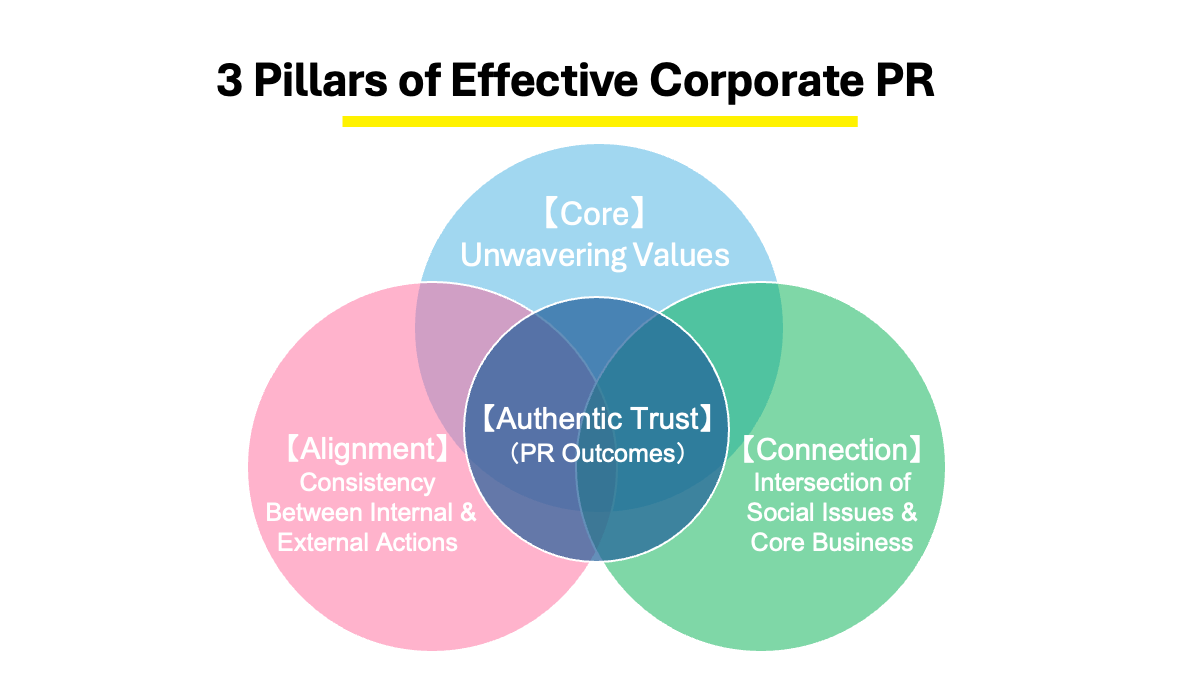
In corporate PR, the “stance” of how one engages with society is more important than the techniques or methods of “what to communicate.” Society pays attention not only to the words a company speaks but also to the “sincerity” and “consistency” behind those words. Rather than lining up good-looking words, clarifying the stance that serves as the company’s core is the first step toward being truly trusted by society.
Having a Core Message
The first commonality among successful companies is having a clear “core message” based on values the company believes in, without being swayed by trends or temporary public opinion. No matter how excellent the communication is, if the content changes based on the convenience of the moment, it will be difficult to leave a lasting impression on people. Maintaining a consistent axis of “this is how we think and act,” and continuing to communicate while maintaining transparency and sincerity, leads to the establishment of a corporate identity.
Consistency Between Internal and External Realities
It is also important that the messages communicated are not limited to external appeals but are consistent with the internal reality and the perceptions of employees. Even if only convenient information is released to the outside, if it does not match the reality, it is highly likely to damage trust instead. Companies where the corporate stance has permeated from management to PR, HR, and frontline employees, and which engage with both the outside and inside with an “unwavering attitude,” are the ones capable of building essential relationships of trust with stakeholders.
Designing Touchpoints with Society
Companies that can strategically design “touchpoints with society”—how they can contribute to the challenges of society as a whole, not just their own interests—can generate deep empathy. It is necessary to communicate with a sense of ownership regarding how to improve society through core business activities, rather than stopping at formal Corporate Social Responsibility (CSR). The attitude of not just talking about “ourselves” but connecting and discussing the company’s activities as “social matters” will be a powerful message in modern corporate PR.
Steps to Promote Effective Corporate PR
To make corporate PR effective, it is necessary to proceed through strategic steps. Rather than sending out one-off news items to match the topics of the moment, delve deep into your company’s identity and carefully design touchpoints with society. Here, we explain four specific steps to lead corporate PR to success.
| Stage | Details of Implementation | Key Outputs |
|---|---|---|
| Step 1 | Reorganization of Corporate Philosophy, Purpose, and Values | Corporate PR Tagline and Concept |
| Step 2 | Target Analysis, Story Construction, and KPI Setting | PR and Communications Strategy Roadmap |
| Step 3 | Press Releases, SNS, Owned Media, and Press Conferences | History of Dialogue with Society and Reputation Changes |
| Step 4 | Effectiveness Measurement, Feedback Analysis, and Issue Extraction | PR Strategy Improvement and Next Action Plan |
Step 1: Redefine Identity and Solidify the Core
The first thing to do is to delve deep into your company’s identity. Identify the founding spirit, the journey so far, and the values that employees hold dear, and redefine “what kind of value we provide to society.” This verbalized “corporate core” becomes the consistent standard for all communication.
Step 2: Design PR Strategy and Define Communication Themes
Once the corporate identity is clear, meticulously design a PR strategy for “to whom” and “in what context” it should be communicated. Analyze what each stakeholder is looking for and where social interests lie, and find the points where the company’s stance and social interests overlap. If you find this design stage difficult, you may want to consider using an external partner with specialized expertise.
Step 3: Conduct Continuous Dialogue to Deepen Relationships
Based on the strategy, engage in continuous information dissemination and dialogue through various channels. Rather than just aiming for media coverage, continue to show a consistent attitude at every touchpoint, including the company website, social media, and internal events. The ultimate form of corporate PR is an “endless dialogue” where you do not stop at a single communication but sincerely accept feedback from society and continue to improve your own activities.
Step 4: Measure Effects and Update Measures
After communicating, quantitatively and qualitatively measure the results of the PR activities performed. In addition to numerical data such as the number of media mentions and the ripple effect on social media, verify the degree of achievement against the KPIs set in Step 2, such as changes in stakeholder awareness and reputation. By extracting issues from the results and running a cycle to improve (update) the next strategy and message, corporate PR efforts will evolve into something stronger and more refined.
Why Corporate PR is Difficult to Function with Internal Management Alone
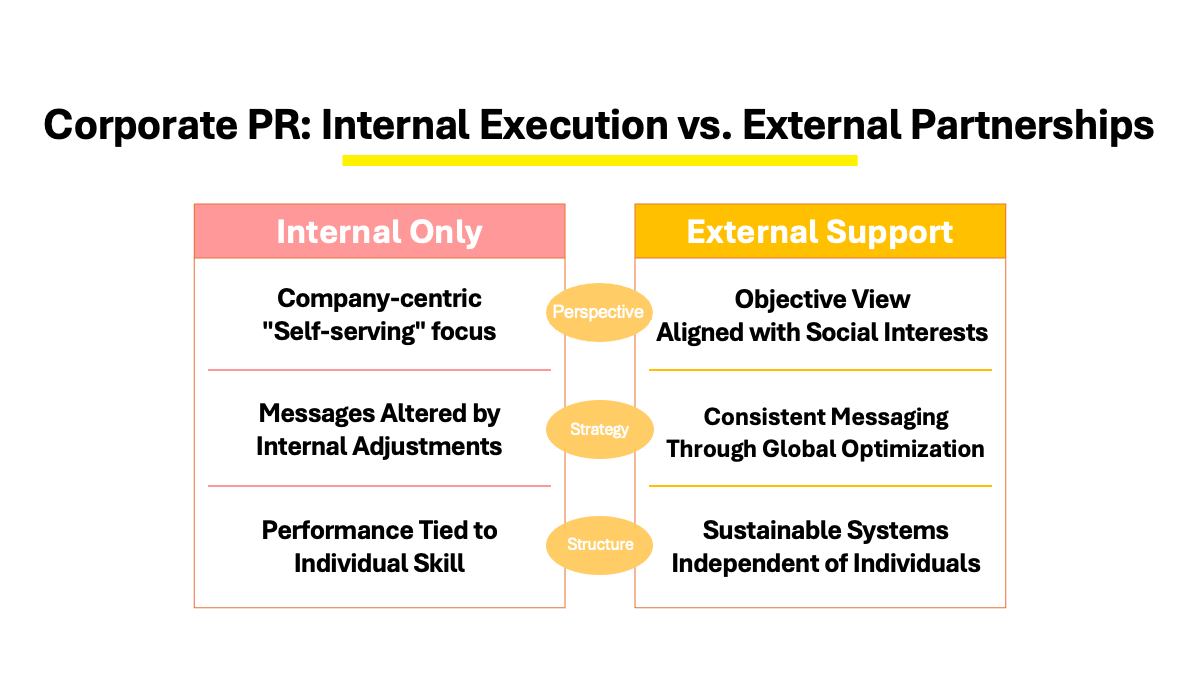
When trying to complete corporate PR entirely within the company, consistency of messaging and an objective perspective tend to be lost. While employees understand the company’s appeal best, there are challenges that internal management alone cannot fully address. Here, we summarize the reasons why internal management is difficult to function and the benefits of incorporating an external professional perspective.
Structural Reasons for Inconsistency in Communication (Expertise in Strategic Design)
When corporate PR is conducted only internally, the content to be communicated fluctuates because different departments value different things. The sales department emphasizes revenue, while the HR department prioritizes recruitment, leaving the PR person busy with internal coordination. As a result, the fundamental message of the company as a whole becomes blurred. To look at the big picture and create a coherent plan, an objective perspective, wisdom, and expertise that are not bound by internal relationships are required.
Perspectives Gained by Bringing in an External Partner (Necessity of a Third-Party Perspective)
When thinking about corporate PR only internally, there is an inevitable bias toward “what we want to say.” Technologies or initiatives that are taken for granted within the company often actually attract high social interest. This is where an external third-party perspective, which can calmly assess the social atmosphere and media interest, becomes important. By passing information through an objective filter of how it is seen by society, one-sided communication can be prevented.
Importance of “Systematizing” Corporate PR (Difficulty of Continuous Operation)
Corporate PR is an activity that leads to results only when continued over the medium to long term, but internal management is prone to becoming dependent on specific individuals. If it depends on the ability of a particular person, there is a risk that PR activities will stop completely when they transfer or resign. To prevent PR from losing priority while busy with daily operations, a more reproducible and organizational system is necessary.
Why More Companies are Working with External Partners for Corporate PR
In recent years, there has been an increase in cases where companies do not complete everything internally but work together with external partners on corporate PR. Specialized know-how is indispensable to respond to increasingly complex social needs and deliver information accurately. By incorporating external expertise and resolving internal resource shortages, aim for more certain results. Here, we explain the specific reasons why many companies rely on external partners such as PR firms.
| Strengths of External Partners | Specific Support Content | Expected Effects |
|---|---|---|
| Expertise in Strategic Design | Current Situation Analysis and Roadmap Creation | Consistent Information Dissemination Without Hesitation |
| Media Connections | Approach to Appropriate Media and Relationship Building | Information Reaches the Intended Target Audience Reliably |
| Internal Communications | Formulation and Systematization of Internal Messages | Employee Understanding Deepens and the Organization Unites |
Capable of Accompanying You from Strategic Design
To make corporate PR successful, a clear blueprint that looks at the whole picture is needed, rather than one-off measures. External partners provide support in identifying strengths and challenges from an objective perspective. Based on the analysis results, they build a PR strategy from the ground up regarding what should be communicated to whom. They also handle the creation of actionable roadmaps and the design of KPIs (Key Performance Indicators) to measure achievement. Being able to have someone firmly accompany you through strategic design from scratch is a major benefit of hiring external experts.
Media Network
Selecting the most suitable media for your company and delivering information accurately is an extremely difficult task. External partners, including PR firms, have strong networks with the media cultivated over many years. They are well-versed in what kind of information reporters from various outlets are looking for and can approach them with the appropriate angle. High-quality media exposure that cannot be obtained simply by distributing press releases can be expected. By utilizing unique connections, a company’s communication power and social credibility can be boosted at once.
Internal Permeation Support
In corporate PR, activities to promote internal understanding are just as important as external communication. If the company’s philosophy and vision are not communicated to employees, contradictions will arise between frontline actions and the content being communicated. External partners also excel at creating systems for such internal communication. They verbalize management’s messages in an easy-to-understand way from an objective standpoint and carefully support the process of generating employee empathy. By ensuring internal permeation, each employee grows into a good spokesperson for the company brand.
[Related article]What is inner branding? Explaining how to proceed with the purpose, effects, and success stories « Column
Summary
Corporate PR is not merely about gaining exposure; it is an activity to communicate a company’s attitude and stance to society and build medium- to long-term relationships of trust with all stakeholders. It also serves as an important foundation supporting individual measures such as product PR, recruitment PR, and IR. If corporate PR is not functioning, it leads to inconsistencies in communication and vulnerability during crises. The key to success lies in an attitude of “transparency, consistency, and a sense of ownership” rather than the content itself, requiring strategic design starting from the redefinition of identity. Corporate PR does not produce results overnight, but continuing to engage with society with a sincere attitude will ultimately become the greatest brand asset that cannot be imitated.
Corporate PR only yields results when designed through to “execution.”
Having read this far, you likely understand the importance of corporate PR, but
・Don’t know where to start
・No internal system to promote it
・Media exposure ends as a one-off
・Brand messages cannot be unified
Many companies may be facing these challenges.
Corporate PR only produces results when it goes beyond just a “way of thinking” to include strategic design, execution, and continuity.
Corporate PR Support from SUNNY SIDE UP
At SUNNY SIDE UP, we support PR design that enhances corporate value rather than just simple media exposure.
▼Examples of Support Areas
・Corporate PR Strategic Design
・Brand Message Organization
・Media Strategy Design
・Press Conferences
・Interview Exposure
・Corporate Branding
・Crisis Management PR
・Internal Permeation Support