What is Brand Equity from a PR Perspective? Explaining the Strategy of Transforming Consumer Trust into Corporate Assets
- カテゴリ:
When you want to enhance your company’s brand power, what indicators come to mind? Many business people likely envision increased sales, high pricing, or brand awareness.
However, the “brand equity (assets)” that public relations (PR) personnel should aim for is not just numerical achievements. It is the invisible but strong “trust” and “goodwill” built with consumers and society.
This article explains the true nature of brand equity from a PR perspective and how to build it. By the time you finish reading, you will see how your company’s public relations activities are building future assets.
What is “Brand Equity” from a PR Perspective?
The term brand equity directly translates to “the asset value that a brand possesses.” It is generally discussed as the premium value added to a product by having a brand, but in the context of PR, it has a slightly deeper meaning.
First, let’s clarify the definition of what we should aim for and what we should accumulate as assets in PR activities.
[Related Article]What is Public Relations (PR)? A Thorough Explanation for Beginners, from Job Content to Strategy Development! « Column
Accumulating Trust and Goodwill in the Minds of Consumers
Brand equity from a PR perspective can be defined as the total amount of “trust,” “goodwill,” “expectations,” and “evaluation” accumulated in the minds of consumers and stakeholders. It refers to a state where positive feelings and evaluations are rooted in the company, going beyond the level of simply knowing the name.
For example, the following reactions are signs that brand equity is being formed:
・When you see the company name in news or articles, you can accept it without any sense of incongruity, thinking, “This is a company I’ve seen often before.”
・Even when you come across reports of scandals or troubles, you don’t become overly negative, thinking, “There must be some circumstances” or “They will probably recover soon.”
・When new initiatives or products are announced, you accept them positively, thinking, “That company must have thought it through carefully.”
・When comparing with other companies in the same industry, it remains a candidate because “I’ve heard the name before” or “The company name gives me a good impression of the services and products.”
・When looking at recruitment information or service guides, the psychological hurdle feels lower than for “companies I’ve never heard of.”
These are not created overnight but are formed through years of corporate activities and accumulated communication.
In other words, the brand equity that PR personnel aim for is a state where people can trust “that company” in times of need. If many consumers recognize it as such, the company will find it easier to operate in society, enabling sustainable growth.
Differences from a Marketing Perspective
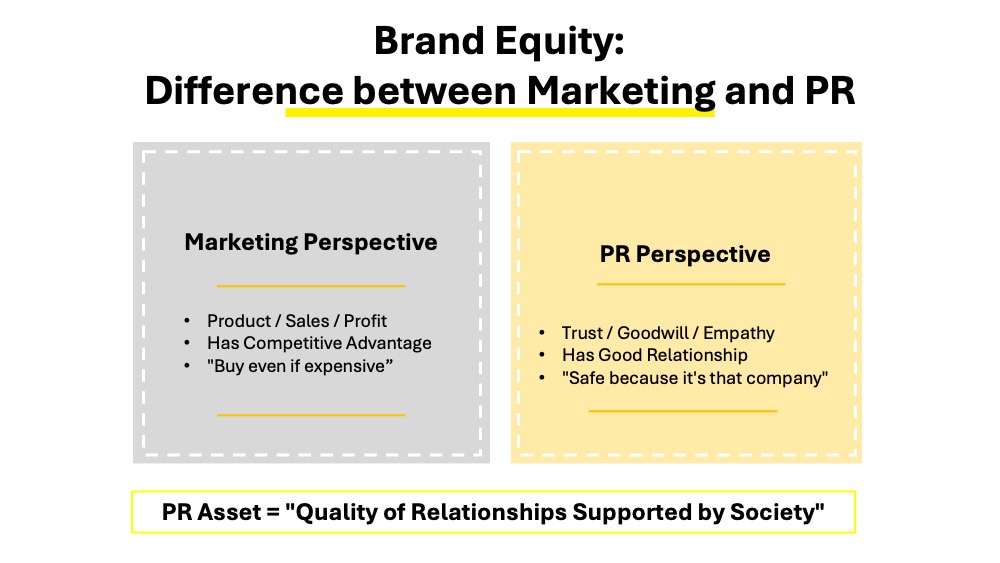
Brand equity from a marketing perspective, which is generally discussed, is ultimately regarded as a value that leads to “purchasing behavior” or “profit.” Aaker’s model is famous, emphasizing competitive advantages in the market such as “selling even at high prices” and “being bought by name.”
On the other hand, the PR perspective emphasizes the “quality of relationships” before purchase. It focuses on whether the company is recognized as a necessary presence for society and whether it is a highly favored and supported entity, prior to whether or not the product is purchased.
The table below summarizes the differences between the two perspectives.
| Comparison Item | Marketing Perspective | PR (Public Relations) Perspective |
|---|---|---|
| Main Purpose | Maximizing Sales Creating Profit |
Building Trust Maintaining Good Relationships |
| Values Emphasized | Price Premium Purchase Intention/High Quality Loyalty |
Reliability Goodwill Social Evaluation |
| Target Audience | Customers (Consumers) Companies |
Society as a Whole Employees Shareholders Media |
| Manifestation of Results | Short- to Medium-Term Performance Improvement | Medium- to Long-Term Reputation Resilience to Crises |
PR personnel should understand this difference and enhance brand value with a different approach from the marketing department.
Transformations Created by Brand Equity
When brand equity is accumulated through PR activities, changes occur in the awareness and behavior of consumers. “Perception change” originates from PR, and then gradually spreads to “behavior change.”
First, by coming into contact with information that can be received as highly reliable by third parties, perceptions of the brand change. By understanding the values and attitudes, the impression of the brand changes positively. As a result, the recognition of “trustworthiness” becomes established, leading to specific actions such as named purchases, recommendations, applications, and inquiries.
Strategic PR aims to intentionally design these changes in perception and behavior, and to enhance the value of the brand over the long term.
Why Building the Invisible Value of a Company Through PR is Important Now
In modern times, the importance of companies building brand equity led by PR is increasing. As the functional differences between products and services decrease, consumers are gradually placing more emphasis on “who they buy from” and “what kind of company is making it.”
Here, we will explain the three reasons why asset formation through PR is necessary, taking into account changes in the business environment.
[Related Article]What is News Value? Explaining How to Create and Deliver Information That Will Be Covered by the Media « Column
Gaining Trust Through Third-Party Evaluations
With the spread of the Internet and SNS, consumers are becoming more cautious about how they receive advertising messages from companies. It is becoming difficult to move hearts with just sales pitches such as “new product,” “highest quality,” and “industry No. 1.”
That’s where objective evaluations from third parties become important. When a company is featured in the media through PR activities or positive word-of-mouth spreads on SNS, it is received as “reliable information” that is different from advertisements that companies pay for.
The fact that “it is being evaluated by a third party,” which is built by PR, strongly supports “perceived quality (trust in quality),” which is the core of brand equity. The words spoken by reliable media and influencers are powerful decision-making materials for modern consumers.
Supporting Corporate Trust Even When Troubles Occur
If you continue to do business for a long time, there is no possibility of facing crisis situations such as scandals or online firestorms. It is the brand equity that has been built up in peacetime that saves companies in times of emergency.
If you are always disseminating sincere information and have built a strong relationship of trust with stakeholders, even if a problem occurs, a favorable interpretation may arise, such as “that company would never intentionally do anything malicious” or “they will surely respond sincerely.”
Conversely, if the same problem occurs in a company without accumulated trust, public opinion may suddenly turn to criticism, resulting in significant damage. Building trust for ToC / ToB through PR on a regular basis is an important activity for corporate survival.
Potentially Easier to Gain Social Credibility, Leading to Advantages in Recruitment and Fundraising
The effects of brand equity are not limited to sales promotion to customers. It can also have a significant impact on securing management resources such as recruitment activities and fundraising.
Some job seekers place importance on whether the company is socially trusted and whether it is a company where they can work with pride when choosing a place to work. If the image of “an advanced company working on social issues” has been established through PR activities, it can be expected that excellent human resources will be easier to gather and recruitment costs can be reduced.
Also, investors and financial institutions often evaluate not only financial statements but also the company’s reputation and future prospects. Companies with high social credibility may be able to gain an advantageous position in negotiations for partnerships and loan conditions. The brand assets created by PR function in all aspects of management activities.
Building brand equity through PR requires not only creating buzz but also a perspective of accumulating trust and empathy. This service connects the context of society and consumers with the value of the brand, and designs a consistent PR strategy. We aim to create a brand that continues to be chosen over the medium to long term, and support everything from awareness to trust formation.
Five Brand Assets Accumulated by PR Activities
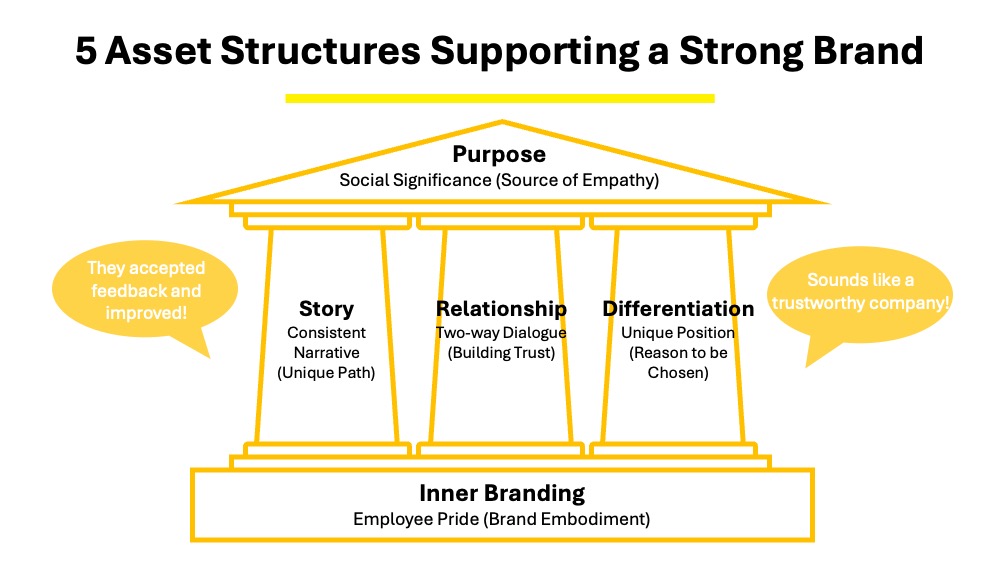
So, what specific elements are accumulated to form brand equity from a PR perspective? It is important to be aware of intentionally accumulating the following five assets, rather than simply disseminating information.
Here, we will explain the components of a brand to which PR activities can directly contribute.
Dissemination of Brand Purpose Showing Social Significance
The most important thing in modern brand equity is empathy with the purpose (reason for existence) of “why that company exists.” It is easy to move people’s hearts not only by providing convenient products but also by having aspirations to realize what kind of society through business.
The role of PR personnel is to convert this purpose into easy-to-understand words and stories and to disseminate it to the world. The company’s attitude, which is spoken in the context of “for the sake of society” rather than “for the sake of sales,” is easy to create empathy in the hearts of consumers and helps to foster respect for the brand.
This “reason to be respected” is a unique brand asset that cannot be imitated by other companies.
Building Relationships with Stakeholders Cultivated Through Sincere Dialogue
Relationships built through two-way communication with stakeholders (interested parties), rather than one-way information dissemination, are also important assets. This includes polite replies on SNS, product improvements that reflect customer feedback, and exchange events with the local community.
The experience of having their voices heard and being valued can transform customers from mere purchasers into “brand fans.” People who have become fans voluntarily begin to talk about the goodness of the brand to those around them, becoming powerful allies who spread new trust.
In PR activities, let’s not forget that “listening” is as important as, or even more important than, disseminating information in terms of asset formation.
The Strength of Inner Branding That Permeates From Employees
It is not only people outside the company who support brand equity. It is the employees on the front lines who actually provide services and embody the brand. It is an extremely important asset for them to be proud of their own brand and to be able to talk about it as their own.
If the corporate philosophy and vision are permeated within the company through inner PR (information dissemination within the company), it will help improve the quality of employee customer service and daily actions. As a result, the experiential value at customer contact points increases, making it easier to create a virtuous cycle in which the brand’s reputation further improves. The very appearance of employees working vibrantly becomes the strongest PR content, boosting the brand’s credibility.
[Related Article]What is Inner Branding? Explaining the Process with Objectives, Effects, and Success Stories « Column
Establishing Uniqueness Through Consistent Story Dissemination
In order to enhance brand equity, it is necessary to have a clear image of “that company is known for ◯◯.” To that end, it is necessary to continue to disseminate a consistent story, from the history of its founding to its current activities and future vision.
By continuing to convey not only fragmented news but also the thoughts and hardships behind it, and the stories of commitment through PR activities, the brand can be given depth. Data and specifications tend to be compared with competitors, but the unique story that the company has walked is difficult for other companies to imitate.
This storytelling creates differentiation from competitors and becomes the reason for being chosen.
Clear Differentiation From Other Companies Based on Empathy and Trust
While technology and specifications are easily imitated, the relationships of trust that companies have cultivated through dialogue with society, and empathy with the vision, cannot be easily imitated by other companies.
What customers ultimately choose is not just a high-performance product, but an existence that they can feel “this company can be trusted” and “this company’s ◯◯ is amazing.” By strengthening emotional connections through strategic PR, it is possible to create a “reason to be chosen” that does not fall into price competition and to establish a unique position that is not compared with competitors.
Steps for a PR Strategy to Enhance Brand Equity
Even if you understand the importance as a concept, many people may be wondering what to do in practice. PR activities to enhance brand equity are not one-off measures but need to be carried out along a strategic process.
Here, we will introduce specific steps for steadily accumulating assets.
Step 1: Design a Context That Connects Social Issues and Your Company
First, start by finding a theme that your company should talk about. Explore what kind of issues and concerns in the world your company’s products and services are linked to, and design a context.
For example, if you are a food manufacturer, you can link your company’s activities to social themes such as “food loss problems” and “children’s health.” By disseminating information not as a mere product introduction but in the context of “a company working to solve social issues,” you can increase interest from the media and consumers.
The important thing is to choose a theme that does not just ride the trend but does not deviate from your company’s main business. It is important to note that activities that are far from the main business may have the risk of being counterproductive.
Step 2: Continue to Disseminate Information That Can Create Empathy
Once the theme is decided, let’s continue to disseminate it as a consistent message. By frankly conveying not only the completed results but also the process of challenges and trial and error, and the lessons learned from them, it becomes easier to be recognized as a sincere and human brand.
Using owned media, blogs, SNS, etc., we will carefully deliver thoughts and backgrounds that cannot be fully conveyed by official information such as press releases. By repeatedly disseminating information, individual pieces of information are connected, and the brand’s way of thinking and attitude are more likely to remain in the memory of consumers.
The important thing is to be aware of “who you are conveying it to” more than “what you are conveying.” Continuing to disseminate information that considers the position of the recipient and their values and happiness is a major factor in creating empathy.
Step 3: Conduct Two-Way Dialogue That Listens to the Voices of Stakeholders
In parallel with information dissemination, let’s establish a system to accept feedback from stakeholders (interested parties). We will sincerely address comments and inquiries on SNS, and questionnaire results, and reflect them in the next activities.
Even critical opinions can be turned into opportunities to deepen trust relationships by responding sincerely. The fact that “they listened to our opinions and changed” strengthens trust in the brand.
It is also recommended to hold fan meetings and round-table discussions to create opportunities for direct dialogue. Steadily building face-to-face relationships will ultimately lead to the construction of the strongest brand equity.
Step 4: Enhance the Consistency of Experiential Value and Brand Recognition From the User’s Perspective
Brand equity is enhanced by providing consistent experiential value from the user’s perspective. It is required that the experience gained through products and services matches the brand’s recognition and image. For example, if a brand advocates high quality, it is necessary to provide a high standard of customer support response quality, product packaging and accompanying items, and Web site and app UI/UX.
On the other hand, even if a sophisticated brand image is promoted through advertising and PR, users will feel uncomfortable if the response to inquiries is uniform or after-sales support is insufficient. The gap received by consumers is easily visualized through SNS and word-of-mouth, and there is a risk of leading to damage to brand value.
Visualize the user journey and regularly verify whether “brand identity” is embodied at each touch point. By analyzing questionnaires, reviews, and voices received by customer support, and repeating improvements, the “experience that can only be obtained from this brand” becomes clear.
Measurement and Evaluation Methods for Invisible Corporate Assets
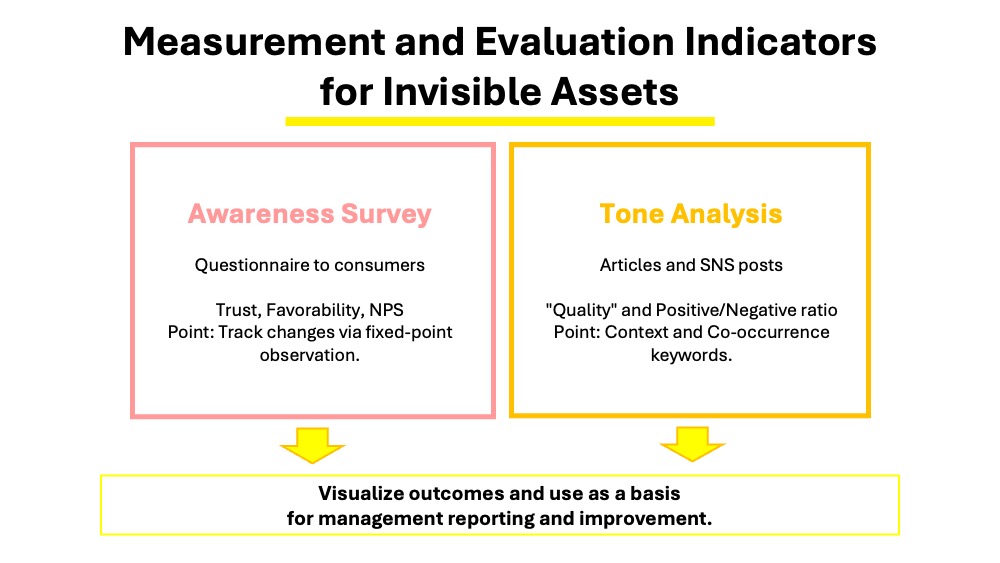
Building brand equity through PR activities is not something that can be immediately quantified like sales. However, in order to visualize the results of activities and rotate PDCA, it is necessary to set appropriate indicators.
Here, we will explain how to measure brand assets.
Measure Favorability and Trust Through Regular Awareness Surveys Such as Questionnaires
The most direct method is a questionnaire survey of the target audience. Numericalize and observe fixed points not only for “awareness” but also for qualitative indicators such as “favorability,” “trust,” and “recommendation intention (NPS).”
For example, we will set up question items such as “Do you think this company is sincere?” and “Do you think it is contributing to society?” and conduct surveys at a frequency of once every six months. You can track changes in numerical values before and after PR measures, and verify what kind of changes the activities have brought to consumers’ awareness. This is a powerful basis for reporting the results of PR activities to management.
Analyze the Quality of Media Coverage and the Tone on SNS
It is also important to evaluate not only the “quantity” but also the “quality” of media exposure. Check whether your company’s brand message and purpose are correctly conveyed in the article, and whether it is being featured in a favorable context.
In addition, we will analyze the content of mentions on SNS using social listening tools. We will investigate not only the number of posts but also the ratio of positive posts to negative posts, and what keywords are being used together. If keywords such as “reliable” and “want to support” are increasing, it is evidence that brand equity is steadily accumulating.
Use of Comprehensive Support Services to Enhance Brand Equity Over the Medium to Long Term with PR as the Core
“It’s become a hot topic, but I don’t feel that it’s leading to an improvement in brand value.”
“PR measures end up being one-off, and it’s difficult to see continuous results.”
Many companies have these kinds of issues.
It is difficult to accumulate trust and empathy from consumers and stakeholders with short-term exposure and awareness acquisition alone, and as a result, it is difficult to lead to an improvement in brand equity.
SUNNY SIDE UP’s support is designed to address these issues and enhance brand equity over the medium to long term with PR as the starting point. By connecting the values and ideas of companies and brands to the context of society and conveying them as a consistent message, we aim to accumulate trust and empathy.
・Design of Brand Strategy and PR Strategy
・Media Relations and Content Development
・Integrated Measure Design Such as Events and Campaigns
We provide end-to-end support to enhance the consistency of brand recognition and image.
By emphasizing the perspective of consumer insights and designing all contact points as brand experiences, we will realize a state where “this brand is chosen because of this.” It is recommended for companies that want to utilize PR as part of their management strategy and achieve both short-term results and medium- to long-term corporate value improvement. Please feel free to contact us.
CONTACT « SUNNY SIDE UP GROUP Inc.
Summary
Brand equity from a PR perspective refers not only to easily visualized indicators such as sales and awareness, but also to intangible values such as “trust, goodwill, and expectations” accumulated in consumers and society. Trust built through third-party evaluations becomes resilience in times of trouble and becomes an asset that functions in all aspects of management activities such as search, sales, recruitment, and fundraising. The important thing is not to end with a one-off topic, but to design a context with social issues, disseminate a consistent story, and accumulate value over the long term through two-way dialogue. Strategically designed PR steadily enhances brand equity and leads companies to become “entities that continue to be chosen.” That’s why PR is now positioned not as a public relations measure but as a “strategic area” for creating corporate value.