What is an influencer marketing strategy from a PR perspective? Designing for success and the approach to utilizing PR agencies.
- カテゴリ:
Do you want more people to know about your company’s products and services, but feel that advertising is becoming less effective? Especially in today’s world, where consumers tend to trust “third-party reviews,” traditional one-sided communication struggles to resonate with consumers.
This is where “influencer marketing strategies” are gaining attention. However, simply paying people with many followers to promote your products will not yield the desired results. On the contrary, if executed incorrectly, there is a risk of damaging your brand’s credibility.
This article explains “influencer marketing strategies” that incorporate a PR (Public Relations) perspective, rather than merely using influencers as advertising vehicles. Furthermore, we will touch upon the synergistic effects with “local SEO,” which is crucial for businesses with physical stores. By the time you finish reading, you should have a clear path to increasing your brand’s fans and driving customer engagement.
What is an influencer marketing strategy?
When you hear “influencer marketing strategy,” you might imagine having famous people on social media introduce products, leading to explosive dissemination. While reach is certainly one of the appeals of influencers, from a PR perspective, the essence lies a little deeper.
First, let’s deepen our understanding of the inherent role of influencer marketing strategies and how they differ from advertising.
Building Trust through Third-Party Connections between Companies and Consumers
An influencer marketing strategy is a marketing method that delivers a company’s message and appeal through individuals (influencers) who have influence within a specific community. The key is that they are not merely media outlets, but entities that have garnered “trust” from their followers.
Consumers tend to empathize more with the authentic voices of influencers they feel close to, who share their actual experiences—such as “it was delicious when I tried it” or “it was convenient to use”—rather than direct messages from companies like “it’s delicious” or “it’s convenient.” In other words, influencers stand between companies and consumers, translating corporate messages into “trustworthy words.” By transforming company-centric information into relatable content from a consumer perspective, natural recognition and understanding can be fostered.
Differences between “Advertising Approach” and “PR Approach”
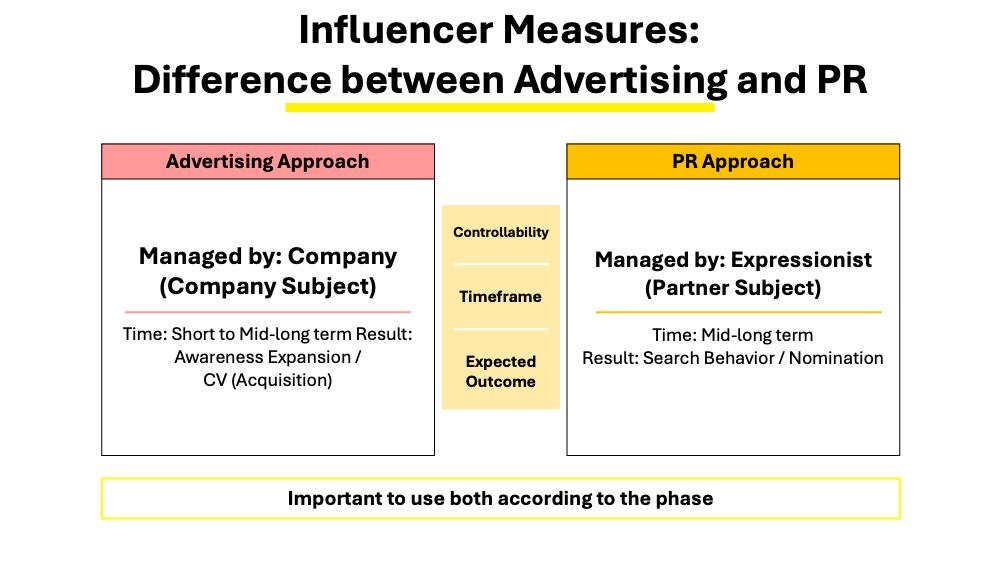
Influencer marketing strategies broadly involve two approaches: the “advertising approach” and the “PR approach,” which differ in methods and objectives.
The advertising approach is characterized by its ability to clearly design the message and expression a company wishes to convey. It is easy to visualize results such as reach expansion, brand awareness, click-through rates, and conversions over short to medium-long terms, making it highly effective for initiatives and campaigns that require speed. It also plays a crucial role as an entry point for many consumers to become aware of a brand by creating contact opportunities.
On the other hand, the PR approach respects influencers as individual creators and partners, emphasizing communication that leverages their perspectives and words. While the content of their communication cannot be fully controlled, their natural language based on experience tends to resonate with consumers, leading to deeper brand understanding and goodwill. This accumulation often manifests as search behavior and direct inquiries in the medium to long term.
| Perspective | Advertising Approach | PR Approach |
|---|---|---|
| Message Control | High | Low |
| Message Design | Easy to convey company’s intended message clearly | Tends to be natural expression leveraging the sender’s perspective |
| Timeframe for Results | Short-term~ | Medium to long-term |
| Impact on Brand | Effective in expanding awareness | Easy to build trust and goodwill |
| Contribution to Search/Direct Inquiry | Likely to trigger awareness contact | Likely to lead to branded searches and recall |
| Suitable Scenarios | New product/feature announcements Campaigns Initiatives requiring immediate results |
Deepening brand understanding Building a fan base |
While the advertising approach excels at generating short-term results, the PR approach plays a role in accumulating brand value. Appropriately combining both approaches according to objectives and phases is key to a successful influencer marketing strategy.
[Related Article]What is Public Relations (PR)? A Comprehensive Guide for Beginners, from Job Description to Strategy Development « Column
Why a PR-focused approach to influencer utilization is crucial now
With smartphones and social media becoming commonplace, we are exposed to a vast amount of information daily. However, consumers also tend to distance themselves from information they perceive as irrelevant or overly promotional.
In this environment, let’s delve into the background and reasons why an influencer marketing strategy incorporating a PR perspective can open up new possibilities for businesses.
[Related Article]What is a PR Strategy? Explaining the Planning Process to Create Trust and Value Beyond Advertising « Column
Third-party voicesneutralize doubts and anxietiesabout corporate communications
As modern consumers have more opportunities to access information, they naturally approach advertisements from companies with caution. It has become quite common for them to pause and consider, “It looks good, but what is it really like?”
In this context, third-party evaluations and recommendations play a crucial role. Opinions from individuals with fewer conflicts of interest, or those who are generally trusted, are more likely to be accepted with conviction than information conveyed directly by the company.
In an influencer marketing strategy from a PR perspective, the focus is not merely on having influencers speak on behalf of the company’s intentions. Instead, it emphasizes having influencers convey the genuine appeal they experienced in their own words. Even if it’s a collaboration, if honest feedback and points of concern are included, it becomes valuable and trustworthy information for followers, ultimately making it easier to reach a wider audience.
Empathy and Context Deepen Brand Understanding and Create Fans
The ultimate goal of PR is to build strong relationships with customers and stakeholders, fostering long-term support. Influencers serve as a powerful asset in achieving this.
Influencers regularly share their lifestyles and values, cultivating connections with people who resonate with their perspectives. For example, followers of influencers interested in environmental issues tend to have a strong interest in ethical consumption.
By collaborating with influencers whose values align with your brand’s philosophy, you can deliver more natural and impactful messages to an audience that shares those values. The unique appeal of a PR-focused influencer strategy lies in its ability to build relationships where people not only learn about your product or service features but also feel, “I can empathize with this brand’s philosophy.”
To succeed in influencer marketing, not only reach but also brand affinity and contextual design are crucial. This service supports everything from strategic design based on SNS characteristics and consumer behavior to execution. We achieve influencer marketing strategies that enhance brand value, centered on trust and empathy.
Synergistic Effects of Influencer Marketing and Local SEO (MEO)
For businesses operating physical stores, influencer marketing strategies can yield various benefits beyond simply increasing awareness. One such benefit is the synergistic effect with “Local SEO (MEO),” which impacts search results on platforms like Google Maps.
We will now clearly explain the mechanism of why it is effective for local businesses to collaborate with influencers who have an impact on social media.
How increased mentions on social media can positively impact map search rankings and overall search rankings
In local SEO, search engines are said to consider factors such as a store’s or service’s “prominence” and how often its name is mentioned online. When business information, such as store names, service names, and addresses, is featured in various places on the internet, it is more likely to be recognized as a “well-known and interesting establishment.”
When influencers actually visit a store and introduce it on social media, including the store name and location, it can organically increase such mentions. If a micro-influencer knowledgeable about specific local information features the business, it can also positively impact searches related to that area.
Creating buzz on social media can, as a result, positively impact search engine and map search rankings, leading to increased exposure and contributing to an overall boost in customer acquisition across the web.
User Behavior Linking MapSearch, SNS, and Branded Search
Looking at recent consumer behavior, a pattern seems to be gradually establishing itself: “finding an interesting store on social media, checking its location and reviews on map search, and then visiting.” This trend is particularly pronounced in industries where experiential value is emphasized, such as restaurants, beauty salons, and tourist attractions.
For example, it is not uncommon for someone to see an appealing lunch post on a photo-centric social media platform, feel like they “want to go,” then search for the store name on a map, check reviews and access, and finally proceed to make a reservation or visit.
The starting point for such behavior is the appealing content accumulated on social media. By increasing high-quality UGC (User-Generated Content) through influencer marketing strategies, you can generate initial “awareness” and broaden touchpoints for local SEO. As a result, the path to customer visits can be made smoother.
How to Maximize Results in Influencer Marketing (PR Perspective)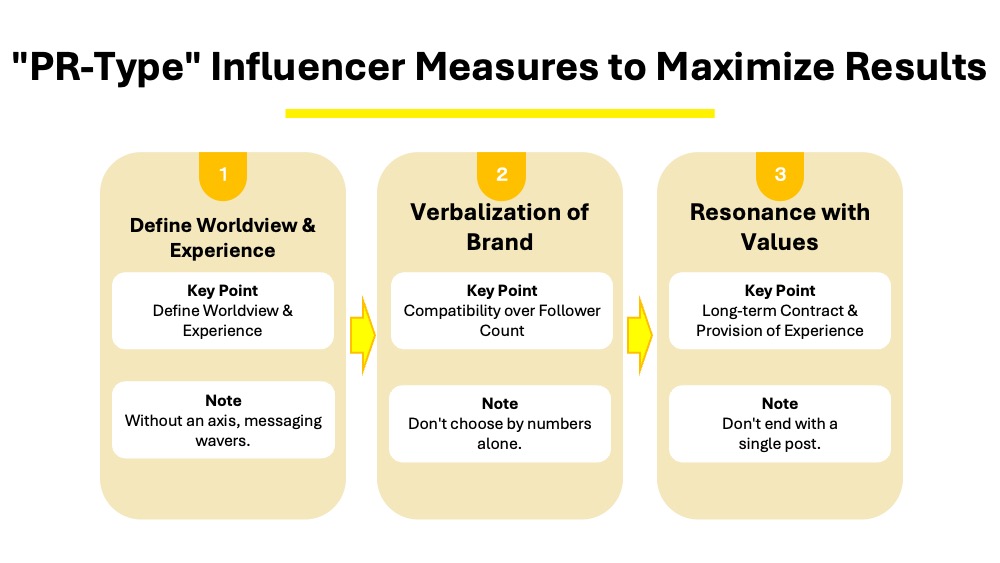
An influencer marketing strategy from a PR perspective aims to enhance brand equity through “empathy,” rather than merely being an advertisement. By treating influencers as partners and building trust, it becomes possible to disseminate high-quality information that resonates with society. Here are three steps to accumulate brand power as an asset, explained concisely.
| Item | Traditional Type | PR Type (Brand-Focused) |
|---|---|---|
| Main Objective | Temporary awareness spread | Gaining trust and accumulating value |
| Selection Criteria | Follower count | Alignment of values |
| Relationship | One-off request | Continuous partnership |
Step 1: Articulate Brand Value and Worldview
First, clearly articulate your brand’s value and worldview. Define why your brand exists and what kind of experience you want to deliver. If this core is unclear, your communications may become scattered, potentially harming brand equity. Organizing it into a story that third parties can easily tell is the first step toward forming a consistent image.
Step 2: Select Influencers Who Resonate with Your Values
Next, select influencers who genuinely resonate with your defined values. Prioritize whether their lifestyle aligns with your brand’s worldview over numerical metrics like follower count. When influencers truly feel a product is “good,” their words gain passion and persuasiveness.
Step 3: Design for Continuous Engagement, Not Just a Single Post
Do not let the initiative end with a single post; design a mechanism for continuous engagement. Consider long-term ambassador contracts or interactive experiences that encourage user participation. By creating a cycle where the brand is naturally recalled in daily life, rather than being a fleeting topic, awareness evolves into strong brand equity.
Learning from Common Mistakes: The Importance of a PR Perspective
When cultivating brand equity through PR activities, there are several points to be mindful of. If too much focus is placed on short-term metrics or buzz, even well-intentioned efforts may not lead to an increase in brand value, making it difficult to build trust.
Such situations often arise when the distinction between short-term, isolated exposure and the role of PR in accumulating brand trust is not clearly defined. From here, we will examine why a PR perspective is crucial in building brand equity, by organizing common pitfalls.
| Category | Common Phenomenon | Impact on Brand Equity |
|---|---|---|
| Selection Error | Prioritizing follower count over affinity or engagement with posts | “Brand identity” erodes, trust declines. |
| Design Error | Ending in a temporary buzz | Difficult to lead to continued use, not accumulated as an asset (User churn increases) |
| Governance Error | Disregard for legal regulations and transparency | Loss of social credibility, brand damage |
Selecting solely based on follower count leads to no results
In influencer marketing, it’s easy to focus on the number of followers, but if selection is based solely on this criterion, the desired results may not be achieved. Even if a message reaches many people, if the influencer’s worldview and values do not align with the brand, the message will struggle to deeply resonate with the audience.
To cultivate brand equity, the trust built with followers and the affinity between the content of communication and the brand context are crucial. Information disseminated without sufficient sharing of the brand’s philosophy can be perceived by the audience as somewhat incongruous. As a result, while numerical exposure may be gained, it becomes difficult to foster goodwill and affection for the brand.
Posts gained traction, but did not lead to searches or visits
Even when posts garner many “likes” and shares on social media, there are cases where they do not translate into actions such as branded searches or visits to physical stores. This often happens when the content of the post focuses too much on the influencer’s individual personality or entertainment value, failing to adequately convey the brand’s appeal, specific use cases, or benefits to customers.
When disseminating information from a PR perspective, it is important to also convey the experiential value that users can relate to in their own lives. By not only delivering visually appealing images and videos but also carefully depicting the context of how they bring benefits to daily life, brand understanding deepens. When the context is well-designed, it leads to memorable brand experiences rather than being a fleeting topic.
Brand Risk Due to Insufficient Understanding of Stealth Marketing Regulations
Compliance with the “Stealth Marketing Regulations” based on the Premiums and Representations Act, which came into effect in 2023, is an indispensable point for conducting brand activities. So-called stealth marketing, which disseminates information without clearly indicating that it is an advertisement, can significantly impact brand trust if discovered.
Once an impression of “lacking integrity” is formed, it takes considerable time and effort to restore that image. In PR activities, in addition to legal compliance such as clearly indicating relationships with “#PR,” it is important to strive for transparent communication that considers evolving societal expectations and ethics.
Thoroughly maintaining this stance ultimately protects brand trust and forms the foundation for cultivating long-term value.
What is the value of a PR agency in influencer marketing?
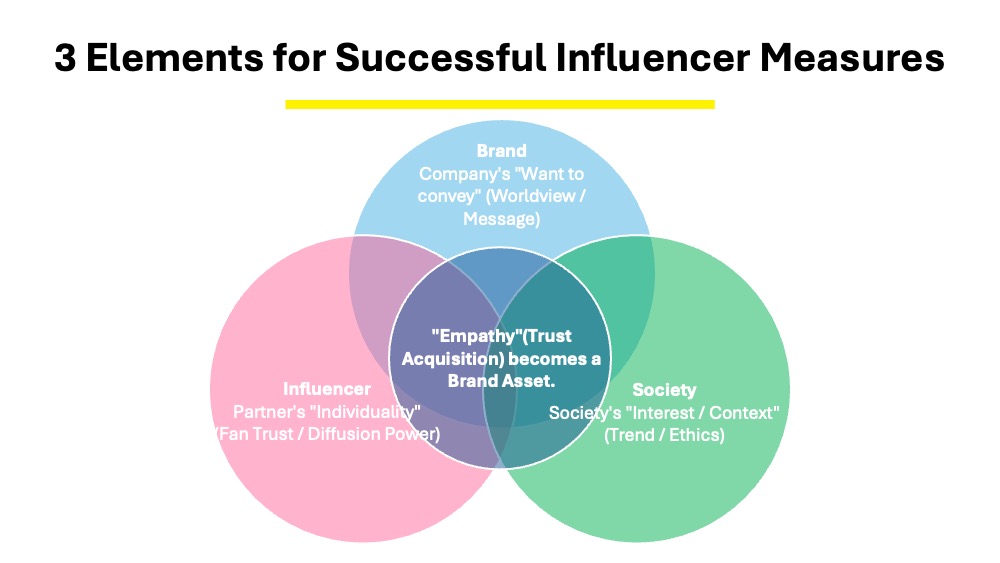
When cultivating brand equity, treating influencer marketing as merely a “promotional slot” often means not fully leveraging its potential.
PR agencies, including SUNNY SIDE UP, have accumulated expertise in delivering information appropriately while identifying the intersection of public interest, trends, and brands. As a result, they can support the formation of brand assets where trust accumulates over time, rather than just creating temporary buzz.
Below, we have summarized the unique value that PR agencies provide in influencer marketing.
| Item | General Casting | Design by PR Agency |
|---|---|---|
| Approach to Initiatives | “Advertising” to gain reach | “Communication” to build trust |
| Influencer’s Role | Main driver of dissemination | One of the “media” conveying context |
| Order of Design | Decide who to ask first | Decide to whom, what, and how to communicate first |
| Impact on Brand | Temporary expansion of awareness | Accumulation of brand value (assets) |
| Risk Management | Primarily contract signing | Crisis management based on social ethics |
Influencers can be designed with “context” rather than as isolated “points.”
In influencer marketing strategies, while influencers play a crucial role in conveying brand value, the core remains the brand’s worldview and its products or services. PR agencies do not solely focus on an influencer’s individual impact but prioritize the background and context, such as “to whom, why now, and how to deliver this information.”
Specifically, before casting, we meticulously design “to whom,” “in what context,” and “what and how to convey.” By connecting the target audience’s challenges and interests, societal trends, and the brand’s strengths, we enable communication that is naturally received as valuable information by followers.
By connecting each individual post as a “point” into a “flow” that conveys the brand’s philosophy and stance, information resonates more deeply. This accumulation forms the foundation for cultivating unique brand equity.
Minimizing Stealth Marketing and Online Firestorm Risks
When disseminating information via social media, it is essential to consider risks such as stealth marketing and online firestorms. PR agencies operate with an awareness of how content will be received by society, while adhering to legal regulations, including the stealth marketing regulations enacted in 2023.
In addition to appropriately using labels like “#PR” or “advertisement,” we carefully verify that post content aligns with the brand’s tone and philosophy. By avoiding excessive or unnatural recommendations, we help maintain a sincere and trustworthy brand image.
Furthermore, in the unlikely event of an unforeseen situation, we can respond calmly by leveraging our expertise in crisis communication. We provide support to prevent significant damage to brand trust through necessary post adjustments and clear explanations.
Measuring and Analyzing Influencer Marketing Effectiveness
While PR activities are sometimes perceived as difficult to measure, by devising appropriate metrics for influencer marketing, it becomes easier to grasp the outcomes of your efforts. Instead of proceeding haphazardly, set KPIs (Key Performance Indicators) aligned with your initiative’s objectives and continuously review them.
Prioritizing Engagement Quality Over Follower Count
Previously, “reach” (how many people saw a post) tended to be emphasized, but recently, “engagement”—such as likes, comments, and saves—has gained attention. Beyond simply reaching many people, how much interest was generated has become more important.
Among these, the number of saves is interpreted as a positive indication of intent, such as “I want to review this later,” “I actually want to visit,” or “I’m considering purchasing.” It is often referenced as a metric closely related to store visits and purchasing behavior. Furthermore, by examining the content of comments and seeing if specific feedback or questions about products and services are being asked, the depth of interest can be understood.
By continuously analyzing such engagement, you can identify which posts resonated with users. Applying these results to subsequent initiatives can lead to more precise influencer marketing strategies.
Visualizing Contribution to Branded Searches and Store Visits
To understand how influencer marketing initiatives translate into actual business results, it is necessary to examine changes in online search behavior and real-world actions.
For example, check how much the number of searches for “brand name” or “store name” increased during the campaign period using search engine trend tools or Search Console. An increase in branded searches suggests not just awareness, but also a heightened interest, indicating users want to “know more” or “research further.”
For businesses with physical stores, the impact on visits can be assessed by asking “How did you hear about us?” in reservation surveys, or by offering influencer-exclusive coupons or menus. By examining multiple indicators together, the effectiveness of the initiative can be understood more comprehensively.
Companies Recommended for Collaboration with a PR Agency
To transform influencer marketing into a brand asset, a strategic design that goes beyond a mere “trend” is required. If you feel that the reproducibility of results is limited with in-house operations alone, collaborating with a PR agency possessing specialized knowledge will be a shortcut to enhancing brand equity.
First, for companies that want to build a mechanism where the brand is continuously discussed in the medium to long term, rather than having initiatives end in a temporary “buzz,” contextual design is essential. Furthermore, the challenge of breaking away from continuously investing in advertising and increasing “branded searches” where users spontaneously search for the brand name can also be solved through PR-focused initiatives. Moreover, many managers likely need objective data-based logic to streamline internal decision-making and compelling proposal documents. Above all, solidifying “defensive governance”—such as compliance with stealth marketing regulations to avoid legal troubles and minimizing the risk of online firestorms—is a top priority for protecting brand trust.
SUNNY SIDE UP provides accompanying support for these challenges with our unique know-how, which has created “fun buzz” in society. If you wish to achieve an influencer marketing strategy that maximizes brand equity and delivers tangible results, please feel free to contact us here.
CONTACT « SUNNY SIDE UP GROUP Inc.
Summary
Influencer marketing is not merely a dissemination method but also a PR activity that builds brand trust through third-party voices. Therefore, strategies that focus solely on follower count or buzz tend to result in temporary exposure and rarely lead to subsequent actions such as brand understanding, direct inquiries, or store visits.
The key is to not let posts be one-off events, but to connect the experiences and evaluations shared on social media with search behavior and local SEO, accumulating them as a “search asset” for the brand. To achieve this, contextual design centered on the brand’s value and worldview is essential, rather than relying solely on an individual influencer’s impact. The presence or absence of PR design is the turning point that determines whether an influencer marketing strategy becomes a consumed initiative or a lasting asset of trust.