Strategies to Enhance Brand Awareness Explained from a PR Perspective! Practical Design to Drive Direct Searches and Inquiries
- カテゴリ:
Do you have a problem where you are confident in your company’s products, but competitors’ products are always chosen instead? In fact, when customers choose a product, ‘whether they know the brand’ may have as much or even more influence than quality or price. The reality is that no matter how attractive a service is, if it’s not among the customer’s options, it’s difficult for them to even consider it.
This article will provide a detailed explanation of “brand awareness,” which is the foundation of marketing activities, from its definition to specific strategies for improvement and methods for measuring its effectiveness. By the time you finish reading, you will have a clear plan for how to establish your brand in the minds of customers, which you can implement starting tomorrow.
What is Brand Awareness from a PR Perspective?
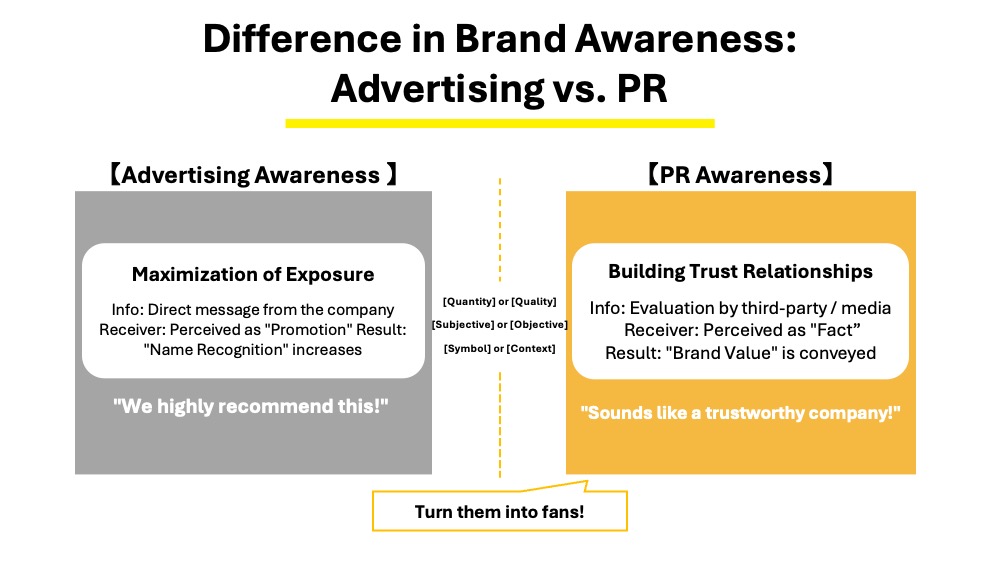
Many companies aim for “brand awareness,” but there is a significant difference between merely having a company or service name known and achieving awareness from a PR perspective. Generally, expanding awareness often refers to “maximizing exposure” through TV commercials and web advertisements.
However, brand awareness from a PR (Public Relations) perspective is not just about increasing name recognition. It emphasizes the quality of the relationship with society, specifically “how the brand is perceived by society and what kind of trust it has earned.” First, we have organized the differences between the general “advertising approach” and the “PR approach,” which emphasizes relationships, in the table below. Please take a look.
| Item | Advertising Approach | PR Approach |
|---|---|---|
| Subject | Our Company (We say) | Third Party/Media (They say) |
| Purpose | Expand the “quantity” of awareness | Gain “quality” awareness and trust |
| Content Delivered | Message the company wants to convey | Social interest and objective facts |
| Consumer Response | Easily perceived as “sales pitch” | Accepted as “information/news” |
| Memory Retention | Short-term memory through repetition | Long-term memory through empathy |
Brand awareness from a PR perspective is not merely about information reaching consumers; it is a process of building an asset called “trust” in their hearts.
[Related Article]What is Public Relations (PR)? A Thorough Explanation from Job Description to Strategy for Beginners! « Column
The Decisive Difference Between Advertising and PR Awareness
The decisive difference between awareness gained through advertising and awareness gained through PR lies in the “source of information” and the resulting “credibility of information.” Advertising awareness involves companies paying for ad space to directly promote “how excellent their products are.” While this is a controllable message, consumers tend to activate a psychological guard because they perceive it as “promotion.”
On the other hand, PR awareness involves information being conveyed through “third parties” such as media and influencers. When information is featured in TV news programs or web media articles, it gains “endorsement” as an objective fact. Consumers receive the information as an objective evaluation from a third-party media, which significantly increases its credibility.
By creating a situation where “someone trustworthy praises you” rather than “praising yourself,” the quality of brand awareness changes significantly.
[Related Article]What is a PR Strategy? Explaining the Planning Process to Create Trust and Value Beyond Advertising « Column
The Impact of Third-Party Endorsements on Brand Recall
One important indicator in brand awareness is “brand recall,” which refers to whether your brand comes to mind when a specific category is mentioned. Third-party endorsements have an extremely powerful influence in enhancing this. This is because customers feel a stronger sense of conviction towards information they discover themselves or information recommended by trusted media. For example, an article in a reputable industry publication featuring a company’s technology as “the most noteworthy technology of the year” tends to be more deeply ingrained in readers’ memories than the company claiming “industry-leading performance” on its own website.
Furthermore, third-party evaluations also serve to clarify differentiation points from competitors. Beyond a mere comparison of specifications, the added value derived from the “social significance” or “relevance to trends” seen through the media’s perspective creates a unique context for the brand. As a result, the probability of the brand being recalled spontaneously, such as “Oh, that’s the company that was talked about in that article,” which is pure recall, increases.
Brand Awareness is Determined by “Semantic Memory” and “Episodic Memory” More Than “Quantity”
To establish brand awareness, it is more important to appeal to “semantic memory” and “episodic memory,” which are mechanisms of human memory, rather than simply pursuing the “quantity” of exposure. “Semantic memory” refers to knowledge-based memory, such as “Company A is a company in the XX industry,” while “episodic memory” refers to memories based on stories and experiences.
When a company’s founding story, development secrets, or efforts to solve social issues are reported through PR activities, they become ingrained as “episodic memories” that evoke emotions in readers. Furthermore, episodic memories are sublimated into semantic memories, making them more likely to be stored in the brain as long-term brand knowledge. One million people who merely know a brand’s name are less powerful in business than ten thousand people who empathize with the brand’s background and story and have deep memories of it, potentially becoming strong fans.
What Does it Mean to Have Brand Awareness?
Brand awareness refers to a state where consumers perceive the existence of a specific brand or can recall it from memory when considering a particular product or service category. Ideally, it’s not just about knowing the name, but also connecting that brand with its characteristics and the value it holds for them.
In the world of marketing, the approach changes depending on the depth of this awareness, so first, understand which stage your company should aim for.
[Related Article]What is Corporate Branding? A Thorough Explanation from Purpose to Process and Success Stories! « Column
A state where consumers recognize a specific product
The process by which consumers recognize a brand is not simply about whether they remember it. It serves as a shortcut, so to speak, for them to feel, “I can trust this,” or “This seems right for me,” among many options.
For example, imagine buying a drink at a convenience store. Among the countless teas lined up, you’re likely to unconsciously pick up a package you’ve seen on TV commercials or social media rather than one from an unknown manufacturer. This is because of the mere-exposure effect, a type of cognitive bias where the brain judges “what is known = safe and trustworthy.”
In other words, gaining brand awareness means creating a place in the consumer’s mind as a “safe option to choose.” Without this place, you would have to start from scratch each time, conveying the product’s appeal and building trust, which inevitably increases the effort and cost involved in sales.
Brand Awareness Has Two Stages: Aided Recall and Unaided Recall
Brand awareness has two main levels, depending on its depth. Differentiating between them and formulating strategies is the first step towards efficient marketing.
| Type of Awareness | Definition | Consumer Psychological State | Specific Example |
|---|---|---|---|
| Aided Recall (Recognition) | Able to recall with a hint | “I’ve seen this logo before” “I’ve heard the name” |
Seeing a product package in a store and thinking “Oh, I know this” |
| Unaided Recall (Recall) | Able to recall without a hint | “When I think of XX, this brand comes to mind” | When thinking “I want a carbonated drink,” a specific brand comes to mind |
In the initial stages of marketing activities, the goal is primarily “aided recall.” The first step is to repeatedly show logos and company names through advertising and social media so that when consumers encounter them in stores or search results, they feel, “Oh, I know this.”
However, the true goal is to achieve “unaided recall.” If you can establish a “top-of-mind” position where your brand is the first thing consumers think of the moment they feel “I want that,” the likelihood of being chosen without comparison to other companies significantly increases.
Why is Brand Awareness Important in Business?
The idea that “if you make good products, they will naturally sell” is becoming increasingly difficult in today’s information-saturated world. No matter how high-quality a product is, if consumers don’t know about it or it doesn’t reach them, it’s as if it doesn’t exist in the market.
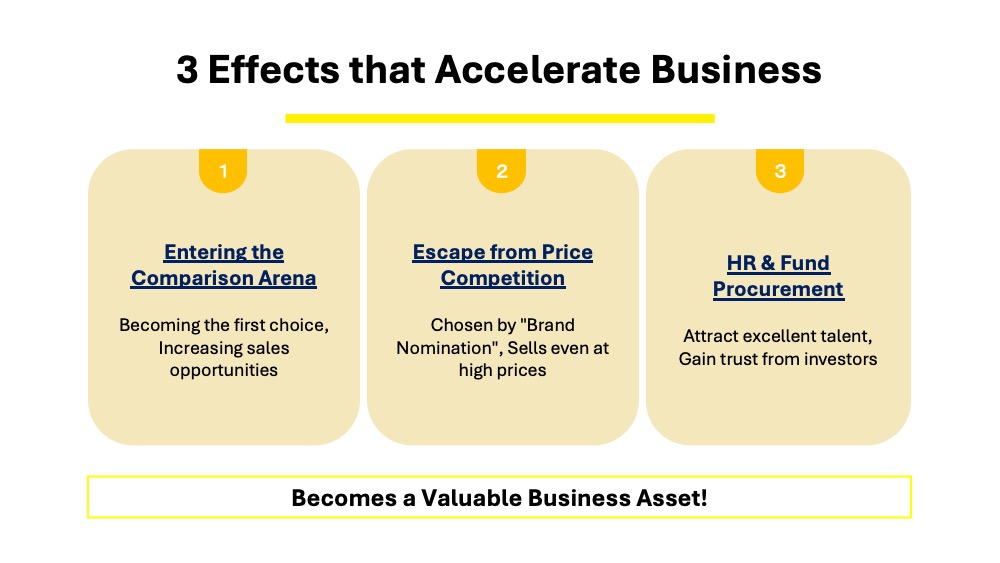
Increasing brand awareness not only makes you famous but also brings significant benefits to your actual business. Here, we introduce three important reasons that directly lead to business growth.
An essential condition for being considered in purchasing decisions
When consumers purchase products, it is physically impossible to scrutinize all available options. People unconsciously narrow down their choices from “known brands” and make a final decision from that selection. This is called the “consideration set.” If a brand cannot enter this consideration set, it will not even be considered for purchase. No matter how good the performance or how low the price, a lack of awareness means it will be overlooked as a comparison target.
Especially in B2B business, when a person in charge considers introducing a service, it is generally thought that they will first contact a few companies that come to mind or familiar companies that appear high in web searches. Gaining awareness is equivalent to acquiring an entry ticket to increase the number of sales opportunities.
Leads to Escaping Price Competition and Improving Profit Margins
Products with high awareness and an established brand image are less likely to be caught in excessive price competition with competitors. This is because customers will purchase based on the value they perceive in “being that brand” itself, rather than just “low price.”
Once brand awareness is established, it becomes possible to sell at appropriate or premium prices, resulting in improved profit margins. Investing the secured profits into further product development and marketing creates a positive cycle that further widens the gap with competitors.
Expected to Gain Trust in Recruitment and Fundraising
The effect of brand awareness extends beyond merely promoting sales to customers. By enhancing corporate credibility, it also provides an advantage in securing management resources such as recruitment and fundraising. Job seekers tend to prioritize “known companies” that are easy to explain to family and friends when choosing a workplace. Companies with high awareness attract talented individuals more easily, making it possible to strengthen organizational capabilities while reducing recruitment costs.
Furthermore, for financial institutions and investors, high awareness can be one of the factors for judging business stability and growth potential. It is not uncommon for negotiations for partnerships and the launch of new businesses to proceed smoothly due to social recognition. Brand awareness serves as an intangible asset that supports overall corporate management.
The Role of Brand Awareness in B2B Business
Generally, for B2C products, consumers often make intuitive purchasing decisions, while in B2B business, logical judgment and rationality are often considered paramount. However, precisely because B2B business involves multiple stakeholders and long-term contracts, “brand awareness” actually functions as a crucial infrastructure that underpins decision-making.
Specifically, we have summarized in the table below how the presence or absence of brand awareness makes a difference in the B2B sales process.
| Comparison Item | Without Brand Awareness | With Brand Awareness |
|---|---|---|
| Lead Generation | Prone to exhaustion relying on cold calls and outbound efforts | Increase in inbound leads from direct searches and inquiries |
| First Meeting | Requires starting with a “company explanation,” taking time to build trust | The other party already understands the company, allowing focus on problem-solving proposals |
| Internal Approval | Requires proof of creditworthiness and reliability: “Is this company trustworthy?” | The psychological hurdle for decision-makers is lowered, thinking “That famous company with multiple achievements is reliable.” |
| Price Competition | Compared solely on features and price, easily caught in price wars | Brand value is reflected in price, enabling orders at appropriate prices |
| Recruitment Activities | Takes time to convey the company’s appeal to talented individuals | Attracts high-quality talent who resonate with the vision more easily |
In B2B, brand awareness is not merely about increasing visibility; it becomes a tangible asset that solves management challenges, such as maximizing sales efficiency and strengthening recruitment capabilities.
Why are “Known Companies” Chosen in B2B?
The biggest reason why “known companies” are chosen in B2B transactions is their ability to alleviate the “fear of failure” that decision-makers harbor. In inter-company transactions, the amounts involved are large, and the scope of impact after implementation is wide, so a selection error can risk damaging the decision-maker’s reputation or career. If features and prices are similar, a conservative psychology, or a risk-aversion filter, tends to favor choosing a “company whose name has been heard” or a “company with a good reputation in the industry” over an unknown one.
Furthermore, if a company’s name is regularly seen in industry media or business magazines through PR activities, a sense of goodwill and trust is unconsciously fostered due to the mere-exposure effect. The fact of being “often seen” is easily converted in the brain into a signal that the company is “socially recognized” and “business is stable.” In B2B, increasing brand awareness is synonymous with securing a place for your brand in the customer’s mind as a “safe and reliable option.”
Why Direct Searches Increase Conversion Rates
In web marketing, the number of “direct searches”—where users search directly for a company or service name—is a barometer of brand awareness strength. Leads (prospects) from direct searches tend to have significantly higher conversion rates and closing rates compared to keyword searches for general information gathering. This is because users conducting direct searches have already recognized the company through PR articles, word-of-mouth, or exhibitions, and are in a “hot” state with high interest and curiosity. The segment of users who come from general keyword searches are still in the information-gathering stage, and most are broadly considering competitors as well.
In contrast, users who perform direct searches have a clear intention, such as “I want to hear from this company” or “I want to know more about this service.”
The True Nature of Brand Awareness that Works During Introduction and Consideration Phases
In the final decision-making and comparison stages, brand awareness plays a significant role as a “mark of trust.” When features and quotes are on par with competitors, the ultimate deciding factor is the trust in the company, the feeling that “we can safely entrust this to this company.” The true nature of brand awareness that comes into play here is not just remembering a name, but the cumulative “company story” and “social evaluation” built through PR.
For example, when a decision-maker makes a final judgment, an interview article in a trusted media outlet or a history of industry awards can provide strong backing. In other words, brand awareness at the final stage of B2B is not a vague image, but the total sum of trust formed by the accumulation of “objective facts” that can be attached to an approval document.
[Related Article]What is News Value? Explaining How to Create and Deliver Information that Gets Media Coverage « Column
To enhance brand awareness, it is essential to design strategies that resonate with consumers’ memories, rather than merely increasing exposure. SUNNY SIDE UP designs communication strategies based on a brand’s strengths and social context, providing comprehensive support from awareness expansion to gaining understanding and empathy. This is a planning service aimed at building brands that are chosen over the medium to long term.
How to Develop a Strategy to Advance Brand Awareness
Simply running advertisements indiscriminately will not lead to efficient brand awareness. To achieve maximum effect with limited budget and resources, a logical strategic design is necessary. Here, we explain the basic steps for developing a strategy to gain awareness.
[Related Article]How to Develop a PR Strategy? A Detailed Explanation of Organizational Design and Operational Steps that Contribute to Management « Column
Assess Current Status and Set Goals for Brand Awareness
Before formulating a strategy, it is crucial to accurately grasp your company’s current position. This is because the measures to be taken will differ depending on whether the current level of awareness is “completely unknown” or “known by name but features are not conveyed.”
The following perspectives are used for current situation analysis:
| Analysis Perspective | Items to Check | Direction of Measures |
|---|---|---|
| Quantity of Awareness | What percentage of the target audience knows your company (or purchases/uses your products/services)? |
Increase exposure Focus on reach and acquisition |
| Quality of recognition | What kind of image do people have? | Planning, creative, and message revisions Development of brand communication |
| Competitor Comparison | Is it more easily recalled compared to competitors? | Highlighting differentiation points Positioning Opportunity |
After understanding the current situation, set specific goals. Establish measurable targets, such as “increase the number of direct searches within the target audience by 1.5 times within six months” or “rank in the top 3 for unaided recall in a specific category.” Clear goals make it easier to prioritize measures.
Design Touchpoints Tailored to Target Customers
Clearly define “who” you want to be recognized by (your target audience) and analyze what media they consume daily and what information they seek. For example, for a cosmetics brand targeting young people, short videos on social media would be more effective touchpoints than TV commercials. On the other hand, for business systems aimed at corporate decision-makers, business media such as taxi advertisements or Nikkei Digital, and offline exhibitions, would be key touchpoints.
The key is to naturally introduce the brand into the target audience’s daily life. Create a customer journey map and design touchpoints so that your company’s information catches their eye when they perceive a problem or are gathering information. Delivering information at the right place and time significantly increases awareness retention.
Effective Measures for Brand Awareness
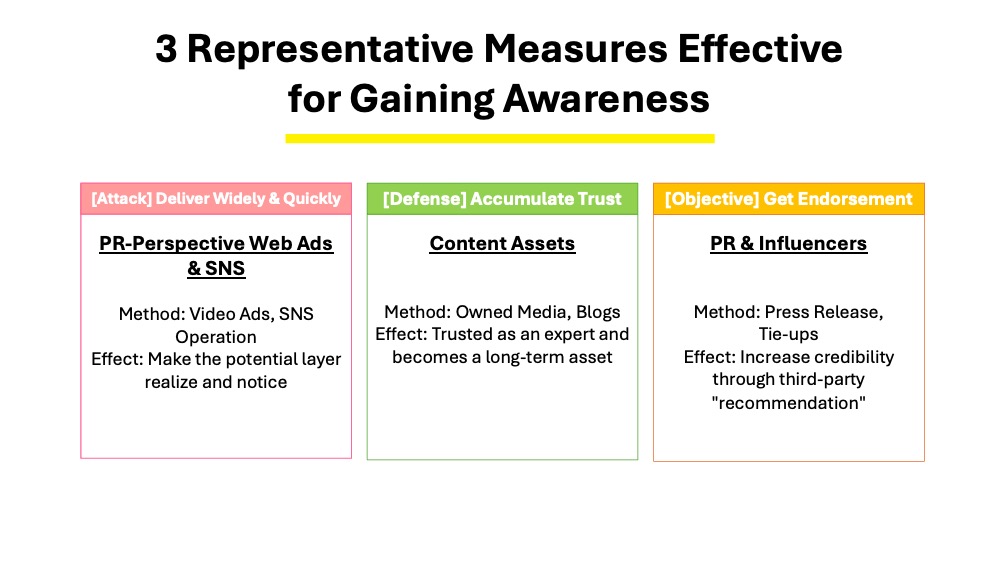
Once the strategy is decided, the next step is to translate it into a concrete execution plan. While there are various methods to enhance brand awareness in current marketing, here we introduce three particularly effective and representative approaches.
Digital Advertising and SNS Management to Reach a Wide Potential Audience from a PR Perspective
If you want to quickly expand awareness, digital advertising offers immediate results. Video ads and social media feed ads, in particular, can naturally deliver information to potential customers who are not yet familiar with your company. The key here is to incorporate a PR perspective.
The key to operation is not just to sell products, but to prepare creative assets that convey the brand’s worldview and story. By leaving an impression such as “This brand seems like it could solve my problems” or “Users with similar tastes to mine could also use this,” it leads to aided recall.
Furthermore, managing official social media accounts as owned media is also important. While advertising provides temporary exposure, social media also serves to connect with users continuously. By consistently disseminating useful information and content that evokes empathy, you can deepen relationships with followers and cultivate natural goodwill through repeated interactions. Campaigns on short-post SNS, leveraging their viral nature, are an effective way to expand awareness at low cost.
Content Marketing to Foster Trust and Affection
To ensure that traffic from advertising and direct searches is not a one-time event, content marketing is also crucial for users to discover you. Provide useful information that answers users’ concerns and questions through owned media and blog articles.
For example, an outdoor equipment manufacturer might publish articles such as “How to Choose Camping Gear for Beginners” or “How to Pitch a Tent Without Mistakes.” Users who visit via search engines gain useful information and, at the same time, develop trust in the brand providing the information.
The strength of content marketing lies in its ability to build trust as an expert. If you can establish the position of “this company is reliable for this field,” you will be much closer to achieving top-of-mind awareness (the highest concept of unaided recall). While it takes time, it accumulates as an asset and contributes to long-term awareness expansion.
Public Relations and Influencers to Gain Third-Party Endorsement
Beyond self-promotion, leveraging information dissemination through third parties can enhance the credibility of awareness. This primarily includes media-oriented public relations activities and influencer marketing.
By distributing press releases and being featured in news media and industry publications, a brand gains recognition as a socially credible entity. Particularly, new product launches and unique initiatives have high news value, creating opportunities for media coverage.
Furthermore, collaborations with influencers who have sway over the target audience are also effective. Consumers tend to respond more positively to recommendations from people they trust than to corporate advertisements. By having influencers share their actual use of a product, positive awareness can spread among their followers, positioning it as “a brand used by someone I admire.”
Methods for Measuring and Analyzing the Effectiveness of Brand Awareness Promotion Measures
After implementing brand awareness measures, it is important to properly verify the effects and connect them to the next action. However, since awareness is a difficult indicator to visualize, it is necessary to replace it with specific numerical values and measure it.
Here, we will explain two measurement approaches that are easy to use in practice.
Quantitatively understand the degree of interest with “branded search volume”
The most accessible and practical indicator is “branded search volume.” Use tools such as the search engine’s Search Console to measure the number of times your company name, service name, or brand name is searched. An increase in branded search indicates that more people are recognizing the brand name and are interested in actively searching for information. By checking how the branded search volume has changed before and after a campaign or press release distribution, you can determine whether the measure has helped to expand awareness.
In addition, the number of mentions on social media (number of UGCs) is also an important indicator. By monitoring how many posts include the brand name, you can grasp the spread of recognition and the buzz in real time.
Regularly observe the recall rate using “questionnaire surveys”
If you want to understand the state of recognition more accurately, conduct a questionnaire survey. Use internet research to ask the following questions to the target audience.
| Survey items | Example questions | Indicators that can be grasped |
|---|---|---|
| Unaided recall | “When you think of ○○, which brand comes to mind?” | Top-of-mind awareness Brand strength |
| Aided recall | “Please select all the brands you know from the following brands.” | Brand awareness Comparison with competitors |
| Purchase intention | “When you purchase ○○ next time, will you consider this brand?” | Quality of recognition Contribution to sales |
By conducting surveys on a regular basis, you can track changes in awareness over time due to measures. By comparing awareness with that of competitors, you can objectively evaluate your company’s position in the market and use it to revise your strategy.
Summary
In expanding brand awareness, increasing the amount of exposure through advertising is an effective means of expanding recall among consumers, but in order to generate pure recall that leads to branded searches and inquiries, it is essential to design recognition from a PR perspective through third-party evaluations. What is important is not to end with a one-off measure, but to link advertising, content, and PR, and accumulate them as “recognition assets” that are effective in search behavior and comparison scenarios.
・For those who feel they have issues with brand awareness
・For those who don’t know what to start with in their own company
・For those who are struggling with how to integrate PR and digital
SUNNY SIDE UP accepts inquiries for work from “brand recognition design” tailored to your company’s situation. We can handle a wide range of tasks, from acquiring third-party evaluations through media relations and designing communication integrated with the digital domain, to strategic planning that sublimates your company’s values into highly social news. We will propose the optimal roadmap for companies facing challenges in improving recognition.
CONTACT « SUNNY SIDE UP GROUP Inc.