Media Strategy in PR Activities: The Concept of “Information Design” That Goes Beyond One-Time Exposure
- カテゴリ:
Many companies want more people to know about their attractive products and services. However, simply disseminating information blindly will result in it being buried and going unnoticed in today’s information-saturated world. What is needed to achieve maximum results within limited budgets and resources is a “media strategy” based on a PR perspective. This does not simply refer to buying advertising space or distributing press releases.
This article will explain everything from how PR and public relations personnel should perceive media to specific steps for collaboration, including SNS and owned media. By the time you finish reading, you should have a clear path for how to deliver your company’s information to society.
What is a media strategy in PR activities?
When you hear the term media strategy, you might imagine planning for TV commercials or newspaper advertisements. However, media strategy in the context of PR (Public Relations) has a slightly different meaning.
The essence of media strategy in PR lies in designing the channels through which information is disseminated to build good relationships between a company and society. Here, we will explain its basic concept.
[Related Article]What is Public Relations (PR)? A thorough explanation for beginners, from job descriptions to strategy formulation « Column
Designing “Who Says What, Where, and How”
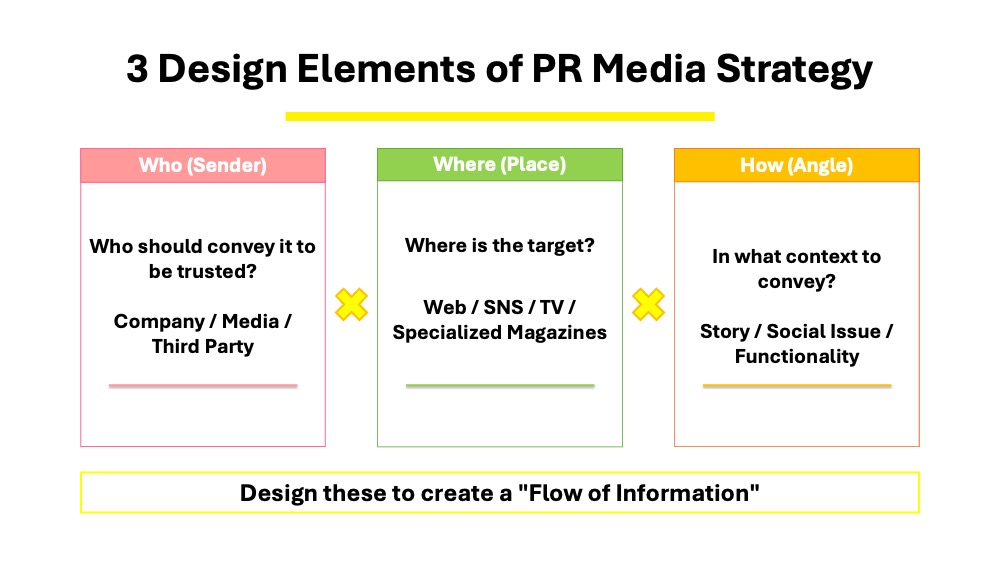
What is important in PR activities is the strategic design of three elements: “who,” “where,” and “how” to communicate. First, “who” refers to the source of information. Whether your company speaks directly, has third-party media speak for you, or communicates through influential experts or influencers. Just changing the messenger can significantly alter the credibility and reception of information.
Next, “where” refers to media selection. Identify the places your target audience encounters daily—mass media like TV and newspapers, web media and SNS, industry trade publications, review sites—and select the optimal media. In today’s era of diversified information touchpoints, an approach combining multiple media is required.
And “how” refers to the angle and expression method of the message. Whether to explain product features, highlight connections to social issues, or appeal to emotions through storytelling—design messages that resonate according to your target’s interests and context.
Integrating these three elements and directing the entire “flow of information” is what is required of today’s media strategy.
Information superiority through PR effects, distinct from advertising
The fundamental difference between advertising and PR lies in the path information takes to reach consumers. Advertising is “a method of creating attractive creative materials and placing ads in various media where target users are present for exposure,” delivering information directly from companies. On the other hand, media exposure through PR is delivered as “information trusted and spread by third parties,” passing through media filters with objective evaluation.
The core of media strategy is how to acquire this “third-party perspective.” While consumers are cautious about information communicated directly from companies, they naturally accept introductions on news programs or posts from trusted influencers. When building media strategy, design angles with social relevance and newsworthiness that make media want to cover them voluntarily. Rather than viewing media as mere information dissemination platforms, adopt an attitude of seeing them as collaborators in delivering valuable information to society.
[Related Article]What is a PR Strategy? Explaining the planning process that generates trust and value beyond advertising « Column
Extending beyond one-off exposure to search, SNS, and direct inquiries
In modern PR activities, the goal should not be a single media mention, but rather a subsequent ripple effect leading to searches, SNS engagement, and direct inquiries. As information is encountered in various places following exposure, its value gradually accumulates.
For example, an article featured in web media that gains traction on SNS can significantly increase awareness and lead to search behavior. Also, by elaborating on content mentioned on TV or in the news on owned media (company-owned media) and capturing inbound traffic from searches, interest can be converted into direct searches.
PR is not about looking at a single exposure. It should be considered as a continuous flow that includes search behavior, SNS reactions, and direct contact points. By expanding exposure while being mindful of the role and sequence of each media, PR can become a long-term effective initiative, not just a temporary buzz creator.
Why do many companies’ media strategies fail?
Even if you continue issuing press releases thinking “we just want media coverage,” it often doesn’t lead to the expected business results. To successfully advance media strategy, rather than making exposure itself the goal, you need to consider what impact that exposure should have on your business and design backwards from there.
Common Pitfall ①: Ending with a press release
A common case is using press release distribution services to disseminate information and considering media strategy complete. Even if articles are published, ending with just a “we got coverage” report might be somewhat wasteful. By introducing coverage results on your company website or utilizing them in sales materials, the value of articles can expand further.
Common Pitfall ②: Disconnected SNS and PR
In today’s media environment, mass media and SNS are closely connected, but it is not uncommon for companies to have public relations and SNS operations separated. When roles are siloed, the synergistic effects that could otherwise be gained cannot be fully leveraged.
For example, if information published in the media cannot be effectively disseminated on SNS, an opportunity for the topic to spread is lost. SNS is not only a platform for dissemination but also an important source for understanding public sentiment.
Common Pitfall ③: Not being evaluated due to lack of management-level KPIs
One reason media strategies are often undervalued internally is that results are not presented using metrics that resonate with management. KPIs such as the number of placements or advertising equivalent value often have an unclear relationship with sales and profit, making them difficult to link to management decisions. As a result, PR activities tend to be treated as a cost rather than an investment. To improve this, it is necessary to incorporate metrics directly linked to management challenges, such as an increase in branded searches, job applications, or impact on business negotiations, into KPIs. Only when results can be demonstrated with numbers will a media strategy be evaluated as a valuable initiative for management.
Three perspectives to organize before considering a media strategy
Before entering specific media selection, what you want to organize first are the three perspectives that form the foundation of media strategy: “who do you want to tell what to,” “what problems do you want to solve and where is your goal,” and “how do you leverage existing resources.”
Without clarity on these points, even if you achieve extensive exposure, it will be difficult to translate into business results. Here, we will explain these three perspectives that should be understood before formulating a media strategy, step by step.
[Related Article]How to formulate a PR strategy? Detailed explanation of organizational design and operational steps that contribute to management « Column
Who, what, and why are you communicating?
The “who, what, and why to communicate” that should be organized in media strategy changes depending on the brand or business phase. Even for the same product or service, appropriate targets and messages differ depending on the situation.
During the launch phase, the focus is on expanding awareness, and it is important to simply convey the existence of the business and its value proposition. In the growth phase, the goal is to clearly articulate strengths and differentiators to those considering options, explaining why they should choose your offering. In the maturity phase, the focus shifts to deepening relationships with existing customers and stakeholders, requiring communication of the brand’s stance and values.
By organizing the target audience and objectives according to each phase, consistency in media communication is achieved, leading to strategic PR activities.(The table below is an example)
| Business Phase | Who | What to Communicate | Why Communicate |
|---|---|---|---|
| Launch Phase | Potential Customers / Entire Market | Existence of Business/Service Value Proposition |
To gain awareness and understanding |
| Growth Phase | Interested Parties / Consideration Stage | Strengths Differentiation Points Achievements |
To clarify reasons for selection |
| Maturity Phase | Existing Customers / Stakeholders | Brand Stance Values Social Significance |
To deepen brand recognition, trust, and relationships |
PR Goals Are “Trust” and “Action”
The goal of PR activities is not simply to widely deliver information, but to “gain trust” and “generate next actions (wanting to hear more, wanting to know detailed information, etc.).” We recommend clarifying what management issues you want to solve through media strategy and setting goal indicators. If this remains vague, you cannot judge the results of initiatives, and activities become formalized.
For example, if the objective is to expand awareness, it is crucial to deliver information to a large audience using web media and SNS. On the other hand, if you want to enhance brand trust, exposure in newspapers and specialized magazines is effective. Furthermore, if the goal is to strengthen recruitment, content that conveys employee voices and corporate culture is more likely to lead to applications.
The choice of media and content varies significantly depending on what you aim to achieve with PR. Sharing internally how you want to build trust and what actions you want to generate forms the foundation for a consistent PR strategy.
[Related Article]What is Internal Branding? Explaining its purpose, effects, and implementation steps with success stories « Column
How to leverage existing resources (people, budget, media)
When considering media strategy, many companies feel that “we lack personnel and budget.” First, organize the resources your company has from the perspectives of “people, budget, and media,” and consider how to combine and leverage each.
For example, if human resources are limited, it is effective to outsource highly specialized areas such as strategy design and media relations, while the in-house team focuses on providing information and preparing materials. Additionally, by allocating a portion of advertising expenses to PR or utilizing owned media and SNS, continuous communication becomes possible even with a limited budget. The key to a successful media strategy is to combine existing resources without overstretching them and utilize them in the most optimal way.
Effective media strategy requires design that identifies the recipients and context, not just exposure acquisition. This service constructs optimal angles and communication methods based on media characteristics and social trends. We support media strategy to accurately convey brand and corporate intentions and expand trust and recognition.
Proper Use of the “Three Types of Media” in PR
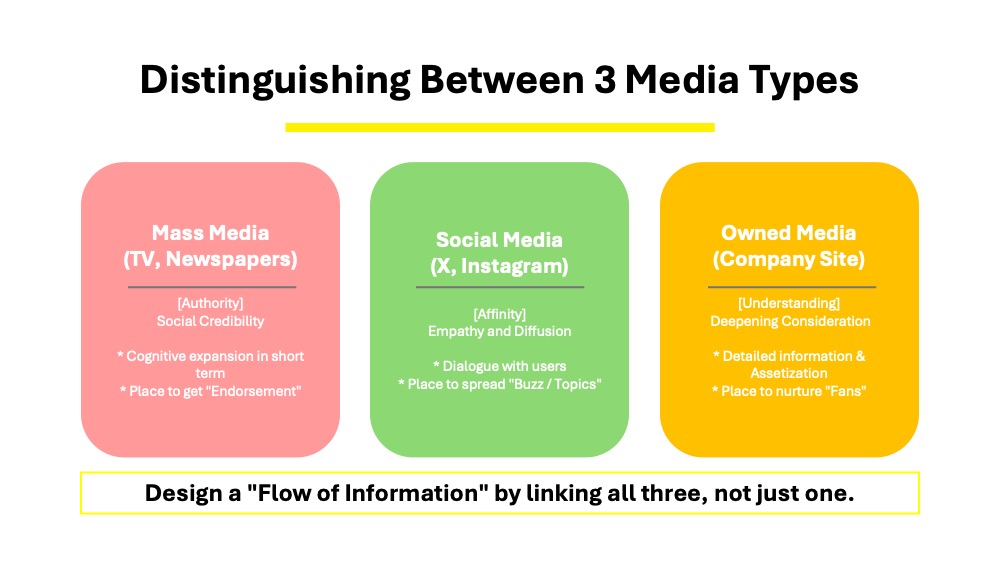
Media that can be utilized in PR activities are broadly divided into three types: “mass media,” “social media (SNS),” and “owned media.” Also called triple media in marketing terms, from a PR perspective, we focus on each medium’s “way of conveying information” and “role” for utilization. Understand the characteristics of each medium and use them appropriately according to your company’s objectives.
Mass Media: Building Social Trust
Mass media such as TV, newspapers, magazines, and radio still possess significant influence and high credibility. Being featured in such media easily leads to a sense of security as a “trustworthy company” for many people.
The main aim of utilizing mass media is to significantly expand recognition in a short period and enhance social credibility. For example, for B2B companies, industry publications including newspapers strong in economics, and for B2C companies, TV information programs can be effective touchpoints.
On the other hand, since mass media are highly public entities, content with strong “promotional” characteristics tends to be less favored. It is important to organize information clearly within contexts of public interest, such as perspectives leading to social problem resolution or relationships with social trends, and arrange it in an easily understandable and communicable form.
SNS and Web Media: Creating Empathy and Viral Spread
SNS is media where information spreads through chains of “empathy” and “likes” among users. Rather than being a place where companies communicate unilaterally, the interactive nature that easily generates conversations and exchanges with users is a major attraction.
The main purpose of utilizing SNS is to foster familiarity with brands and companies and to deliver information to more people. While it doesn’t necessarily have the authority of mass media, users are closer, enabling communication with warmth. It is suitable for fan building and improving daily engagement.
For PR professionals, SNS serves not only as a “means for viral spread” but also as a “research venue for grasping social atmosphere.” By regularly understanding what is currently attracting attention and how it is being discussed, and naturally layering your company’s topics into that flow, you can more easily connect to greater response.
Owned Media: Deepening Understanding and Consideration
Owned media such as company websites, blogs, email magazines, and corporate publications are venues where companies themselves plan and edit content, communicating desired information in their own words. Not only detailed information that cannot be fully conveyed through mass media or SNS, but also corporate thoughts and stories behind initiatives can be carefully explored and communicated in depth.
The important role of owned media is to serve as a “receptacle” for interested people, deepening their understanding while gradually building fandom. If sufficient content is not prepared to meet expectations when people who became interested through other media search and visit, it can lead to missing valuable opportunities.
Furthermore, articles and content published on owned media become accumulated assets over time. By accumulating high-quality content that continues to be read for long periods, it helps with long-term stable customer acquisition and building trust and positive impressions of the brand.
Note that strategy cannot be completed with just one of the “three types of media”
The three types of media—TV, SNS, and owned media—each play different roles, so media strategy is rarely completed with just one. What is important is leveraging the strengths of each medium while coordinating them and designing a natural “flow of information” in advance.
For example, even if mass media generates significant attention, if sufficient information is not prepared on owned media as a receptacle, there is a possibility of dropout at the funnel before interest deepens. Conversely, even if you accumulate high-quality communications on owned media, without viral spread on SNS or support from third-party media, it may be difficult for many people to see it in the first place.
Current consumers tend to move between multiple media, compare information, and make decisions after being convinced. Therefore, rather than operating each medium individually, the key to maximizing results is to organize them as a single pipeline that naturally connects from “recognition” to “understanding and empathy” and then to “action.”
Design Steps for Media Strategy That Leads to Results
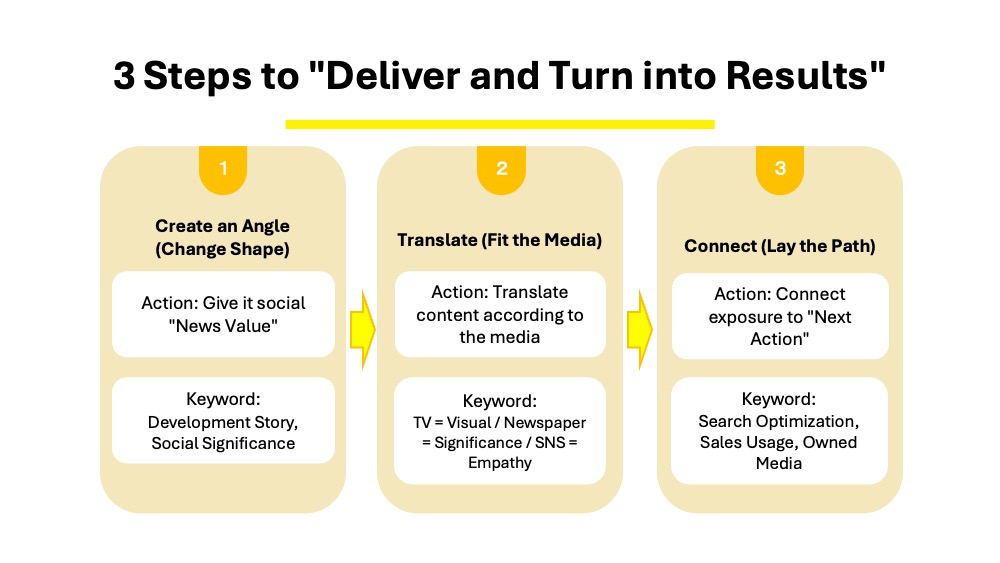
Now that we understand the characteristics of each medium, let’s explain the specific steps for combining them to spread information. The secret to success is not disseminating information separately, but coordinating with narrative coherence.
Step 1: Develop Angles That Make Reporters and Readers “Want to Cover”
The first step in media strategy is thinking of angles that make reporters and readers feel they “want to cover” or “want to tell someone.” Rather than just disseminating information, you need to design topics with awareness of reasons for being treated as news.
Even if a new product announcement alone is weak, newsworthiness increases by combining development background stories, social context, or original research data. Then, refine the angle by assuming “which media might be interested” and “what readers it will reach.” The key to creating angles that move reporters’ and readers’ hearts is not presenting what your company wants to communicate as-is, but reconstructing it by connecting with social interests and media characteristics.
Step 2: Convert Communication Methods for Each Medium
Even with the same information, change the communication method and angle for each medium. Even if the news content is the same, the points and contexts that different media emphasize vary, so reusing one expression as-is is not effective.
For example, while TV emphasizes visual clarity and immediacy, newspapers and business media require industry impact and social significance. On SNS, elements that evoke emotions like empathy or surprise become triggers for viral spread. Imagine “what each medium is trying to convey to what readers” and prepare angles and materials suited to those purposes.
Step 3: Design Post-Exposure Information “Ripple Effect Pathways”
Design pathways that connect media exposure to subsequent search, SNS, and sales activities rather than ending it as a one-time event. The aim is to create a state where information circulates triggered by exposure and interest deepens gradually.
For example, provide detailed explanations of media-covered content on owned media, preparing receptacles for users who search. Simultaneously, by disseminating covered articles and related information on SNS, expand topics while creating continuous contact opportunities. High-credibility coverage results can be utilized in sales and proposal materials, supporting business negotiations.
By connecting post-exposure information to search, SNS, and sales touchpoints, PR develops from temporary topic creation into brand communication that connects to business results.
Don’t End Media Strategy KPIs with “Number of Articles”
A common issue in media strategy is making only “number of articles” or “advertising equivalent value” success indicators. While convenient for understanding activity volume, these are insufficient as indicators measuring contribution to business growth. No matter how many articles are published, if they don’t reach targets and lead to action, the meaning is limited.
Real Indicators to Monitor in PR
What deserves attention when measuring PR results is changes in “branded search volume.” The behavior of searching for company or service names triggered by articles can be considered a sign of increased interest and trust.
Additionally, understand which media contacts occurred before inquiries. By knowing not just last clicks but articles that sparked interest, you can see truly influential media. Furthermore, qualitative effects such as whether articles became topics during business meetings also serve as indicators measuring trust formation.
Common Characteristics of Companies Where “Media Coverage Doesn’t Lead to Sales”
Many companies that acquire exposure but don’t see results likely have insufficient post-exposure pathway design. Even if users who read articles visit websites, if there are no receptacles to deepen understanding or encourage action, interest ends there.
Also, selecting media where targets don’t exist is another cause of failure. What’s important is not “getting coverage” but “how to get them to act after coverage.” Only by designing up to that point does media strategy connect to sales.
Why Executing Media Strategy In-House Is Difficult
Even though media strategy is understood as important, continuously producing results with only internal resources is not simple. This is because it simultaneously requires different types of skills: relationship-building ability, numerical analysis capability, and perspective to oversee the whole.
Strategy Design and Operations Are Completely Different Skills
Media strategy requires both the ability to draw strategy and the power to execute in the field. Strategy design demands thinking ability to oversee markets and business, while operations require relationship building with reporters and persistent proposal skills.
Handling both at a high level alone is difficult, and in-house teams tend to lean toward either strategy or operations. To achieve both, role division and collaboration with external partners become realistic options.
Design Spanning PR, Marketing, and Sales Is Necessary
Behind media strategy’s difficulty in functioning is a siloed structure where KPIs are fragmented by department. Originally, trust and recognition gained through media exposure should be assets leveraged in marketing and sales.
However, without coordination, exposure doesn’t connect to next results. The absence of roles that span departments with a holistic optimization perspective and connect initiatives makes in-house execution difficult.
Difficulty of Simultaneously Holding Reporter, Editorial, and Brand Perspectives
Media strategy requires holding not only brand perspective but also reporter and reader perspectives simultaneously. However, thinking only internally tends to bias toward company perspective.
Bringing in external professionals adds objective perspective of “how it appears from society,” preventing self-centered communication.
SUNNY SIDE UP’s Media Strategy Support: Working Backwards from Business Results
As we have seen, media strategy requires design and execution that connect to business results, not just exposure acquisition. On the other hand, handling everything from strategy design to operations and internal coordination with only in-house resources is not simple.
If you feel the following challenges, it might be time to review your media strategy. If you have these challenges, we recommend redesigning your media strategy.
・Releases often fail to generate a response
・SNS and owned media operate independently and are not linked
・Unable to effectively explain PR results to management
・Want to strengthen PR but don’t know where to start
To address these challenges, SUNNY SIDE UP offers media strategy consulting tailored to each company’s situation and objectives. We provide comprehensive support, from PR strategy design aligned with business phases to integrated design across media, SNS, and owned media, and topic development based on a journalist’s perspective.
Rather than making “getting coverage” the purpose, how to build trust and connect to action after coverage. SUNNY SIDE UP’s strength is being able to accompany you from design to execution. If you are considering evolving media strategy into initiatives that connect to business growth, please feel free to consult with us. We will propose optimal approaches suited to your company’s situation.
CONTACT « SUNNY SIDE UP GROUP Inc.
Summary
Media strategy in PR activities is not about exposure acquisition itself, but about designing “who says what, where, and how” and creating information design that circulates information in society. States like ending after issuing releases, PR and SNS being disconnected, and evaluating only by number of articles tend to end in one-time exposure and struggle to connect to business results. On the other hand, if you can coordinate mass media, SNS, and owned media and create pathways that ripple from exposure to search → branding → business meetings and applications, PR becomes a continuously effective “asset.” In fact, strategic PR affects search, sales, and recruitment, accumulating corporate trust and action. Therefore, PR today is not about “whether to do it” but has become a “strategic domain” designed backwards from business results.