
How should we set goals at the beginning of the term in public relations? KPI indicators and planning methods to visualize the results of PR activities
- カテゴリ:
“We are aiming for the number of media placements as a goal, but as a result, we tend to focus on media that are easy to be published.”
“I’m not sure how to show whether awareness is increasing.”
Many public relations personnel may feel these concerns every time they start a new fiscal year or term. In public relations activities, where there are no easy-to-understand numbers like sales, it tends to be difficult to set goals that are convincing to both the company and the person in charge. However, by carefully designing goals, the direction in which public relations activities should proceed becomes clear, and it becomes easier to gain understanding and trust within the company.
In this article, we will explain in an easy-to-understand manner the “PR goal setting and KPI design” that makes it easy for management to understand and allows those in charge of actual work to work without hesitation in their daily decisions, along with specific procedures and examples of indicators.
Reasons why it is difficult to set public relations goals
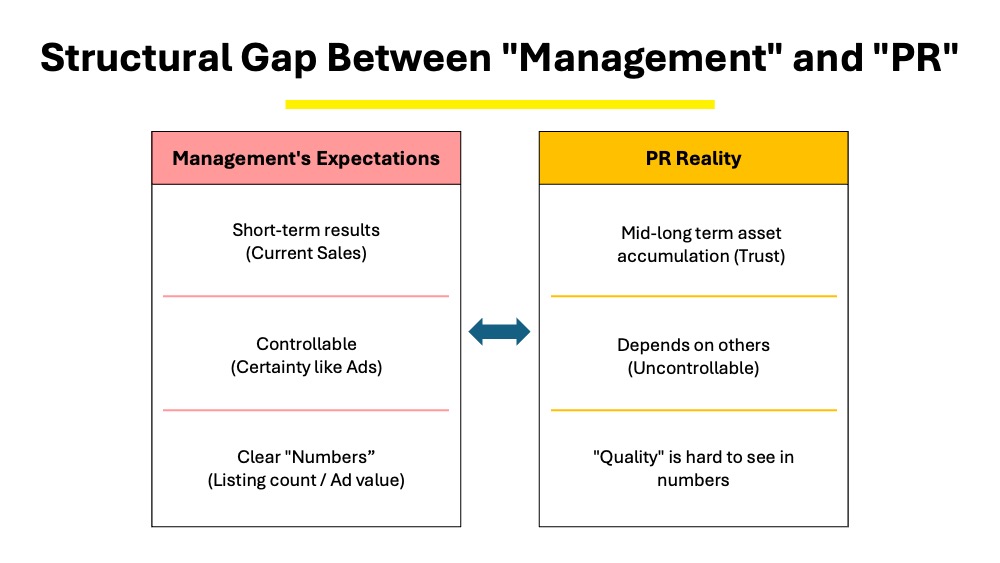
In the first place, why is it so difficult to set public relations goals? The reason why many people stumble is the uniqueness of the job of public relations. First, let’s verbalize the “true nature of the difficulty” and organize the assumptions.
[Related article]What is Public Relations? A thorough explanation for beginners, from job description to how to develop a strategy! « Column
It takes time to see results, it is difficult to control, and it tends to deviate from management.
A major feature of public relations activities is that it takes a certain amount of time for results to appear after implementing measures. For example, there is no guarantee that the information you send out today will be picked up by the media immediately, and it is not uncommon for inquiries and changes in awareness to occur as a result of published articles.
On the other hand, management tends to focus on short-term results such as sales and KPIs. This “difference in time axis until results are visible” is a factor that tends to create a gap in recognition between public relations and management.
In addition, media coverage is not something that companies can completely control like advertising. Whether or not to publish is left to the media’s judgment, and is also affected by external factors such as social conditions and news value. Many public relations personnel feel uneasy about the fact that their efforts do not necessarily produce immediate results.
Public relations is an activity that accumulates value from a medium- to long-term perspective, and it is necessary to understand results on a different time axis than management. The fact that this premise is not shared is what leads to the difficulty of setting goals.
“The number of articles published” alone does not lead to the company’s growth.
In the past, “number of media placements” and “advertising equivalent value,” which converts the amount of space published into advertising costs, were often used as public relations goals. While it is easy to understand as a number, it has the disadvantage that it is difficult to reflect the differences in quality, such as which media it was published in and what the content was.
With this evaluation axis, more emphasis tends to be placed on “how many articles were published” than on affinity with the target audience or impact on the business. As a result, actions are encouraged to accumulate exposure in media that are easy to be published, rather than the value of being featured in depth in influential industry media.
In this situation, even if a public relations person tries to make strategic decisions and choose exposure that leads to the company’s growth, it will be difficult for their efforts to be reflected in their evaluation. A structure that uses only the number of articles published as a performance indicator reduces the role of public relations to “collecting numbers” and deprives the person in charge of the value and discretion that they can originally demonstrate.
Three steps to set PR goals that you can agree with
So, how should you set goals? Instead of suddenly deciding on “◯ articles published,” it is important to build up logic by calculating backwards from the management strategy. Here, we will introduce three steps using the KGI, CSF, and KPI frameworks.
[Related article]What is a PR strategy? Explaining the planning process for creating trust and value that cannot be obtained through advertising alone « Column
Step 1: Determine KGI (final goal) by calculating backwards from management issues
The first step is to clarify the final goal (KGI: Key Goal Indicator) of public relations activities. The important thing here is not to set goals for the public relations department alone, but to think from the perspective of “what role does public relations play in the company’s management issues?”
The KGI of public relations changes significantly depending on the purpose of management.
・If the management theme is to strengthen recruitment, “increase in the number of recruitment applications” or “improvement in the degree of motivation”
・If the purpose is to expand awareness of new businesses, “improvement of awareness in the new business area” or “improvement of recall rate within the industry”
・If you want to increase the number of branded searches, “increase in the number of searches for brand names and service names”
・If the purpose is to acquire leads, results that lead to the next sales activities, such as “number of inquiries” and “number of requests for materials”
The goal that public relations should pursue differs depending on the direction that management is aiming for. The starting point for goal design is to discuss with management what the company wants to focus on most this term and what role is expected of public relations in achieving that goal.
Step 2: Decompose CSF (success factors) to achieve KGI
Once the KGI has been determined, the next step is to break down the success factors (CSF) necessary to achieve it, while organizing “who needs to be aware of and understand what and how.” CSF refers to the “key elements (Critical Success Factors)” that are essential to achieving the KGI.
For example, if the KGI is “expanding awareness of new businesses,” simply increasing exposure is not enough.
・”Who do you want to reach (industry stakeholders, potential customers, recruitment candidates, etc.)?”
・”What do you want them to understand (the value of the business, its uniqueness, the issues it can solve)?”
・”At what point do you want to promote awareness and understanding?”
Organize the CSF from the perspective of
Specifically,
・Acquiring exposure in major industry media to help industry stakeholders understand the significance and expertise of the business
・Increasing word-of-mouth (UGC) on social media to help potential customers imagine actual usage
・Strengthening president’s exposure as an evangelist to convey the brand’s philosophy and future potential
It can be broken down in the form of
By organizing CSF as a “design for awareness and understanding,” it becomes clear “why this measure is being taken,” and it is possible to prevent the means themselves from becoming the purpose.
Step 3: Translate into KPIs that public relations can move
Finally, in order to visualize the progress of CSF, set specific numerical indicators (KPI: Key Performance Indicators) that can be controlled by public relations activities. The KPIs set here will be the goals that the field should pursue in daily public relations measures.
It is not necessary to limit the number of KPIs to one. Rather, in order to capture the results of public relations activities in three dimensions, design a combination of action indicators such as the number of media exposures and the quality of articles, and result indicators such as the increase in the number of branded searches, the number of Web traffic, and the number of inquiries. For example, if you organize KPIs by role as shown below, the relationship between public relations efforts and results will become clear.
| Perspective | Main KPI examples |
|---|---|
| Action indicators | Number of media exposures, quality of articles |
| Changes in awareness and interest | Number of branded searches, number of Web traffic |
| Business results | Number of inquiries |
By setting KPIs in stages, it is possible to logically explain “why we are pursuing this number,” and it becomes easier to share within the company how public relations activities are contributing to the business.
[By purpose] Examples of indicators that you want to set as KPIs for public relations
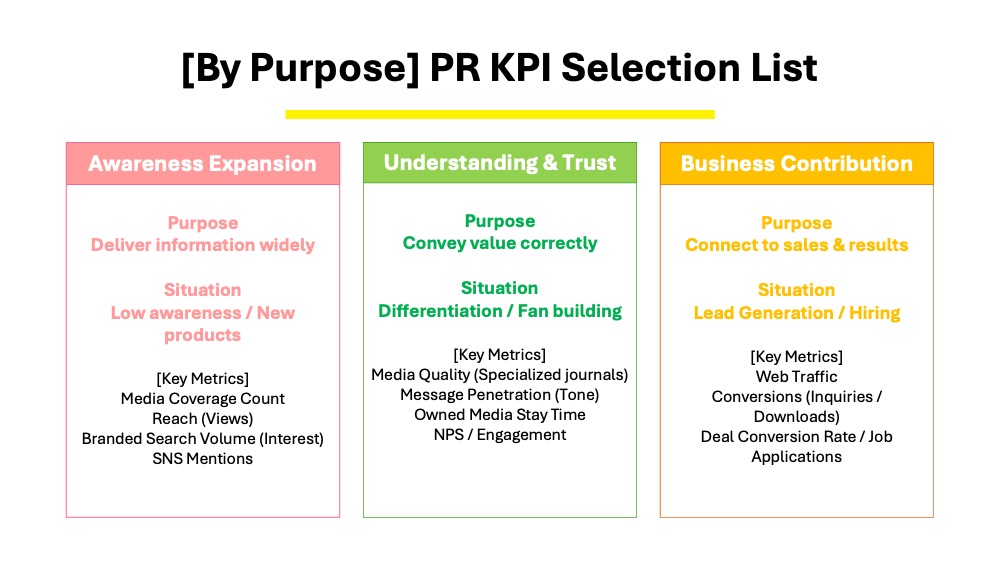
The indicators to look at will vary greatly depending on the purpose of public relations. Here, we will introduce specific examples of KPIs that should be set according to three common purposes. Please customize it to suit your company’s phase and issues.
[Related article]How to develop a public relations strategy? Explaining in detail the organizational design and operational steps that contribute to management « Column
When aiming to “expand awareness”
In the phase where your company name and services have not yet fully penetrated, the important purpose is to first deliver information to a wide range of people and maximize reach (reach rate). At the same time, it is also necessary to be aware of whether the number of contacts is not only a simple number of contacts, but also leads to future recall.
・Number of media exposures:
This is an indicator that forms the foundation for expanding awareness. By setting goals for each medium such as “Web,” “Newspaper,” and “Television,” it becomes easier to understand the reach to the targeted audience.
・Reach (estimated number of views):
Calculated based on the number of copies issued and the number of PVs of the published media, and measures how many people the information has reached. By grasping the quantitative reach, you can objectively judge the progress of expanding awareness.
・Indicators that lead to recall:
As an indicator to indirectly measure brand recall after publication, check the number of mentions and the quality of reactions on SNS. The point is to judge whether it is “memorable exposure” rather than just the number of impressions.
・Number of branded searches:
By checking whether people are searching for the company name or service name after exposure, you can measure whether the reach does not end up being temporary and remains in their interest and memory.
By tracking indicators that expand reach and changes in behavior such as recall and branded searches together, it becomes easier to judge whether “expanding awareness” is actually progressing to the next phase.
When the purpose is brand understanding and trust
In a phase where a certain level of awareness has already been acquired, but the brand’s value and strengths are not being communicated correctly, or when you want to differentiate yourself from competitors, it is necessary to pay attention to the quality of “where” and “how” it was communicated, and the active response of the recipient.
・Quality of published media:
Evaluate whether it is published in industry-specific media or highly reliable media, rather than just the number of articles published. The media in which it is discussed greatly affects brand understanding and trust formation.
・Message penetration:
Check whether the company’s strengths, value proposition, and differentiation points are correctly expressed in the article. By qualitatively evaluating the tone of the article (positive/negative) and the degree to which key messages are reflected, you can measure how much the content you want to convey has penetrated.
・Content dwell time:
This is an indicator that shows how much users are reading the content in published articles and owned media. The longer the dwell time, the stronger the attitude to understand the content is considered to be.
・Number of branded searches:
By checking the number of times the company name or service name is searched on search engines, you can understand the depth of interest and understanding after information contact.
・Number of SNS engagements (likes, saves, comments):
This is an effective indicator to measure the degree of empathy and trust from users.
・NPS (Net Promoter Score):
Grasp the intention to recommend through questionnaire surveys, etc., and quantitatively check how much trust in the brand has been built.
By tracking these indicators in combination, you can evaluate in three dimensions whether the brand is progressing from a “known” state to a “understood and trusted” state.
When the purpose is business contribution
For BtoB companies in particular, in the phase where you want to connect public relations activities to creating Web traffic, CV (conversion), and even business negotiations, it is important to design indicators that clearly measure “how it is connected to business results” rather than “how much exposure you have.”
・Number of Web traffic (owned media/branded search)
This is a basic indicator that measures how much you have been able to attract users to your company’s website as a starting point for public relations activities.
Points to review if not achieved: Re-examine whether the published media and article themes match the target audience, whether the message design encourages branded searches, and whether the lead (in-article links/CTA) is appropriate.
・Number of CVs (inquiries, material downloads, etc.)
This shows the number of cases that have led to specific results such as downloading white papers and inquiries out of Web traffic.
Points to review if not achieved: Improve the clarity of CV points, the consistency of content and appeal axes, the input load of forms, and offer design (content and value of materials).
・Negotiation rate
This is an indicator that shows the percentage of acquired CVs that actually proceeded to business negotiations. It plays a role in measuring the “quality” of leads created by public relations.
Points to review if not achieved: Review the gap between the public relations message and the sales target, the temperature of the acquired leads, and the cooperation with the sales department (follow-up timing and hearing content).
・Supplementary indicators for recruitment purposes:
In recruitment public relations, check the number of applications to the recruitment site, the pass rate of the selection process after entry, and the final number of hires.
Points to review if not achieved: Lack of content to deepen understanding of the company, lack of information that job seekers want to know (culture/work style), and difficulty in understanding the application lead can be considered.
In this way, by gradually tracking Web traffic, CV, and negotiation rate, and defining “what to improve if not achieved,” it becomes possible to design practical KPIs that directly connect public relations activities to business growth.
In order to enhance the results of public relations activities, it is essential to set clear goals that match the purpose. At SUNNY SIDE UP, we organize the issues of companies and brands, verbalize the role and goals of public relations, and then design a strategy. We support the setting of public relations goals that balance short-term measures and medium- to long-term perspectives and lead to execution.
How to run the operation cycle that leads to KPI achievement
It is meaningless to create a great goal sheet and then leave it unattended because you are busy with your daily tasks. We will explain the operation cycle for making goals an engine for activities without making them a mere formality.
Divide indicators into short-term/medium-term/long-term
Since there is a time difference before the results of public relations activities appear, it is not possible to make a correct judgment if everything is evaluated over the same period. It is recommended to design indicators by dividing the timing to check for each purpose. The basic is to combine “monthly progress check” and “quarterly to semi-annual review.”
First, the “awareness phase” is checked monthly. Focus on action and quantitative indicators such as the number of media exposures and reach to check “whether you are creating opportunities for exposure as planned.” If this is not achieved, review the amount of activity such as the number of media approached, the number of planned articles, and the frequency of contact with reporters.
Next, the “understanding phase” is evaluated quarterly. Judge whether the brand and message are being conveyed correctly through trends in the number of branded searches and the quality of article content. By looking at trends over a three-month period rather than short-term increases or decreases, you can calmly determine whether the direction of public relations measures is appropriate. If this is not achieved, improve the message design, angle, and selection of published media.
Then, the “sales contribution phase” is viewed from a perspective of about half a year. Track indicators such as Web traffic, CV, and negotiation rate originating from public relations over the medium to long term to check whether they are connected to business results. If the numbers are not growing, consider redesigning the cooperation between public relations and sales/marketing, and the CV lead/content content.
By dividing the evaluation axes in this way, you can calmly judge “what should be improved now” without being swayed by short-term results, and it becomes easier to continuously connect public relations activities to results.
How to review when goals are not achieved and how to proceed after that
Even if the target number is not reached, there is no need to immediately judge the entire measure as a “failure.” What is important is not the result itself, but to structurally organize “where the bottleneck was” and clarify the next course of action.
When reviewing, it is easier to identify the cause by dividing it into the following three perspectives.
・Message:
Check whether the value and strengths you want to convey were clear, and whether the planning and angle matched the interests of the media and readers. If the message is abstract or cannot be differentiated from competitors, it is necessary to redesign the plan and review the appeal axis.
・Media:
Reflect on whether the selection of media to approach was appropriate. If the characteristics of the media and the readership do not match your company’s theme, increasing the amount of activity will not lead to results. If this is not achieved, switch the media to focus on or redefine the media rank.
・Target:
Check whether it was clear who you wanted to deliver the information to. If the target setting is ambiguous, such as decision-makers, field staff, and job seekers, the message will also be dispersed. If necessary, reorganize the target image and the community to appeal to.
In addition, check whether the number of approaches was sufficient and whether it was affected by external factors such as social conditions and industry trends. By breaking down to “what to change next” in this way, KPI underachievement becomes not just a result, but a learning opportunity that leads to the next result. The accumulation of review and improvement itself will be accumulated as reproducible know-how for the public relations team.
Common points of companies that tend to fail in goal setting
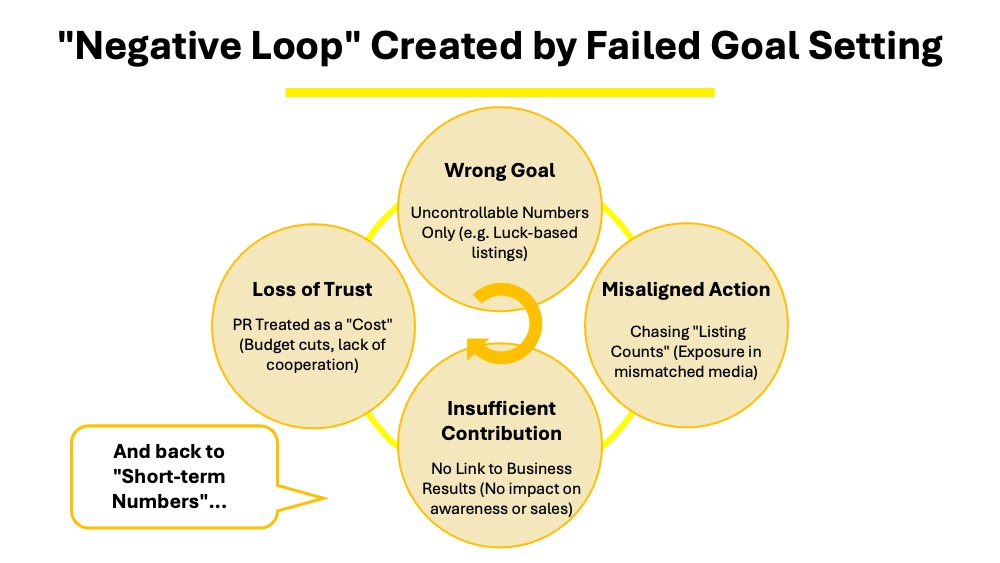
Setting goals in public relations activities can be said to be one of the difficult points that many people in charge struggle with. If the goal setting is not appropriate, not only will the direction of the activities be blurred, but it will also be difficult to obtain evaluation from within the company. Companies that tend to fail often have certain common patterns. First, let’s check whether your company’s current goal setting has fallen into the “failure pattern” shown in the table below.
| Item | Goal setting that tends to fail | Successful goal setting |
|---|---|---|
| Nature of indicators | Only “results” that are influenced by luck and external factors | Combination of “actions” and “results” that can be controlled by oneself |
| Balance of evaluation | Only the number of articles published, or only image improvement | Balance of quantitative evaluation by numbers and qualitative evaluation by quality |
| Cooperation with the organization | Completed independently only by the public relations department | Linked to management goals and issues of other departments |
| Evaluation cycle | Review only once every six months or a year | Flexibly review KPIs on a monthly or quarterly basis |
You only have “indicators that you cannot control”
The most common failure in setting public relations goals is to set only “indicators that cannot be controlled by the company,” such as the number of articles published in the media and advertising conversion costs. Of course, the number of articles published is an important result, but the final decision-making power lies with the media, and it is also affected by the news cycle and accidents in the world.
As a countermeasure, it is necessary to set “action goals that are completed by your own actions,” such as the number of press releases distributed and the number of interviews with reporters. By managing the action goals (outputs) and the result goals (outcomes) separately, you can correctly evaluate the activity process. You will be able to run a healthy PDCA cycle without being swayed too much by external factors.
It is biased towards either quantitative or qualitative
Public relations activities also tend to stagnate if goal setting is extremely biased towards either “numbers (quantitative)” or “nature (qualitative).” For example, if you only pursue the number of articles published, it may lead to actions that deviate from the essence, such as increasing exposure in media that do not match the brand image.
Conversely, with only qualitative goals such as “improving awareness” and “acquiring trust,” the achievement criteria become ambiguous, and the results report to the company lacks persuasiveness. The ideal goal setting is to visualize progress with quantitative numbers while ensuring quality with qualitative evaluation axes such as the content and tone of published articles.
Specifically, it is a good idea to incorporate ideas such as “exposure rate of key messages in target media” to quantify quality.
You are trying to complete it with public relations alone
There are also many companies where the goals of the public relations department are separated from the goals of management strategy, marketing, and sales divisions, and are independent. Public relations activities are originally a means to solve the company’s management issues and should contribute to the achievement of goals for the entire organization.
If public relations personnel complete the goals on their own, it will be difficult to obtain cooperation from other departments, and as a result, it will not be possible to create a company-wide impact (attractiveness). It is essential to have a process of deeply hearing what management values and what issues there are in the sales and recruitment fields.
By setting public relations goals that are directly linked to business growth, public relations will be recognized as a “value center” rather than a “cost center” for the first time. Defining public relations goals as a common language for the organization by involving other departments is the key to maximizing results.
The results of public relations goal setting are determined by “support” rather than “design”
In setting public relations goals, what is more important than creating a perfect plan is the flexible “support” to connect daily activities to results.
SUNNY SIDE UP does not just provide consulting, but also acts as a partner that supports companies at the forefront of actual work. By constantly synchronizing management strategy and public relations actions, and making optimal course corrections according to the situation, we will realize the operation of living goals that do not become a mere formality.
| Support phase | Operation only by our company | Benefits of support type |
|---|---|---|
| Formulation of goals | Set on the extension of the past | Essential design calculated backwards from management issues |
| Execution process | Falling behind due to lack of resources | Aggressive PR and public relations development by a team of experts |
| Verification of effects | Ends with reporting the number of articles published | Multifaceted analysis to utilize for the next measure |
| Speed of improvement | Correction in units of half a year to a year | Rapid improvement proposal |
The value of support that supports everything from strategy to improvement
In order to reliably achieve public relations goal setting, it is essential not to divide the processes from strategy planning to execution and improvement based on effect measurement. SUNNY SIDE UP has a system in place to support all of these processes in a consistent manner.
We immediately feed back the response and media reaction obtained in the execution phase of the field to the target value, and always propose “measures to be taken now.” Because we have unique knowledge to verbalize and visualize qualitative public relations results as assets, we can support continuous growth without hesitation.
Prevent “formalization of goals” due to self-completion and ensure results
If you set goals using only internal resources, they will inevitably fall within the achievable range, and the impact on management will tend to be weak. In addition, it is not uncommon to lose sight of the original purpose while being busy with daily tasks, and the purpose of filling in the numbers themselves becomes “formalization.”
SUNNY SIDE UP’s intervention from a third-party perspective enables healthy goal management. Support that objectively captures social trends and draws out potential value that cannot be noticed by the company alone will be a powerful engine to accelerate the business.
[Related article]What is inner branding? Explaining how to proceed with the purpose, effects, and success stories « Column
What SUNNY SIDE UP thinks about “public relations goals”
The public relations goals that SUNNY SIDE UP defines are not simply the accumulation of media exposure numbers. SUNNY SIDE UP believes that public relations activities should be an “investment” that solves corporate management challenges and accelerates medium- to long-term business growth. Rather than pursuing superficial numbers alone, we consider measuring how these activities change stakeholder awareness to be the true goal setting.
| Comparison Items | General PR Goals | Goals SUNNY SIDE UP Considers |
|---|---|---|
| Evaluation Metrics | Number of publications, advertising equivalent value | Social trust, degree of attitude change |
| Initiative Perspective | Exposure itself is the purpose | Solving management challenges is the purpose |
| Scope of Impact | Specific media exposure only | Company-wide impact including sales, recruitment, IR, etc. |
| Role Definition | Information dissemination and communication agent | Decision-making support that drives management |
Public relations is not “topic creation” but a “management decision-making apparatus”
The true value of public relations does not stop at mere temporary topic creation. It should serve as a “management decision-making apparatus” that influences all corporate activities, including strengthening brand power, attracting excellent talent through recruitment activities, supporting sales to drive contract closures, and gaining investor trust through IR.
By analyzing real reactions from media and society from multiple perspectives and providing feedback to management, it becomes an important indicator for developing future strategies. SUNNY SIDE UP provides comprehensive support from goal design to execution and improvement to maximize this broad influence. If you are considering transforming public relations into a powerful management weapon to pioneer your business future, please consult with SUNNY SIDE UP.
CONTACT « SUNNY SIDE UP GROUP Inc.
Summary
When public relations goal setting focuses solely on “increasing the number of publications,” it tends to bias toward easily covered media outlets and becomes difficult to connect with company growth. Because it takes time to see results and is influenced by external factors, it is important to work backward from management challenges to establish KGIs, break down CSFs, and translate them into KPIs (behavioral indicators + result indicators) that public relations can influence. Furthermore, by switching indicators according to purpose among “awareness,” “trust and understanding,” and “business contribution,” and operating cycles across short-term, medium-term, and long-term timeframes, goals do not become formalistic but serve as decision-making criteria.
Appropriate goal setting becomes a compass that protects public relations personnel and accelerates corporate growth. Start by engaging in dialogue with management about “what public relations is for.”
SUNNY SIDE UP views public relations not as “topic creation” but as a management decision-making apparatus, providing comprehensive support from goal design through operation and improvement. If you would like to organize your public relations goals and KPIs in a way that leads to results, please consult with us.