What is a PR Strategy? Explaining the Planning Process to Build Trust and Value Beyond Advertising
- カテゴリ:
In an era where simply promoting products is no longer sufficient for companies to achieve sustainable growth and establish a competitive advantage in the market. Consumers now carefully compare and consider “appeal promotions” (direct appeals highlighting the attractiveness and strengths of a company’s products/services) from companies, placing greater emphasis on third-party evaluations and the company’s stance toward society. This is where “PR strategy” gains increasing importance. PR (Public Relations) is a crucial communication method for companies, involving activities that foster trust through two-way communication, aligning with societal interests and challenges.
This article focuses on the distinction that advertising is about “conveying” information, while PR is about “building trust.” It will thoroughly explain the unique value of PR measures and the process for formulating an effective PR strategy.
What is a PR Strategy? How Does It Differ from Advertising?
A PR strategy refers to a mid- to long-term action plan formulated by a company to build and maintain good relationships with its stakeholders (customers, employees, shareholders, business partners, local communities, etc.). PR is not merely about distributing one-off press releases or getting media coverage. The process of consistently communicating the message, “Who are we, and what value do we offer to society?” to gain social empathy and trust is the essence of a PR strategy. First, we will clarify the differences from “advertising,” which is often confused with corporate communication activities, and organize the fundamental role of PR.
【Related Article】What is Public Relations and PR? A Thorough Explanation for Beginners, from Job Description to Strategy Formulation! | Column | Column|SUNNY SIDE UP Inc.
Definition of Public Relations: Building Good Relationships with Society
PR is an abbreviation for “Public Relations.” While it is sometimes used in Japan to mean “self-promotion” or “advertising,” its original meaning is “a philosophy and approach to action for creating desirable relationships between an organization and the people (individuals/groups) surrounding it.” In other words, the goal is to deepen mutual understanding through two-way communication, rather than simply conveying information unilaterally. The role of PR can be said to be laying the foundation for a company to be recognized as a member of society and to continue its activities for a long time.
【Related Article】What is Media Relations? Explaining the Basics and 5 Key Points for Success | Column | Column|SUNNY SIDE UP Inc.
The Difference Between Advertising and PR: “Third-Party Perspective” and “Credibility”
Both PR and advertising aim to increase awareness and build branding, but there are significant differences in their approach and the quality of information. Advertising is a method where companies deliver messages directly, whereas PR is an effort to cultivate reputation by having positive messages disseminated by third parties.
The biggest difference lies in the subject of information dissemination and the locus of control. Advertising involves companies purchasing media space to disseminate information, allowing them to control content and timing. In contrast, PR involves media or third parties disseminating information they deem “valuable,” meaning companies cannot control its placement.
The table below compares the main differences between PR and advertising.
| Item | PR (Public Relations) | Advertising (Promotion) |
|---|---|---|
| Information Source | Media / Third Party | Company (Advertiser) |
| Publication Authority | Resides with the Media | Resides with the Company |
| Nature of Information | Objective Facts / Reporting | Subjective Claims / Promotion |
| Credibility | High (Third-party endorsement) | Limited |
| Main Objective | Gaining Trust, Promoting Understanding, Building Fans | Sales Promotion, Gaining Awareness |
Information disseminated through PR activities is characterized by its very high credibility among consumers because it is conveyed through a “third-party perspective.”
Why Strategic PR is Indispensable in Modern Business
With the widespread adoption of the internet and social media, the amount of information consumers receive has exploded. As a result, one-sided advertising messages from companies are easily buried, and reliable media articles, social media reviews, and influencer evaluations now significantly influence purchasing decisions. With growing interest in SDGs and ESG management, corporate social responsibility and ethics are also being scrutinized more rigorously. We have entered an era where simply increasing exposure through advertising slots is insufficient, and the value of PR, which was already important, is being re-evaluated. Strategic PR activities that emphasize dialogue with society have become more indispensable than ever.
Five Key Values a PR Strategy Brings to a Company
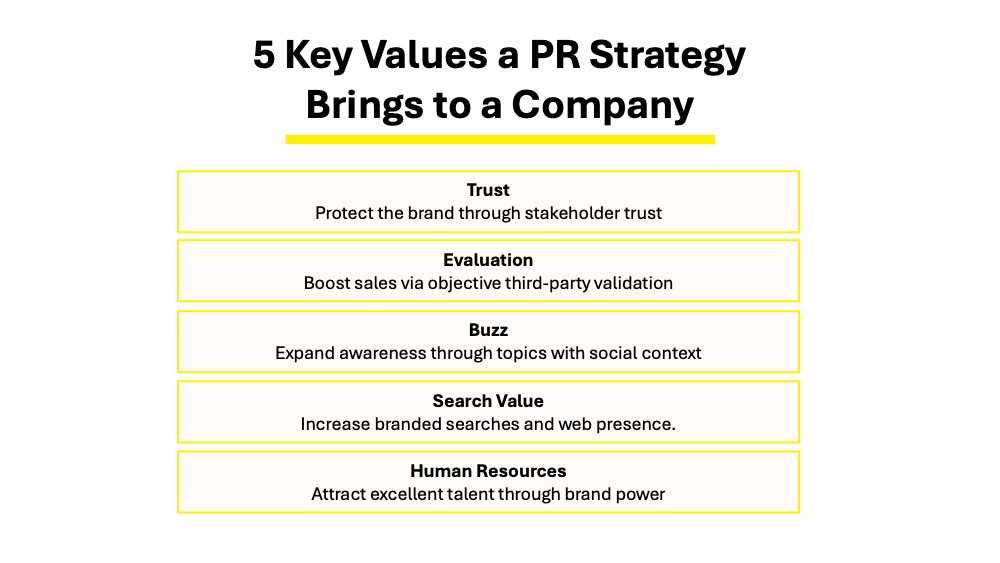
By properly executing a PR strategy, companies can achieve unique results that cannot be obtained through advertising alone. Here, we explain the five unique values of PR measures: “trust, evaluation, buzz, search, and talent.”
Gaining “Trust” from Stakeholders to Protect Your Brand
The greatest outcome of PR activities is gaining “trust.” When a company’s initiatives or the story behind product development are reported in newspapers, news programs, or highly credible web media, it directly translates into social credibility. The perception that “a company featured on TV must be reliable” or “a company covered in the newspaper is solid” has a certain positive impact not only on customers but also on business partners, financial institutions, and job seekers. Accumulated trust becomes a brand asset, acting as a reputation safeguard that minimizes damage even in the event of unforeseen scandals or troubles.
Objective “Evaluation” from Third Parties Drives Purchases and Contracts
When consumers choose products or services, the ultimate deciding factor is “evaluation” by a third party. While companies convey product features through their own information dissemination, combining this with expert review articles or interviews with actual users can often provide more persuasive information. The same applies to B2B business; case study interviews and features in industry publications serve as strong evidence for decision-makers when approving proposals. Visualizing how well a company’s products are evaluated in the market through a PR strategy has the effect of increasing the conversion rate of sales activities and marketing initiatives.
Expanding Awareness with “Buzz” Placed in a Social Context
PR has the power to transform mere product information into social news. For example, when launching a new product, instead of simply introducing its specifications, positioning it as a “solution to current social issues” can create “buzz” that the media is more likely to cover. Information placed within a social context is easily spread on social media, potentially generating explosive awareness (virality) without advertising costs. The ability to naturally bring a company’s topic into people’s conversations is a unique value of PR.
Increasing Branded Searches and Enhancing “Search Value” on the Web
Increased media exposure and social media mentions through PR activities inevitably lead to an increase in web search behavior. In particular, the rise in “branded searches”—direct searches for brand or product names—is extremely important from an SEO (Search Engine Optimization) perspective. When many users search with branded keywords and visit a site, it sends a strong signal to search engines like Google that “this site is popular and trustworthy.” Furthermore, acquiring backlinks from influential media sites and public institutions can improve domain authority, leading to a synergistic effect of boosting the overall search ranking of the site. Recently, with advancements in technology, the scope of “search” that companies should be aware of has also expanded. In addition to traditional search engine optimization, for app providers, ASO (App Store Optimization) to rank higher in app stores, and efforts to be referenced by rapidly spreading generative AI, are also gaining importance. Currently, various terms such as GEO (Generative Engine Optimization) and AEO (Answer Engine Optimization) are being proposed and are in flux regarding optimization for AI search experiences, but here we will collectively refer to them as “AIO (AI Optimization).” In conclusion, PR is an effective measure to maximize “search value” across all channels: search engines, app stores, and AI.
Enhanced Brand Power Attracts Excellent “Talent”
When a company’s brand power is enhanced through a PR strategy, it creates a significant competitive advantage not only in customer acquisition but also in recruiting excellent talent. Job seekers tend to select companies not only based on conditions like salary and benefits but also heavily on “how the company is evaluated in society” and “what vision it holds.” When a company’s initiatives and the CEO’s vision are communicated through the media, it can deeply convey a positive impression to job seekers, such as “an energetic company” or “a socially trustworthy company.” Furthermore, external communication also has the effect of reminding existing employees that “we are doing valuable work that is noticed by society.” As a result, a PR strategy not only accelerates external talent acquisition but also strengthens internal organizational capabilities, creating a virtuous cycle where excellent talent continues to stay.
How to Formulate a Results-Driven PR Strategy! 5 Practical Steps
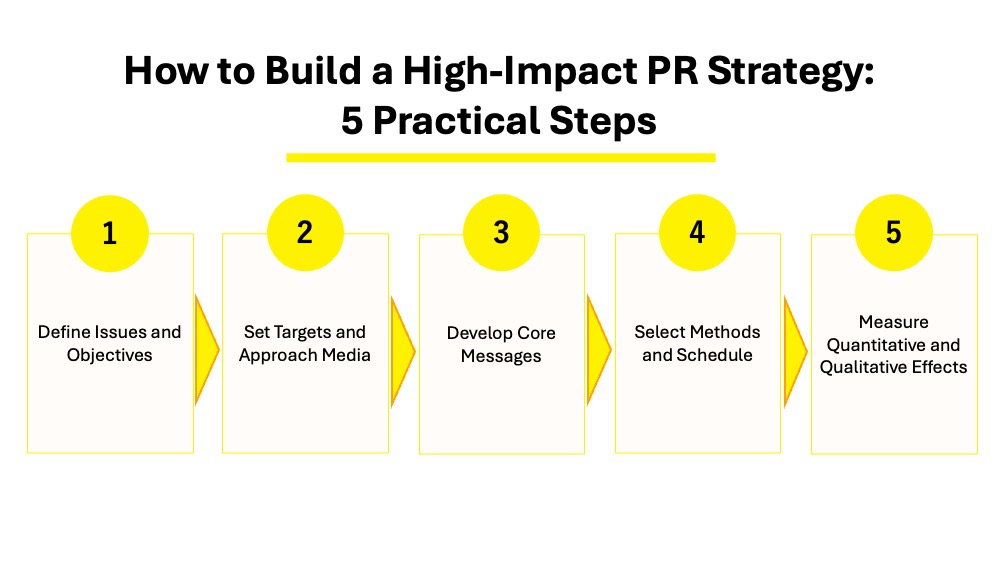
To conduct effective PR activities, it is necessary to formulate a strategy in a logical sequence, rather than simply issuing press releases on a whim. Here, we introduce five steps for formulating a PR strategy that leads to results.
Step 1: Analyze the Current Situation to Define Challenges and PR Objectives
First, objectively analyze your company’s current situation and clarify the challenges that PR should address. The necessary actions will differ depending on the challenge, such as “awareness exists but understanding is shallow,” “technical capability is strong but credibility is lacking,” or “losing to competitors in recruitment.” Organize your company’s situation using frameworks like SWOT analysis (Strengths, Weaknesses, Opportunities, Threats). Then, set the objective of your PR activities (KGI): “What state do we want to achieve, and by when?” If the objective is ambiguousthe means may become the end, leading to a lack of results.
Step 2: Define Target Audience and Media to Approach
Next, specifically define who you want to reach with your message. Develop target profiles for each stakeholder group, including not only customers but also shareholders, employees, and recruitment candidates. Then, research what media sources these targets typically use to obtain information and select the target media to approach. The approach to information and its delivery will vary significantly depending on whether you aim for mass media like television and national newspapers, or highly specialized industry publications and web media.
Step 3: Develop a Core Message that Connects Your Company with Social Interests
The success or failure of PR hinges on the development of this “core message.” It involves finding the intersection between what the company wants to convey and what the media and society want to know, then transforming it into a newsworthy statement. Instead of merely announcing a “new product launch,” it requires a perspective that connects the company with social interests, such as presenting it as a “tool to promote work-style reform” or a “new material contributing to SDGs.” The message must resonate with media reporters and editors, and further evoke empathy from readers and viewers.
Step 4: Select the Optimal Methods and Create an Execution Schedule
Once the message is determined, select the specific methods for delivering it. Methods are diverse, including press release distribution, press conferences, media caravans (individual visits to reporters), communication via owned media, social media campaigns, and event hosting. Rather than executing these in isolation, it’s crucial to design a “communication strategy” that combines them according to target behavior changes. Create an annual PR calendar and schedule information dissemination at optimal times, aligning with seasonal events and social trends.
Step 5: Set KGI/KPIs and Measure Effects Quantitatively and Qualitatively
PR activities can be measured by setting appropriate indicators. Set KPIs (Key Performance Indicators) to track progress towards the KGI (Key Goal Indicator), which is the ultimate goal.
The table below shows examples of KPIs for PR activities.
| Indicator Type | Specific KPI Examples |
|---|---|
| Exposure Volume (Quantitative) | Number of Articles Published Advertising Equivalent Value Reach (PVs) |
| Quality Evaluation (Qualitative) | Article Tone (Positive/Negative) Key Message Inclusion Rate Placement Size |
| Behavioral Change | Branded Search Volume Website Traffic Social Media Engagement Job Applications |
It is important to regularly measure these figures, check if the plan is progressing as intended, and if the message is being conveyed correctly, then fine-tune the strategy (PDCA cycle).
Successful PR strategy requires professional planning capabilities and strong media relations. SUNNY SIDE UP’s PR services comprehensively support all PR activities, from press release distribution to media training and crisis management. We achieve effective information dissemination through a strategic approach based on extensive experience. Please check the details of our PR services below.
PUBLIC RELATIONS | Services | PR Company | SUNNY SIDE UP Inc. | SUNNY SIDE UP Inc.
Utilizing the “PESO Model” for Strategy Formulation
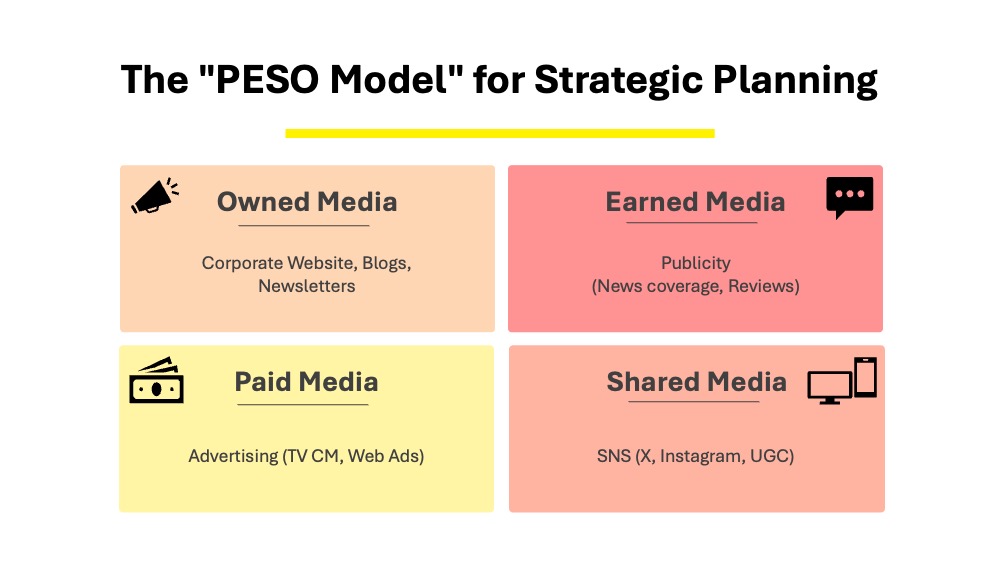
Essential to modern PR strategy is the “PESO Model,” which categorizes media into four types. By combining these and leveraging their respective characteristics, the reach and depth of information can be maximized.
The Concept of Media Mix Centered on Earned Media (Reputation Acquisition)
At the core of the PESO model is “Earned Media,” which refers to publicity activities discussed so far. This includes highly credible information disseminated by third parties, such as news sites, newspaper articles, and blogs. In a PR strategy, it is effective to first aim for exposure in earned media, and then use the resulting “objective evaluation” as a starting point to expand to other media. For example, an article published in web news can be shared on the company’s social media or repurposed for sales materials. By presenting the “credibility” of objective media coverage, awareness can be expanded while giving recipients a sense of security.
Collaboration Between Owned Media (Self-Dissemination) and Shared Media (Empathy and Diffusion)
“Owned media” refers to information dissemination platforms fully controlled by the company, such as corporate websites and company blogs. It is suitable for deeply conveying detailed information that could not be fully expressed in earned media, or stories behind development. On the other hand, “shared media” refers to platforms like social media, where consumers share and spread information among themselves. The ideal flow in modern PR strategy is to create a situation where users discuss topics that gained buzz in earned media on social media, then flow into owned media seeking more detailed information. By combining these with “paid media” (advertising media) as needed, it is possible to boost awareness.
Key Points to Consider for a Successful PR Strategy
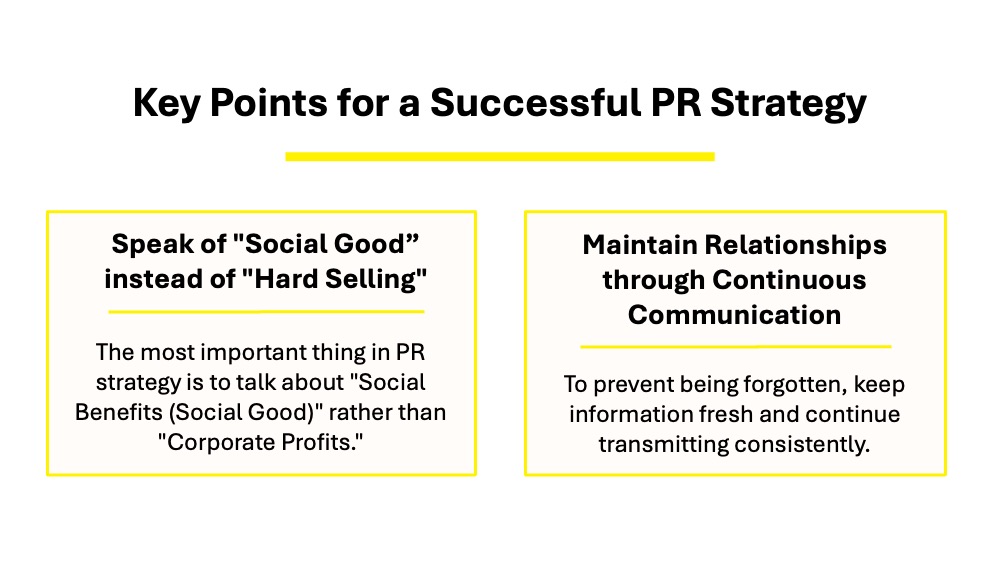
Finally, let’s touch upon the mindset that should always be maintained when executing a PR strategy. The shortcut to success is to uphold fundamental principles rather than resorting to mere techniques.
Point 1: Speak to Social Significance, Not Just Sales Pitches
Media and consumers react sensitively to, and may even reject, corporate “sales pitches.” The most crucial aspect of a PR strategy is to speak to “social benefit (social good)” rather than “company profit.” You must not lose sight of the perspective that “this product’s widespread adoption solves this social issue” or “people’s lives will be enriched in this way,” rather than simply “this product’s sales will benefit our company.” Continuously positioning your company’s activities within a social context and communicating them as an empathetic story leads to long-term trust building.
Point 2: Maintain Relationships with Media and Customers Through Continuous Communication
PR does not yield results overnight. If activities cease after a single media feature, the company will quickly be forgotten. What is important is to maintain the freshness of information and continue disseminating it. Even when there is no major news, efforts are required to disseminate information from different angles, such as publishing reports on industry trends or focusing on employee work styles. The accumulation of steady communication builds trust (relations) with media contacts, allowing the company to grow into a reliable presence when needed. Furthermore, continuous information dissemination fosters a sense of security and trust among customers, making them feel that “this brand is always genuinely engaged.” Long-term trust with customers is built not through temporary exposure, but through the accumulation of daily communication.
Summary
A PR strategy is not merely a means to gain media exposure; it is a management strategy itself for building strong relationships with stakeholders and enhancing corporate brand value.
Information dissemination that emphasizes a “third-party perspective” and “social significance,” distinct from advertising, has become an indispensable element in today’s business world, where credibility is paramount. By referring to the “PESO model” and the five practical steps introduced in this article, you can draw a roadmap tailored to your company’s challenges, which is the shortcut to success. We encourage you to implement strategic PR and achieve sustainable growth for your company.
Formulating an effective PR strategy requires specialized expertise, such as understanding media trends and discerning optimal timing. SUNNY SIDE UP, leveraging its extensive track record and strong media relations, can propose the ideal PR strategy to help you achieve your goals. Please feel free to contact us via the inquiry form for a consultation. Our experienced staff will conduct a thorough interview.