Explaining the Establishment of a Crisis Management System! What are the Keys to Public Relations Response to Protect Trust?
- カテゴリ:
In corporate activities, “crises” such as unexpected troubles, scandals, and natural disasters are always present, regardless of their size. Once a crisis occurs, the company’s reputation and credibility are greatly damaged, and in the worst case, the continuation of the business may be jeopardized. In such a situation, “crisis management” is essential to minimize damage and protect corporate value. This article will explain in detail from a professional perspective the basic definition of crisis management, the differences between risk management and BCP (Business Continuity Plan), which are often confused with each other, and the specific steps that companies should take now to build a system.
What is Crisis Management?
Crisis management is often used as a translation of the English term “Crisis Management.” Specifically, it refers to the entire range of activities aimed at minimizing damage to a crisis that has already occurred and restoring corporate activities to a normal state as quickly as possible. Factors include both external and internal factors, such as natural disasters, system failures, information leaks, scandals, and social media firestorms. In recent years, information dissemination during a crisis (crisis management public relations) has been positioned as the core of the system. Incorrect information or silence can lead to misunderstandings and secondary damage beyond the facts. This column positions it as essential to establish an accurate, rapid, and sincere information dissemination system from normal times, from the perspective of “minimizing damage,” “maintaining trust,” and “business continuity.”
Clarify the Specific Definition of Crisis Management
Crisis management is an activity that focuses on responding “after a crisis has occurred.” Specific activities include information gathering, analysis, decision-making, public relations (crisis management public relations) at the time of a crisis, and the execution of specific countermeasures to resolve the situation. The important thing is to ensure that everyone from on-site employees to management can take prompt and consistent action based on pre-determined rules. Sharing this definition throughout the organization is the first step in establishing a crisis management system.
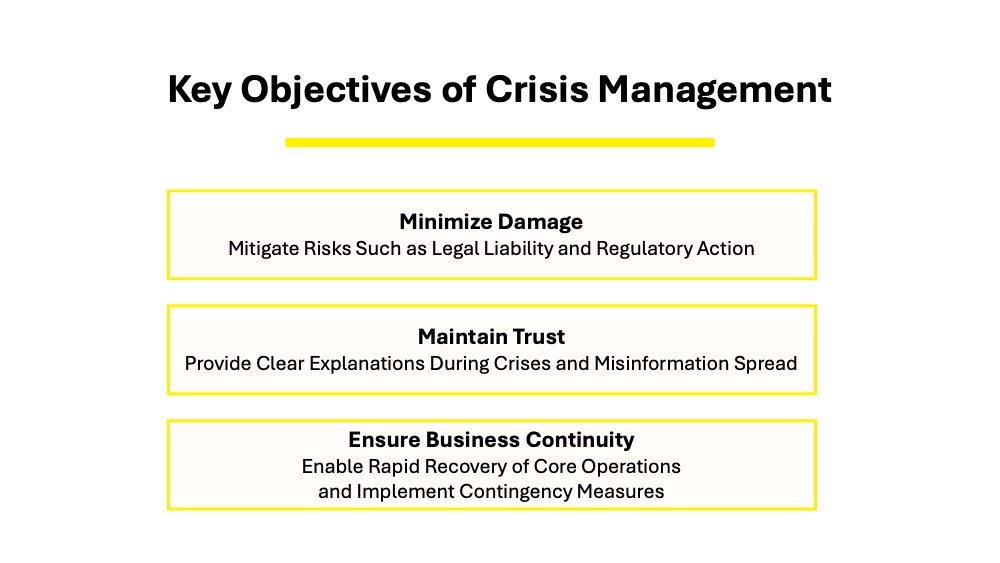
The Purpose of Crisis Management is to Minimize Damage, Maintain Trust, and Ensure Business Continuity
The primary purpose of crisis management is to minimize the damage (financial and reputational) suffered by the company, with the highest priority given to ensuring the safety of human life. Especially in modern times, the speed of information dissemination has increased dramatically due to the progress of digitalization, so delays in initial response and inappropriate information dissemination can lead to a fatal loss of trust. It is about protecting the trust of stakeholders through highly transparent explanations and sincere responses, and ensuring the continuity of business by resuming core operations as quickly as possible even when business is interrupted by an emergency.
| Purpose of Crisis Management | Specific Benefits |
|---|---|
| Damage Mitigation | By taking appropriate action from a legal compliance perspective, the risks of damages and administrative penalties are reduced. |
| Trust Preservation | Prevent loss of credibility through swift and sincere responses to stakeholders (customers, shareholders, society). |
| Business Continuity | Directly linked to the early recovery of core businesses and corporate survival. |
Understand the Difference Between Crisis Management and Risk Management
Crisis management and risk management are like the two wheels of a car that are essential for the survival of a company, but the timing and purpose of their responses are clearly different. Understanding this difference is the key to building an appropriate system.
Risk Management is a “Prevention” Effort
Risk management is an activity that is carried out in the stage “before a crisis occurs.” The main purpose is to identify potential risks, assess their probability of occurrence and impact, and take preventive measures to prevent the risks from materializing. Examples include strengthening information security measures, conducting compliance training, and reinforcing equipment based on hazard maps.
Crisis Management is an “After-the-Fact Response” Effort
On the other hand, crisis management is a response “after a crisis has occurred.” It specializes in stopping and resolving damage when preventive measures in risk management have not been sufficient, or when an unexpected situation has occurred. The “response plan” when risk management preventive measures are broken, or when a risk has materialized, is the core of crisis management.
Crisis management public relations is strictly positioned as part of crisis management, but it plays an intermediate and bridging role between risk management and crisis management in that it is responsible for pre-occurrence preparation (media training and development of expected Q&A) and post-occurrence information dissemination (handling of reporters and formulation of SNS policies).
In other words, crisis management public relations is an area that “serves as the cornerstone for protecting the organization’s trust through the planning and execution of information dissemination.”
| Comparison Item | Crisis Management | Risk Management |
|---|---|---|
| Timing of Response | During/After a Crisis (Emergency) | Before a Crisis (Normal Times) |
| Main Objective | Minimize damage incurred “Response and Recovery” |
Prevent risks from occurring “Prevention” |
| Activities | Emergency response, information dissemination, press conferences, business recovery activities | Identification, evaluation, and implementation of avoidance measures for potential risks |
Reasons Why Crisis Management is Indispensable for Companies and Necessary Responses
The importance of crisis management continues to increase due to changes in the environment surrounding companies. Having an appropriate crisis management system is directly linked to stabilizing corporate management.
Protect Corporate Trust and Brand
When incidents such as scandals, product recalls, and information leaks occur, the subsequent response determines the company’s evaluation. Explanations lacking transparency and attitudes that avoid responsibility spread quickly through SNS and media in a short period of time, and it takes a long time and cost to regain lost trust.
Therefore, it is important to thoroughly implement the following three points in crisis management public relations.
・Speed: Disseminate the first report as soon as possible after confirming the facts (do not stop disseminating even if “currently under confirmation”)
・Sincerity: Avoid excessive excuses and speculation, and clearly state confirmed information and future response policies
・Consistency: Unify the content of internal and external communications to prevent contradictions and misunderstandings
By building a system that can respond from normal times, it is possible to prevent “delays in information dissemination” and “inconsistent responses” in the event of an emergency, and as a result, minimize the decline in reliability.
Ensure the Safety of Employees and Stakeholders
Crisis management is directly linked not only to external responses but also to internal safety and information sharing.
Companies have a “duty of care” to protect the lives and safety of their employees, and at the same time, they also have a responsibility to “provide accurate information” so that employees can act with peace of mind.
For example, in the event of a social media firestorm, internal announcements are distributed to prevent employees from spreading incorrect information, and internal messages from management share response policies and attitudes toward preventing recurrence. Linking “internal public relations” and “external public relations” in this way leads to the peace of mind of diverse stakeholders such as employees, customers, shareholders, and local communities.
Avoid Bankruptcy and Business Suspension Risks
Natural disasters and large-scale system failures force companies to suspend their business activities. Especially in today’s world where supply chains have become more complex, the possibility that the shutdown of some functions will trigger a chain of business interruptions is high. The formulation of a BCP is an indispensable preparation for quickly restoring core businesses in such situations and avoiding the worst-case scenario of bankruptcy.
*BCP (Business Continuity Plan) is a plan that defines policies and procedures for not interrupting important operations or restoring them in the shortest possible time even when faced with such unforeseen circumstances.
・Clarify business recovery procedures, alternative locations, and personnel system in the BCP
・Accurately disseminate recovery prospects and impact on customers through crisis management public relations
By linking BCP and crisis management public relations, confusion inside and outside the company can be minimized.
| Damage a Crisis Inflicts on a Company | Effectiveness of Crisis Management Measures |
|---|---|
| Deterioration of Corporate Image | Lead to the recovery and maintenance of trust through sincere responses. |
| Pursuit of Legal/Administrative Responsibility | Avoid serious liability through appropriate initial response. |
| Economic Loss (Decreased Sales/Compensation) | Minimize losses and accelerate business recovery. |
However, the current situation is that many corporate systems have action manuals for when a crisis occurs, but do not have a crisis management public relations system that defines “who, what, and how to disseminate information.” This lack of development of an information dissemination system can lead to delays in response and confusion of information in the event of an emergency.
SUNNY SIDE UP provides consistent support from the design of crisis response manuals to media training, mock press conferences, and support for the development of information dissemination policies, tailored to each company’s business characteristics and organizational structure. By establishing an information dissemination system from normal times, it is possible to respond with consistency and reliability even in the event of an emergency.
PUBLIC RELATIONS | Service | PR Agency | SUNNY SIDE UP Inc.
5 Steps to Build a Crisis Management System
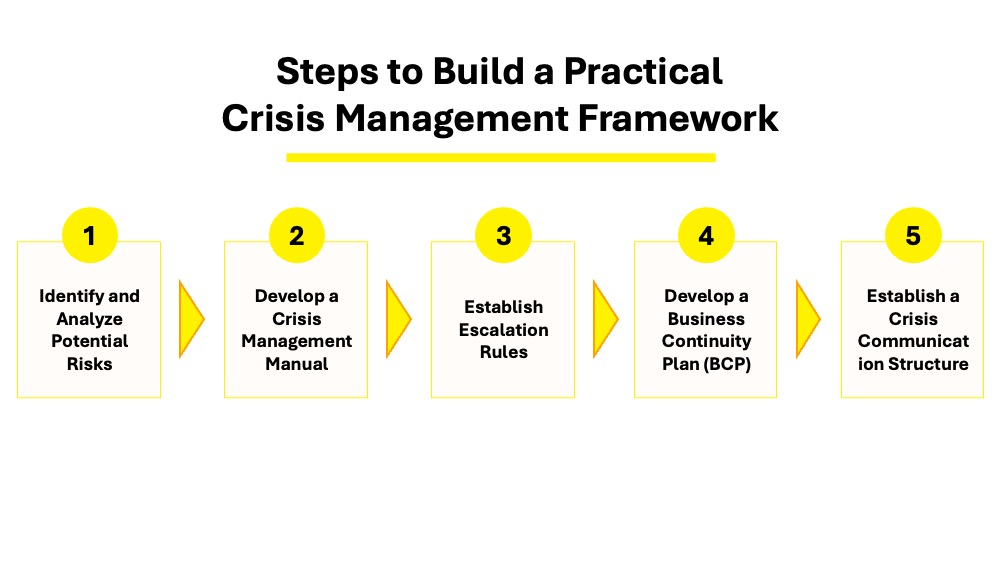
In order to build a highly effective crisis management system, it is necessary to take concrete steps based on procedures from normal times. Here, we will explain the main steps in building a system.
Step 1. Identify and Analyze Potential Crises
First, start by identifying potential crises (crisis scenarios) for your company. Identify a wide range of risks, such as natural disasters, system failures, information leaks, scandals, and terrorism, and analyze their “probability of occurrence” and “impact on business.” Based on this analysis, determine the priority of measures.
Step 2. Create a Crisis Management Manual
Create a crisis management manual that defines specific action guidelines based on the assumed crisis scenarios. The manual should clearly state the initial response in the event of a crisis, the roles of responsible persons and persons in charge, and the methods of information gathering and transmission. In addition, it is important that the manual is stored in a location that is easily accessible to all employees, not just specific personnel, and that its contents are shared so that they can be understood.
Step 3. Set Escalation Rules
Clarify the route and judgment criteria for “reporting, contacting, and consulting (escalation)” in the event of a crisis. By setting rules on what level of situation to report to whom and by when, delays in response can be prevented. It is necessary to have a system in place to resolve minor issues on-site and to report serious situations to management promptly.
Step 4. Develop a BCP (Business Continuity Plan)
The BCP is a plan to prevent core businesses from being interrupted in the event of a crisis, or to restore them as quickly as possible even if they are interrupted. The Cabinet Office’s “Business Continuity Guidelines” also indicate its necessity. Specific steps in formulating the plan include identifying core businesses, setting recovery time goals, considering alternative means, and implementing preventive measures. The BCP is one of the most important components of a crisis management system for achieving the goal of “business continuity.”
Step 5. Develop a Public Relations Information Dissemination System
In order to disseminate accurate information without confusion in the event of a crisis, it is essential to develop an information dissemination system that clearly defines “what, who, when, and through which media” to disseminate. By appointing a person in charge of information dissemination and a substitute in normal times, and by establishing rules for the flow of media response (from receiving inquiries to approving and publishing responses), delays in initial response can be prevented. In addition, it is important to organize information in stages for SNS dissemination: “Primary Report: Fact Recognition,” “Secondary Report: Cause/Response,” and “Tertiary Report: Recurrence Prevention.” Unifying internal notifications to employees and responses to inquiries, and maintaining information consistency between external and internal sources, is also key to maintaining trust. As a mechanism to support these efforts, it is necessary to develop expected Q&A, templates, and a system for supervising and recording information dissemination.
How to Improve the Effectiveness of Crisis Management?
The crisis management system is not complete just by creating a manual. The following points are essential to make the system a “living plan.”
Conduct Regular Education and Training
Whether the formulated manual and BCP will function in an emergency depends on the frequency and quality of training. It is important to regularly conduct not only evacuation drills and safety confirmation drills for all employees, but also mock press conferences (media training) for management and members of the crisis response headquarters, and decision-making drills for resolving the situation. Through training, identify deficiencies in the plan and connect them to continuous improvement.
Organize a Dedicated Crisis Management Team
It is desirable to organize a “Crisis Response Headquarters” composed of personnel with specialized knowledge of crisis response from normal times. In particular, include members from the public relations, legal affairs, general affairs, and IT departments, and clarify their authority and division of roles. This dedicated team will serve as the core for enhancing the organization’s overall “crisis management capabilities,” such as crisis prediction, avoidance, damage mitigation, and recurrence prevention.
Determine the Response Flow of the Crisis Management Public Relations System
If the content of information dissemination and the approval flow remain ambiguous, it will cause confusion of information and delays in response, leading to secondary confusion.
Therefore, it is important to develop the following public relations system from normal times.
・Clarification of Initial Information Dissemination Flow: Determine who will disseminate the primary report within the first 1 to 2 hours of a crisis
・Design of Approval/Substitute Route: Set rules for delegating authority to prevent information dissemination from stopping even when management is absent
・Templating of Information Dissemination Content: Standardize the primary report (fact finding) / secondary report (response policy) / tertiary report (recurrence prevention measures)
・Information Monitoring and Log Management: Collect reactions from SNS and media, and build a system to record information dissemination history
Such a system needs to be continuously refined through training and verification, rather than being finalized once it is formulated.
| Initiatives to Enhance Effectiveness | Purpose |
|---|---|
| Regular Training and Education | Ensure employees internalize manuals and BCPs, and verify their effectiveness. |
| Formation of a Dedicated Team | Accumulate knowledge during normal times to enable swift decision-making in times of crisis. |
| Establishment of a Public Relations Response Flow | Reduce time spent deliberating during a crisis to ensure accurate, swift, and sincere information dissemination, and prevent confusion and the spread of misinformation early on. |
Success Principles and Practical Points of Crisis Management Public Relations
In crisis management public relations, designing not only how quickly you can act, but also “how to communicate” and “who to deliver to” will determine the success or failure of maintaining trust.
In particular, it is important to thoroughly implement the three principles of transparency, speed, and consistency, and to operate information dissemination in stages.
Three Principles of Transparency, Speed, and Consistency
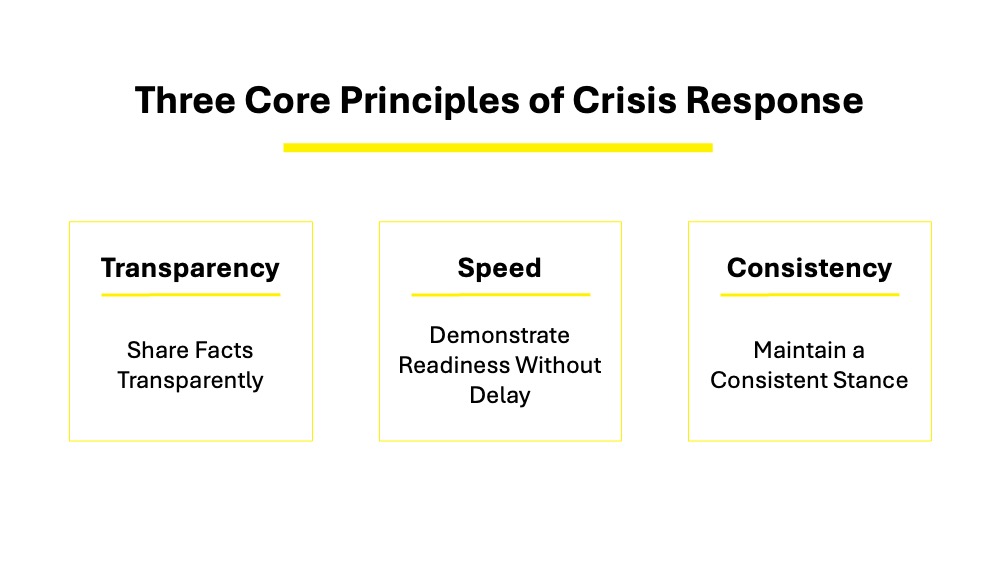
The basic principle of information dissemination in crisis response is to “not hide, not delay, and not waver.”
・Transparency: Explain in an easy-to-understand manner without hiding facts or conveying them ambiguously with speculation, and with clear evidence. It is also necessary to disseminate technical content in plain language that people outside the field can understand.
・Speed: Silence amidst confusing information creates misunderstandings and speculation. Even if there are undetermined items, indicate “under confirmation” and “will be updated at ○ o’clock as soon as determined” to show a continuous updating attitude, which leads to trust.
・Consistency: Unify the messages of internal public relations, media response, and SNS dissemination, and develop a confirmation/approval flow before dissemination so that different explanations are not given by each department or person in charge.
Training these three principles from normal times and establishing them as an organizational culture will serve as the foundation for maintaining trust in times of crisis.
Information Dissemination Steps to Guide Trust Recovery
It is effective to disseminate information in stages according to the progress of the situation during a crisis.
Initial sincerity and continuous accountability are key to guiding trust recovery.
Step 1. Initial Announcement (Primary Report): Briefly disseminate facts, scope of impact, provisional response, and next report notice to prevent initial confusion.
Step 2. Follow-up Report (Secondary Report): Show the hypothesis of the cause, the verification status, and the direction of permanent response to clarify the attitude of responding sincerely.
Step 3. Recurrence Prevention Announcement (Tertiary Report): Announce the completion goal and follow-up plan when the measures are determined. Convey the seriousness of the commitment to improvement.
Step 4. Summary: By looking back on the entire crisis response and sharing the response results and lessons learned with society, the company fulfills its accountability.
By consistently operating this step, the reconstruction of trust can be established.
Building Media Relations from Normal Times
The quality of information dissemination in an emergency depends on the relationship building in normal times. By building trusting relationships with reporters, industry media, government agencies, and local stakeholders on a daily basis, it is possible to have accurate information transmission and reporting without misunderstandings even in the event of a crisis.
Specifically, it is effective to hold regular information exchange meetings and facility tours, transparently share press materials and data, and hold interviews and review meetings after crisis response.
Sincere relationship building in normal times leads to prompt and constructive reporting response in an emergency.
Summary
Crisis management is not just about “dealing with damage.” It is an effort to protect trust through sincere information dissemination and enhance the organization’s resilience. The accuracy of preparation and operation in normal times determines the results in an emergency.
SUNNY SIDE UP can provide support based on practical experience, from risk analysis and crisis response manuals to the design of response policies and public relations information dissemination systems, and media response in the event of an emergency. Please contact us when considering building a highly effective system that is tailored to your company’s business characteristics.