What is Media Relations? Explaining the Basics and 5 Key Points to Lead to Success
- カテゴリ:
Building strong relationships with the media is essential for corporate public relations activities. However, many public relations representatives struggle with concerns such as, “Our press releases don’t get turned into articles very often,” or “I don’t know how to build relationships with reporters.” The key to solving these issues lies in “media relations.”
This article provides a comprehensive explanation of media relations, covering basic concepts, specific activities, keys to success, and important considerations.
What is Media Relations?
Media relations refers to the comprehensive activities undertaken by companies and organizations to build and maintain long-term, positive relationships with various media outlets and individuals, including newspapers, television, magazines, web media, influencers, and KOLs (Key Opinion Leaders who possess expertise and significant influence over consumer purchasing decisions). The objective is not merely to disseminate information, but to understand the needs of media outlets and establish mutually beneficial communication.
◾️The Importance of Building Good Relationships with the Media
Media holds significant influence over society. Television serves as the primary information source across all generations, with 90.1% utilization, followed by “Internet (provided by entities other than television, newspaper, and radio operators)” at 89.2%. Media coverage dramatically increases awareness of companies and products while establishing social credibility.
Research on information credibility reveals that 63.4% of respondents consider television “trustworthy,” demonstrating its continued strong influence. Unlike advertising, information disseminated through the objective perspective of third-party media is perceived by consumers as more credible. To achieve effective information dissemination, maintaining positive relationships with media outlets is extremely important.
◾️The Difference Between Media Relations and Media Promotion
A term often confused with media relations is “media promotion.” Let’s understand the difference between the two in order to develop an effective public relations strategy.
| Term | Objective | Approach | Time Frame |
|---|---|---|---|
| Media Relations | Long-term and positive relationship building with media |
Press release distribution, press conferences, daily information exchange, and other comprehensive activities |
Long-term |
| Media Promotion | Getting specific information featured in articles or programs |
Direct approach (pitching) through phone calls, emails, and visits |
Short-term |
Media promotion is positioned as one specific action within the larger framework of media relations. In other words, the effects of media promotion are maximized when based on solid media relations.
◾️Why is Media Relations Gaining Attention Now?
The proliferation of the internet has led to a rapid increase in the number of media outlets, including web media and social media. As the volume of information consumers encounter continues to grow, it has become increasingly difficult for companies to deliver their information to target audiences. The value of disseminating information through credible media has relatively increased, leading to renewed recognition of the importance of building relationships with media outlets—namely, media relations.
Specific Activities in Media Relations
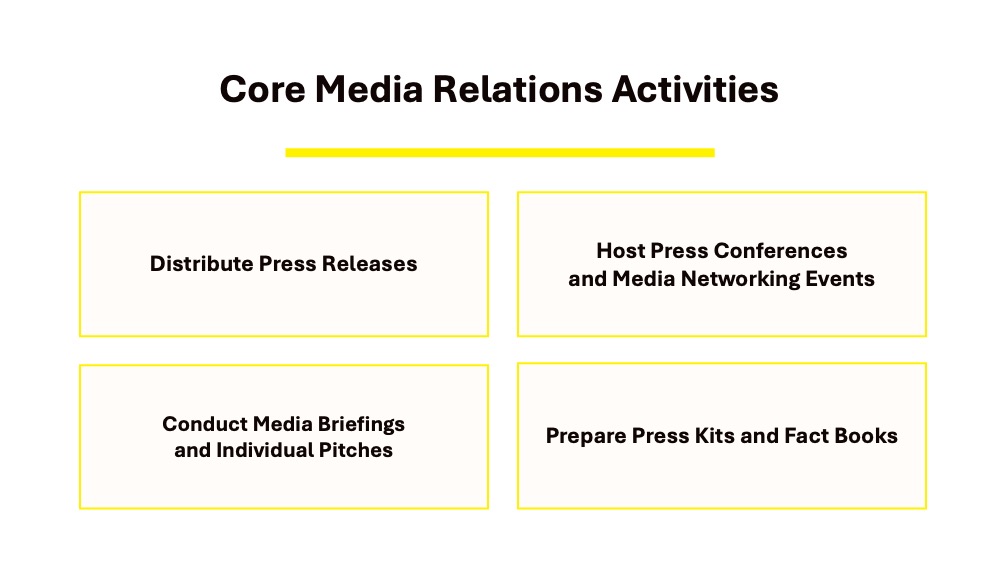
Media relations consists of a wide range of activities. Here are some of the most common activities.
◾️ Press Release Distribution
A press release is an official document that informs media outlets about new developments within a company, such as new products, services, events, or management information. It represents the most fundamental activity in media relations. Rather than simply sending information, incorporating connections to social issues of interest or compelling narratives makes it more likely to catch journalists’ attention.
◾️ Holding Press Conferences and Informal Press Gatherings
Press conferences are effective when announcing particularly important information, such as the launch of a new product or the start of a large-scale project. Gathering many media representatives in one place and allowing them to directly experience the product or service promotes a deeper understanding. In addition, small-group informal press gatherings are valuable opportunities to build closer relationships with reporters and exchange candid opinions.
◾️ Conducting Media Caravans and Individual Pitches
A media caravan is an activity in which public relations representatives directly visit media editorial departments to provide information and make sales pitches. On the other hand, an individual pitch is a method of individually proposing information tailored to the interests of a specific reporter. Both are effective methods for conveying information more deeply and enthusiastically to the target media and reporters.
◾️ Preparing Press Kits and Fact Books
A press kit is a comprehensive set of materials containing information that journalists may require, including company overview, logo data, related photographs, and past press releases. A fact book is more detailed background material that compiles company history, performance data, and market information. Preparing these materials in advance enables journalists to write articles quickly and accurately while reducing the burden on media outlets.
5 Benefits of Media Relations
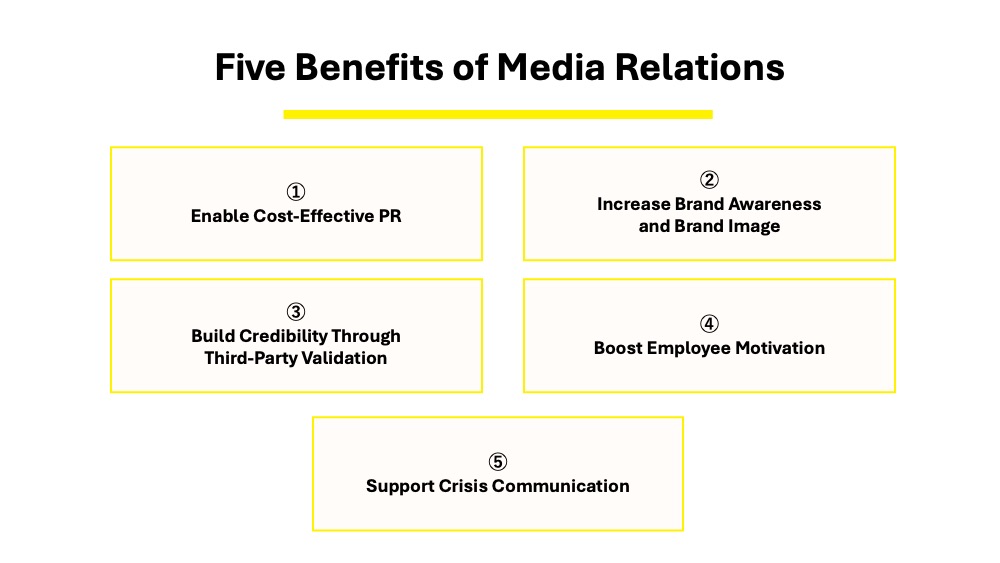
Focusing on media relations brings numerous benefits to companies. Here, we explain five representative advantages.
■ Benefit 1: Achieving cost-effective PR
Publicity, which is when a company is featured in an article in the media, differs from advertising, which involves paying for a placement slot. If you can gain publicity through media relations, you can deliver information to many people without spending money on advertising. This is a significant benefit, especially for startups and small and medium-sized enterprises with limited advertising budgets.
■ Benefit 2: Improving company recognition and brand image
As media exposure increases, so does corporate recognition. By repeatedly appearing in the media, it is possible to establish a position as an expert, such as “this company for this field.” Being reported in a positive context also greatly contributes to improving the company’s brand image.
■ Benefit 3: Gaining credibility through objective third-party evaluation
Media coverage includes the objective perspective of a third party, such as a reporter or editor, which increases the credibility of the information. This works favorably in consumer purchasing motivation, selection of business partners, and recruitment activities.
■ Benefit 4: Contributing to improved employee motivation
Having your company featured on television, in newspapers, or web news becomes a source of great pride for employees and contributes to improved work motivation. Feeling that their work is recognized by society enhances engagement and contributes to overall organizational vitalization.
■ Benefit 5: Supporting crisis management (crisis communication)
Corporate activities sometimes involve the risk of negative events such as scandals and accidents. In a crisis situation, if you have built a relationship of trust with the media on a regular basis, you can quickly and accurately communicate the company’s official views to society. Media relations plays an important role in preventing the spread of misinformation and minimizing damage.
Looking for an effective media strategy? SUNNY SIDE UP provides comprehensive media solutions utilizing diverse media channels from mass to niche to social media. We achieve maximum effectiveness through strategies that leverage the characteristics of each media channel. Our media strategy design creates synergistic effects to support your business growth.
Media | Services | PR Company | SUNNY SIDE UP Inc.
Five Key Points for Successful Media Relations
Building effective media relations requires several important considerations. Here, we explain five essential elements for success.
■ Point 1: Deeply understand the characteristics of each media outlet and journalists
Providing the same information to all media outlets rarely leads to successful outcomes. “Media research” that deeply understands what readership each media outlet serves and what type of information they seek is essential. Furthermore, understanding what fields individual journalists are interested in and what articles they have written in the past enables more personalized and targeted approaches.
■ Point 2: Provide information with social value
The media is looking for information that is beneficial to society and that readers and viewers are interested in, not just corporate advertising. When disseminating your company’s information, always have the perspective of “What value does it have for society?” You will be required to tell a story in a larger context, such as how your company’s efforts contribute to solving specific social issues or how they create new trends.
■ Point 3: Maintain continuous contact through regular information dissemination
Relationships with media outlets do not end once established. It is important to continuously remind media outlets of your company’s presence through regular information dissemination via press release distribution, social media, owned media, and other channels. Even during periods without major news, maintain continuous communication by providing commentary on industry trends.
■ Point 4: Maintain prompt and sincere responses
Reporters are always pressed for deadlines. Responding to inquiries and interview requests from the media as quickly as possible is the basis of a trusting relationship. Even if you cannot answer immediately, it is important to first inform them and provide an estimate of when you can answer, demonstrating a sincere attitude. It is also important to collect information within the company on a regular basis and prepare a system that can respond to sudden requests.
■ Point 5: Build a cooperative system throughout the organization
Media relations cannot be achieved by the public relations staff alone. Cooperation from management and on-site employees is essential for responding to interviews. The key to success is to inform the company of the importance of public relations activities and build a system in which all departments cooperate. By creating a mechanism that constantly gathers new information from each department, it becomes possible to disseminate more news.
3 Precautions in Media Relations
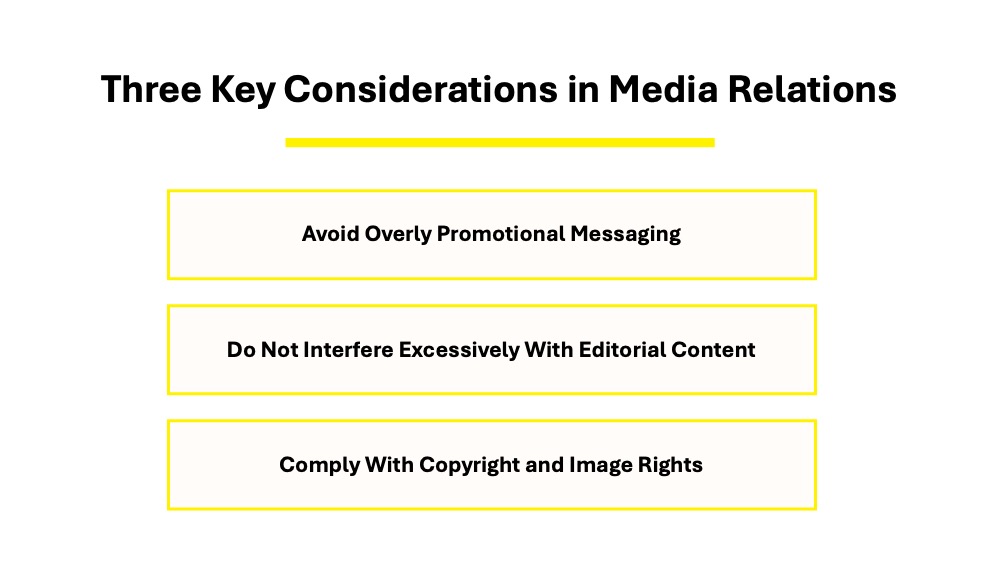
To avoid damaging positive relationships with media outlets, there are several points that require attention. Here, we highlight three particularly important considerations.
◾️ Do Not Provide Information That Is Biased Towards Your Own Advertising
Press releases and information provided should not be full of your own advertising slogans, as in advertising. The media values objective facts and social significance. Information that is heavily promotional is avoided, and repeatedly sending it may damage the company’s credibility. Always remember to provide “news that is valuable to society.”
◾️ Do Not Interfere Excessively with the Content of Articles
After an interview, the media has the editorial authority to decide what the article will be like. With the exception of obvious factual errors, you should avoid making excessive demands that impose your own convenience, such as “I want you to treat it more prominently” or “I want you to delete this part.” This is seen as infringing on the independence of the media and can cause a deterioration in relations.
◾️ Comply with Rules Such as Copyright and Portrait Rights
When providing photos or videos to the media, be sure to confirm that copyright and portrait rights of the subject have been properly obtained. In addition, when “reusing” articles and photos published in the media on your company’s website, you must obtain permission from the media. Unauthorized use constitutes copyright infringement, so follow the rules set by each medium and take appropriate procedures.
Reference: Copyright Text -2025 Edition- Copyright Division, Ministry of Culture
Summary
Media relations is a steady activity to build long-term relationships of trust with the media. It is not just about disseminating information, but also about understanding the characteristics of the media, providing social value, and building up sincere communication. By putting into practice the activities and keys to success introduced in this article, you will greatly contribute to improving corporate recognition and brand value. Let’s regard the media not merely as a means of transmitting information, but as an important partner connecting society and companies, and build good relationships.
Building media relations requires continuous relationship development and strategic approaches. SUNNY SIDE UP leverages our extensive media network and proven track record to provide strong support for your information dissemination. Why not maximize your exposure opportunities? If you are considering an effective media relations strategy, please contact us for consultation.