
Public Relations (PR): A Comprehensive Guide for Beginners, From Job Responsibilities to Strategy Development!
- カテゴリ:
Are you a new public relations representative wondering what to do, specifically? Or perhaps you’re unsure of the difference between PR and advertising? Public relations (PR) is a critical activity for corporate growth, but its diverse roles and methods can be confusing.
This article explains the basic knowledge of public relations (PR), specific job responsibilities, and how to develop strategies for achieving results, all in an easy-to-understand manner for beginners. By the end of this article, you will understand the overall picture of public relations (PR) and be able to confidently tackle your tasks from tomorrow.
What is Public Relations (PR)? Explanation of Basic Definitions and Objectives
The first step in public relations (PR) activities is to correctly understand the meaning and purpose of the words. Here, we will explain the basic definitions of public relations (PR), the differences between similar terms, and the objectives of the activities.
Definition of Public Relations (PR)
Public relations (PR) refers to all communication activities that companies and organizations undertake to build good relationships with the public. It is an important management function that supports the sustainable growth of a company by communicating the corporate philosophy, business content, and the value of products and services to society, thereby gaining understanding and trust. It includes not only disseminating information but also “public listening” activities to listen to the voices of society.
The Essential Difference Between “Public Relations” and “PR (Public Relations)”
In Japan, “public relations” and “PR” are often used synonymously, but strictly speaking, there is a slight difference in nuance. “PR (Public Relations)” is a broader, more strategic concept that aims to build good relationships between a company and society. On the other hand, “public relations” tends to be used as a specific action of “broadly reporting information,” which is at the core of PR activities. However, the essential purpose of both is the same: to build trust with stakeholders.
Three Main Objectives of Public Relations (PR)
Public relations (PR) activities are mainly carried out to achieve the following three objectives:
・Building Good Relationships with Stakeholders: The most important objective is to build and maintain good, trust-based relationships with all stakeholders, including customers, business partners, shareholders, employees, and the local community.
・Improving Recognition of Companies, Products, and Services: By continuously providing valuable information to society, companies attract the attention of the media and consumers, thereby increasing the recognition of companies, products, and services.
・Enhancing Corporate Brand Image and Gaining Trust: By communicating the company’s vision and values through consistent information dissemination and gaining empathy from society, companies form a positive brand image and gain trust.
Why is Public Relations (PR) Important Now?
In today’s business environment, the importance of public relations (PR) is increasing. This is because the way information is received and the nature of communication are changing significantly.
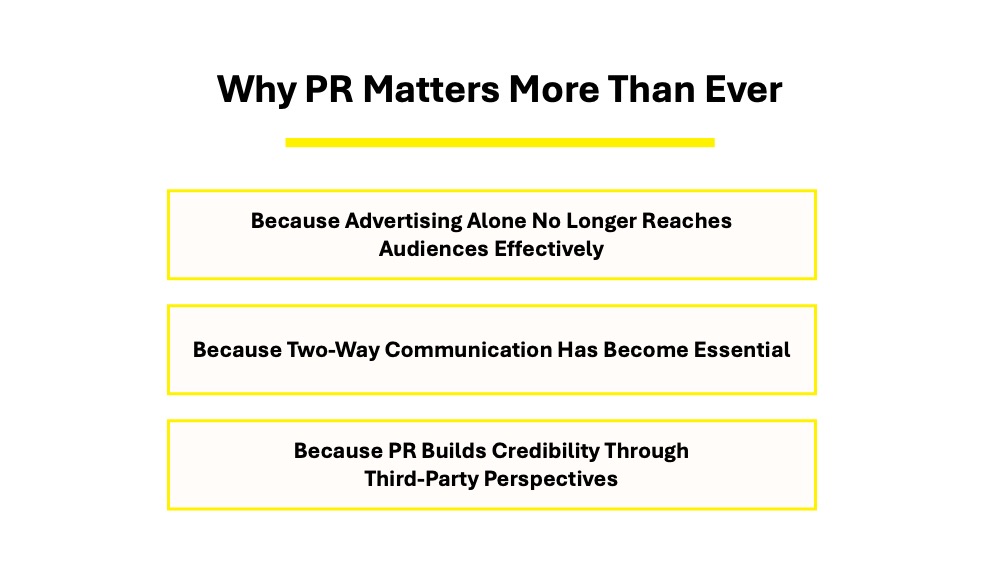
It has become difficult to deliver information through advertising alone
With the spread of the Internet and social media, the amount of information people receive daily has exploded. As a result, consumers have become more proactive in selecting information and tend to avoid unilateral advertising from companies. In fact, a survey conducted by ICA Co., Ltd. targeting Generation Z (ages 18-27) found that the most common impression of advertising was “intrusive and annoying as it interrupts content” (45.5%), followed by negative opinions such as “unilateral and unreliable” (25.2%) and “feels exaggerated” (21.4%). In particular, about 90% (89.9%) of people feel uncomfortable with video ads, and about 80% (78.9%) feel uncomfortable with social media ads. Many people take actions such as “immediately pressing the ad skip or close button” (43.7%) to avoid ads, and even if ads are displayed, the original content is difficult to reach them. In this situation, communication methods other than advertising are essential for companies to deliver the messages they want to convey.
Two-way communication has become more important
Social media has become a powerful tool for companies to communicate directly with consumers. Companies can use social media to share their thoughts and stories, and deepen relationships through dialogue with fans. In today’s world, where consumer voices spread instantly, sincere two-way communication is an important factor that affects a company’s reputation.
It provides a third-party perspective that enhances corporate credibility
Being featured as “objective information” by third parties such as newspapers, television, and online media through public relations (PR) activities greatly enhances corporate credibility. Information that passes through the filter of the media tends to be perceived as more reliable than advertising information that companies disseminate themselves.
The Decisive Difference Between Public Relations and Advertising
Public relations (PR) and advertising are both means of communicating corporate information to society, but there are clear differences in their objectives and methods. Understanding these differences is crucial for developing effective communication strategies.
| Category | Public Relations/PR | Advertising |
|---|---|---|
| Purpose | Building good relationships with stakeholders, gaining trust | Sales promotion of products/services, direct sales |
| Information Source | Media, influencers (third parties) | Company (advertiser) |
| Content Control | Not possible (content is edited by media) | Possible (content and expression can be freely determined) |
| Credibility | High (easily recognized as objective information) |
Relatively low (easily recognized as subjective promotion) |
| Cost | Mainly personnel costs (media placement costs are generally not incurred) |
Costs for purchasing advertising space in media |
Difference in Objectives: Relationship Building vs. Sales Promotion
The main objective of public relations (PR) is to build long-term, good relationships with various stakeholders such as the media, consumers, and shareholders, and to increase the number of corporate fans. On the other hand, the main objective of advertising is to directly convey the appeal of products and services, stimulate consumers’ desire to purchase, and lead to short-term sales growth.
Difference in Control over Publication and Reliability
Advertising involves companies paying to purchase media space, allowing them to completely control the content, expression, and timing of the message they want to convey. In contrast, with public relations (PR), companies provide information to the media, but the decision of whether to feature that information as an article or news story, and the content of the report, is left to the media. Because a third party is involved, information disseminated through public relations (PR) is highly objective and has the significant advantage of being more trustworthy than advertising.
Difference in Cost Considerations
Advertising involves significant costs for purchasing advertising space, such as TV commercials and online ads. On the other hand, public relations (PR) does not incur any costs for being featured in the media as an article. The main costs of the activity are the personnel expenses of the public relations staff who create press releases and plan and manage events.
Specific Job Responsibilities and Methods of Public Relations (PR)
The work of public relations (PR) is diverse. Here, we will explain the typical job responsibilities and specific methods, divided into three aspects: “external public relations,” “internal public relations,” and “crisis management.”
External Public Relations: Building Media Relations
Media relations is the activity of building good relationships with media representatives, such as newspaper reporters, TV program directors, and online media editors. The purpose is to deepen trust through regular information sharing and exchange of opinions, making it easier for your company’s information to be featured as news.
It is also important to constantly consider and investigate what kind of information third parties (media representatives and influencers) will accept and feature in articles or posts.
External Public Relations: Creating and Distributing Press Releases
A press release is a formal document that summarizes information such as new products, new services, and new corporate initiatives in a way that makes it easy for the media to write articles. By distributing it to media representatives, it creates opportunities for articles and interviews. It is important to be concise, easy to understand, and clearly convey the news value (novelty, social significance, etc.).
External Public Relations: Information Dissemination on Owned Media and Social Media
It is also important to deliver information directly to consumers and customers through company-operated blogs (owned media) and official social media accounts. By sharing the behind-the-scenes stories of development and the thoughts of employees that cannot be fully conveyed in press releases, companies can increase their fans and enhance engagement.
External Public Relations: Planning and Managing Events and Seminars
Companies plan and manage events such as new product launches, press conferences, and user seminars to create opportunities for direct communication with the media and consumers. Through events, they can deeply convey the appeal of products and services and promote the company’s stance.
Internal Public Relations: Activities to Foster a Sense of Unity Within the Company
Internal public relations is the activity of disseminating information to employees. Through the publication of in-house newsletters and the planning of internal events, companies convey the vision of the management team and promote mutual understanding between departments. The purpose is to enhance employee engagement and foster a sense of unity throughout the organization.
Crisis Management (Crisis Communication)
It is also an important role of public relations to disseminate information to minimize damage in the event of negative situations for the company, such as product defects or scandals. A swift and sincere response prevents the loss of trust from society and customers. It is necessary to anticipate risks and prepare response manuals in advance.
If you are looking for strategic public relations (PR), SUNNY SIDE UP’s PR services can support you. We can handle a wide range of services from press release distribution to media relations and crisis management. We will disseminate the company’s appeal at the optimal timing and maximize media exposure. We also have a wealth of experience in providing PR support for local governments and non-profit organizations.
PUBLIC RELATIONS | Services | PR Company | SUNNY SIDE UP Inc. | SUNNY SIDE UP Inc.
Local Government & Non-Profit Organization PR | Services | PR Company | SUNNY SIDE UP Inc. | SUNNY SIDE UP Inc.
5 Steps to Develop an Effective Public Relations (PR) Strategy
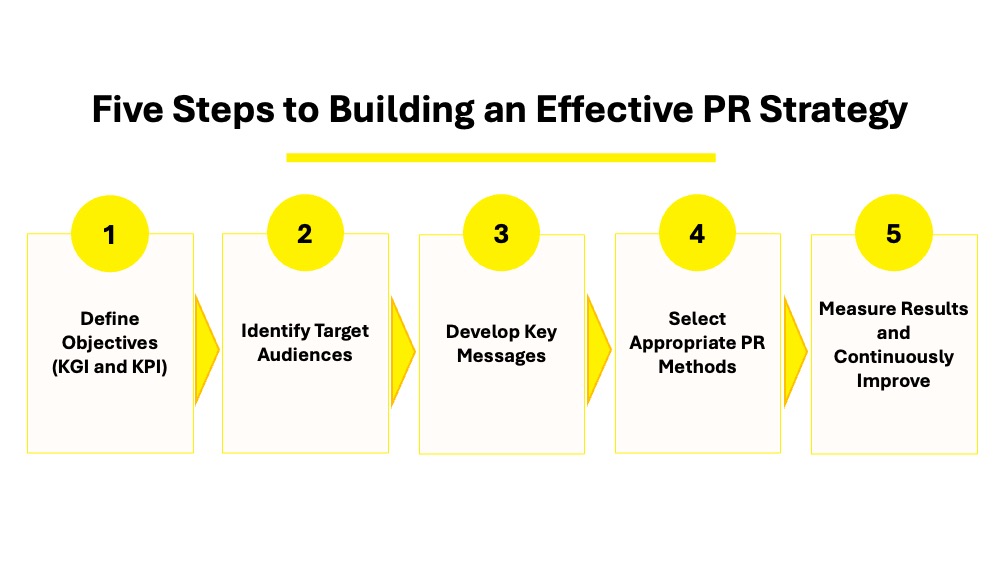
In order to achieve results with public relations (PR) activities, it is essential to proceed strategically rather than haphazardly. Here, we will explain how to develop a strategy following five basic steps.
Step 1: Clarify Objectives (KGI/KPI)
First, clarify the purpose of conducting public relations (PR) activities. For example, set specific and measurable goals (KGI/KPI) such as “increase awareness of the new service by 20% in six months” or “increase the number of job applicants by 1.5 times compared to the previous year.” It is also important to design and prepare measurement methods in advance according to each indicator, such as survey research and web search counts for awareness, and application management systems for the number of applicants.
Step 2: Set a Target Audience
Next, specifically define “who you want to deliver information to.” The message to be conveyed and the optimal approach will vary depending on whether the target is customers, investors, or potential employees. It is best to set detailed information about the target audience, such as age, gender, and interests.
Step 3: Develop a Message to Communicate
Consider the core message of “what to convey” and “what to leave behind” to the set target. Clarify what value your company can provide to the challenges and needs of the target, and express it in concise and impactful words. This message will be the axis of all public relations activities.
Step 4: Select Appropriate Public Relations Methods
Select the most effective method to deliver the developed message to the target. For example, press releases and press conferences are recommended if you want to inform a wide range of people at once, and social media and events are recommended if you want to build deep relationships with specific communities. Combining multiple methods can be expected to have a higher effect.
Step 5: Repeat Effect Measurement and Improvement
After conducting the activity, be sure to measure the effect. Analyze the number of web articles published, the number of mentions on social media, and changes in website access, and check the achievement of the goals (KPI) set in Step 1. The key to improving the accuracy of the strategy is to analyze the results and rotate the PDCA cycle to connect them to the improvement of the next action plan.
Points to Succeed in Public Relations (PR)
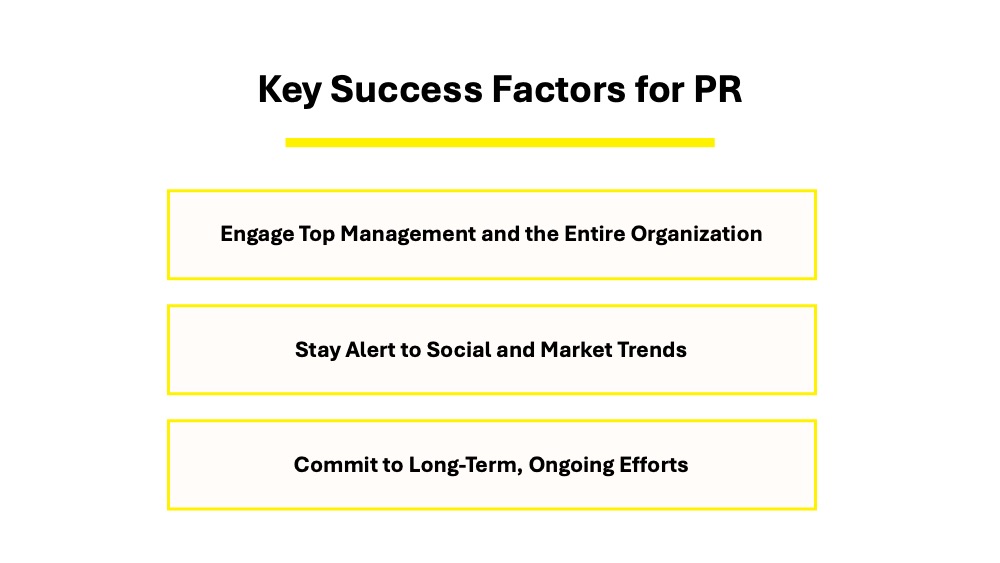
Finally, we will introduce three points that you should always be aware of in order to lead public relations (PR) activities to success.
Point 1: Involve Management and Work on it Company-Wide
Public relations (PR) is not something that can be completed by a single department alone. It is necessary to closely link with the company’s vision and management strategy, so the deep understanding and cooperation of the management team is essential. By building a company-wide information sharing system and proceeding with activities in cooperation with each department, you can send a consistent and powerful message.
Point 2: Always Keep an Eye on Social Trends
Public relations (PR) representatives are required to be aware not only of their own company but also of trends in society as a whole and the interests of people. By linking the movements of the world with your company’s activities, you can disseminate highly newsworthy information with a social context. Be sure to constantly collect information through newspapers, news sites, and social media.
Point 3: Engage in Continuous Activities from a Long-Term Perspective
The effects of public relations (PR) may not appear immediately. Relationships of trust with society and the media cannot be built overnight. Without being overjoyed or disappointed by short-term results, regard it as an investment in the company’s future, and persistently continue steady information dissemination and communication, which will ultimately lead to great results.
Summary
This article comprehensively explained everything from the basic concepts of public relations (PR) to the differences from advertising, specific job responsibilities, and how to develop strategies. Public relations (PR) is an important communication activity for building good relationships with society and enhancing corporate value in the long term. Please refer to the steps and points introduced this time to review your company’s public relations (PR) activities and take the next step.
Strategic information dissemination and appropriate media approach are key to successful public relations (PR). SUNNY SIDE UP proposes public relations (PR) measures that enhance your company’s brand value and provides total support from awareness expansion to trust building. If you are considering effective public relations (PR), please feel free to contact us first.