



Provided ¥32,000 “Oshogatsu (New Year’s Allowance for Adults)” to Approximately 380 Employees: Survey Report Released Visualizing Changes in Behavior and Awareness
- INFO
- SUNNY SIDE UP GROUP
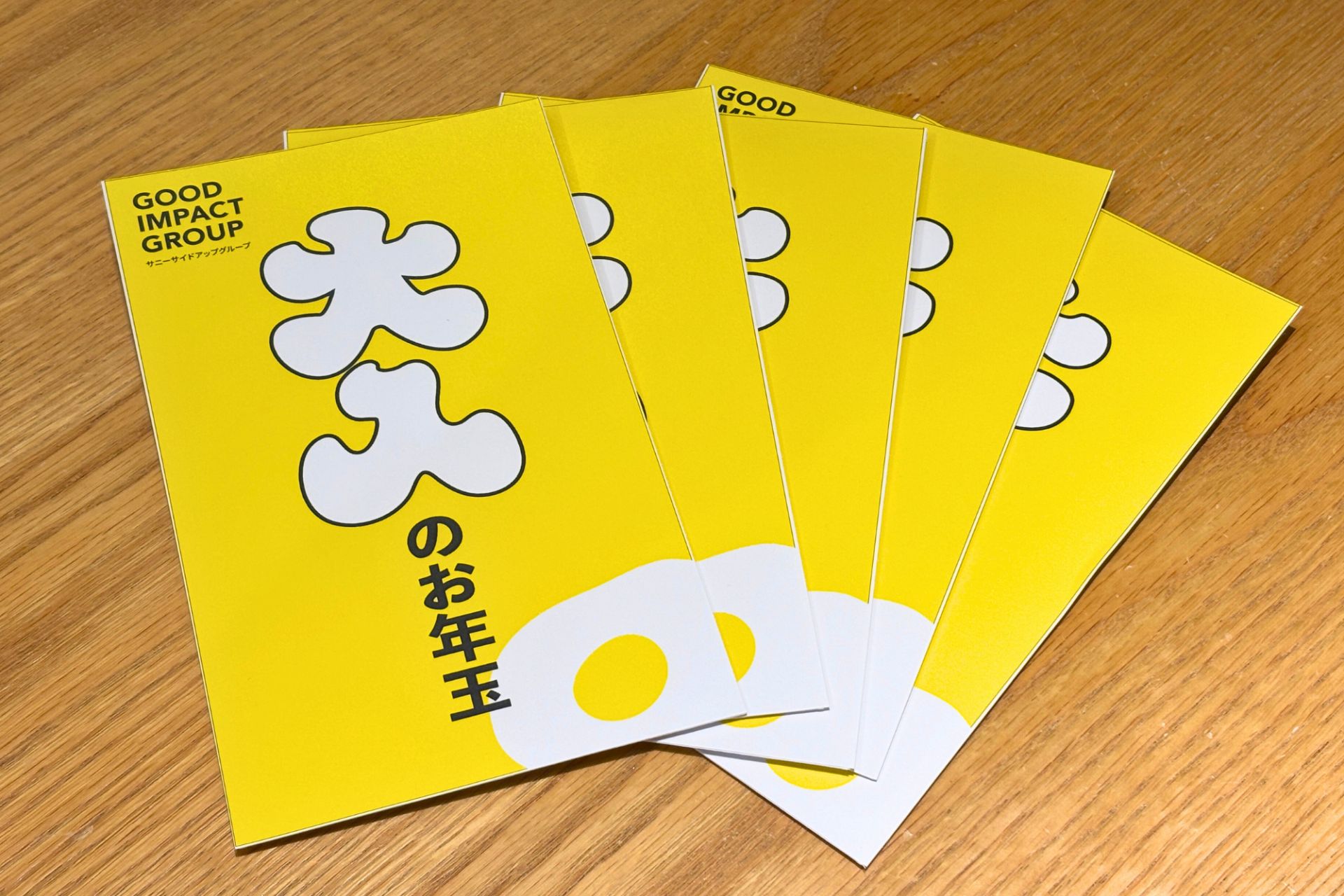
SUNNY SIDE UP GROUP Inc. (Head Office: Shibuya-ku, Tokyo; President and CEO: Etsuko Tsugihara; hereinafter, “the Company”) focused on the stagnant consumer mindset in Japan amid rising prices. As a means of “boosting consumption,” the Company conducted a post-implementation questionnaire survey on the “Oshogatsu (New Year’s Allowance for Adults)” project, an internal initiative in which \32,000 was provided to approximately 380 employees, and announced the results as a survey report.
This survey analyzed how the provided funds led to specific consumer behavior and what changes occurred in attitudes and psychology toward consumption, based on the responses of 312 employees who actually used the Oshogatsu (New Year’s Allowance for Adults).
The results revealed the background behind the tendency of Japanese consumer behavior to lean towards “saving,” as well as differences in consumption trends and spending decisions. It also highlighted the potential for “reasons to spend” and allowance design to encourage a shift in consumer behavior. Based on these analyses, this report summarizes suggestions for how companies and society can proactively encourage consumption in the future.
■ Background
According to the Statistics Bureau of the Ministry of Internal Affairs and Communications, the consumer price index (CPI) for 2025 will be 112.8 compared to 2020, an increase of 3.0% year-on-year. On the other hand, wage growth has not kept pace with rising prices, and a survey by SBI Shinsei Bank shows that the amount of pocket money for office workers in 2024 has decreased to about half of the peak around 1990. In addition, cash and deposits account for the majority of Japanese household financial assets, and the trend of surplus funds remaining in savings rather than being spent continues. The Ministry of Internal Affairs and Communications’ household survey also shows that real consumption continues to decline, and about 60% of children’s Oshogatsu (New Year’s Allowance) is put into savings, indicating that the awareness of “not spending money” is spreading throughout Japanese society, regardless of age or gender.
This stagnation in consumption leads to sluggish sales, investment, and wage increases for companies, resulting in a “negative cycle” in which income does not increase and spending is suppressed, which is considered to be one of the factors making it difficult for the Japanese economy to recover.
Against this background, SUNNY SIDE UP GROUP implemented the “Oshogatsu (New Year’s Allowance for Adults)” project, which encouraged employees to “spend without saving,” with the desire to “create an opportunity to boost the Japanese economy through proactive consumption, starting from within the company.” In this project, approximately 380 employees, including full-time employees, contract employees, and some part-time employees, were provided with \32,000 per person as Oshogatsu (New Year’s Allowance). It was recommended that the funds be used for consumption, excluding savings and investment, and that they be spent within a two-week period.
■Survey Summary
① [Consumption Arousal Rate: 82.3%,Key is “Justification of Consumption”]
257 out of 312 respondents answered that they “would not have purchased (42.9%)” or “were hesitant (39.4%)” without this allowance. This suggests that the provision of the “Oshogatsu (New Year’s Allowance for Adults),” which is surplus funds, encouraged many employees to purchase or experience things they had been considering.
② [“Food Experiences” and “Home Appliances to Improve QOL” Rank High, Emphasizing Quality of Experience and Fulfillment of Life]
As for the ranking by purchase/experience genre, the first place was “Food Experiences/Gourmet (approximately 28%),” where people spend special time with family and friends, and the second place was “Home Appliances/Interior to Improve QOL (approximately 22%),” which enriches daily life, revealing a tendency to emphasize the quality of experience and fulfillment of life.
③ [Expansion of Economic Effect through “Upgrade Consumption”]
Not only spending the entire provided \32,000, but also “upgrade consumption,” in which respondents added their own funds to “upgrade travel” or “invest in expensive self-improvement,” was seen in approximately 30% of all respondents.
④ [Change in Awareness from Saving to “Circulation” through “Personalizing the Economy”]
To the question, “Did this give you an opportunity to think about spending money and the economy?”, approximately 95% answered “Yes (42.8%)” or “Somewhat Yes (48.2%).” In the free descriptions, the overwhelming majority of respondents stated that “I used to think that consumption was an act of reducing my assets, but through this project, my perception changed to thinking of it as an act of creating economic circulation.”
⑤ [Decision-Making Power Brought About by “Limited Time Period”]
From the responses regarding the reasons for using the Oshogatsu (New Year’s Allowance for Adults) by multiple employees, the two-week usage period setting became an important factor in making the “consumption that had been postponed” apparent.
Please see the PDF for details.